


























Views
Downloads

Printable Exponents with Decimal and Fractions | Grade 6-8
Paste this activity's link or code into your existing LMS (Google Classroom, Canvas, Teams, Schoology, Moodle, etc.).
Students can open and work on the activity right away, with no student login required.
You'll still be able to track student progress and results from your teacher account.
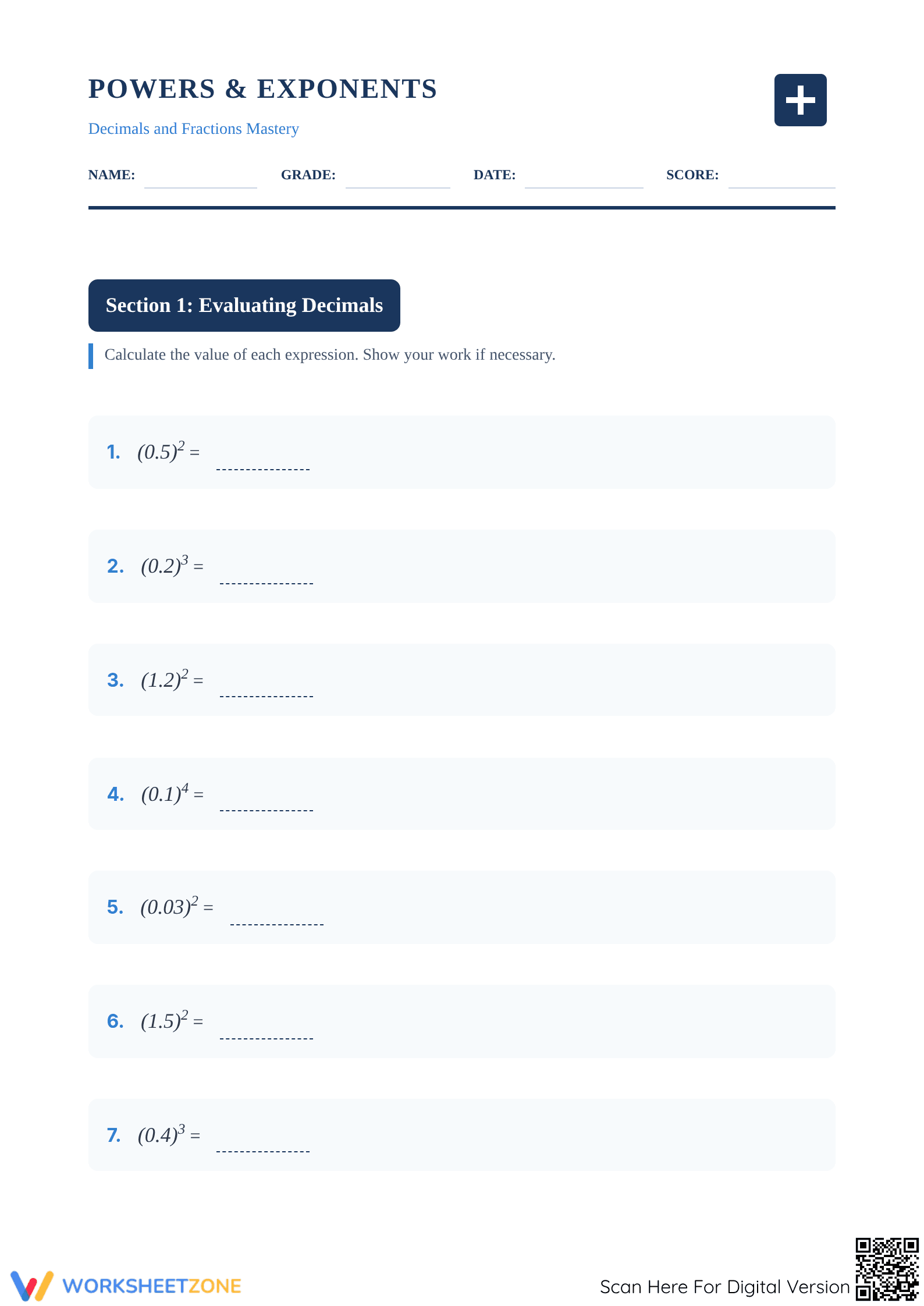
This comprehensive math worksheet focuses on evaluating exponents with decimal and fractional bases, a critical bridge between basic arithmetic and algebraic reasoning. Students move from simple squares and cubes to complex real-world applications involving area and volume. By solving 32 targeted problems, learners solidify their understanding of power notation and rational number operations.
At a Glance
- Grade: 6-8 · Subject: Math
- Standard:
CCSS.MATH.CONTENT.6.EE.A.1— Write and evaluate numerical expressions involving whole-number exponents and rational bases- Skill Focus: Rational Base Exponents
- Format: 5 pages · 32 problems · Answer key included · PDF
- Best For: Independent practice and homework reinforcement
- Time: 40–50 minutes
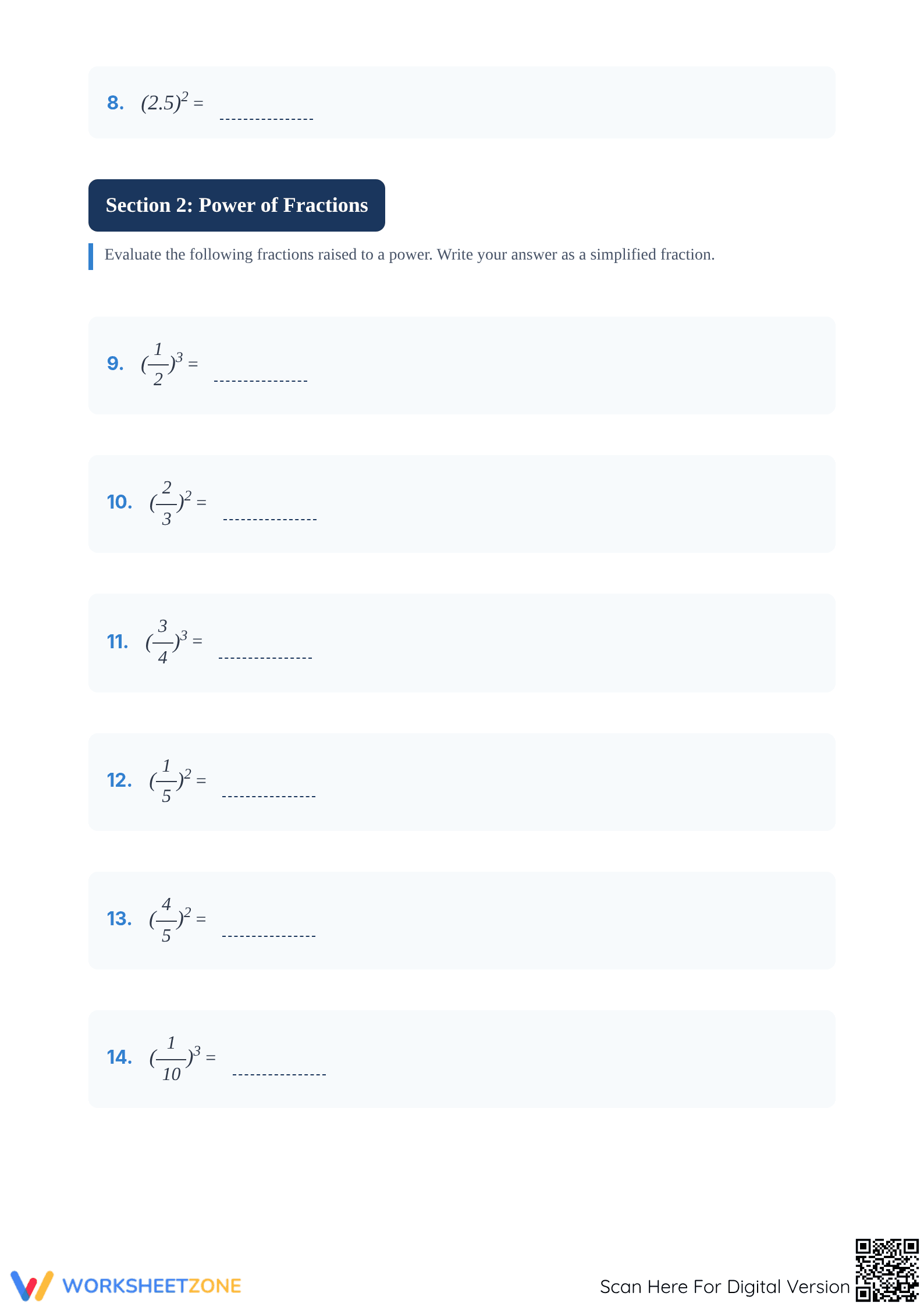
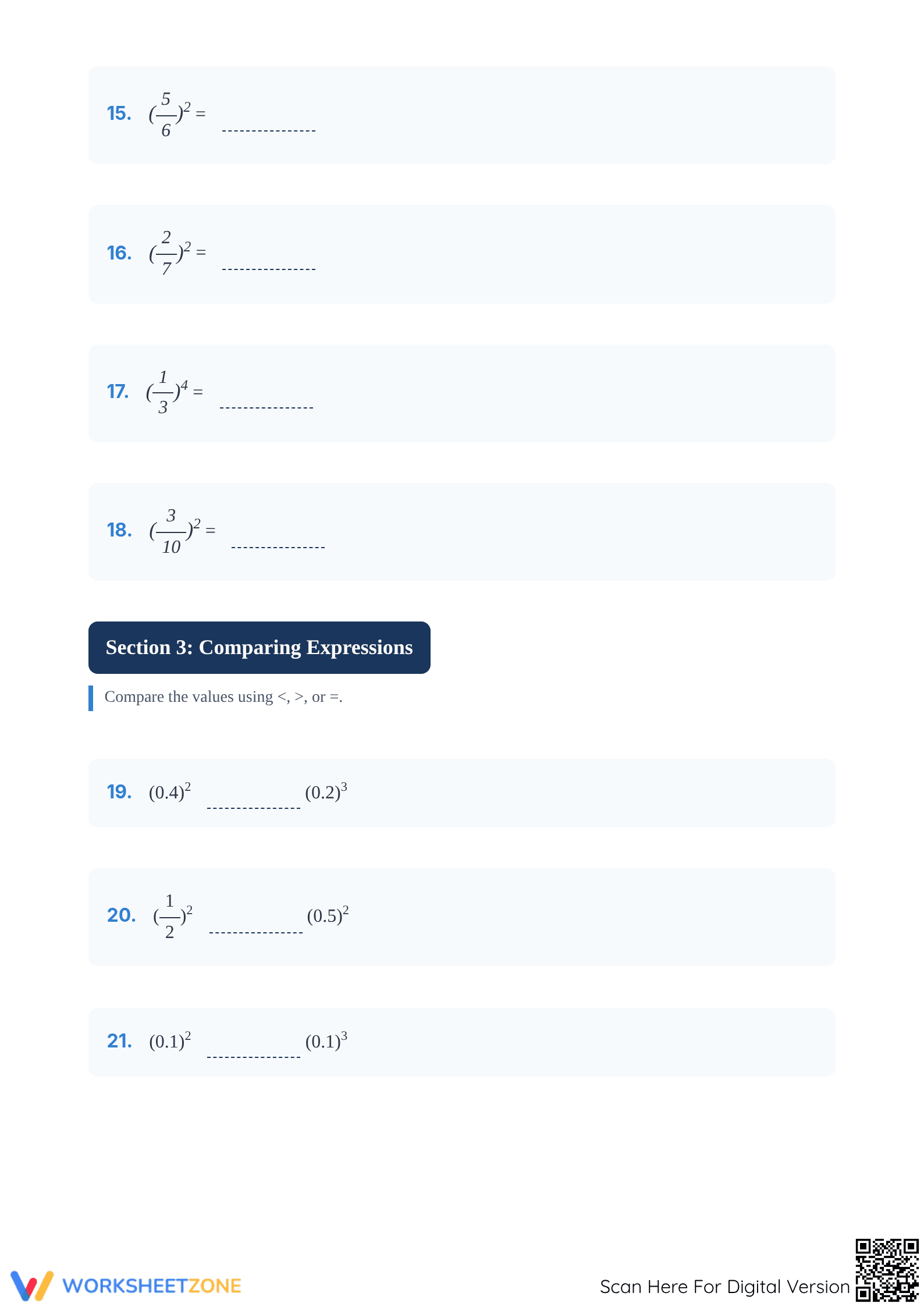
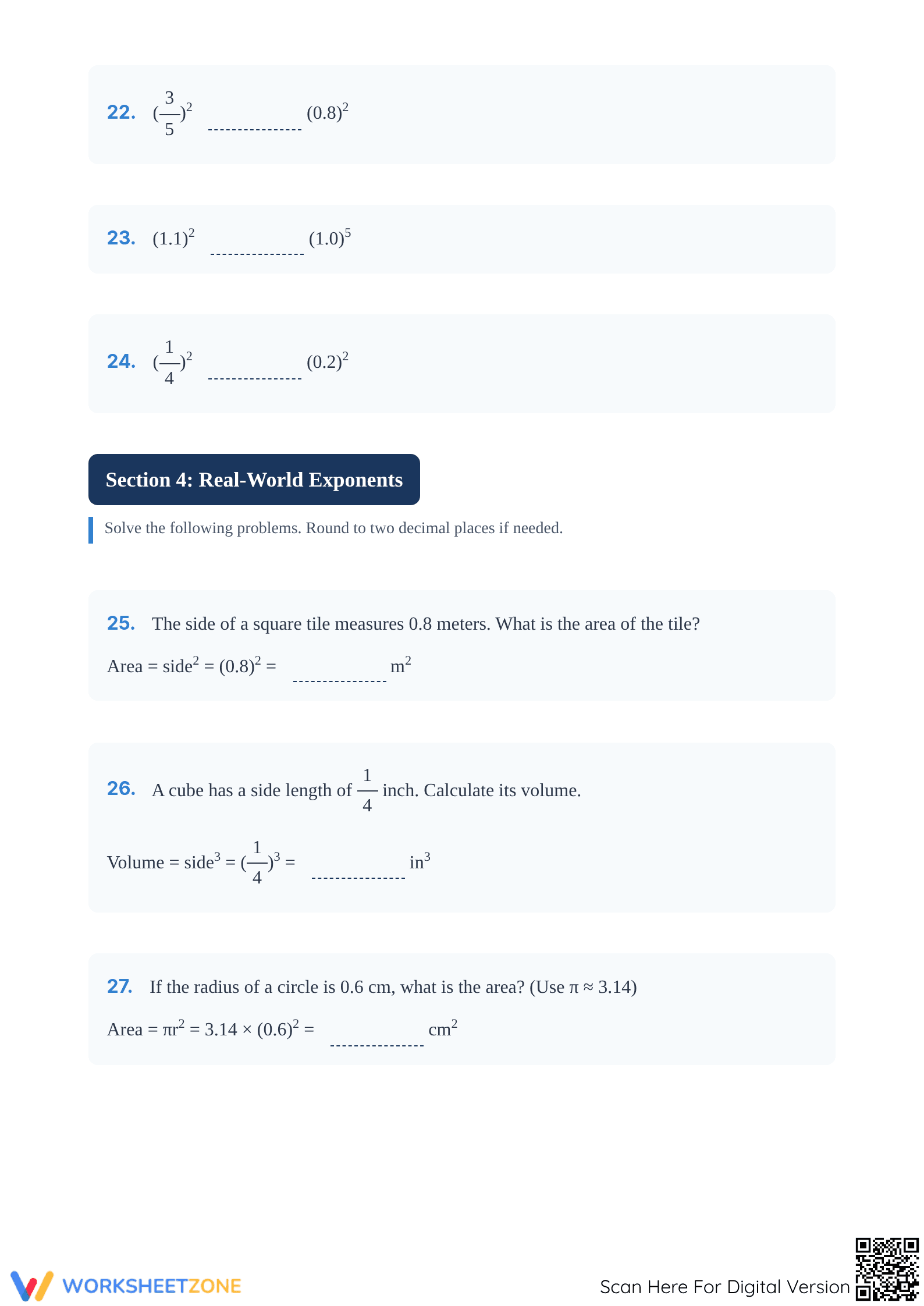
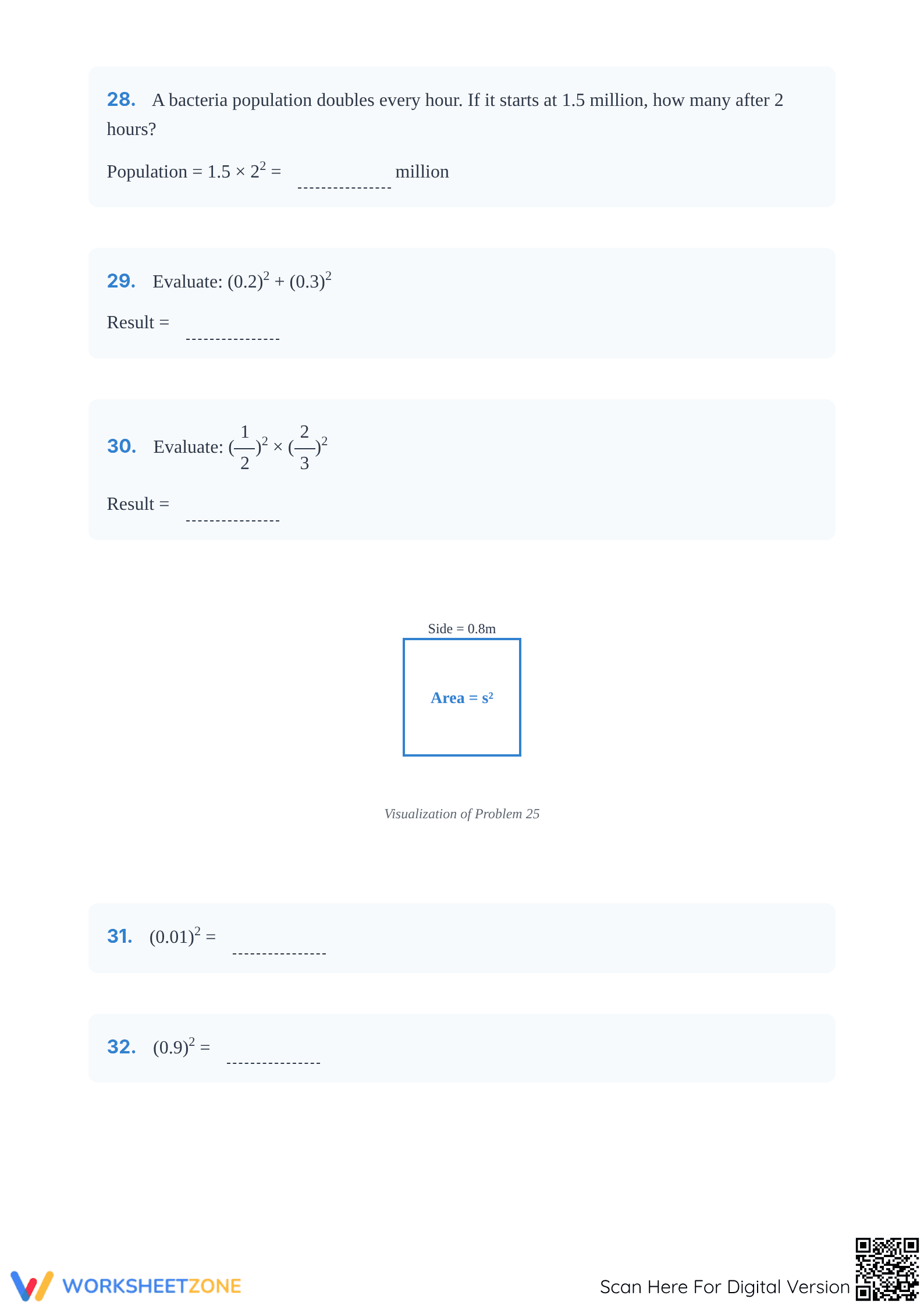
The PDF contains five pages of structured mathematical practice. Section 1 covers decimal bases with varying exponents, while Section 2 transitions to fractions. Section 3 introduces comparison tasks, requiring students to evaluate and order different exponential values. Finally, Section 4 provides real-world geometry problems and multi-step evaluations to ensure deep conceptual mastery and practical application.
Skill Progression
- Guided practice: Problems 1–8 introduce decimal bases with simple exponents like 0.5 squared, using worked space to visualize the repeated multiplication process.
- Supported practice: Problems 9–18 challenge students to square and cube fractions, focusing on the correct application of the power to both numerator and denominator.
- Independent practice: The final 14 problems integrate comparison symbols and geometric formulas, requiring students to apply their evaluation skills to find area and volume in contextual settings.
This progression follows a gradual-release model, building student confidence before introducing complex word problems.
Standards Alignment
The primary alignment is CCSS.MATH.CONTENT.6.EE.A.1, which requires students to evaluate numerical expressions involving exponents. While the base standard often uses whole numbers, this resource extends that logic to rational numbers, supporting high-school readiness. Both standard codes can be copied directly into lesson plans, IEP goals, or district curriculum mapping tools.
How to Use It
Use this during the independent practice phase of a lesson on exponents or as a comprehensive homework assignment after direct instruction. For a formative assessment, observe students during Section 3 to see if they can accurately compare 0.4 squared versus 0.2 cubed without calculation errors. Expect a completion time of 45 minutes for proficient learners.
Who It's For
This resource is designed for middle school students in grades 6 through 8 who are mastering rational number operations. It serves as an excellent differentiation tool for advanced sixth graders or a remediation resource for eighth graders needing a refresher on non-integer bases before moving into scientific notation. Pair this with a geometric formula anchor chart.
Evaluating exponents with rational bases is a foundational skill that bridges middle school arithmetic with high school algebra. According to the RAND AIRS 2024 report, students who master numerical expressions involving powers demonstrate higher proficiency in later functions and exponential growth models. This worksheet targets CCSS.MATH.CONTENT.6.EE.A.1 by providing 32 structured opportunities to evaluate powers with decimals and fractions. Fisher & Frey (2014) emphasize that such scaffolds—moving from isolated computation to real-world application like area and volume calculations—are essential for the successful transition to independent problem-solving. By requiring students to compare expressions and solve word problems, this resource ensures that the mathematical logic is internalized rather than just memorized. This comprehensive set is an essential tool for teachers looking to provide rigorous, standards-aligned practice that meets the demands of modern mathematical frameworks and prepares students for more advanced secondary coursework.


