


























Views
Downloads

Essential Exponents Standard Notation Worksheet - Grade 6-8
Paste this activity's link or code into your existing LMS (Google Classroom, Canvas, Teams, Schoology, Moodle, etc.).
Students can open and work on the activity right away, with no student login required.
You'll still be able to track student progress and results from your teacher account.
This middle school math worksheet helps students master numerical expressions involving whole-number exponents through structured practice. By identifying bases and exponents and converting between notations, students build a concrete understanding of exponential growth. The exercise ensures learners can evaluate standard notation accurately, providing a foundation for algebraic success and higher-level mathematics.
At a Glance
- Grade: 6–8 · Subject: Math
- Standard:
CCSS.MATH.CONTENT.6.EE.A.1— Write and evaluate numerical expressions involving whole-number exponents.- Skill Focus: Converting exponents to standard notation
- Format: 3 pages · 9 problems · Answer key included · PDF
- Best For: Independent practice or formative assessment
- Time: 20–30 minutes
What's Inside
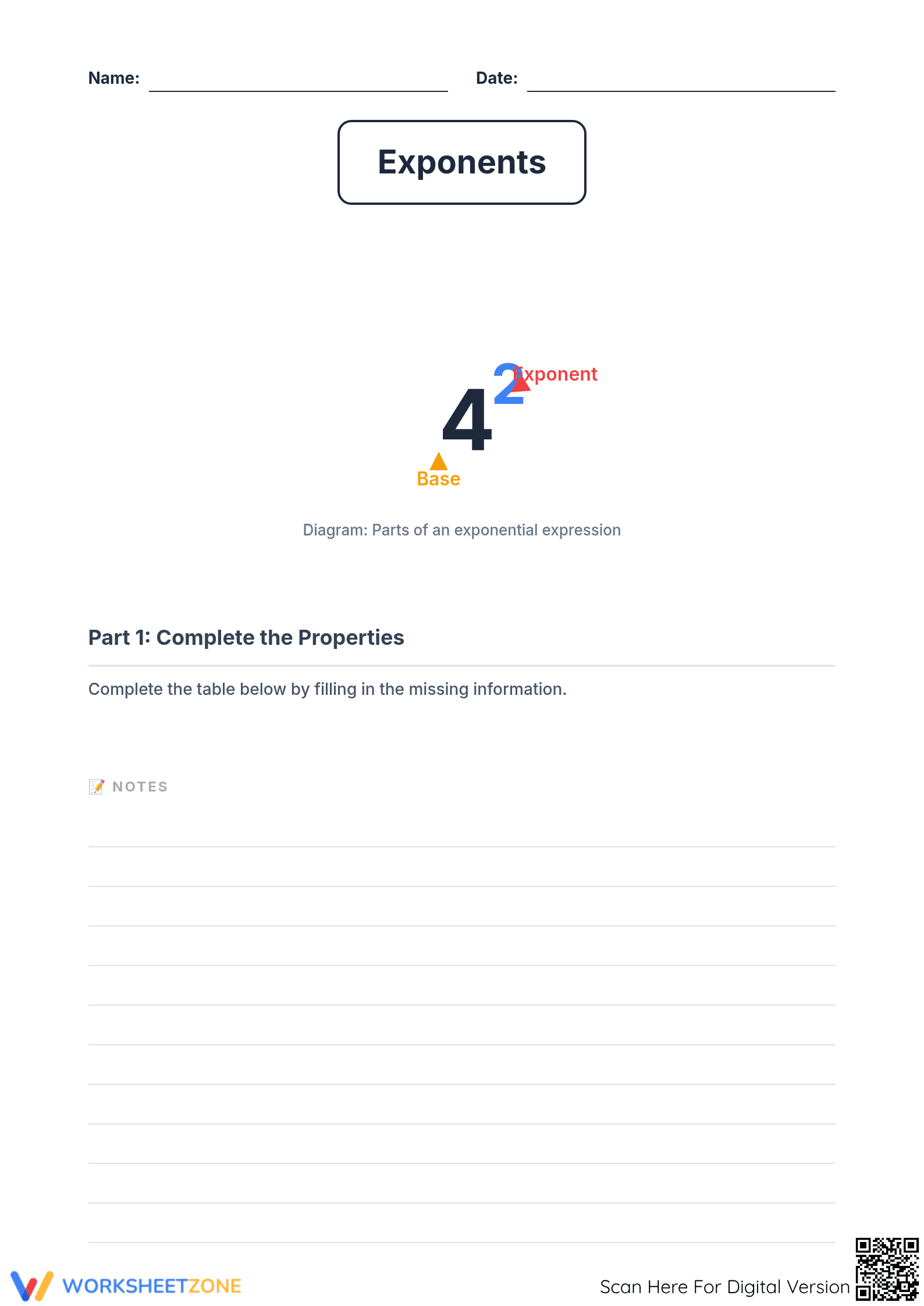
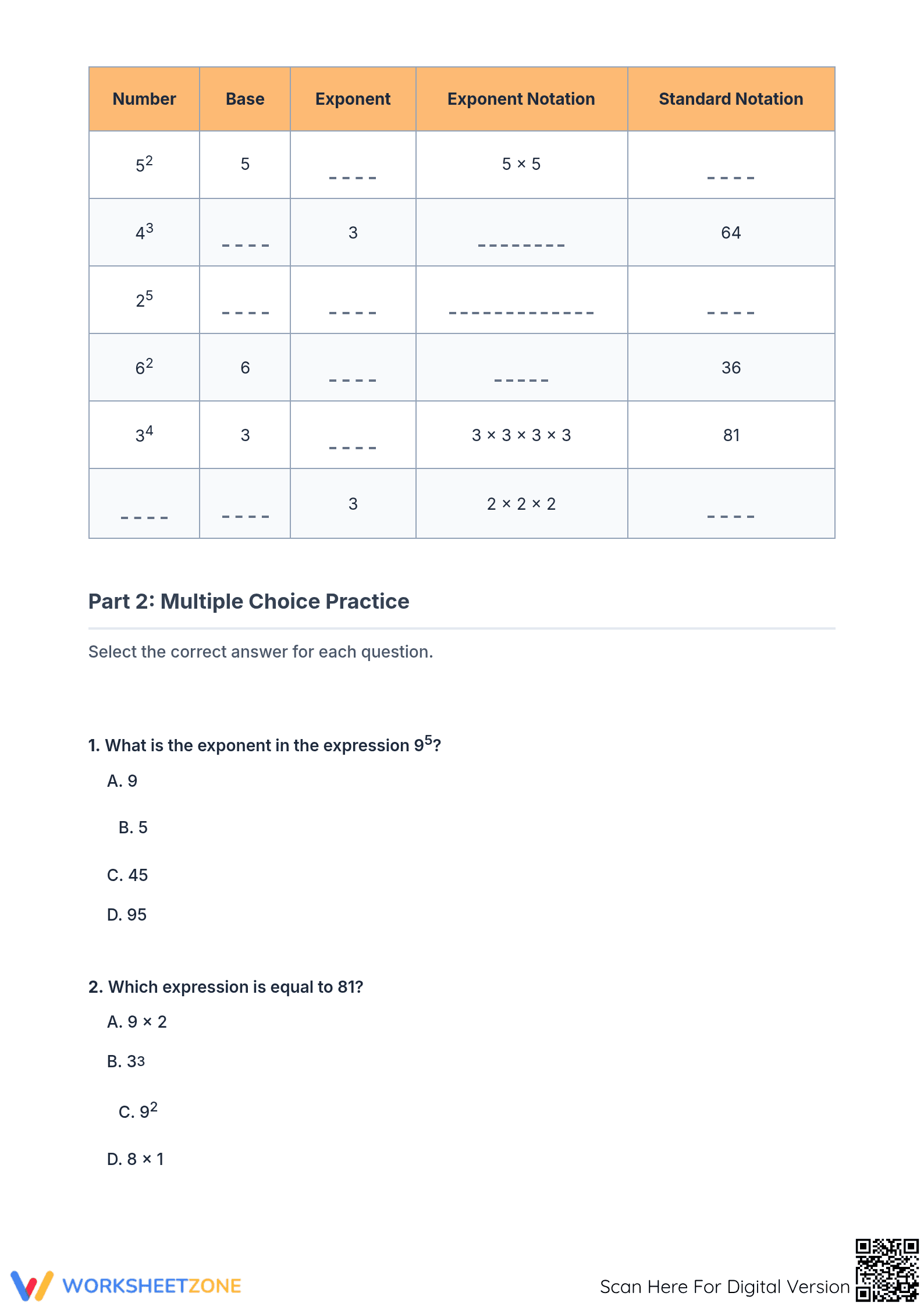
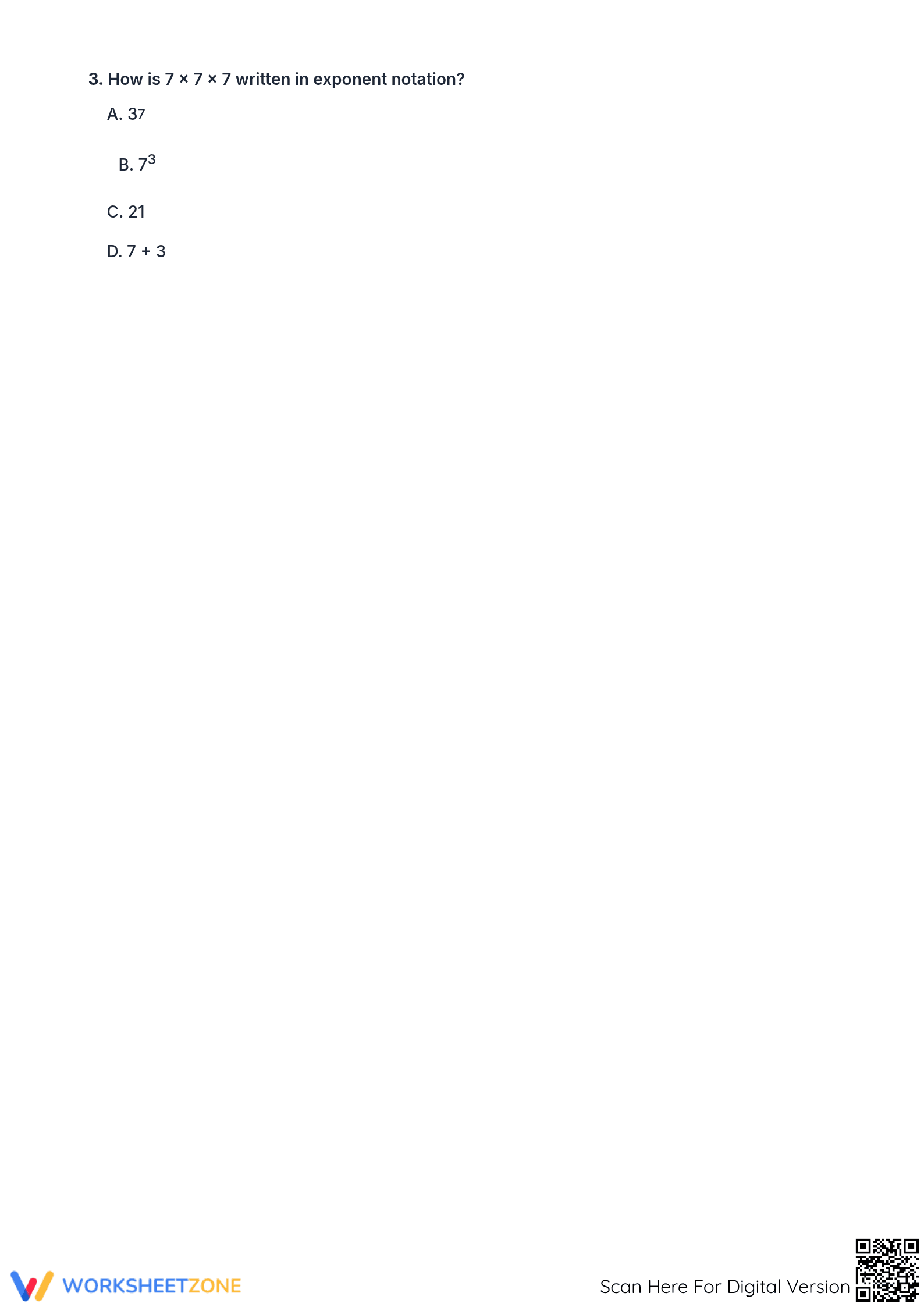
This 3-page PDF contains a mix of instructional diagrams and student tasks. The first page features a visual diagram defining the base and exponent components of an expression. A multi-column table on the second page requires students to break down six different exponential numbers, identifying the parts and calculating the final product. Finally, three multiple-choice questions challenge students to apply their knowledge in a standardized test format. A full answer key is included.
Zero-Prep Workflow
This resource is designed for immediate classroom implementation with zero teacher setup. First, print the 3-page document (30 seconds). Next, distribute the worksheets to your students for a quiet independent working block or a quick sub plan (1 minute). Finally, use the included answer key to conduct a rapid whole-class check or individual grading session (1 minute). This print-and-go solution fits easily into any busy instructional schedule.
Standards Alignment
The primary focus of this worksheet is `CCSS.MATH.CONTENT.6.EE.A.1`: "Write and evaluate numerical expressions involving whole-number exponents." Students interact with this standard by expanding notations like 5x5 into exponential forms and evaluating the resulting standard notation. This resource also supports foundational understanding for 8th-grade expressions and equations. Both standard codes can be copied directly into lesson plans or district curriculum mapping tools.
How to Use It
Deploy this worksheet during the "Independent Practice" phase of a lesson on exponents to solidify the transition from repeated multiplication to evaluation. Alternatively, use the multiple-choice section as an exit ticket to gauge student mastery before moving on to scientific notation or square roots. While students work, look for common errors in identifying the base versus the exponent.
Who It's For
This resource is optimized for 6th, 7th, and 8th-grade students who are developing their fluency with exponents. It is effective for learners who benefit from structured tables to organize their mathematical thinking. The clear diagrams make it a suitable choice for English Language Learners or students requiring visual scaffolds. Pair this with a set of exponent task cards for a complete learning station.
This worksheet is engineered to support the rigorous demands of CCSS.MATH.CONTENT.6.EE.A.1, focusing on the essential skill of evaluating numerical expressions with whole-number exponents. According to research from Fisher & Frey (2014) on the gradual release of responsibility, providing visual scaffolds like the included base-and-exponent diagram significantly improves students' ability to move from guided practice to independent mastery. The transition from table-based expansion to multiple-choice evaluation aligns with best practices for multi-modal assessment, ensuring that students do not merely memorize procedures but understand the underlying logic of standard notation. By requiring learners to explicitly identify components before calculating the final product, the resource minimizes common "base-multiplied-by-exponent" errors. This pedagogical structure provides teachers with high-quality evidence of student thinking, making it a reliable tool for both instructional support and formative data collection within a middle school mathematics curriculum.


