


























Views
Downloads



Essential Exponents & Standard Notation Worksheet Grade 6-8
Paste this activity's link or code into your existing LMS (Google Classroom, Canvas, Teams, Schoology, Moodle, etc.).
Students can open and work on the activity right away, with no student login required.
You'll still be able to track student progress and results from your teacher account.
This essential Grade 6-8 Math worksheet provides students with a comprehensive and structured way to master numerical expressions involving whole-number exponents. By completing detailed tables that break down base, power, and notation, students gain a deep conceptual understanding of how exponents represent repeated multiplication and result in standard numerical values.
At a Glance
- Grade: 6–8 · Subject: Math
- Standard:
CCSS.MATH.CONTENT.6.EE.A.1— Write and evaluate numerical expressions involving whole-number exponents- Skill Focus: Exponential Evaluation
- Format: 4 pages · 22 problems · Answer key included · PDF
- Best For: Independent practice or sub plans
- Time: 25–40 minutes
What's Inside
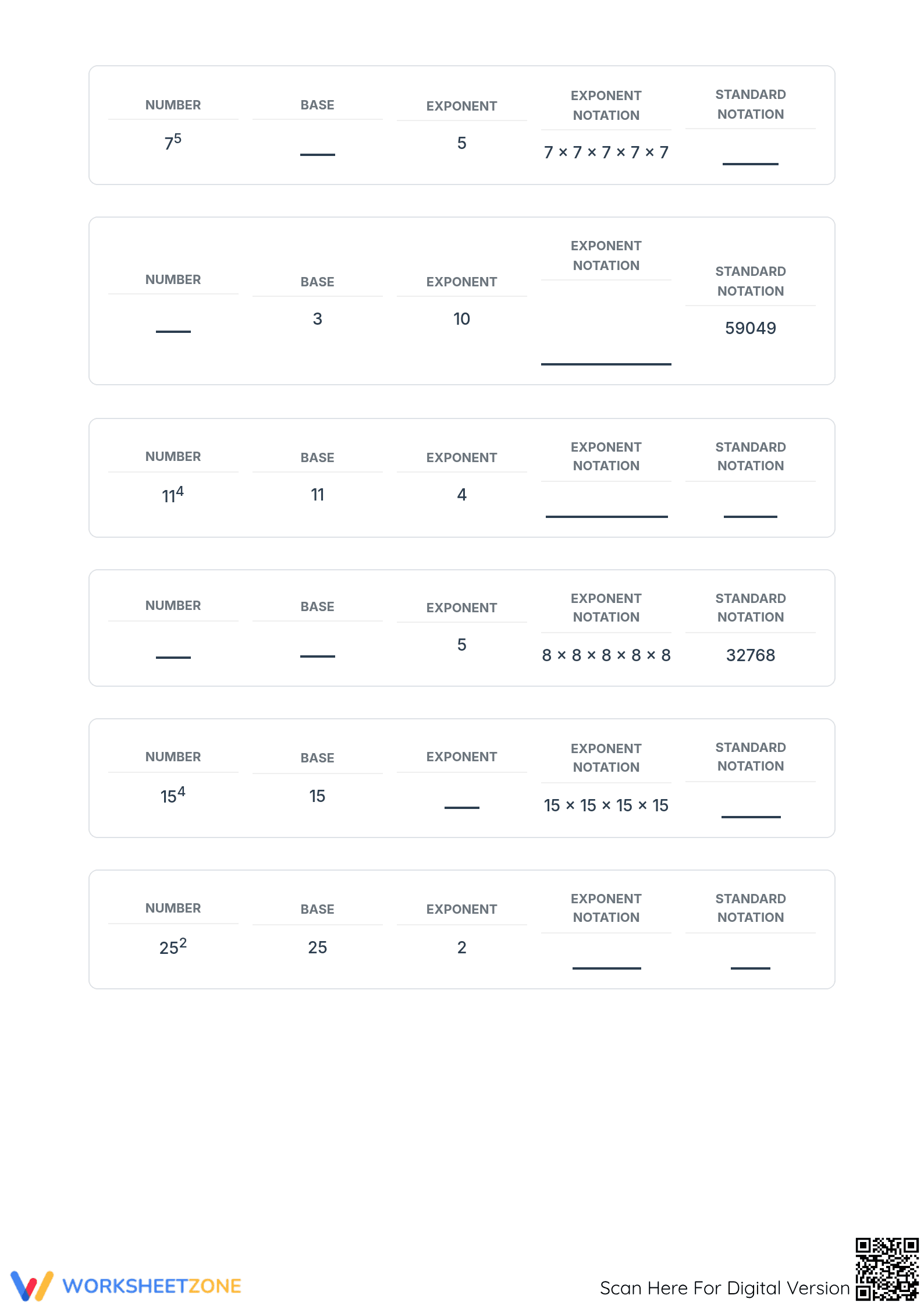
Inside this printable pack, you will find four dedicated pages of practice tables. Each page features multiple "exponent cards" that challenge students to identify the base and exponent, write the expanded exponent notation (e.g., 14 × 14 × 14 × 14), and calculate the final standard notation value. The consistent table structure provides a clear visual scaffold that helps students organize their mathematical thinking across 22 unique problems.
Zero-Prep Workflow
The zero-prep workflow for this resource is designed for maximum efficiency. Teachers can print the four-page set in under 30 seconds, distribute the packets to the class in less than a minute, and use the provided answer keys for a rapid five-minute review at the end of the period. This streamlined process requires less than two minutes of total teacher preparation, making it a reliable solution for busy instructional days or emergency sub plans.
Standards Alignment
This worksheet is primarily aligned to CCSS.MATH.CONTENT.6.EE.A.1, focusing on the evaluation of numerical expressions. It also supports higher-grade fluency requirements for exponent properties by bridging the gap between basic multiplication and algebraic powers. Both standard codes can be copied directly into lesson plans, IEP goals, or district curriculum mapping tools to ensure instructional alignment.
How to Use It
Use this collection as a formative assessment during your exponents unit. By observing how students fill in the expanded notation column, you can quickly identify if they are confusing exponents with multiplication (e.g., treating a power of three as a multiplier). It also serves as an excellent "Early Finisher" packet that students can work through independently while you provide targeted support to small groups during direct instruction.
Who It's For
This resource is designed for middle school students in Grades 6 through 8 who are developing their algebraic thinking skills. It is particularly effective for students requiring a visual organizer to process multi-step evaluations and those who benefit from repetitive practice to build procedural fluency. Pair this worksheet with a coordinate plane lesson or a scientific notation anchor chart to provide a broader context for powers of ten.
The pedagogical structure of this exponents worksheet aligns with the principles of cognitive load theory, as analyzed in the RAND AIRS 2024 report on mathematical instructional materials. By providing a repetitive, predictable table format, the resource minimizes extraneous cognitive processing, allowing students to focus entirely on the core task of evaluating numerical expressions according to CCSS.MATH.CONTENT.6.EE.A.1. Research by Fisher & Frey (2014) emphasizes the importance of guided practice and scaffolds like the included notation columns to move students toward mathematical independence. As noted in the ScienceDirect TpT Analysis, high-quality printable math resources that include explicit expanded-form steps significantly reduce student errors when transitioning from basic arithmetic to algebraic thinking. This 4-page collection serves as a validated tool for building the procedural fluency required for success in high school algebra and advanced scientific computation across middle school curriculum cycles.


