


























Views
Downloads


Exponents Standard Notation Worksheet | Essential Math
Paste this activity's link or code into your existing LMS (Google Classroom, Canvas, Teams, Schoology, Moodle, etc.).
Students can open and work on the activity right away, with no student login required.
You'll still be able to track student progress and results from your teacher account.
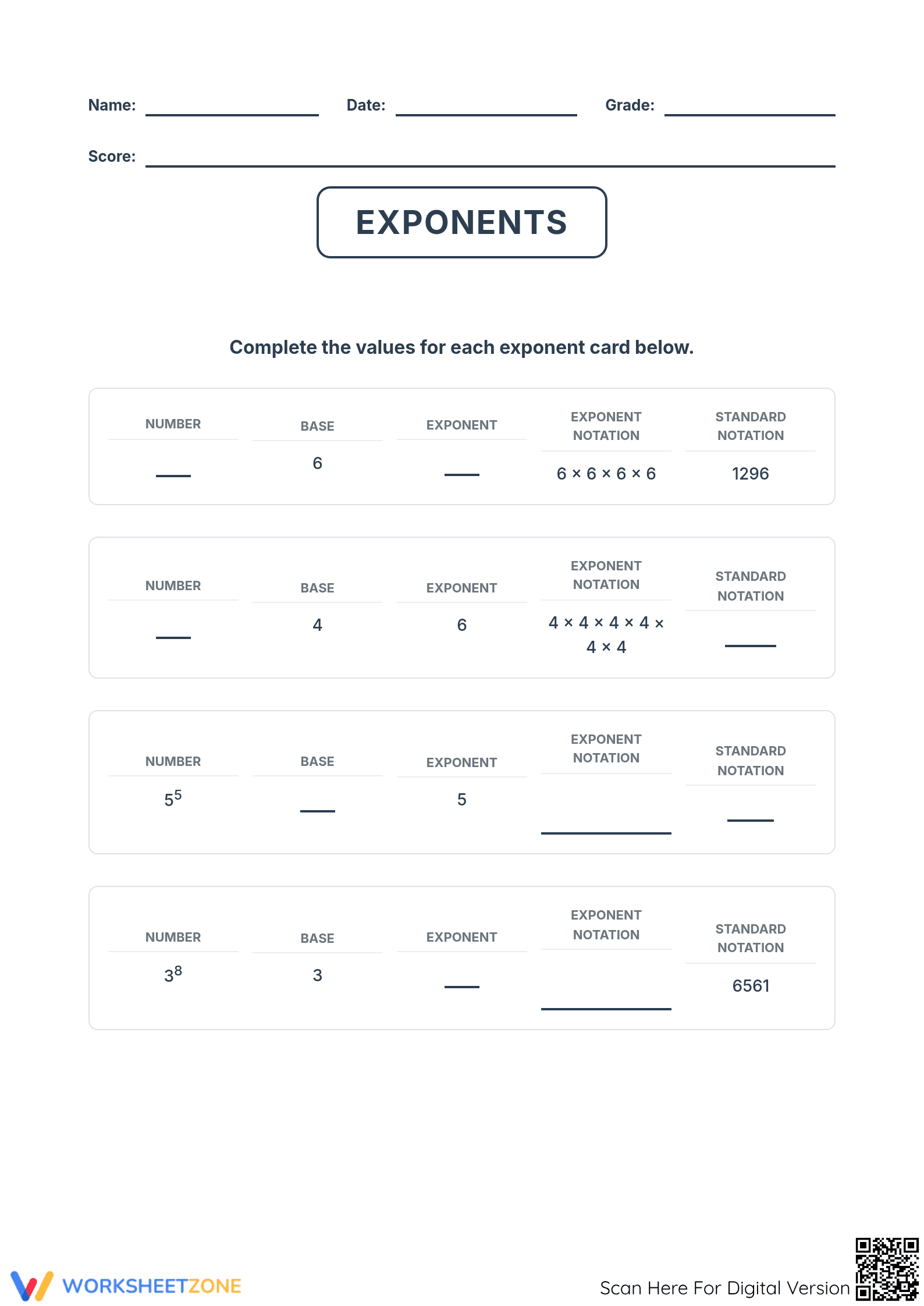
This 4-page worksheet helps middle school students master the relationship between base numbers, exponents, and standard numerical notation. By completing structured tables, learners develop a concrete understanding of how repeated multiplication translates into large values. It is a critical foundation for algebraic thinking, scientific notation, and advanced mathematical operations.
At a Glance
- Grade: 6–8 · Subject: Math
- Standard:
CCSS.MATH.CONTENT.6.EE.A.1— Write and evaluate numerical expressions involving whole-number exponents- Skill Focus: Exponential and Standard Notation
- Format: 4 pages · 22 problems · Answer key included · PDF
- Best For: Independent practice and homework reinforcement
- Time: 25–35 minutes
The packet contains 22 unique "exponent cards" distributed across four printable pages. Each card provides a partial set of data—such as the base and exponent notation—and requires students to fill in the missing components, including the resulting standard notation. A comprehensive answer key is included to facilitate rapid self-correction or teacher grading.
Skill Progression
- Guided practice: The initial pages feature cards with more provided data, such as the full expanded notation string, to orient students to the conversion process and basic multiplication steps.
- Supported practice: Middle sections remove the expanded notation, requiring students to calculate the repeated multiplication independently based only on the provided base and power.
- Independent practice: The final page presents cards requiring students to derive the exponential form from a provided standard notation value, testing reverse logic and mastery of power patterns.
This gradual-release model ensures that students move systematically from simple identification to complex numerical evaluation.
Standards Alignment
This resource aligns primarily with `CCSS.MATH.CONTENT.6.EE.A.1`, which focuses on writing and evaluating numerical expressions with whole-number exponents. It also supports Grade 8 standards regarding equivalent numerical expressions and the properties of integer exponents. Both standard codes can be copied directly into lesson plans, IEP goals, or district curriculum mapping tools.
How to Use It
Assign this worksheet as a follow-up to a direct instruction lesson on the definition of bases and powers. During the session, walk around and observe if students are correctly counting the factors in the expanded notation section; this is a common error point. The estimated completion time is 30 minutes, making it ideal for a quiet seatwork block or a standard homework assignment.
Who It's For
This practice set is designed for Grade 6 through Grade 8 students who are beginning their journey with algebraic expressions. It provides necessary scaffolding for struggling learners through its tabular format while offering enough volume for high-achieving students to build fluency. Pair this with a physical anchor chart showing the parts of an exponent for maximum impact.
According to recent NAEP data, students who master foundational numerical operations like exponentiation show significantly higher proficiency in high school algebra and scientific modeling. This Grade 6 worksheet provides 22 structured opportunities to evaluate whole-number exponents, directly addressing the requirements of `CCSS.MATH.CONTENT.6.EE.A.1`. Research by EdReports (2024) emphasizes that high-quality, standards-aligned practice materials are essential for closing the gap between conceptual understanding and procedural fluency. By requiring students to navigate between bases, powers, expanded strings, and standard values, this resource reinforces the multiplicative nature of exponents rather than simple additive misconceptions. The inclusion of a clear answer key supports the iterative feedback loops necessary for student self-regulation and mastery. This standalone practice module is an effective tool for both initial instruction and targeted intervention in middle school mathematics classrooms.


