


























Views
Downloads

Printable Exponents and Standard Notation Math Worksheet
Paste this activity's link or code into your existing LMS (Google Classroom, Canvas, Teams, Schoology, Moodle, etc.).
Students can open and work on the activity right away, with no student login required.
You'll still be able to track student progress and results from your teacher account.
This comprehensive exponents and standard notation worksheet helps middle school students master the relationship between exponential expressions and their numerical values. Students identify base and power components before calculating standard notation through expanded multiplication. Bridging theoretical notation with concrete arithmetic, this resource ensures students develop a fluent understanding of mathematical powers.
At a Glance
- Grade: 6-8 · Subject: Math
- Standard:
CCSS.MATH.CONTENT.6.EE.A.1— Write and evaluate numerical expressions involving whole-number exponents- Skill Focus: Exponent Evaluation and Notation
- Format: 3 comprehensive pages · 9 multi-part problems · Full answer key included · Printable PDF
- Best For: Independent homework, classroom practice, or quick formative assessment
- Time: 20–30 minutes
What's Inside
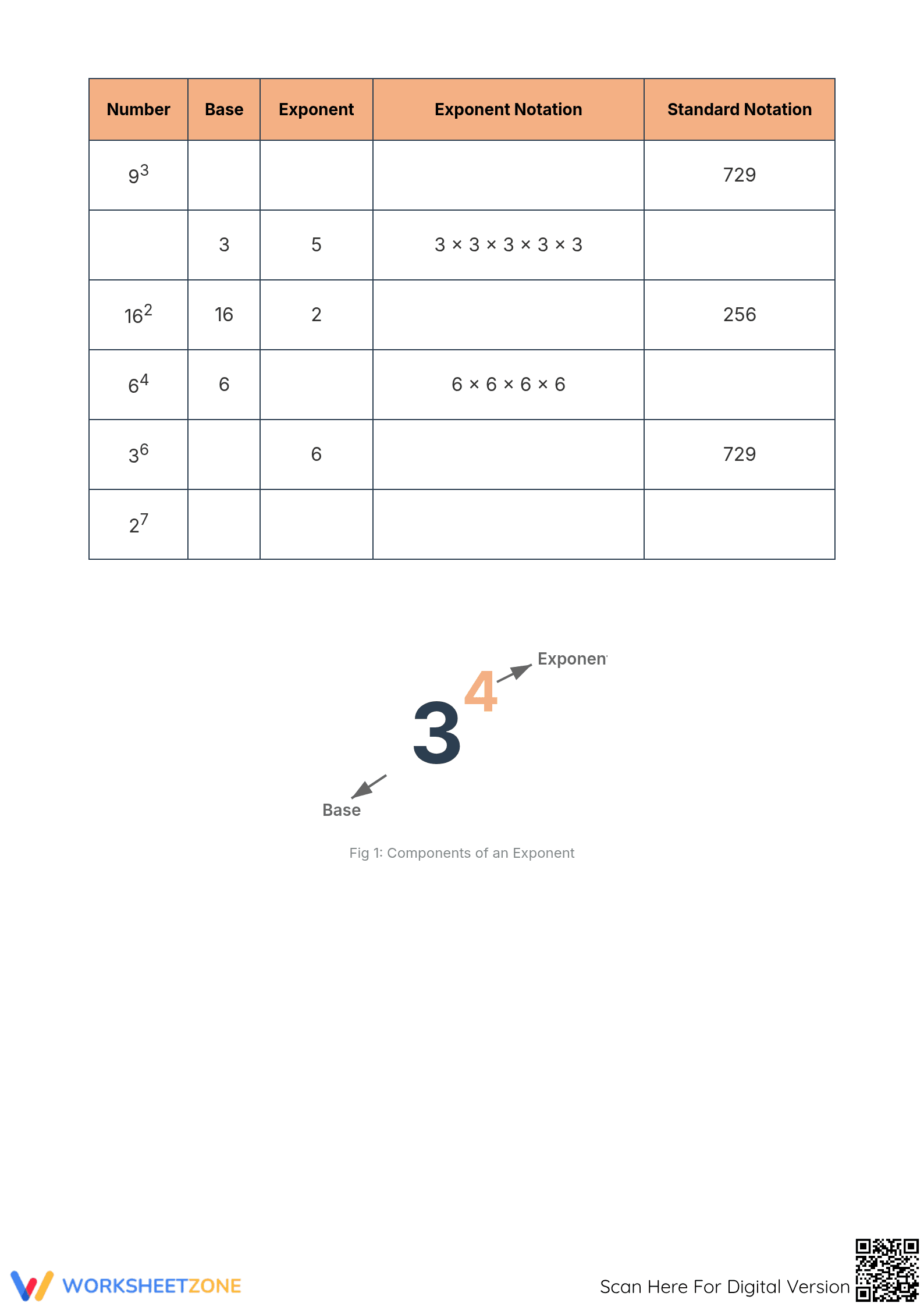
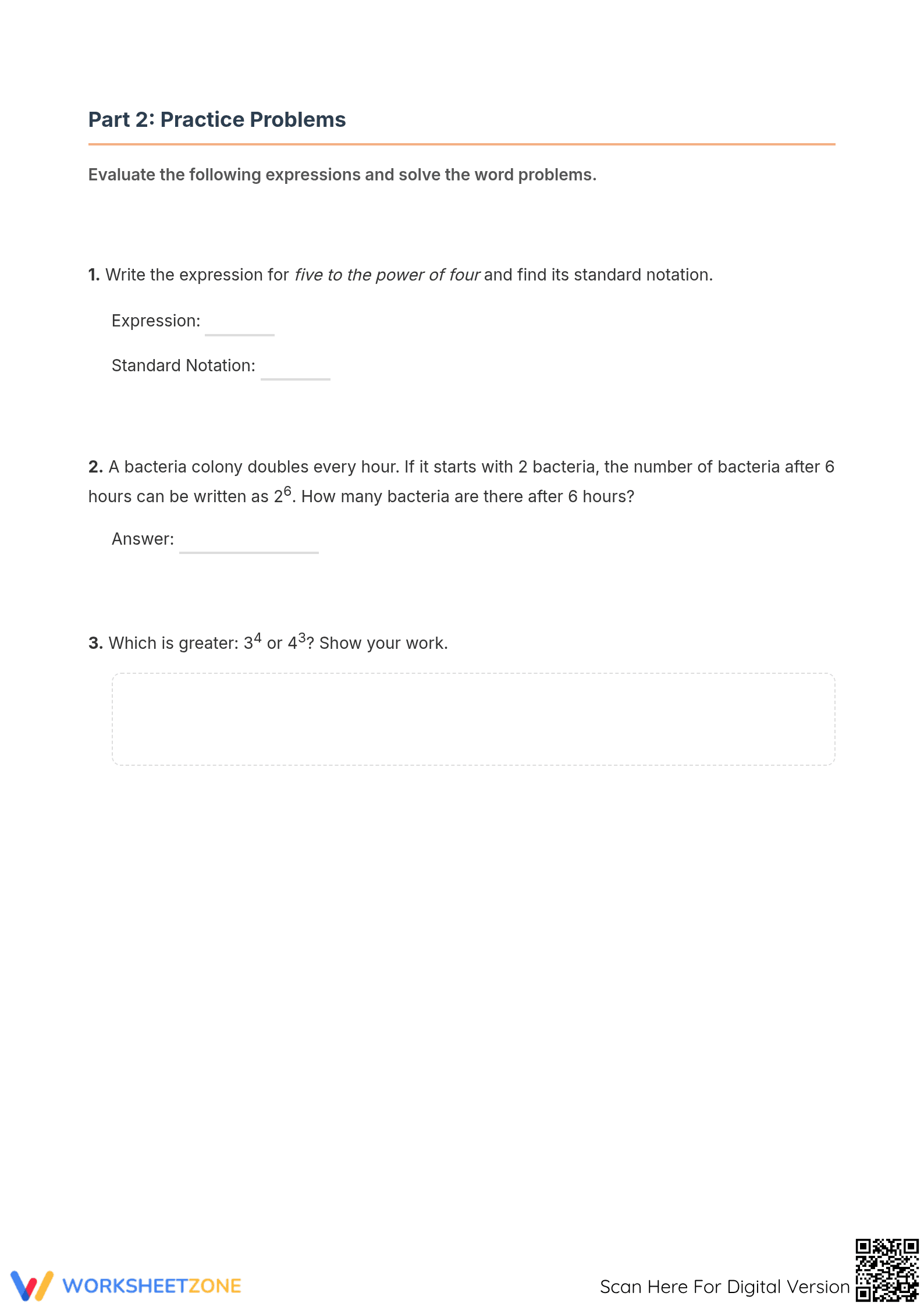
This 3-page PDF includes a structured exponents table where students fill in missing information across five categories: Number, Base, Exponent, Exponent Notation, and Standard Notation. The second half features three word-based practice problems that require students to translate verbal descriptions into powers, solve a bacteria growth scenario, and compare values like 3 to the 4th versus 4 cubed. A complete answer key is provided.
Skill Progression
- Guided Practice: Six table rows provide partial data to help students identify the structural relationship between bases and exponents.
- Supported Practice: Problems 1 and 2 require students to translate written phrases into expressions and solve basic application scenarios.
- Independent Practice: Problem 3 challenges students to evaluate and compare multiple powers using self-directed work.
This I Do, We Do, You Do approach ensures students build confidence before tackling complex comparisons.
Standards Alignment
The primary standard for this resource is `CCSS.MATH.CONTENT.6.EE.A.1`, which requires students to write and evaluate numerical expressions involving whole-number exponents. Students demonstrate alignment by decomposing 16^2 into its base and exponent while calculating the standard value of 256. Both standard codes can be copied directly into lesson plans, IEP goals, or district curriculum mapping tools.
How to Use It
Use this worksheet during the "You Do" phase of a lesson on powers. It serves as an excellent mid-unit check or a structured homework assignment. During the activity, observe students as they complete the table; those who confuse the base and exponent require immediate re-teaching of the concept of repeated multiplication. Expect students to finish in 20 to 30 minutes.
Who It's For
This resource is designed for Grade 6-8 students in general education or Tier 2 math intervention groups. The visual diagrams of exponential components make it particularly helpful for English Language Learners. It pairs naturally with a lesson on the order of operations or a scientific notation anchor chart to provide consistent skill reinforcement.
As established by Fisher & Frey (2014), the gradual release of responsibility is essential for mathematical fluency, a principle deeply embedded in this exponents resource. By requiring students to navigate between exponent notation and standard notation, the worksheet reinforces the conceptual understanding of CCSS.MATH.CONTENT.6.EE.A.1. Research indicates that structured tables help students organize mathematical relationships, reducing cognitive load during the evaluation of numerical expressions. This worksheet bridges the gap between rote memorization and application through diverse task types, including comparison and word problems. With nine targeted problems and a clear visual guide, it provides the scaffolding needed for students transitioning to algebraic thinking. Educators can rely on this tool for high-quality, printable practice that meets the rigorous demands of state and national standards while supporting diverse learner needs in the middle school classroom.


