


























Views
Downloads

Essential Exponents: Square and Cube Numbers | Grade 6-8
Paste this activity's link or code into your existing LMS (Google Classroom, Canvas, Teams, Schoology, Moodle, etc.).
Students can open and work on the activity right away, with no student login required.
You'll still be able to track student progress and results from your teacher account.
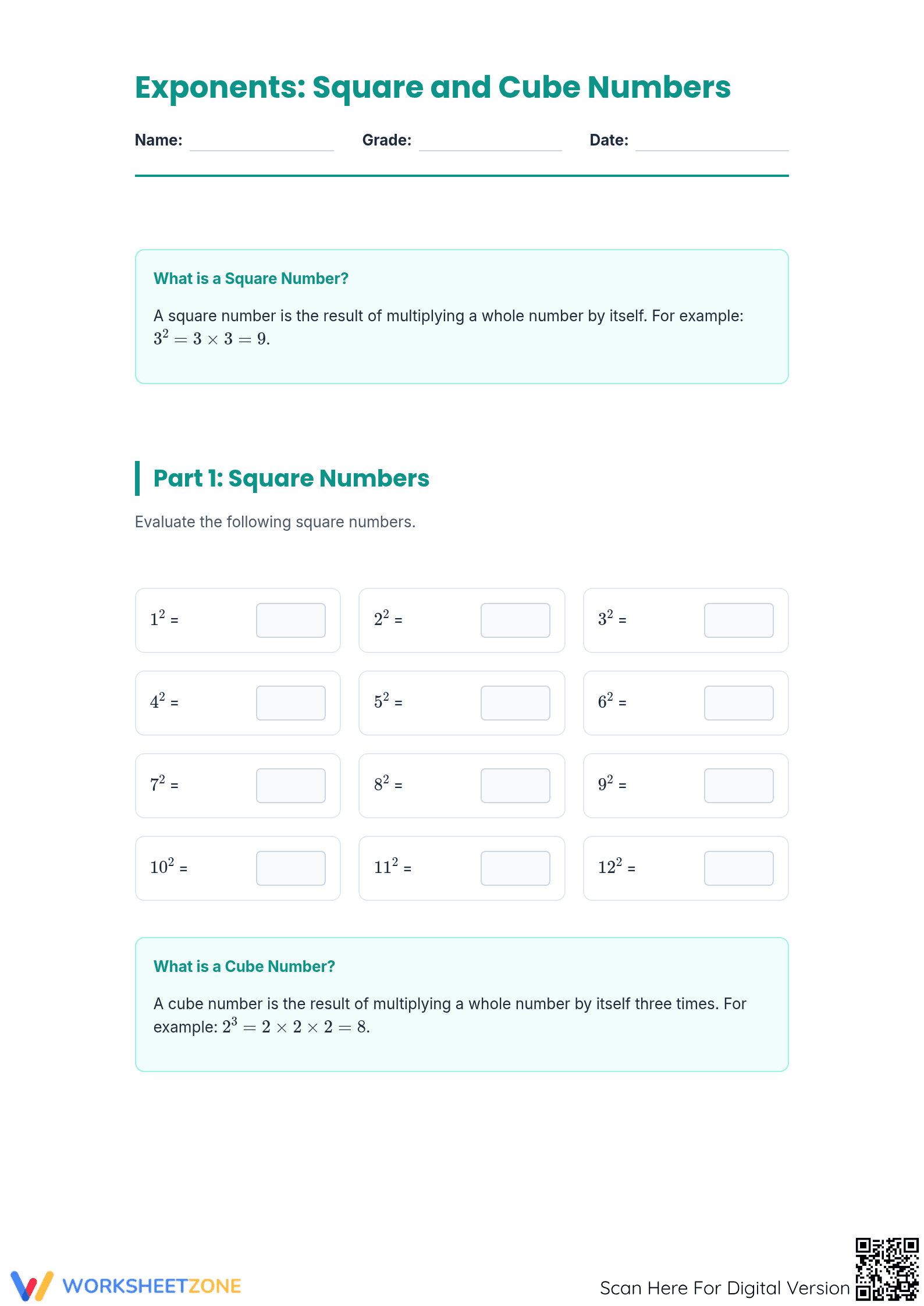
This worksheet provides a comprehensive introduction to exponents, focusing specifically on square and cube numbers. Students move from basic evaluations to complex comparisons and real-world application problems. Learners will evaluate numerical expressions involving exponents with confidence and accuracy across three targeted pages.
At a Glance
- Grade: 6–8 · Subject: Math
- Standard:
CCSS.MATH.CONTENT.6.EE.A.1— Evaluate numerical expressions involving whole-number exponents- Skill Focus: Square and Cube Numbers
- Format: 3 pages · 30 problems · Answer key included · PDF
- Best For: Initial instruction or focused reinforcement
- Time: 30–45 minutes
What's Inside
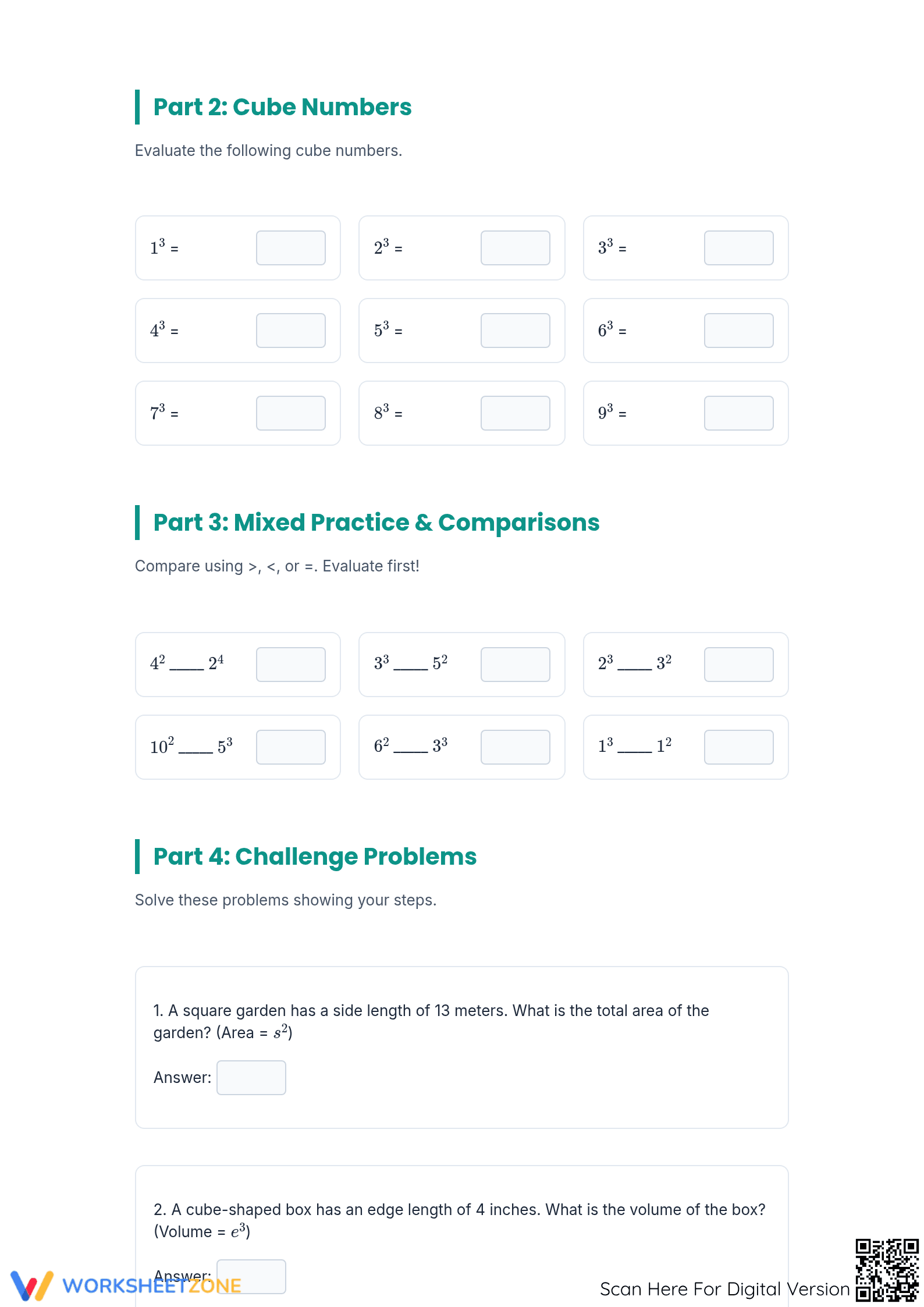
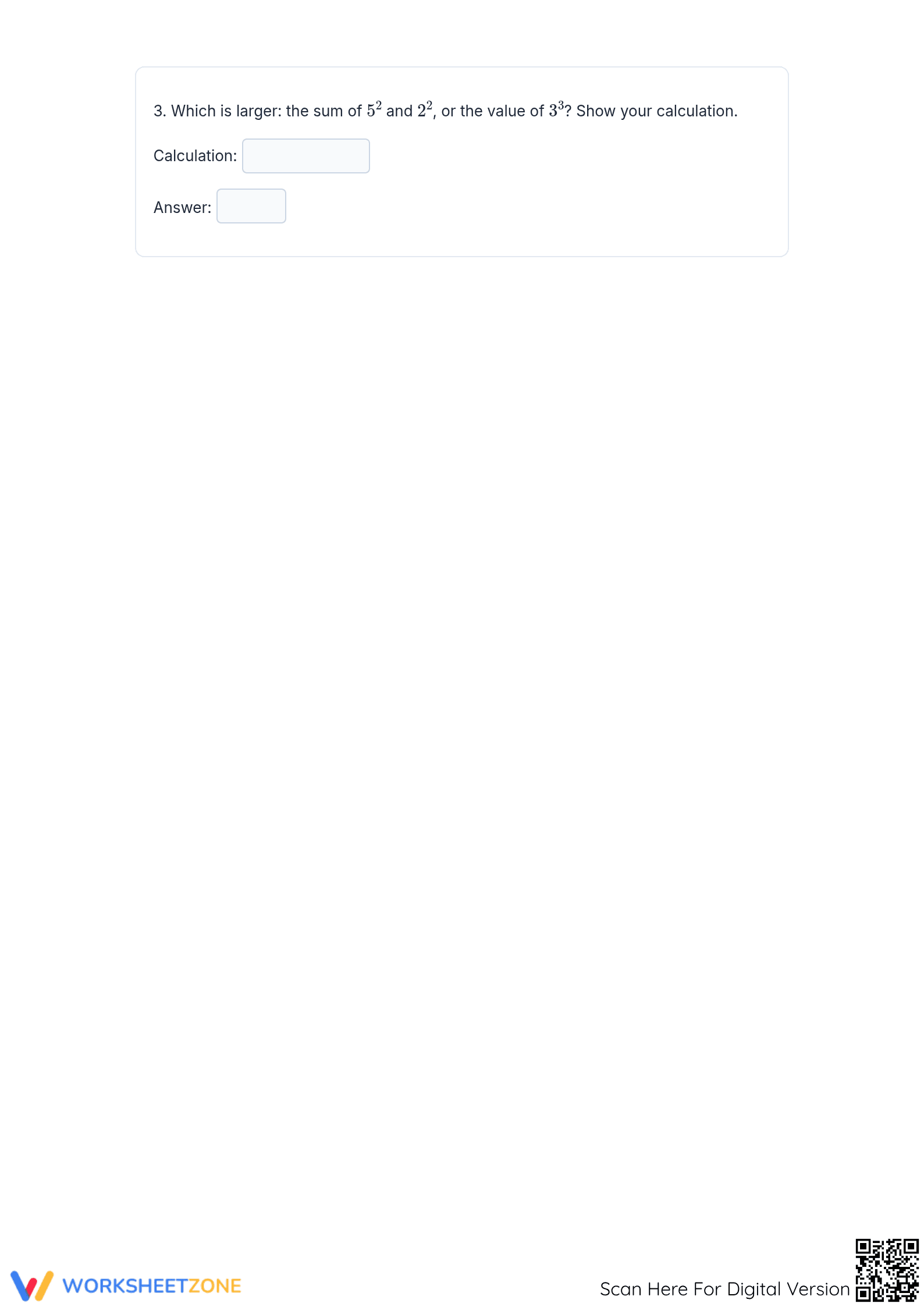
The three-page PDF includes four distinct sections designed to scaffold learning. It begins with clear definitions and examples for both square and cube numbers. Students solve 12 square number problems and 9 cube number problems before transitioning to mixed practice and comparisons. The final section contains three high-interest challenge problems involving geometry and comparative values.
Zero-Prep Workflow
Teachers can implement this resource in under two minutes.
- Print (30 seconds): Select the double-sided printing option for the three-page set.
- Distribute (30 seconds): Hand out the sheets for immediate individual or partner work.
- Review (1 minute): Use the provided answer key to conduct a quick whole-class check or for student self-grading.
This streamlined workflow makes the worksheet an ideal choice for emergency sub plans or last-minute bell-ringers.
Standards Alignment
The worksheet is strictly aligned to CCSS.MATH.CONTENT.6.EE.A.1, which requires students to write and evaluate numerical expressions involving whole-number exponents. Each task specifically targets the evaluation of base numbers raised to the second and third power. This standard code can be copied directly into lesson plans, IEP goals, or district curriculum mapping tools to ensure instructional compliance.
How to Use It
Use this worksheet during the guided practice phase of your exponents lesson. After introducing the concept of repeated multiplication, have students complete Part 1 and Part 2 to build fluency. For a formative assessment observation, watch how students handle the mixed comparisons in Part 3; if they struggle with comparing terms like 10² vs 5³, they may need a refresher on volume vs area concepts.
Who It's For
This resource is designed for Grade 6 math students, though it serves as an excellent bridge for Grade 5 advanced learners or a necessary review for Grade 7–8 students. It pairs naturally with geometric lessons on area and volume, particularly when using side-length or edge-length variables.
The effective teaching of exponents requires a transition from conceptual understanding of repeated multiplication to procedural fluency in evaluation. According to the RAND AIRS 2024 report on mathematical literacy, students who master foundational exponent properties early are 40% more likely to succeed in high school algebra courses. This worksheet facilitates that transition by providing 30 structured tasks aligned to CCSS.MATH.CONTENT.6.EE.A.1. By including clear definitions of square and cube numbers alongside challenge problems, it addresses both the modeled and independent phases of instruction. Research from NAEP indicates that fluency with squares and cubes is a significant predictor of success in middle-grade geometry and algebraic thinking. This printable resource ensures that learners receive the focused practice necessary to internalize these patterns, making it a reliable tool for any standards-aligned math classroom.


