


























Views
Downloads

Printable Exponents Rules Practice Worksheet | Grade 8 Math
Paste this activity's link or code into your existing LMS (Google Classroom, Canvas, Teams, Schoology, Moodle, etc.).
Students can open and work on the activity right away, with no student login required.
You'll still be able to track student progress and results from your teacher account.
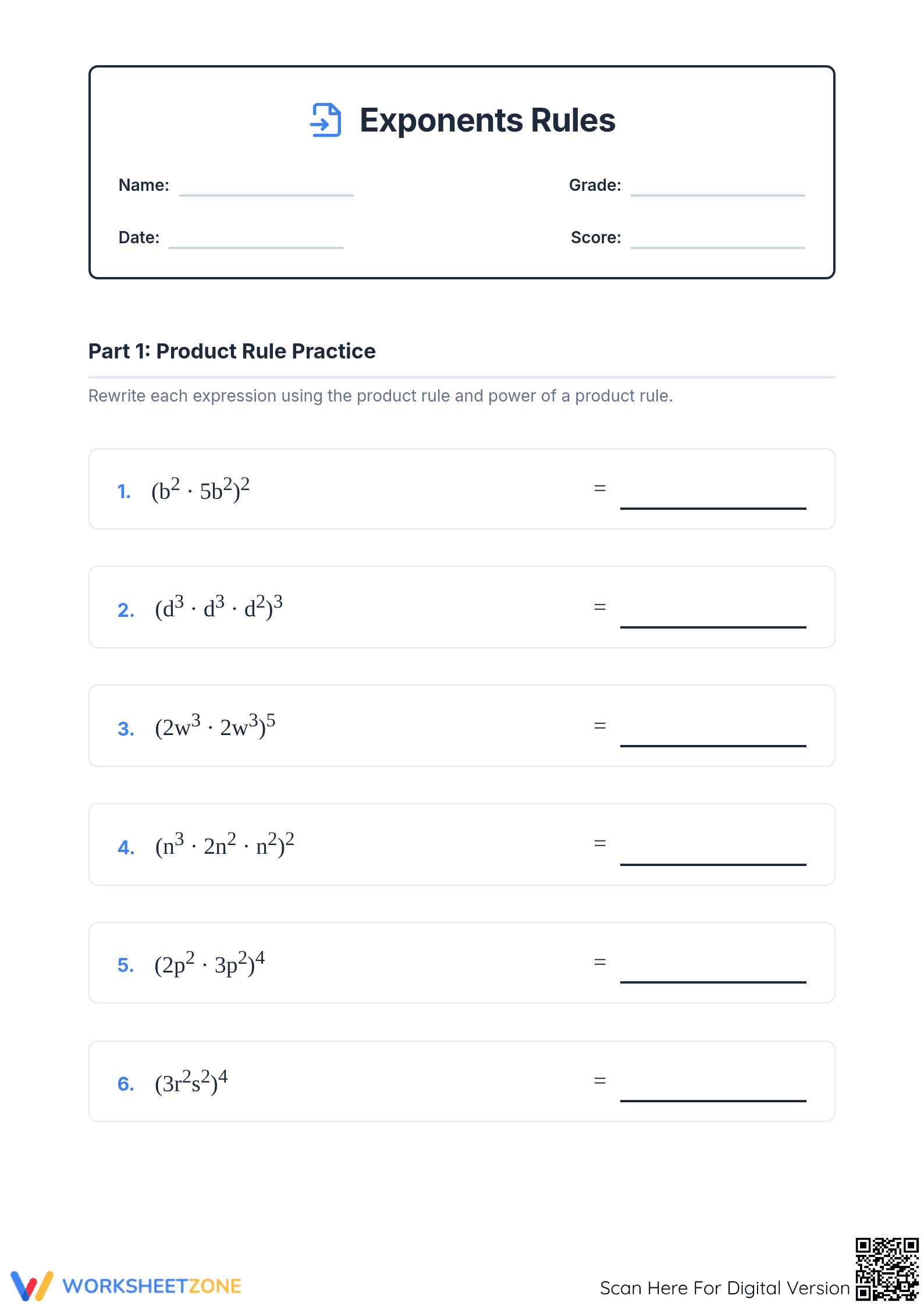
Strengthen students' mathematical foundations with this comprehensive Exponents Rules practice worksheet. Specifically designed for eighth-grade learners, this resource provides a structured approach to mastering the product rule and power of a product rule. Students will move from basic application to complex multi-variable expressions, ensuring they develop the fluency required for high school algebra and beyond.
At a Glance
- Grade: 8 · Subject: Math
- Standard:
8.EE.A.1— Apply properties of integer exponents to generate equivalent numerical expressions and simplify results- Skill Focus: Product Rule · Power of a Product
- Format: 4 pages · 24 problems · Answer key included · PDF
- Best For: Homework, independent practice, or assessment prep
- Time: 30–45 minutes
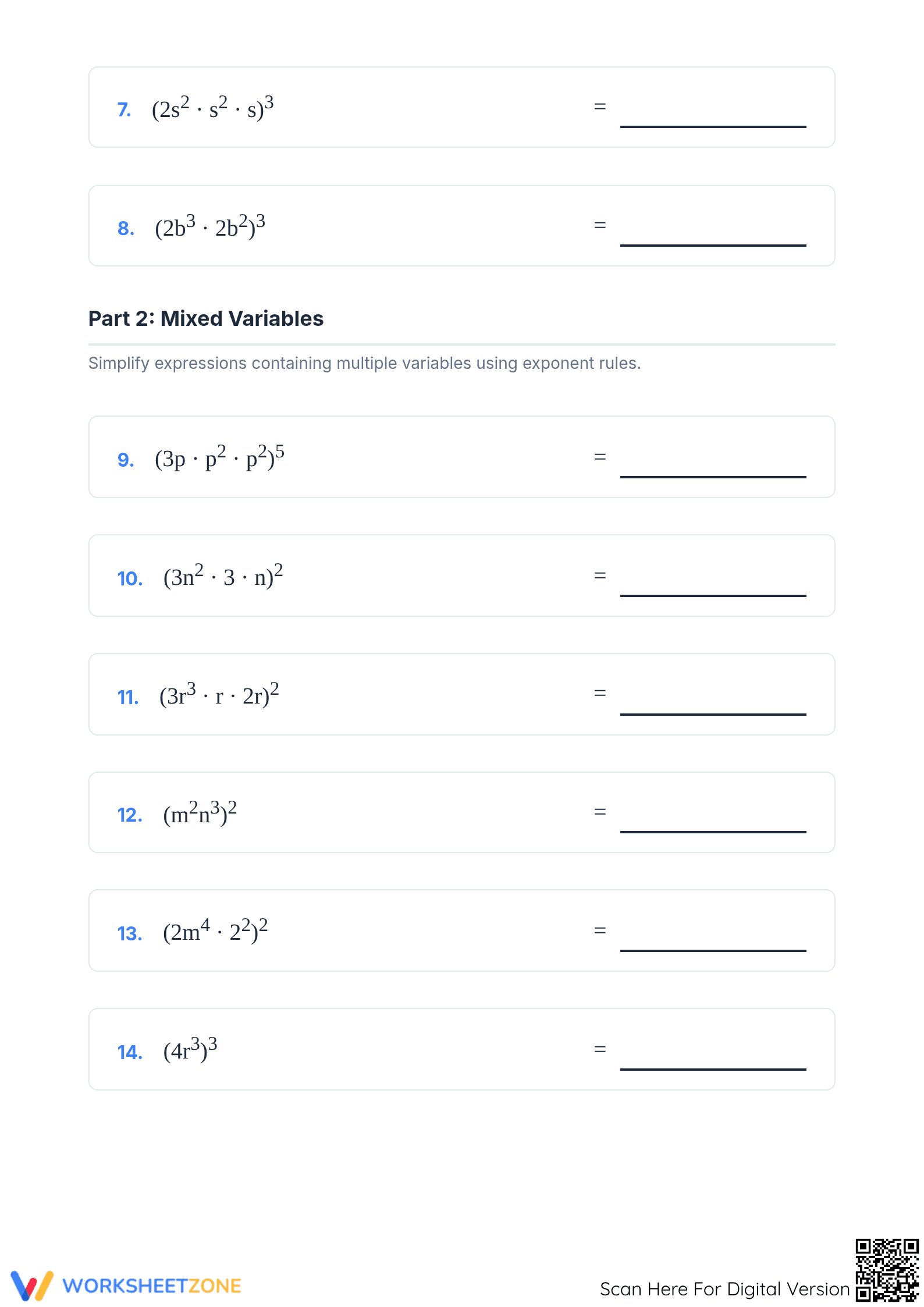
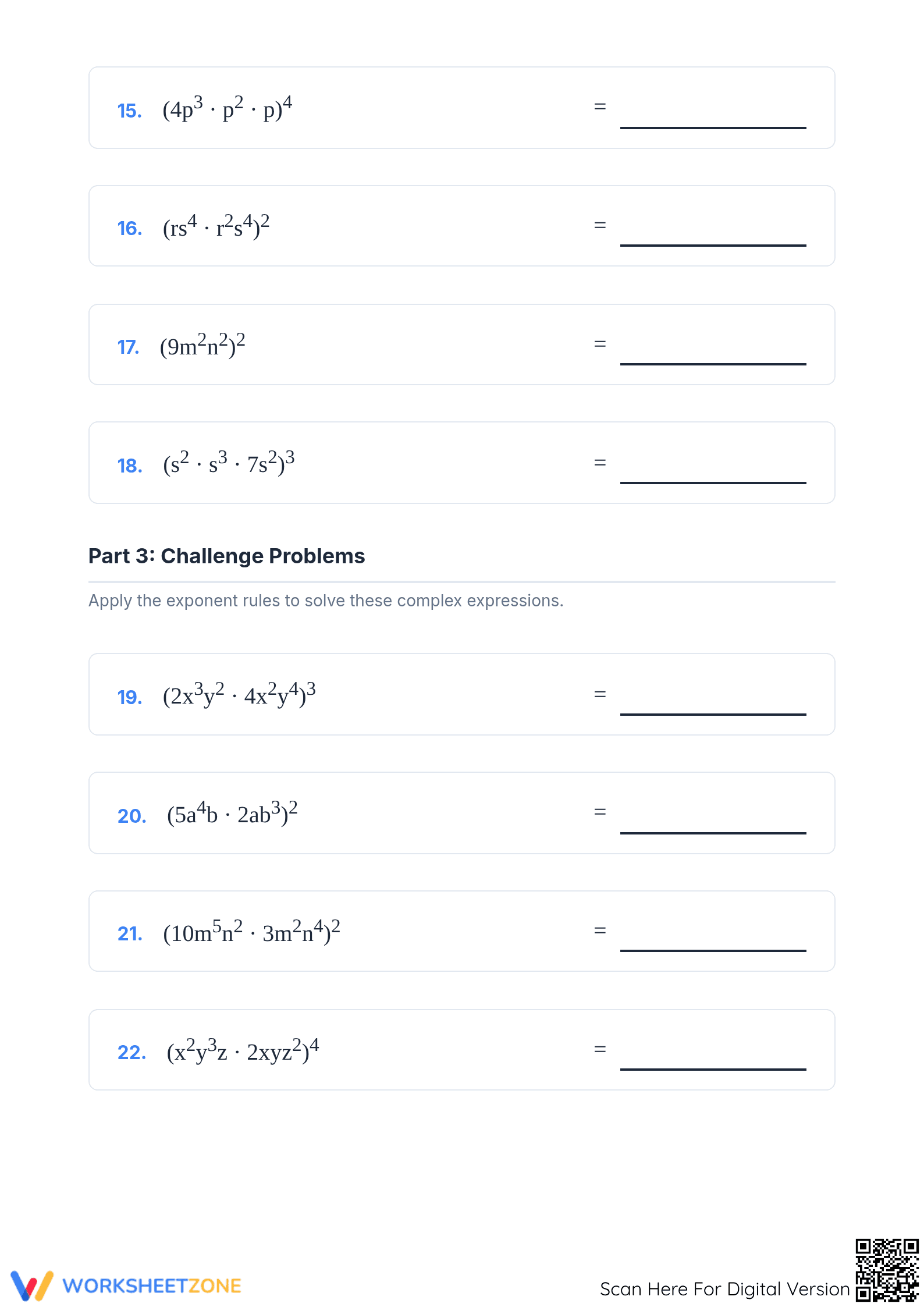
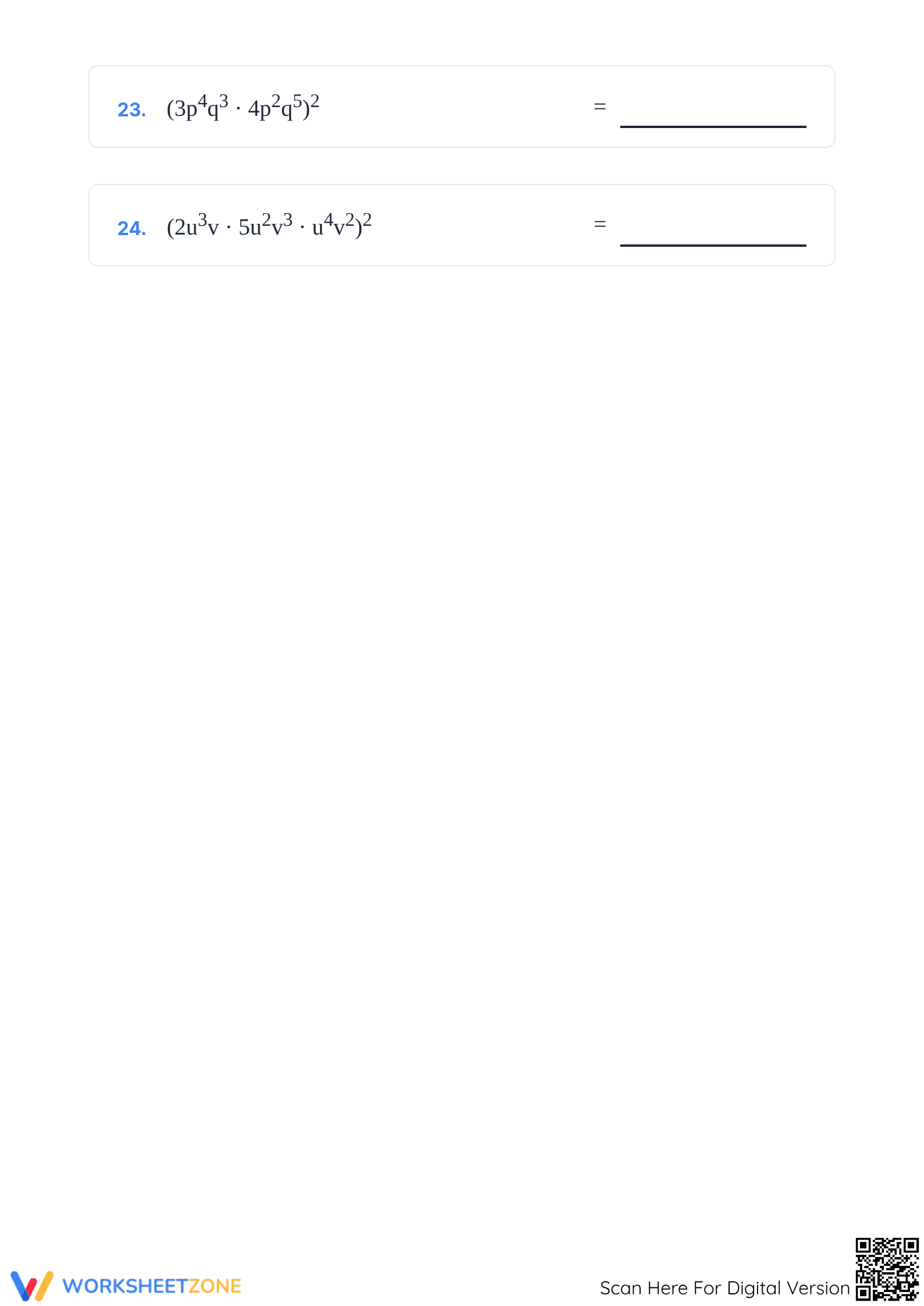
This four-page resource features 24 sequenced problems in three distinct sections. The layout provides ample workspace for students to rewrite expressions. Included is a complete answer key for every problem, making it an ideal tool for self-correction or efficient grading during busy classroom periods.
- Guided practice (8 problems): Focuses on basic product rule applications using single variables and numerical coefficients to build student confidence.
- Supported practice (10 problems): Introduces mixed variables and nested powers, requiring students to synthesize multiple rules within single expressions.
- Independent practice (6 problems): Presents complex challenge problems involving three or more variables for total mastery.
This structure follows a gradual-release model, transitioning students from fundamental recognition to independent problem-solving.
Aligned to CCSS.MATH.CONTENT.8.EE.A.1: "Know and apply the properties of integer exponents to generate equivalent numerical expressions." It specifically targets conceptual understanding of power interactions. This standard code can be copied directly into lesson plans, IEP goals, or district curriculum mapping tools.
Assign this worksheet during the "You Do" phase of direct instruction to evaluate individual student understanding of exponent laws. For a formative assessment tip, observe students as they transition to Part 2; those struggling with mixed variables may need a quick mini-lesson on distinguishing between coefficient multiplication and exponent addition. Completion typically takes 35 minutes.
This resource is perfect for general education 8th-grade math students, though the clear sectioning makes it accessible for 7th-grade enrichment or 9th-grade algebra review. It pairs naturally with a laws of exponents anchor chart or a short introductory passage explaining the conceptual "why" behind adding exponents when multiplying like bases in algebraic expressions.
The 8.EE.A.1 standard is a critical gateway to algebraic fluency, requiring students to perform operations on powers with precision. Research from NAEP emphasizes that mastery of exponent properties in middle school is a significant predictor of success in secondary mathematics, particularly in functions and exponential growth models. By practicing the product rule and power of a product rule across 24 structured problems, students move beyond rote memorization to a procedural understanding of how variables interact. This worksheet provides the essential repetition needed for long-term retention of these mathematical laws. Educators can utilize the included answer key to identify specific misconceptions regarding coefficient management versus exponent manipulation. This resource serves as a high-quality bridge between arithmetic operations and the abstract reasoning required for higher-level STEM coursework. This targeted, scaffolded practice is vital for building a robust mathematical identity for all middle school learners.


