


























Views
Downloads

Essential Exponents Practice | Grade 8 Math Worksheet
Paste this activity's link or code into your existing LMS (Google Classroom, Canvas, Teams, Schoology, Moodle, etc.).
Students can open and work on the activity right away, with no student login required.
You'll still be able to track student progress and results from your teacher account.
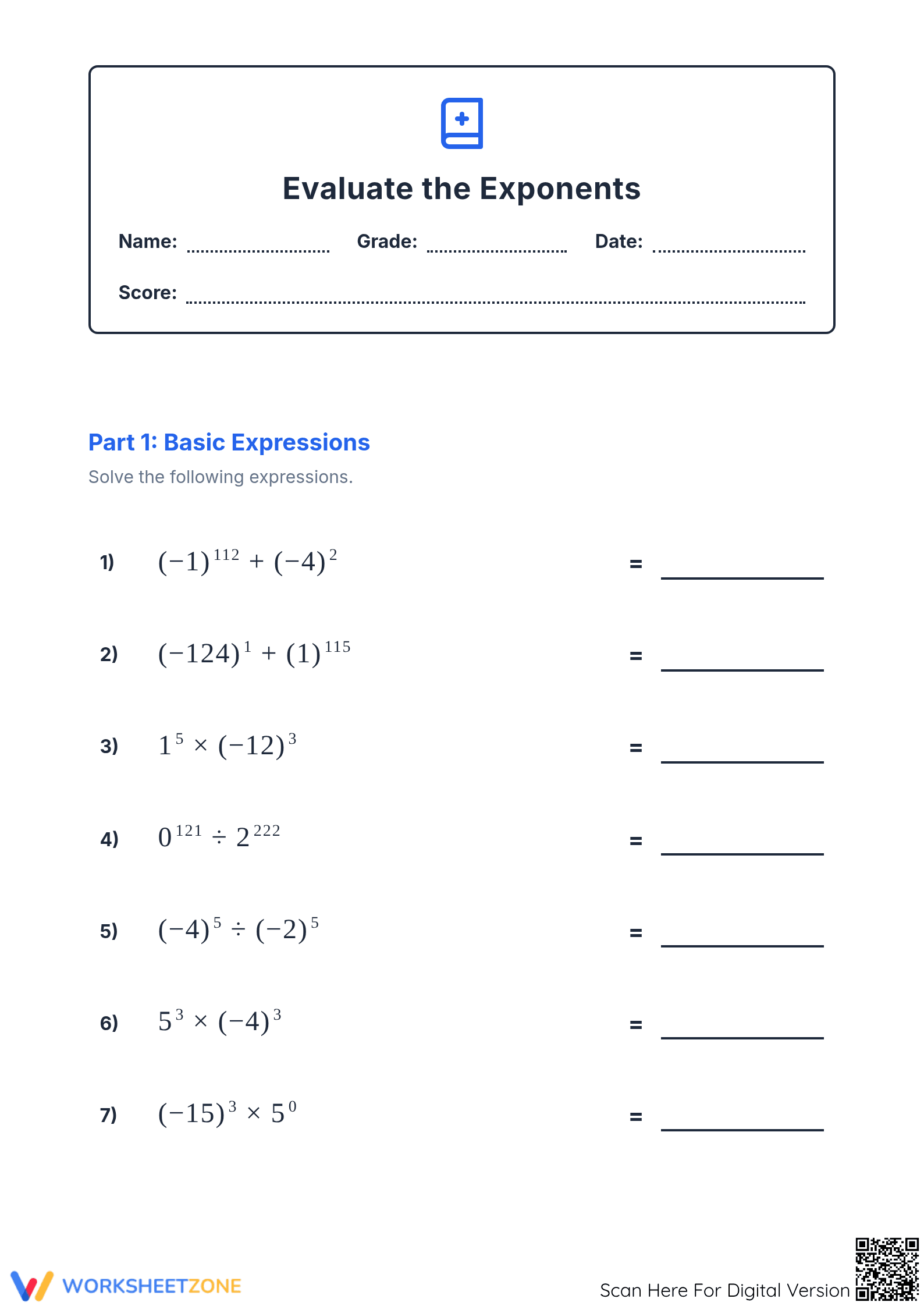
This Grade 8 math worksheet focuses on evaluating expressions with negative base exponents. Students will master integer exponent rules while applying addition, subtraction, multiplication, and division. This resource ensures students accurately determine results, building a strong foundation for algebra. By completing 24 problems, learners gain fluency in exponent parity rules.
At a Glance
- Grade: 8 · Subject: Math
- Standard:
CCSS.MATH.CONTENT.8.EE.A.1— Apply the properties of integer exponents to generate equivalent numerical expressions- Skill Focus: Negative base exponentiation with mixed operations
- Format: 3 pages · 24 problems · Full answer key included · High-quality PDF
- Best For: Essential independent practice and formative assessment
- Time: 25–35 minutes
What's Inside
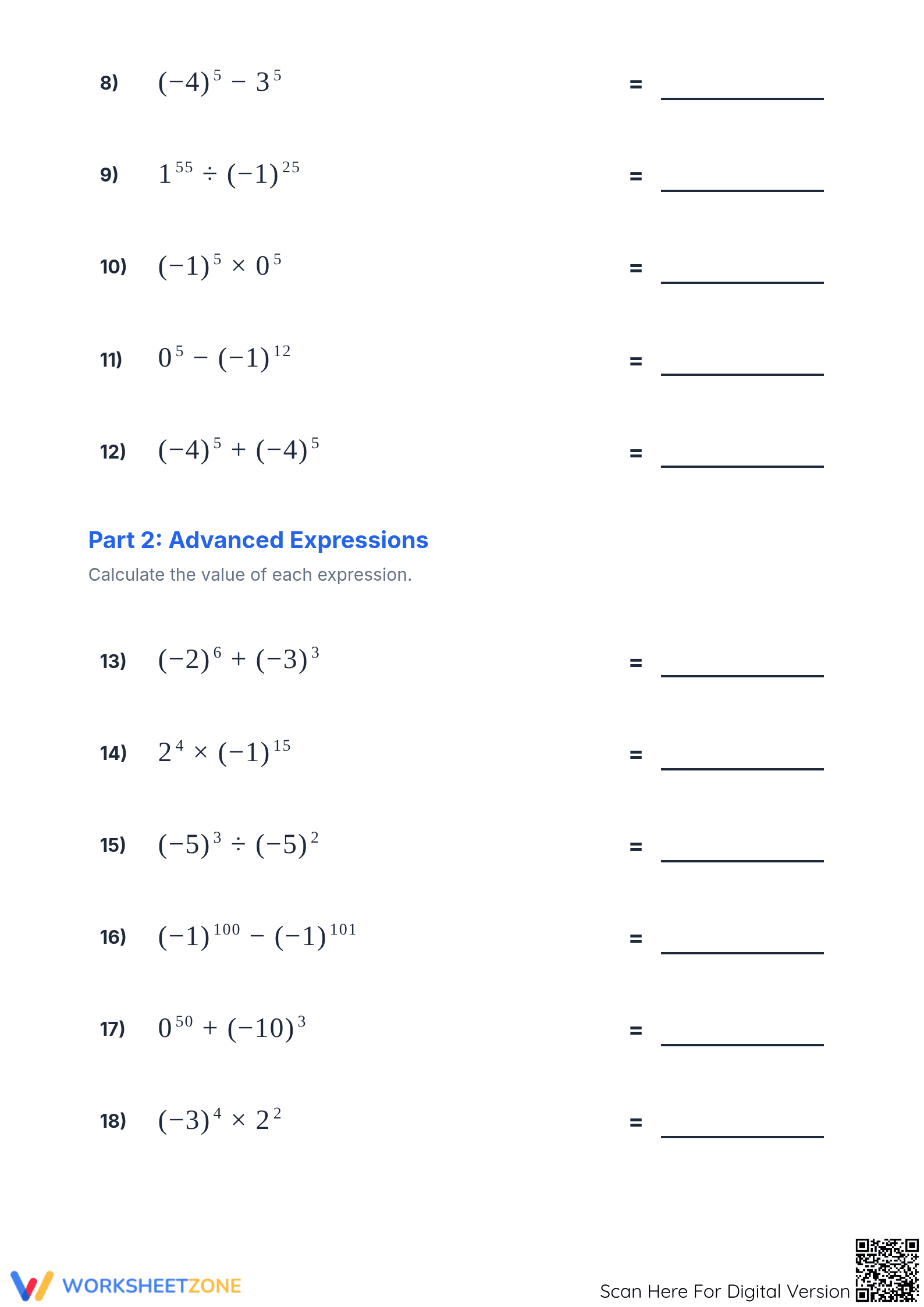
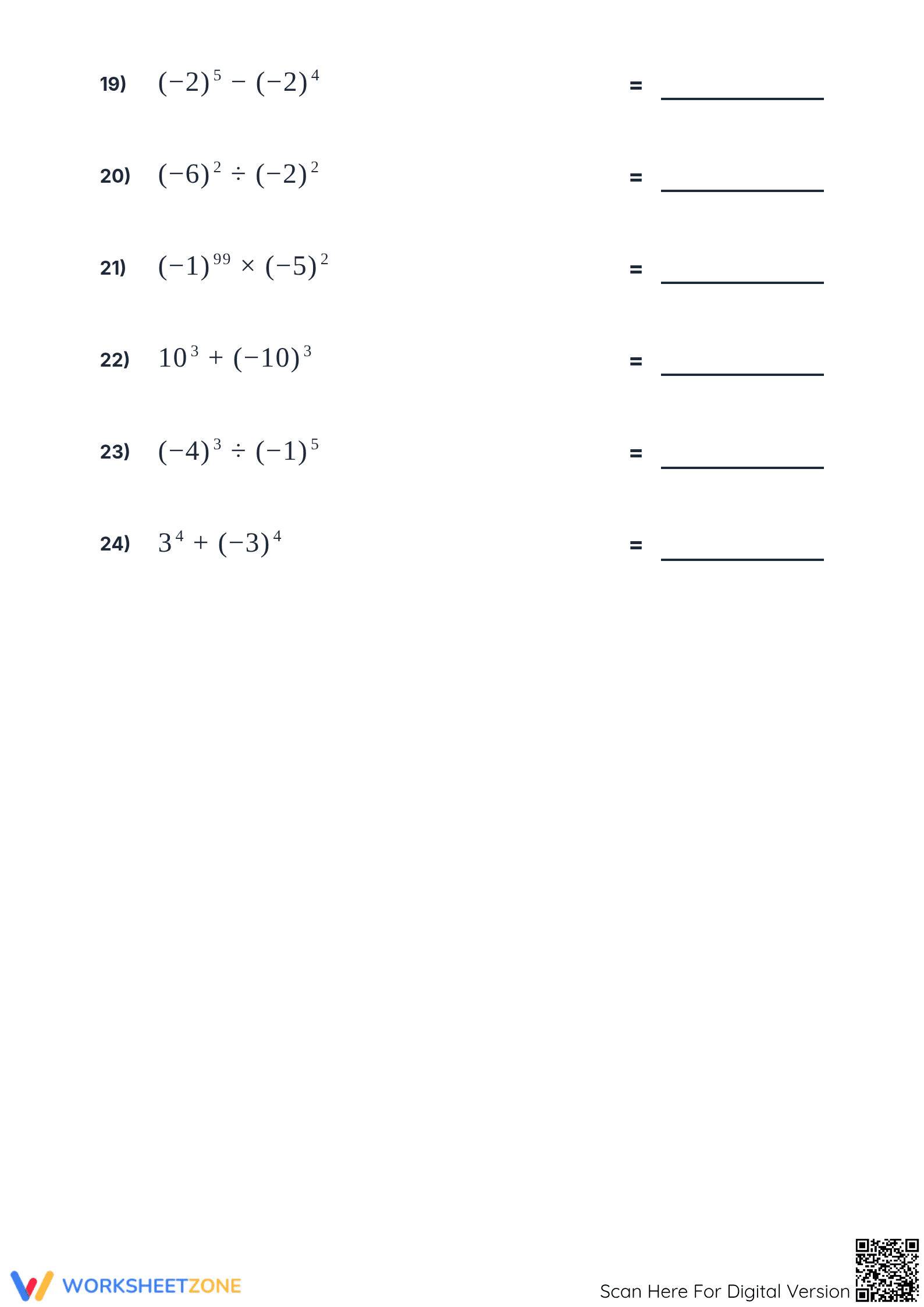
This three-page PDF contains 24 problems divided into two sections. Part 1 focuses on basic expressions, establishing rules for negative bases and operations. Part 2 introduces advanced expressions, requiring students to apply complex integer rules. Each page provides ample space for student work, and a comprehensive answer key is included for teacher or student review.
Skill Progression
- Guided Practice: Problems 1–6 establish rules of parity using addition and multiplication.
- Supported Practice: Problems 7–12 introduce division and subtraction, challenging students to maintain sign accuracy.
- Independent Practice: Problems 13–24 require students to evaluate larger exponents and complex operational strings.
This gradual-release approach builds confidence and ensures students move from conceptual understanding to procedural fluency.
Standards Alignment
The primary focus is CCSS.MATH.CONTENT.8.EE.A.1, applying integer exponent properties. It also supports CCSS.MATH.CONTENT.7.NS.A.2 regarding rational number operations. Both standard codes can be copied directly into lesson plans, IEP goals, or district curriculum mapping tools to ensure documentation and reporting accuracy.
How to Use It
Deploy this resource during the independent practice phase to gauge understanding. It serves as an excellent warm-up or a formal exit ticket. Teachers should observe students during Part 1 to identify misconceptions regarding zero exponents or sign flipping. Completion typically takes 30 minutes, providing a clear snapshot of student mastery.
Who It's For
This practice set is for Grade 8 students or advanced Grade 7 learners exploring algebra. Clear sectioning provides scaffolding for students with IEPs. Pair this resource with an anchor chart detailing negative base rules or a direct instruction lesson on integer properties to maximize instructional impact and student retention.
The evaluation of numerical expressions involving integer exponents, particularly those with negative bases, represents a critical juncture in middle school algebraic readiness. According to Fisher & Frey (2014), the gradual release of responsibility model is most effective when students transition from basic sign rules to complex multi-operational expressions. This resource aligns with CCSS.MATH.CONTENT.8.EE.A.1, requiring students to determine the sign and magnitude of results when negative bases are raised to varying powers. Mastery of these rules prevents common computational errors in later quadratic modeling. By providing 24 targeted problems, the worksheet ensures that the cognitive load remains focused on the properties of exponents rather than procedural distractions. Data from NAEP indicates that students who demonstrate fluency in integer operations show higher success rates in secondary mathematics. This practice set provides the necessary repetition to internalize the parity rules governing negative base exponentiation across addition, subtraction, multiplication, and division.


