


























Views
Downloads


Essential Negative Base Exponents Worksheet | Grade 8 Math
Paste this activity's link or code into your existing LMS (Google Classroom, Canvas, Teams, Schoology, Moodle, etc.).
Students can open and work on the activity right away, with no student login required.
You'll still be able to track student progress and results from your teacher account.
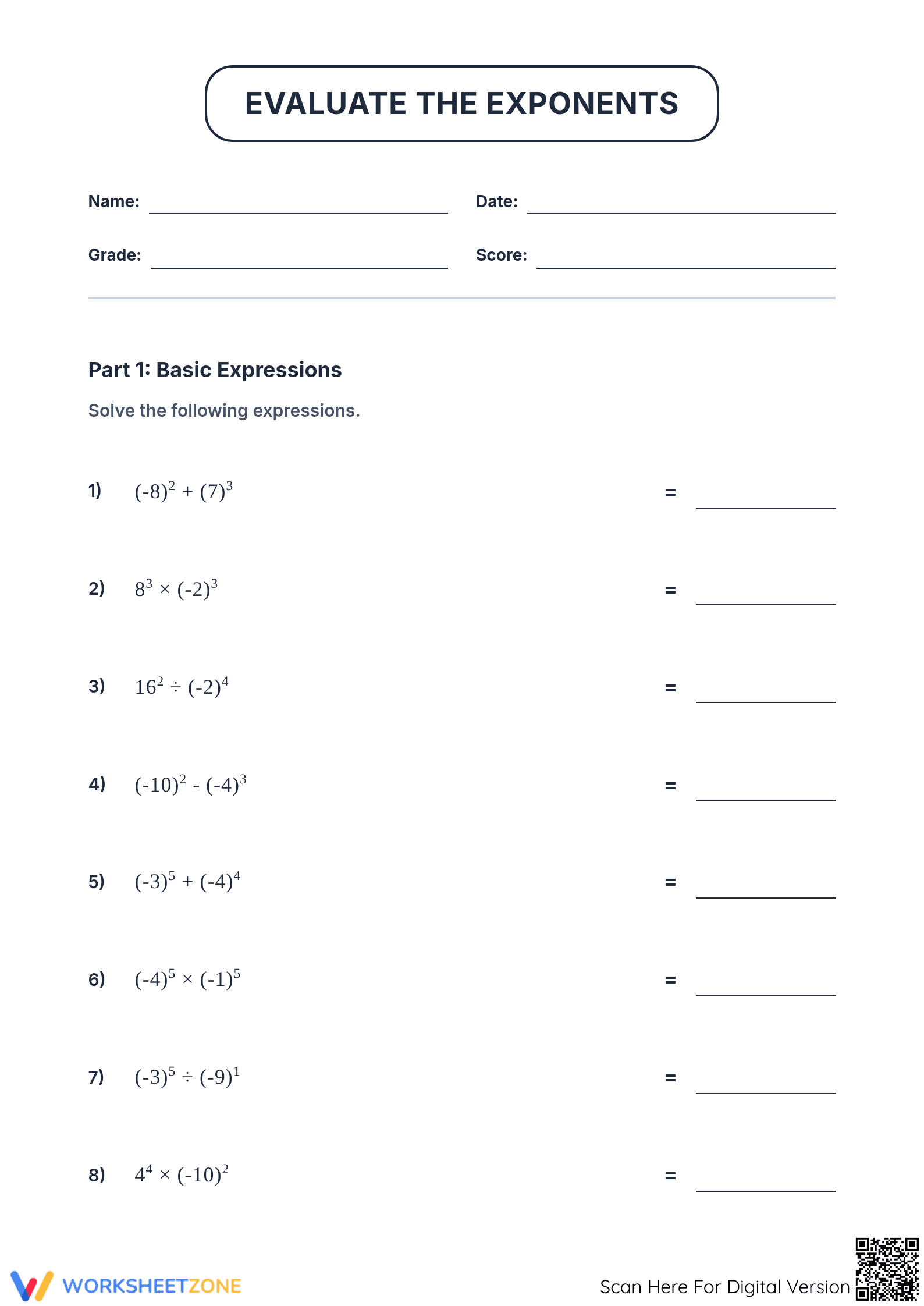
Help your students master the complexities of numerical expressions with this comprehensive practice set. This worksheet focuses on evaluating exponent equations where the base is negative, requiring careful attention to signs and the order of operations. Students will develop a strong conceptual understanding of how even and odd exponents affect negative integers through repetitive, structured practice.
At a Glance
- Grade: 8 · Subject: Math
- Standard:
CCSS.MATH.CONTENT.8.EE.A.1— Apply properties of integer exponents to evaluate and simplify numerical expressions accurately- Skill Focus: Negative Base Exponents
- Format: 3 pages · 20 problems · Answer key included · PDF
- Best For: Middle school math fluency and review
- Time: 25–35 minutes
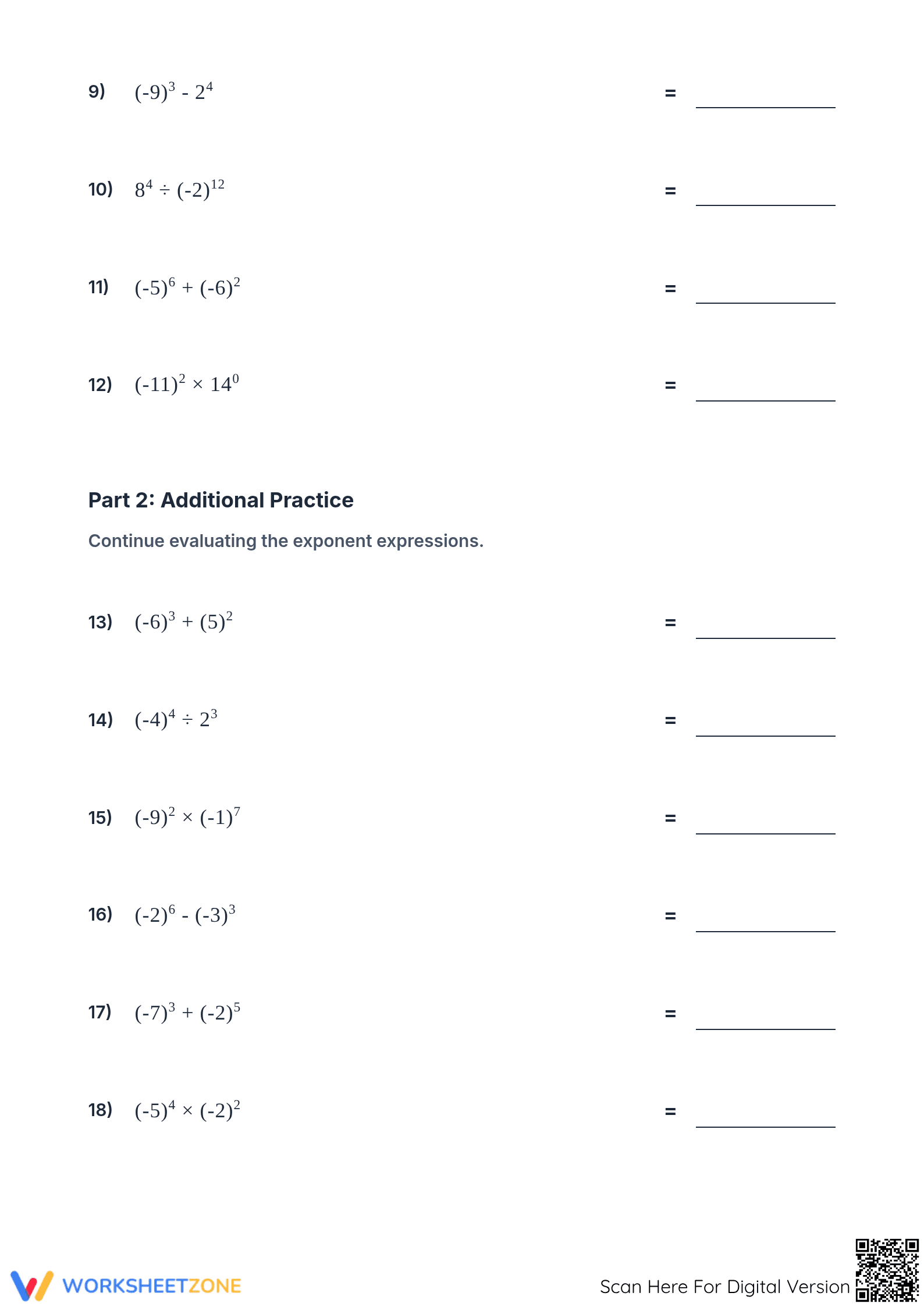
This three-page PDF collection features 20 targeted problems divided into two logical sections. Part 1 provides 12 basic expressions to establish a baseline, while Part 2 offers 8 additional practice problems to reinforce mastery. Every question requires students to evaluate expressions involving negative bases raised to various powers, combined with addition, subtraction, multiplication, and division. A complete answer key is provided for rapid grading.
Skill Progression
- Guided Practice: The initial set of 8 problems introduces simple combinations, such as squaring negative eight, allowing students to practice sign rules in a structured format with clear equals signs and scaffolded space.
- Supported Practice: Problems 9 through 12 transition into more complex operations, including division and higher exponents, requiring students to apply the order of operations to multi-step numerical expressions.
- Independent Practice: The final 8 problems in the additional practice section challenge students to solve similar equations autonomously, ensuring they can consistently handle negative bases without teacher assistance.
This worksheet follows a gradual-release model, moving from foundational sign identification to the independent evaluation of multi-operational exponent equations.
Standards Alignment
This resource is directly aligned with CCSS.MATH.CONTENT.8.EE.A.1: "Know and apply the properties of integer exponents to generate equivalent numerical expressions." It specifically targets the student's ability to evaluate numerical expressions involving exponents. Both standard codes can be copied directly into lesson plans, IEP goals, or district curriculum mapping tools.
How to Use It
Use this worksheet as a focused bell-ringer or "do now" activity during a unit on integer properties to build computational fluency. It also serves as an excellent formative assessment tool; observe students as they work through the first five problems to identify common misconceptions regarding even versus odd exponents with negative bases. The 30-minute completion window makes it ideal for a mid-unit check.
Who It's For
This resource is designed for Grade 8 math students, though it is highly effective for Grade 6 and 7 students ready for algebraic acceleration. It is a natural pairing for direct instruction lessons on the laws of exponents or as a supplemental resource for students requiring Tier 2 intervention in numerical fluency.
According to the RAND AIRS 2024 analysis of middle school mathematics curricula, structured repetition is vital for students to internalize the abstract rules governing integer exponents. This worksheet addresses that need by providing 20 consistent tasks that isolate the variable of negative bases. By requiring students to evaluate numerical expressions across mixed operations—addition, subtraction, multiplication, and division—it builds the procedural fluency necessary for high school algebra readiness. The inclusion of an answer key supports immediate feedback, a critical component of the "I Do, We Do, You Do" instructional framework. This specific focus on CCSS.MATH.CONTENT.8.EE.A.1 ensures that learners are not just memorizing rules but applying them to varied numerical contexts. Educators can use this 3-page guide to provide high-quality, standards-aligned practice that fits into any instructional block, making it a reliable resource for both general education classrooms and specialized intervention settings.


