


























Views
Downloads


Printable Exponents Practice Worksheet | Grade 6-8 Math
Paste this activity's link or code into your existing LMS (Google Classroom, Canvas, Teams, Schoology, Moodle, etc.).
Students can open and work on the activity right away, with no student login required.
You'll still be able to track student progress and results from your teacher account.
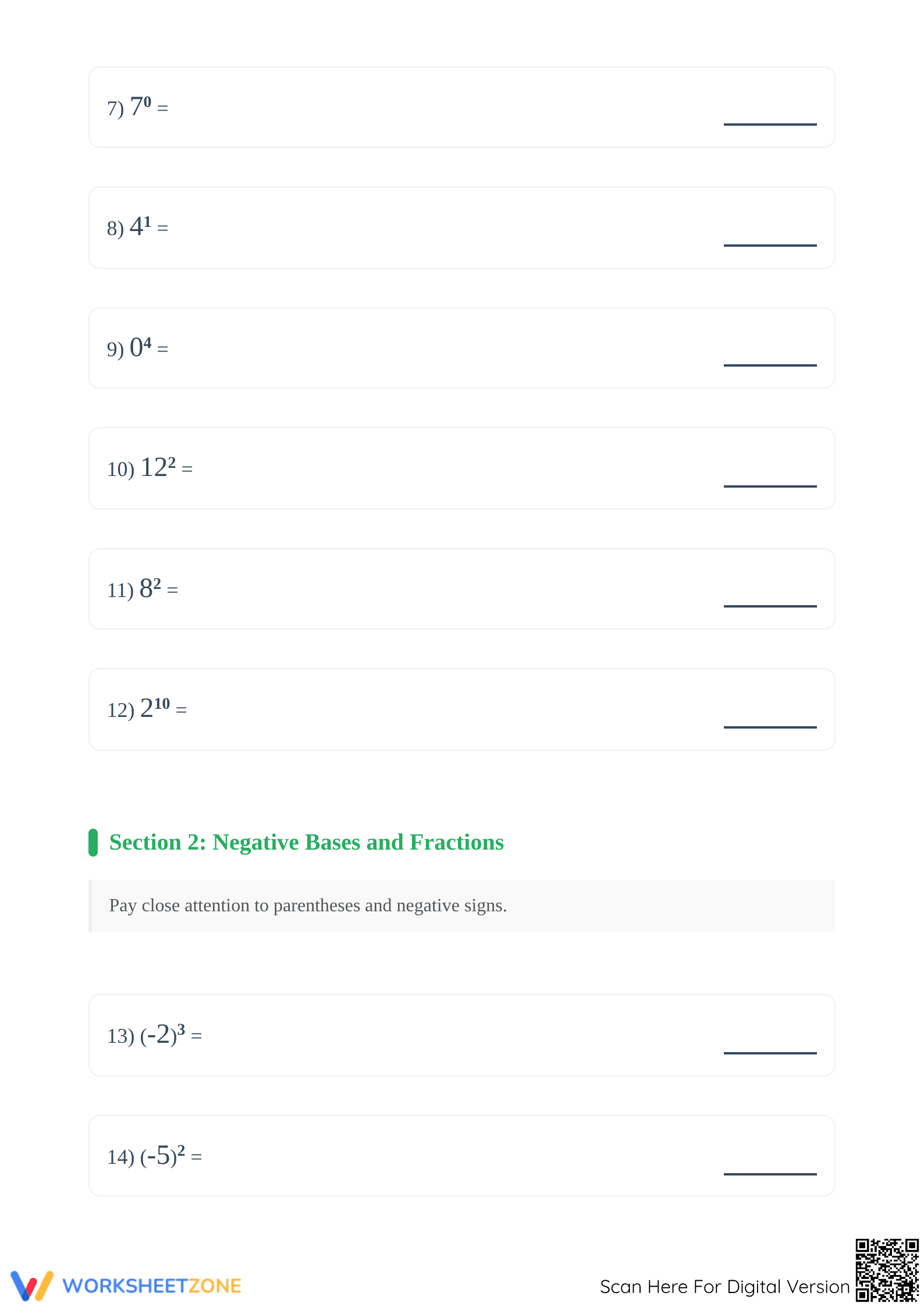
This comprehensive exponents worksheet provides a structured pathway for middle school students to master numerical expressions. Students progress from evaluating basic whole-number bases to tackling complex negative bases and fractional exponents. By bridging the gap between repeated multiplication and exponential notation, this resource ensures a deep conceptual understanding of mathematical powers and their properties.
At a Glance
- Grade: 6–8 · Subject: Math
- Standard:
CCSS.MATH.CONTENT.6.EE.A.1— Write and evaluate numerical expressions involving whole-number exponents- Skill Focus: Exponential Evaluation and Notation
- Format: 5 pages · 39 problems · Answer key included · PDF
- Best For: Middle school math skill reinforcement
- Time: 45–60 minutes
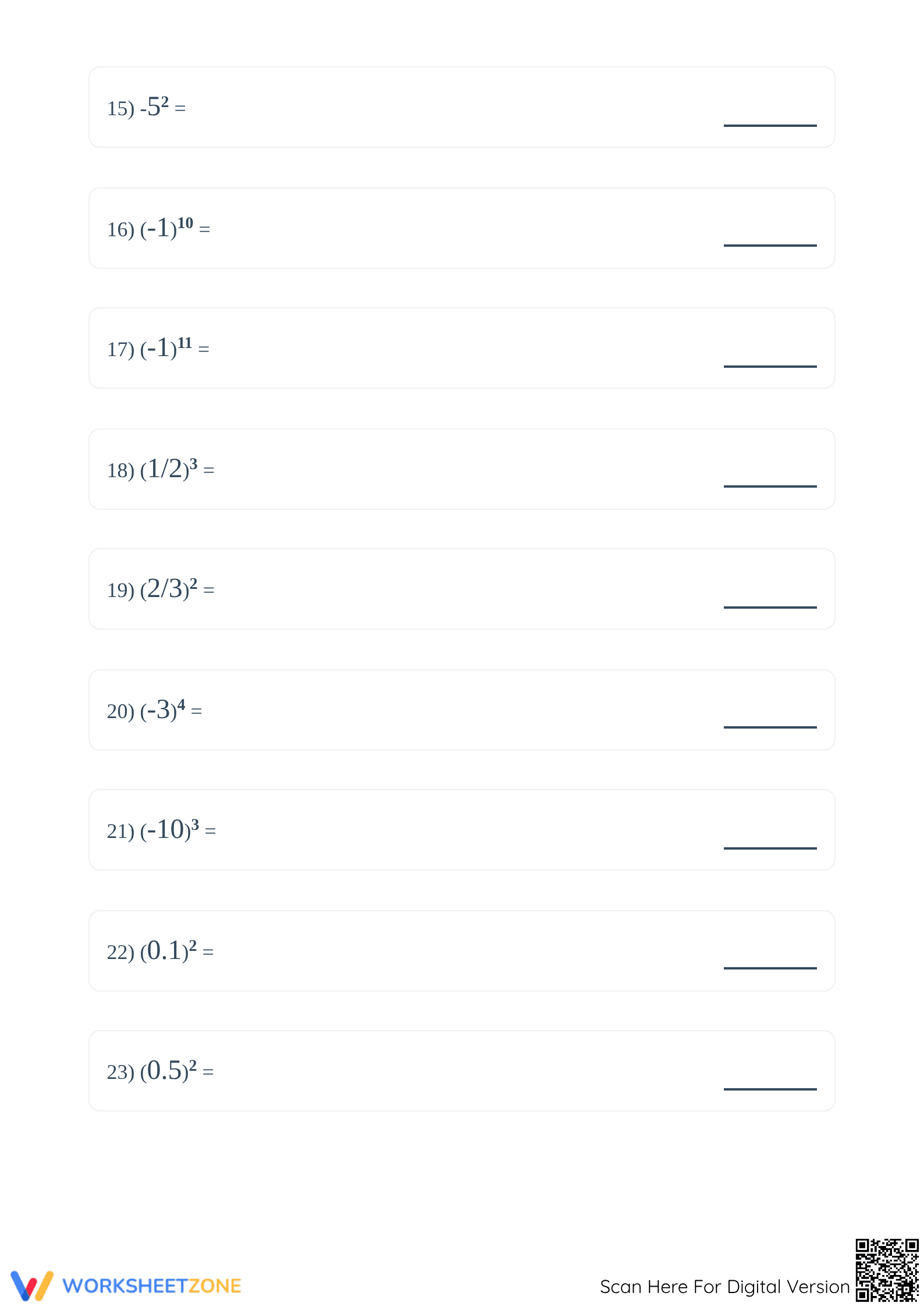
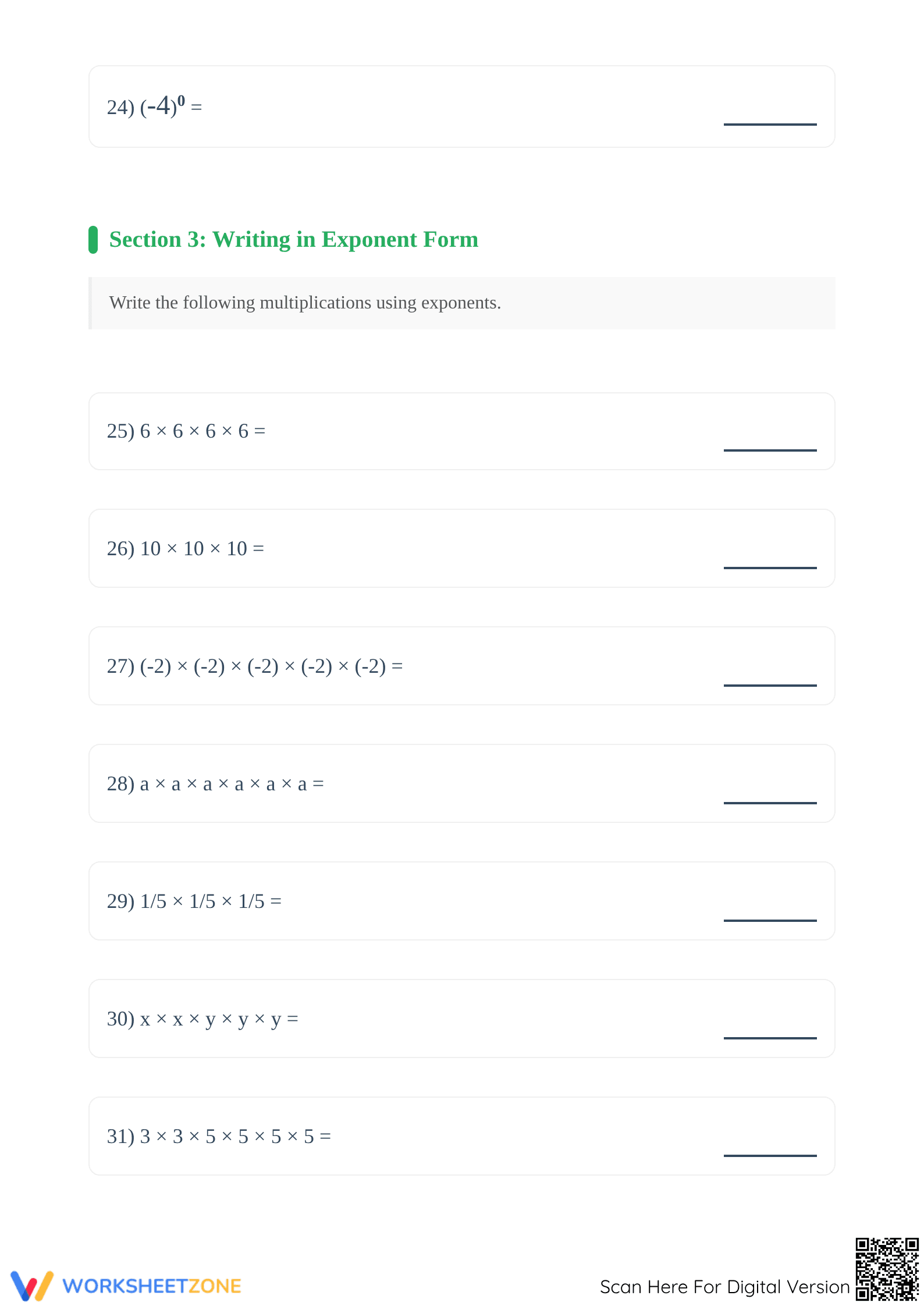
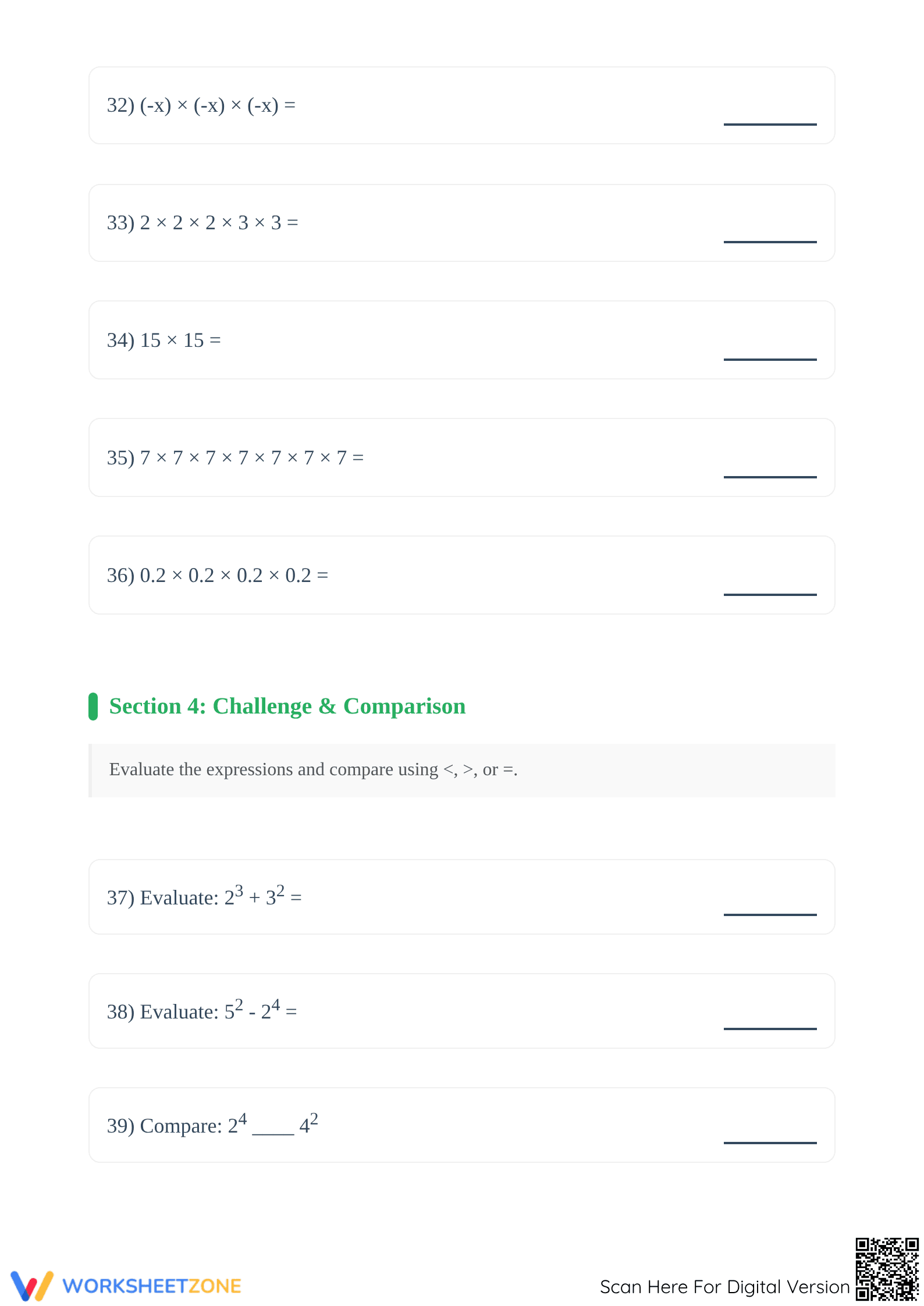
The packet contains five detailed pages organized into four distinct sections. It starts with twelve basic evaluation problems, moves into twelve problems featuring negative bases and fractions, and follows with twelve tasks for writing multiplications in exponent form. The final section provides three high-level challenge and comparison problems. A complete answer key is provided to facilitate quick grading and immediate student feedback.
Skill Progression
- Guided Practice (12 tasks): Students begin by calculating the value of basic expressions like 5 squared and 3 cubed, utilizing a provided reminder of the exponent definition to anchor their initial efforts.
- Supported Practice (12 tasks): The complexity increases as students apply their knowledge to negative bases, fractions, and decimals, requiring careful attention to parentheses and sign rules.
- Independent Practice (15 tasks): Learners transition to writing expanded multiplications in exponent form and conclude with comparative evaluations that demand higher-order synthesis of exponential properties.
This sequence follows the gradual-release model, moving from scaffolded computation to abstract representation and comparative analysis.
Standards Alignment
The primary focus is CCSS.MATH.CONTENT.6.EE.A.1: "Write and evaluate numerical expressions involving whole-number exponents." This resource also supports CCSS.MATH.CONTENT.8.EE.A.1 by introducing negative bases and zero exponents. Both standard codes can be copied directly into lesson plans, IEP goals, or district curriculum mapping tools.
How to Use It
Use this as a post-instruction practice set after introducing the concept of repeated multiplication. During class, circulate while students work on Section 2 to observe if they correctly handle the interaction between negative signs and even/odd exponents. This activity typically requires 45 to 60 minutes for complete mastery across all four sections.
Who It's For
This resource is designed for Grade 6, 7, and 8 students developing fluency with expressions and equations. It is particularly effective for those needing extra practice with non-whole number bases. Pair this with a visual anchor chart displaying exponent vocabulary like "base" and "power" for maximum instructional impact.
Research by Fisher & Frey (2014) emphasizes that the gradual release of responsibility is essential for mathematical fluency, particularly when transitioning from concrete operations to abstract notation like exponents. This worksheet embodies that principle by partitioning 39 problems into discrete phases of difficulty, ensuring students encounter the standard CCSS.MATH.CONTENT.6.EE.A.1 in varied contexts. The inclusion of negative bases and comparison tasks aligns with findings from the NAEP, which suggests that students who can evaluate and compare exponential expressions demonstrate a higher readiness for algebraic thinking. By providing multiple pages of focused practice, educators can systematically close the gap between procedural knowledge and conceptual mastery. This evidence-based approach to mathematical practice provides the necessary repetition for long-term retention of exponent properties. This self-contained module is a printable solution for any middle school classroom seeking rigorous, aligned, and effective practice materials for essential math skills.


