


























In this lesson, students will learn how to develop equations for exponential growth and decay. Students will:
- determine the multiplier for a percentage increase or decrease.
- develop equations for exponential growth or decay.
- calculate x and y using exponential equations.
- use their calculator to determine an exponential equation for a given data set.
- How can we decide whether a real-world scenario should be represented by a quadratic, polynomial, or exponential function?
- How can you describe the advantages of using multiple approaches to represent exponential functions (tables, graphs, equations, and contextual situations)?
- Exponential Growth: An exponential model in the form, y = a\(b^x\), where b>1; function increases exponentially.
- Exponential Decay: An exponential model in the form, y = a\(b^x\), where 0 < b<1; function decreases exponentially.
- Percent Grids Worksheet (M-A2-4-3_Percent Grids Worksheet and KEY)
- Exponential Growth and Decay Notes (M-A2-4-3_Exponential Growth and Decay Notes and KEY)
- Exponential Growth and Decay Worksheet (M-A2-4-3_Exponential Growth and Decay Worksheet)
- Lesson 3 Exit Ticket (M-A2-4-3_Lesson 3 Exit Ticket and KEY)
- Stat Plot Instructions
- Population Estimates
- graphing calculator (for the extension activity)
- The Lesson 3 Exit Ticket assignment assesses students' understanding of increases and falls in amounts over time using two real-world logarithmic growth/decay models. Students' comprehension of the relationship between each component of logarithms and the specific properties of the models will reflect their level of understanding.
Scaffolding, Modeling, and Explicit Instruction
W: Students will be taught about exponential growth and decay. In many real-life scenarios, these concepts are very important. Observation, exit tickets, and a test will be used to grade the students.
H: The idea of saving money is what got the students interested in the lesson.
E: Today, students will work alone and with a partner. They will find out how many different ways exponential growth and decay can be used.
R: During the class review, students will have a chance to think about and go over the problems again. After that, students will use what they've learned to go over how they thought about the next job again. Students will get comments on how to make changes and answer questions by watching others work.
E: When students check their work with a partner, they will be able to judge how well they did. Their friends or classmates might be able to help them understand better.
T: This lesson is designed to get students to work together, whether they are in groups of students with similar skills or groups of students with different skills. It's also hard for students who need more practice or who work faster than their friends on the extensions.
O: This lesson is broken up into four parts. In each part, you will either work alone or with a partner. During the review, students will go over each problem and talk about them with the whole class. The class will move from one task to the next through the discussions.
Have a discussion about the students' future. "Why do you want to attend college? What are your career interests, and what type of career do you want? Who wants to travel or have a family? Why do you want to do or have any of these things for which saving and accumulating some money is a useful goal?" (discussion)
"These are all scenarios in which saving money might be an intelligent choice. Saving money is an excellent illustration of exponential growth. Consider this case. If you save one penny on day one and double it every day for 30 days, how much money would you have by the end of the month?" (about $5.36 million)
Part 1
"Before we start creating more equations like this, we need to talk about percentages and multipliers. Does anyone know why, in our case, we multiplied by 1.1 after increasing our savings by 10%?" (It is fine if no one knows; that is what the beginning of this lesson is about.)
(The following problem can be solved as a class. Following this example, students will solve certain problems by themselves.)
Display two grids of the same size.
"Let's say we are going to buy something that costs $100." Point at the grid on the left, explaining that it shows the total cost.
"We found a coupon for 15% off. Let's shade in the discount in the grid on the right to see how much it costs after the discount."
"Algebraically, how could we solve for the discount?" (Tailor the conversation to the students' past knowledge of percentages. They should remember that when we use percentages in calculations, we must convert them to decimals.)
"Our item costs $100, but we provide a 15% discount. So we multiply 100 by 0.15 to calculate the discount. From here, we remove the discount to get our final cost, which is what?" ($85)
"How could we do this if there were a percentage increase, like a tax or a tip?" (Promote discussion and discover what students know about percentage increases. If students do not volunteer their ideas, use the following questions.)
"Using the same grid, what if my item was taxed at 6% instead of being discounted? How much will I pay?" ($106)
"How many squares will I fill in?" (6)
"Do we subtract those squares from my total cost?" (no)
The discussion should be about how you pay 100% plus an additional 6%, which means you add, not subtract.
Distribute the Percent Grids Worksheet (M-A2-4-3_Percent Grids Worksheet and KEY). "With a partner, you will calculate costs following various scenarios, such as discounts, taxes, and tips. After you and your partner have finished, get together with another pair to review your work. Be careful on the sheet. Not every grid contains 100 squares!"
When the students have completed the grids, leave them in groups of four. Challenge them to come up with a formula or equation for a percentage decrease and a percentage increase. After some time, get the class back together to talk about multipliers.
"Returning to my original example, suppose we don't know what the price is. We will call it X. To calculate the discount, we converted the percentage to a decimal and multiplied it by the original price. So, how did we determine the total sum we paid?" (subtracted)
"Let's look at the algebraic expression." Write on the board:
Original Price - Discount = Final Price
X - (.15)X = 0.85X
"Let's think about it. If we get a 15% discount, what percentage is left over?" (85%) "So the shortcut to determining how much something costs with a discount is to simply multiply the price by the percentage (as a decimal) remaining after the discount. Let's look at the tax example." Write on the board:
Original Price + Tax = Final Price
X + (.06)X = 1.06X
"When we have a percentage increase, we pay for 100% of the item plus the increase. So we have 106% left over, which equals 1.06 as a decimal. This means that the shortcut way to figure out how much anything costs with an increase is to multiply the price by 1 plus the percentage increase (as a decimal). Let's try a couple of examples."
Determine the multipliers for the following scenarios as a class:
1. 11% discount (.89)
2. 18% tip (1.18)
3. 36% decrease (.64)
4. 7.5% tax (1.075)
5. 22% discount (.78)
6. 0.6% tax (1.006)
"Today we are going to learn about functions that don't grow or decline at a constant rate, but by a constant percentage. Let's look at a case study. Let's say we have $5 and save 50¢ every month. After a year, how much money will we have? To figure this out, make a table of numbers and write an equation." Walk your students through the steps of making the table.
Equation: y = .50x + 5
"Now let's say that we save 10% of our income every month. What is 10% of $5?" (Give students time to answer.) "Right, $0.50 . We would have $5.50 after one month. We'll save 10% of $5.50 next month. How much is that? We will need to write an equation and make a table of numbers to figure out how much money we will have in a year. It will then be a comparison between saving 50¢ and 10%." (You will need to show the students how to write the equation for this part of the lesson. You will go into more depth later in the lesson.)
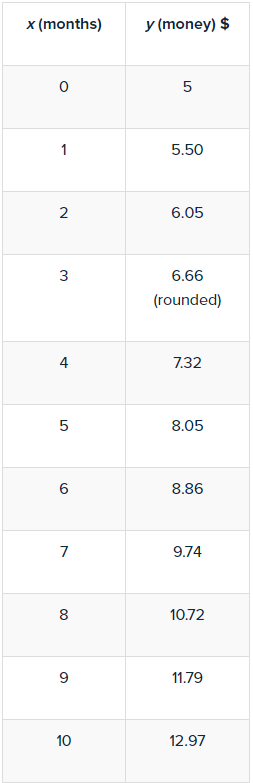
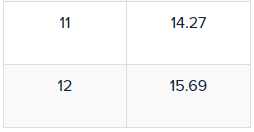
Equation: y = 5\((1.1)^x\)
"In our first case, our values grew by 0.50. Is that the situation here? Because we do not increase by the same value but rather by the same percentage, we must divide to determine how much we MULTIPLIED each time. 5.50/5 = 1.1. What term do we use to describe repeat multiplication?" (exponents)
"So our equation would be what if we started with $5 and kept multiplying by 1.1?"
“Let's make an exponential growth function graph using our table of values.”
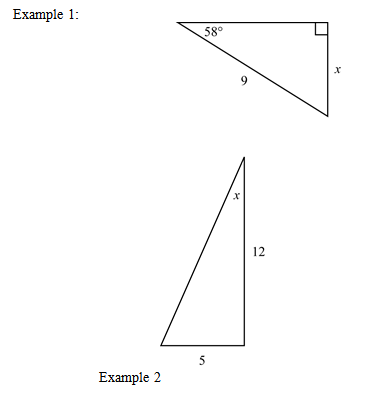
"We recently examined an exponential growth function. An exponential growth function can be written as y = a\(b^x\), where b > 1. The exponential decay function can be expressed as y = a\(b^x\), where 0 < b < 1."
"Here are two examples: y = .6\((3)^x\) and y = 10\((.41)^x\). These examples illustrate exponential growth and exponential decay, respectively."
Remind students to review the definitions of exponential growth and exponential decay in the vocabulary section.
Part 2
"Now that we've learned how to write the multipliers of percentage changes, let's revisit our first example. We began with $5 and were saving 10% per month. What was our multiplier?" (1.10) "We began with $5. To find out how much we have after one month, we multiply by 1.1, yielding $5.50. To calculate how much we will have in two months, multiply 5.50 by 1.1. The equation is y = 5(1.1)(1.1)(1.1) = 5\((1.1)^x\). The original value, or starting amount, is 5; the multiplier is 1.1. This is known as exponential growth."
Distribute copies of the Exponential Growth and Decay Notes (M-A2-4-3_Exponential Growth and Decay Notes and KEY) and fill them in with the whole class.
Have the following problems posted on the board. Students can write their replies on the back of their note sheets.
"Write an exponential equation for the following situations."
1. a car valued at $5,340 that depreciates 14% per year [y = 5340\((.86)^x\)]
2. an antique painting valued at $200 appreciates 9% a year [y = 200\((1.09)^x\)].
3. a bank account with $20.45 earns 4.5% interest a year [y = 20.45\((1.045)^x\)].
4. 100 grams of a radioactive isotope decreases 45% a year [y = 100\((.55)^x\)].
"Notice that in exponential decay scenarios, the integers representing b are less than one but bigger than zero. Also, take note that b is larger than 1 in exponential growth scenarios."
Part 3
"What if we were not provided the initial value or percentage rate and had to write the exponential equation? For example, suppose my savings account earns 5% interest per year, and after two years, I have $325 in it. How much money did I have in the beginning? (Write this information on the board and allow students some time to consider it. (One or two students could come up with it.) "What are we solving for?" (Initial value)
Ask if any students would like to present their thoughts or work on the board.
"We know the multiplier is 1.05. Since x indicates time, I will substitute 2 for x. Where should I substitute 325?" Discuss the equation with the students.
325 = a\((1.05)^2\) 325 = a(1.1025) a = 325 ÷ 1.1025 ≈ $294.78
"What if I knew I invested $300 originally and ended up with $358 after three years? What are we solving for now?" (multiplier)
Ask students how they would solve for the multiplier. Go through the steps together.
358 = 300\((b)^3\) 1.19 = \(b^3\) Cube root both sides or elevate both sides to the 13th power
b ≈ 1.06
Distribute the Exponential Growth and Decay Worksheet (M-A2-4-3_Exponential Growth and Decay Worksheet). Students can do this in pairs. Walk around and check their work; ask questions. See how they do when they get to the final three questions. If the class is stuck, bring them back together.
"What if there are two points on the graph and neither of them is the initial value? For example, suppose in a science experiment we found 220 bacteria after 2 days and 275 bacteria after 4 days. How many bacteria were there initially and at what rate are they growing?" (Ask students if they have any ideas about how to start the problem.)
"Let's create a table with the two points." Write on the board:
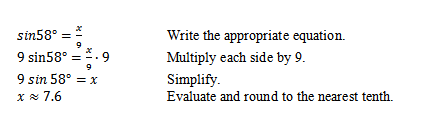
"Since we multiply exponentially, we divide 275 by 220. We receive 1.25. How many times did we use the multiplier to go from 2 to 4 days?" (twice)
"Since we multiplied a number twice, we must take the square root of 1.25 to obtain our multiplier. Our multiplier is at 1.118, which means the germs are increasing by what percentage per day?" (11.8%)
"Now how do we find the initial value?" (replace the multiplier in the equation with one of the given points.)
Allow students time to complete the task using what they know today.
Final Activity
Distribute the Lesson 3 Exit Ticket (M-A2-4-3_Lesson 3 Exit Ticket and KEY) to determine whether students comprehend the principles.
Extension:
1. Students will need a graphing calculator to complete this assignment. Distribute the Population Estimates spreadsheet and Stat Plot Instructions.
2. They can choose between national statistics and a specific state. Because the numbers are so large, the data appears more linear, but discuss with the class whatever form of function would be most appropriate. Does a population grow by the same number or percentage each year?
3. Have them respond to the following questions: What is the multiplier, and what does it mean in terms of population growth? What is the original value, and what does it represent? What number of years will it take for the population to double?

Exponential Growth and Decay (M-A2-4-3)
In this lesson, students will learn how to develop equations for exponential growth and decay. Students will:
- determine the multiplier for a percentage increase or decrease.
- develop equations for exponential growth or decay.
- calculate x and y using exponential equations.
- use their calculator to determine an exponential equation for a given data set.


