


























Views
Downloads

Essential Animal Cell Worksheet | Grades 5-7 Science
Paste this activity's link or code into your existing LMS (Google Classroom, Canvas, Teams, Schoology, Moodle, etc.).
Students can open and work on the activity right away, with no student login required.
You'll still be able to track student progress and results from your teacher account.
This Grade 5-7 science worksheet provides a comprehensive introduction to animal cell biology through a relatable city analogy. Students analyze a detailed diagram and reading passage to identify key organelles and their specific roles in maintaining cellular life. It transforms abstract biological concepts into concrete, memorable functions for middle school learners.
At a Glance
- Grade: 5-7 · Subject: Science
- Standard:
MS-LS1-2— Model how cell parts contribute to the function of the whole cell- Skill Focus: Organelle Structure and Function
- Format: 2 pages · 11 problems · Answer key included · PDF
- Best For: Independent practice or sub plans
- Time: 25–35 minutes
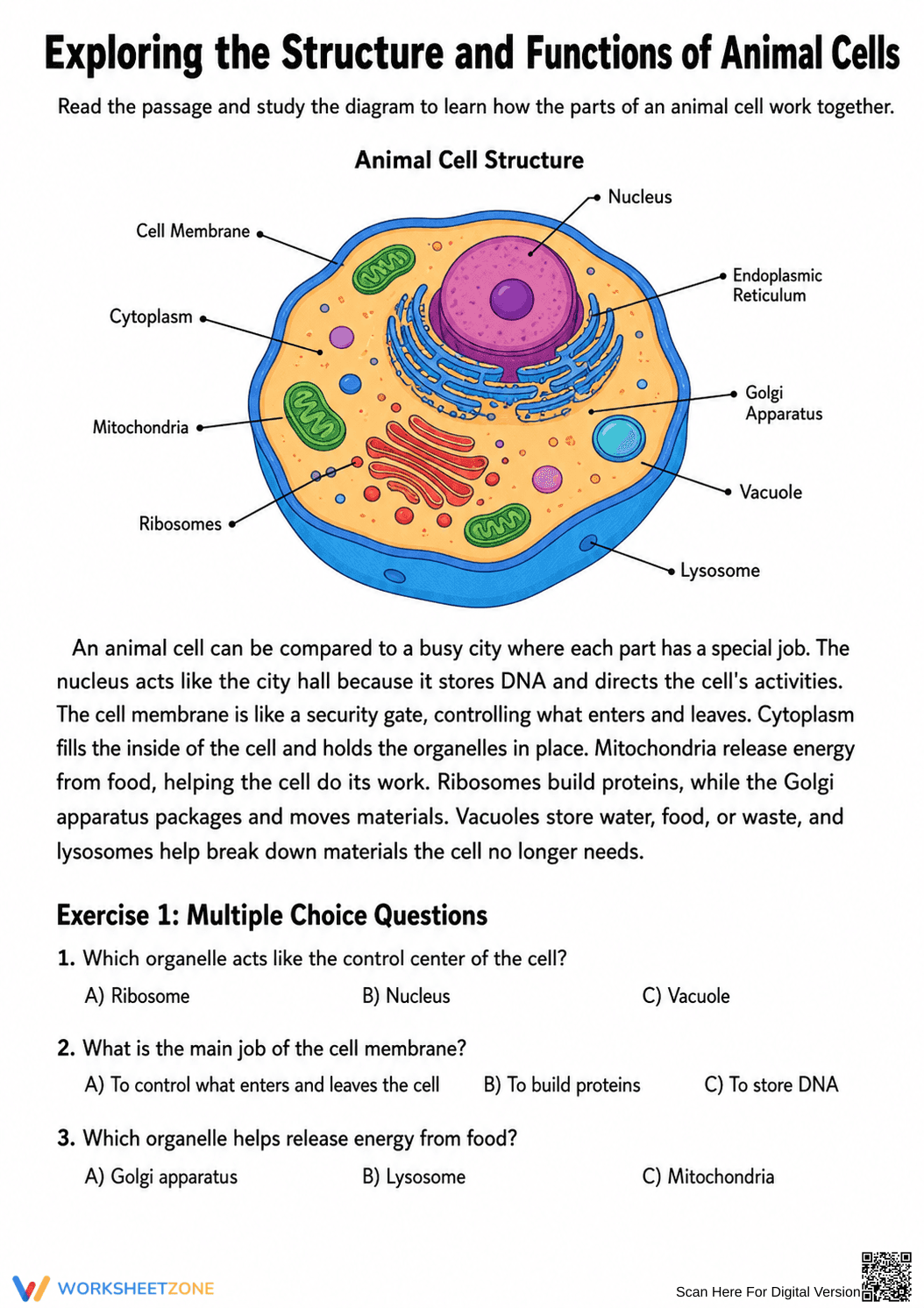
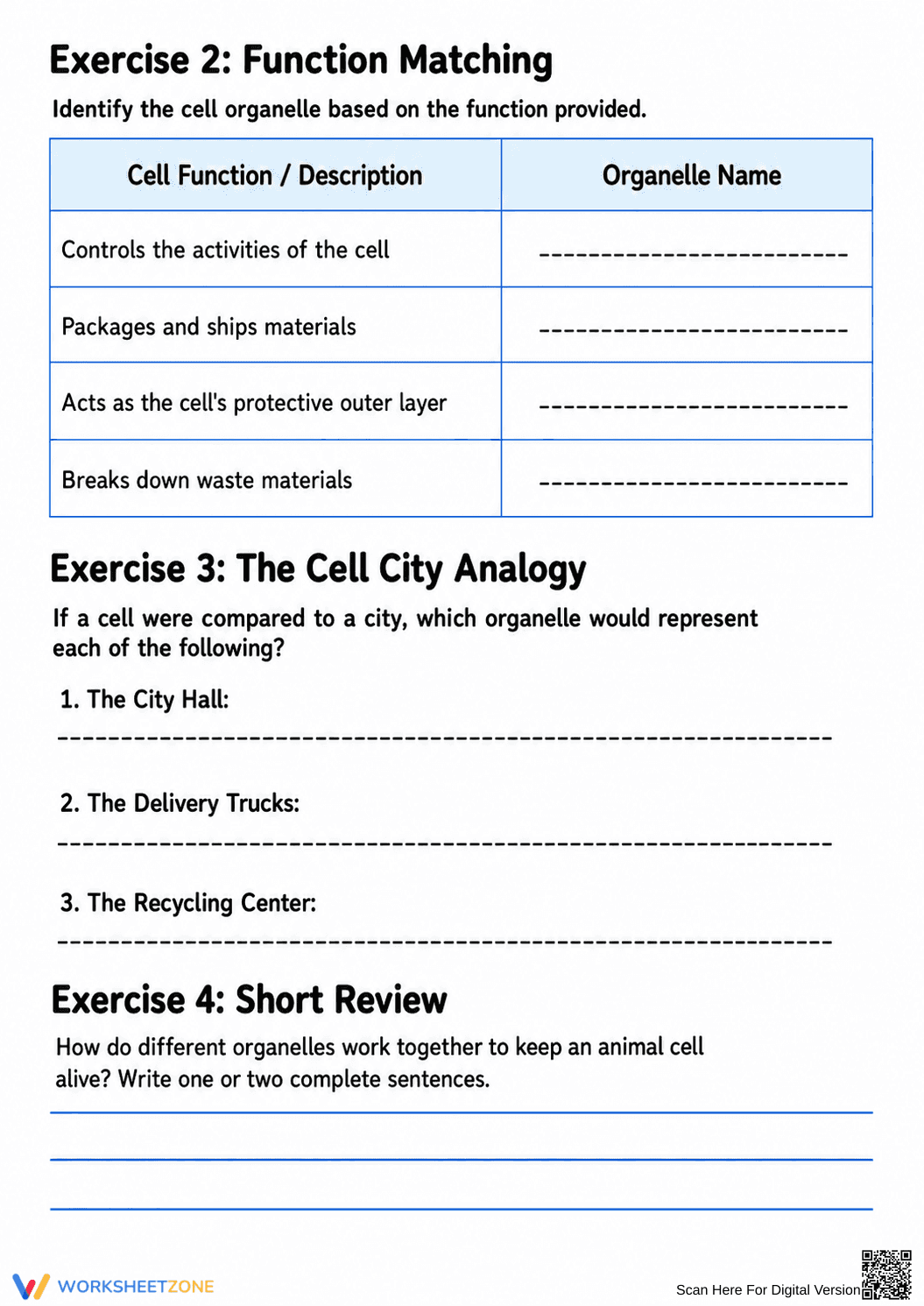
The two-page PDF includes a high-resolution labeled diagram of an animal cell and a descriptive passage using the "Cell City" analogy. It features four distinct exercise sections: three multiple-choice questions for quick checks, a four-item function matching table, three analogy-based application questions, and a short-response review section to synthesize learning.
This resource is designed for immediate classroom implementation with a total teacher prep time of under 2 minutes. Simply print the two-page document and distribute it to students for a 30-minute independent work block. The self-contained reading passage ensures students can review the material and complete the 11 tasks without additional lecture or external research, making it a perfect emergency sub plan.
Standards Alignment: Primary standard `MS-LS1-2`: "Develop and use a model to describe the function of a cell as a whole and ways parts of cells contribute to the function." This worksheet uses the city analogy as a conceptual model to help students visualize how individual organelles like the nucleus and mitochondria support the entire system. Both standard codes can be copied directly into lesson plans, IEP goals, or district curriculum mapping tools.
Use this worksheet as a formative assessment after an initial lecture on cell biology to gauge student understanding of organelle roles. Alternatively, assign it as a "no-prep" sub plan where students can work through the reading and exercises independently. Monitor student progress by checking if they can correctly map the "City Hall" analogy to the nucleus during the Exercise 3 section. Expected completion time is 25 to 35 minutes.
This resource is ideal for upper elementary and middle school science teachers, homeschooling parents, and ESL students who benefit from the visual support of the labeled diagram. It pairs naturally with a cell-building project or an interactive digital microscope lab for a complete unit on life science.
According to Fisher & Frey (2014), the use of analogies in science education significantly bridges the gap between abstract microscopic processes and student prior knowledge. This worksheet aligns with the MS-LS1-2 standard by requiring students to model the animal cell as a functional system where parts like the cell membrane and ribosomes have interdependent roles. Research from the RAND AIRS 2024 report suggests that structured, reading-based science tasks with immediate application exercises improve long-term retention of biological vocabulary. By engaging with 11 targeted tasks across two pages, students move from basic identification to higher-order conceptual mapping. This resource provides a reliable, evidence-based framework for introducing cellular biology in Grades 5 through 7, ensuring that learners can articulate how organelles work together to keep an animal cell alive.


