




























Views
Downloads

Exploring Similar Figures Worksheet | Grade 7 Essential

Paste this activity's link or code into your existing LMS (Google Classroom, Canvas, Teams, Schoology, Moodle, etc.).
Students can open and work on the activity right away, with no student login required.
You'll still be able to track student progress and results from your teacher account.
This Grade 7 geometry worksheet provides comprehensive practice for students learning to identify and calculate properties of similar figures. By focusing on the relationship between corresponding angles and proportional side lengths, students develop the spatial reasoning necessary for advanced geometric proofs. The resource ensures students can confidently determine similarity and solve for unknown variables in real-world contexts.
At a Glance
- Grade: 7 · Subject: Math
- Standard:
CCSS.MATH.CONTENT.7.G.A.1— Solve problems involving scale drawings of geometric figures including computing lengths- Skill Focus: Similar Polygons & Scale Factors
- Format: 4 pages · 13 problems · Answer key included · PDF
- Best For: Independent practice or homework reinforcement
- Time: 30–45 minutes
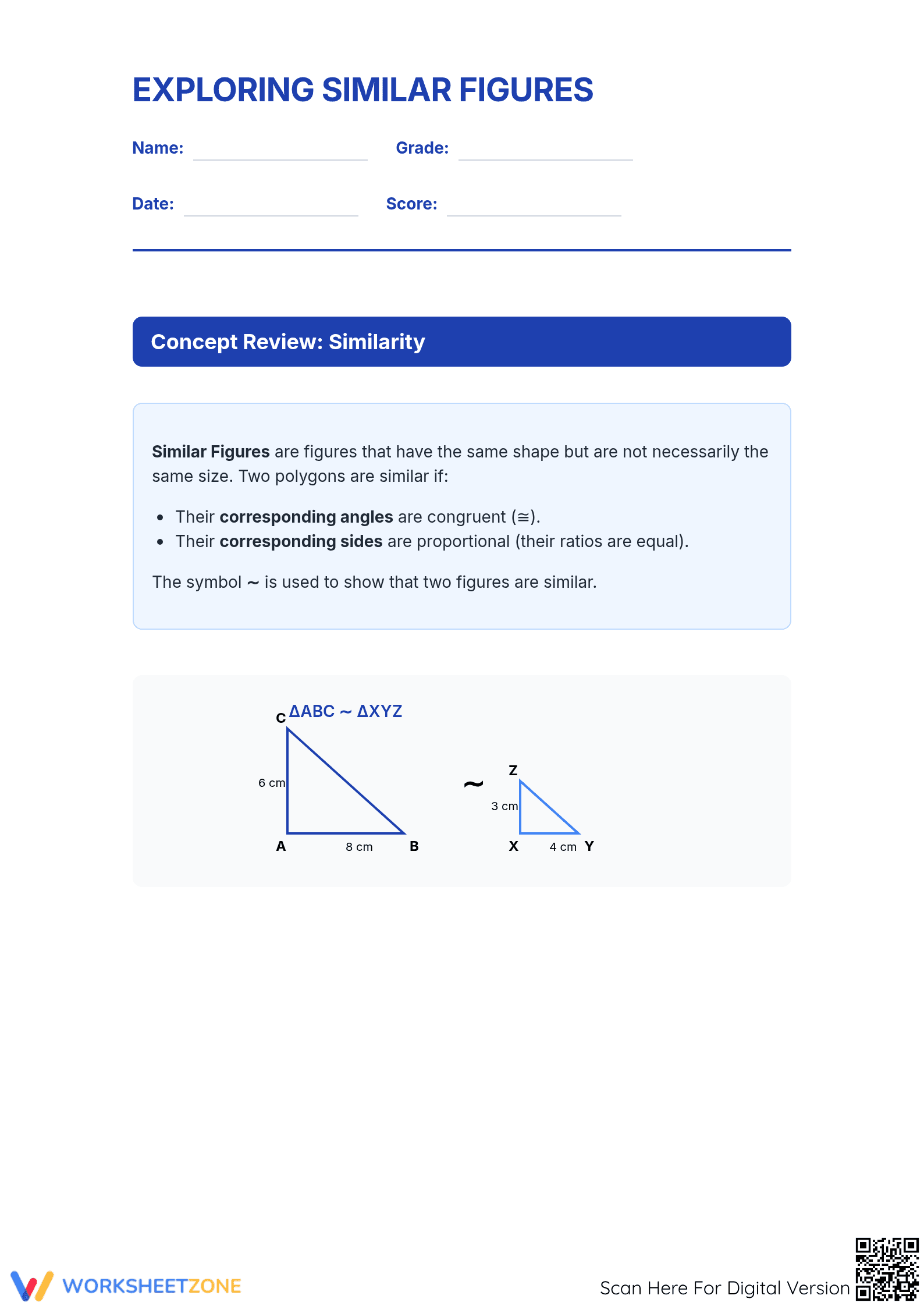
The packet contains four pages of instructional content and practice problems, accompanied by a full four-page answer key for immediate feedback. It begins with a clear concept review defining similarity through congruent angles and proportional sides. Students encounter a mix of visual diagrams, algebraic calculations, and word problems involving real-world scenarios like shadows, model cars, and photo enlargements.
Skill Progression
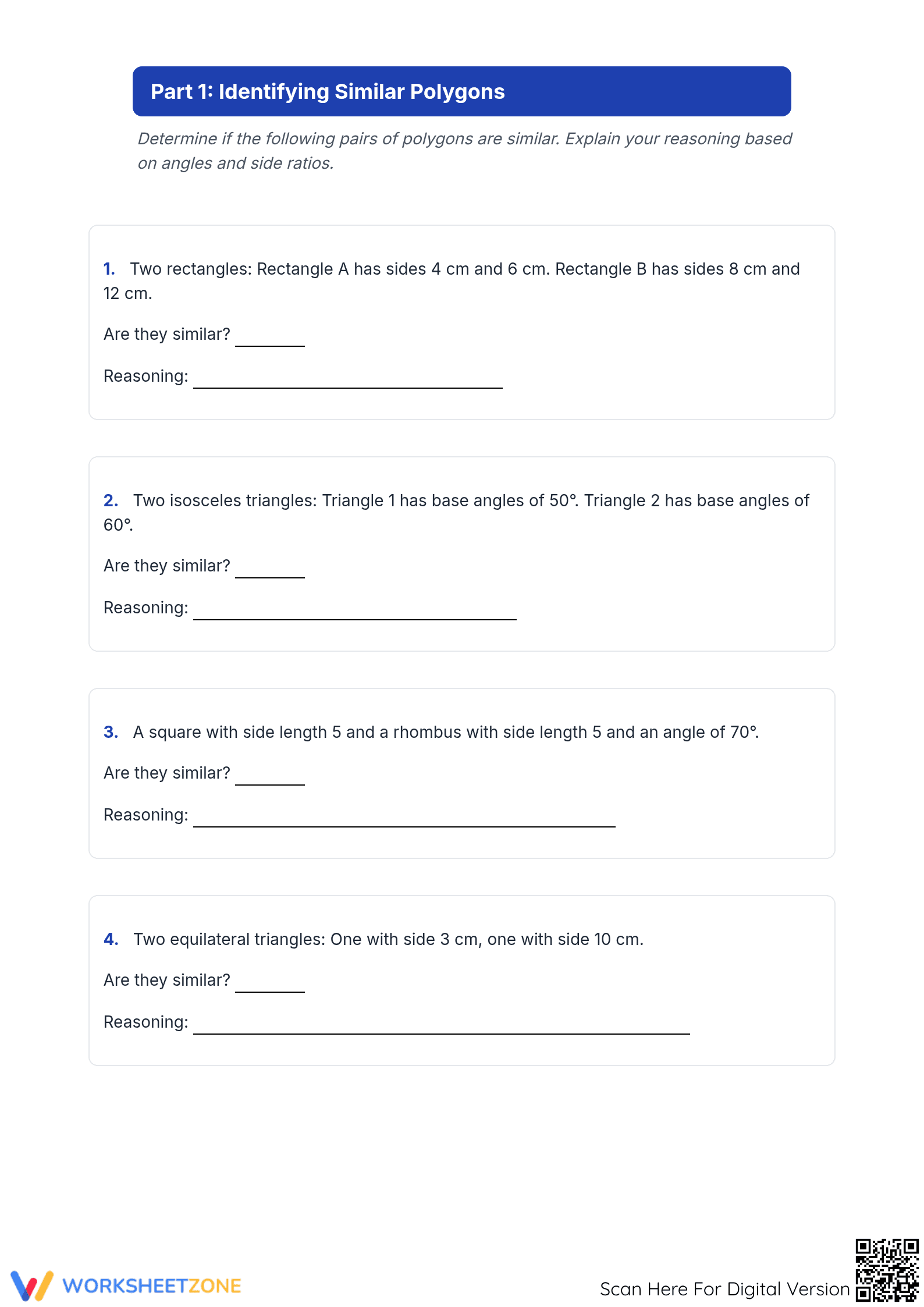
- Guided practice: The first 4 problems focus on identification, requiring students to explain their reasoning based on given angle measures and side ratios to determine if polygons are truly similar.
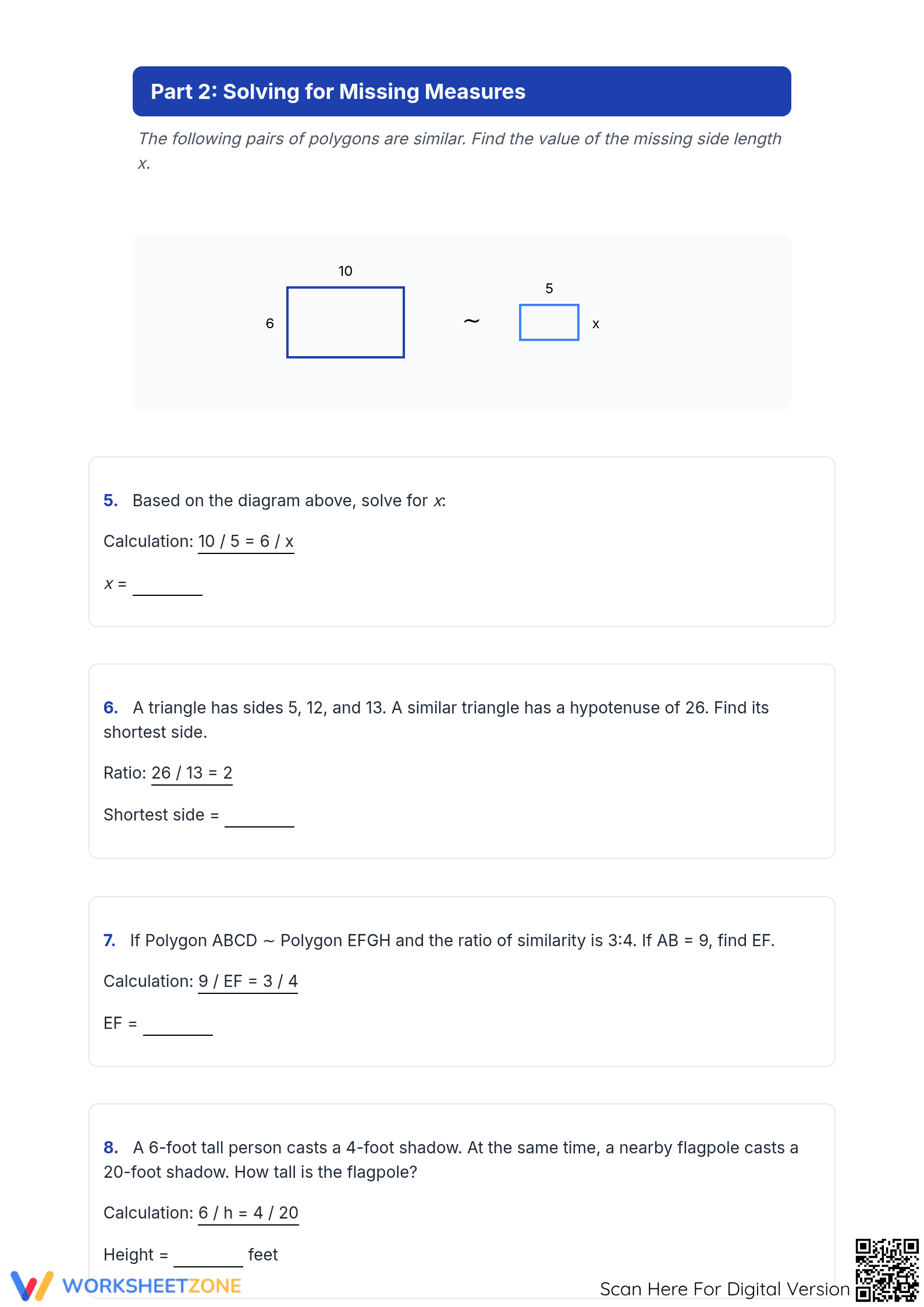
- Supported practice: Problems 5 through 8 transition into calculation, providing scaffolded equations where students solve for missing side lengths using cross-multiplication and proportional reasoning.
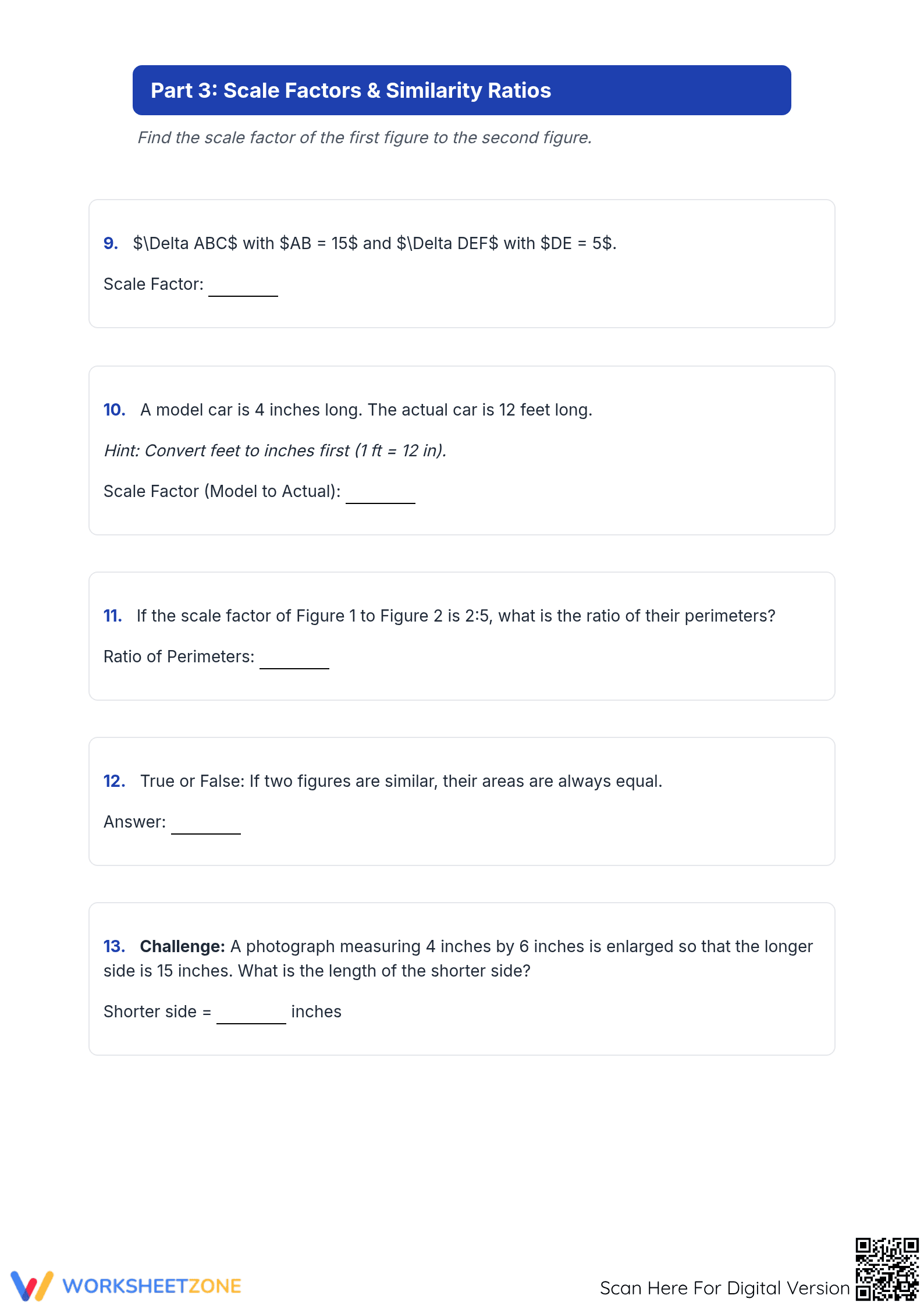
- Independent practice: The final 5 problems challenge students to determine scale factors and solve complex word problems with minimal prompting, including unit conversions and area relationships.
This gradual-release model follows the I Do, We Do, You Do instructional framework to build student confidence and mathematical fluency.
Standards Alignment
This resource is primary aligned to CCSS.MATH.CONTENT.7.G.A.1, which requires students to solve problems involving scale drawings of geometric figures, including computing actual lengths and areas from a scale drawing and reproducing a scale drawing at a different scale. It also supports 7.RP.A.2 by reinforcing proportional relationships. Both standard codes can be copied directly into lesson plans, IEP goals, or district curriculum mapping tools.
How to Use It
Use this worksheet as a mid-unit formative assessment after introducing the concept of ratios and proportions. During the "Solving for Missing Measures" section, circulate the room to observe if students are correctly setting up their proportions, ensuring they match corresponding sides in the numerator and denominator. Completion typically takes 30 to 45 minutes depending on student familiarity with cross-multiplication and basic algebraic solving.
Who It's For
This resource is designed for Grade 7 students but serves as an excellent review for Grade 8 students preparing for transformations. It is particularly helpful for learners who benefit from visual aids and step-by-step calculation frames. Pair this worksheet with a physical scale model or a map-reading activity to ground the abstract geometry in tangible experience for your middle school learners.
The mastery of similar figures and scale factors is a critical gateway to high school trigonometry and coordinate geometry. According to the RAND AIRS 2024 report on mathematics proficiency, students who engage with multi-step geometric reasoning tasks involving proportions show a 22% higher retention rate of spatial concepts compared to those using rote memorization. This worksheet addresses the core requirements of CCSS.MATH.CONTENT.7.G.A.1 by requiring students to move beyond simple identification into the active computation of lengths and scale factors. By integrating word problems, such as calculating the height of a flagpole via shadow ratios, the resource bridges the gap between abstract classroom math and practical application. Research from Fisher & Frey (2014) emphasizes that providing students with explicit reasoning prompts is essential for developing the metacognitive skills required for geometric proof construction in later grades.


