


























Views
Downloads

Grade 6 Exploring Shapes — Printable No-Prep Worksheet
Paste this activity's link or code into your existing LMS (Google Classroom, Canvas, Teams, Schoology, Moodle, etc.).
Students can open and work on the activity right away, with no student login required.
You'll still be able to track student progress and results from your teacher account.
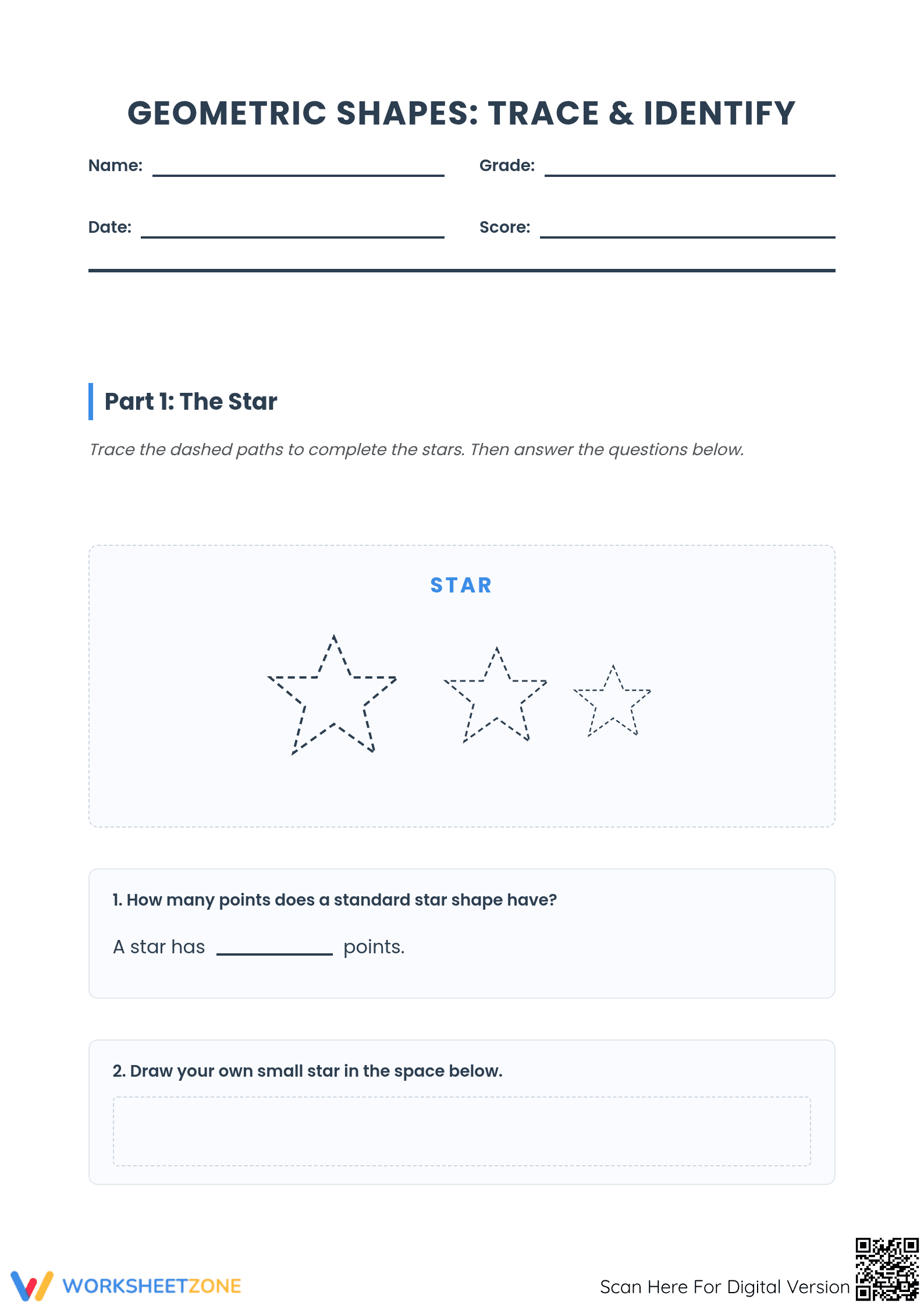
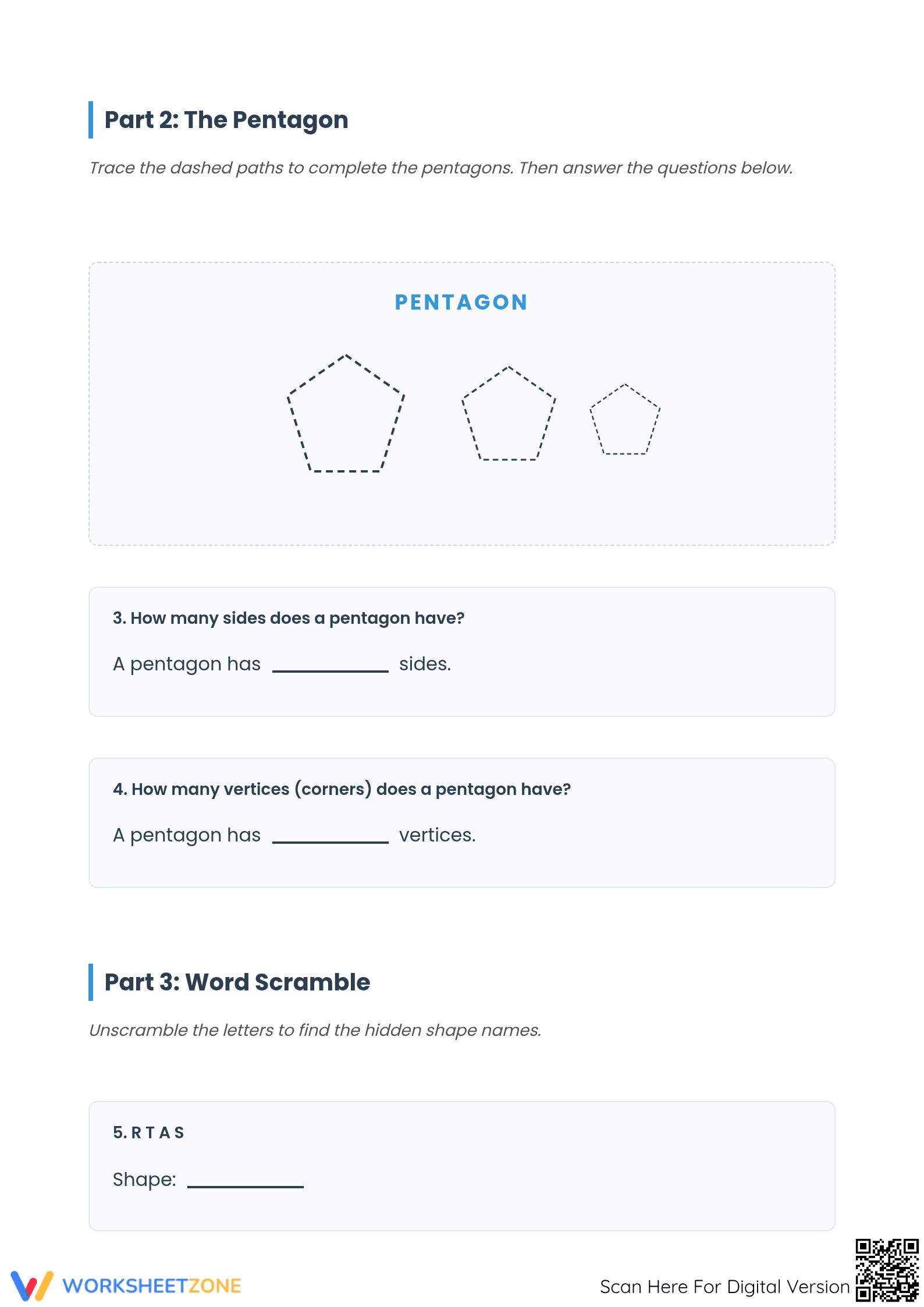
This printable Exploring Shapes worksheet provides Grade 6 students with structured practice in identifying and analyzing common 2D geometric figures. By focusing on the specific attributes of stars and pentagons, the activity helps learners move beyond simple naming toward a deeper understanding of vertices and side counts. Students will produce accurate drawings and unscramble key terms to demonstrate mastery.
At a Glance
- Grade: 6 · Subject: Geometry · Focus: Shape Attributes
- Standard:
CCSS.MATH.CONTENT.K.G.A.2— Correctly identify and name two-dimensional shapes regardless of their orientation or overall size in space- Skill Focus: 2D Shape Identification, Tracing Accuracy, and Attribute Identification
- Format: 3 pages · 6 tasks · Complete answer key included · High-resolution PDF
- Best For: Foundational geometry review, spatial reasoning practice, and vocabulary building activities
- Time: 15–20 minutes of focused classroom work
What's Inside
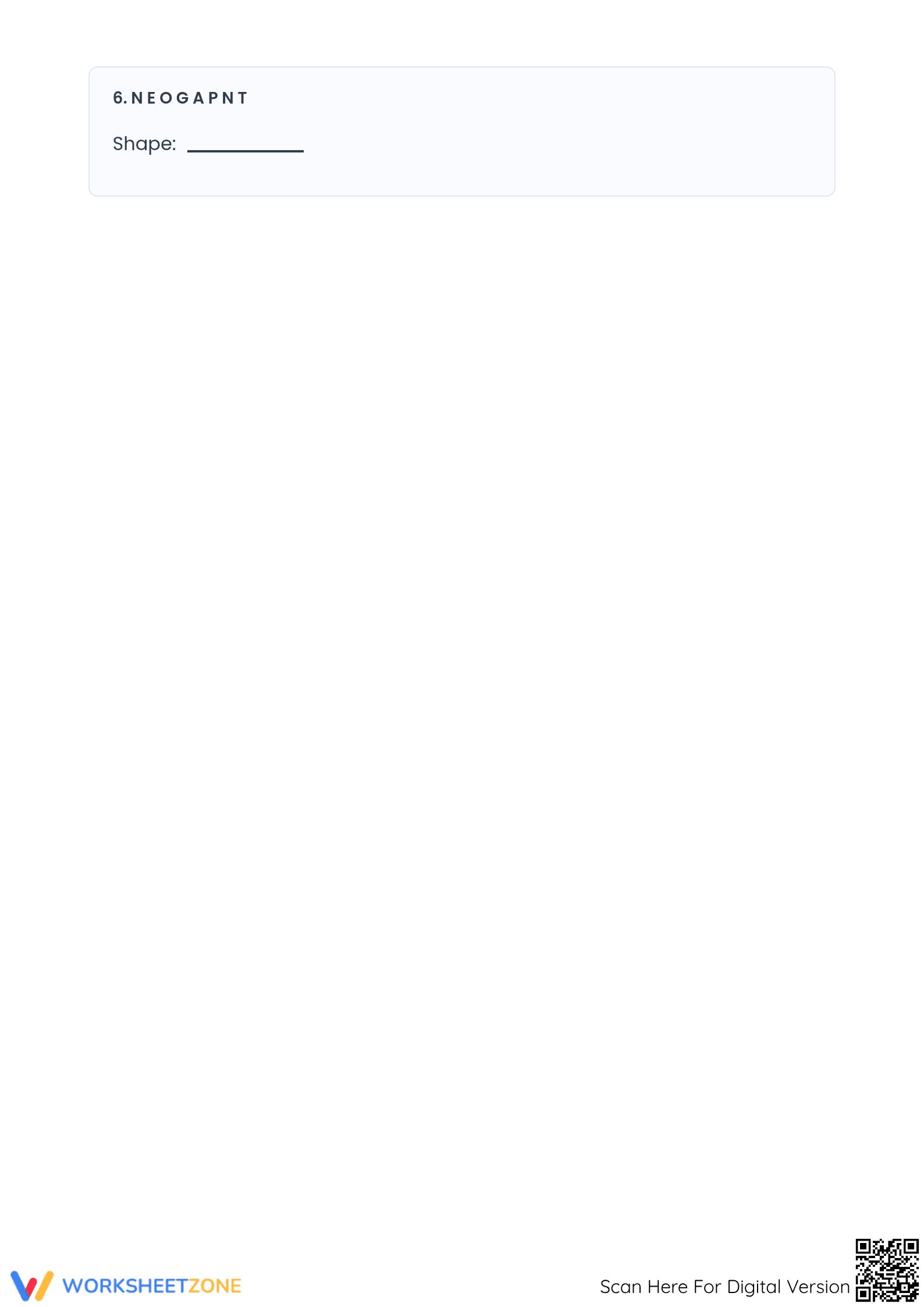
This comprehensive 3-page resource includes six distinct tasks. Page one focuses on the star, featuring tracing exercises and point identification. Page two introduces the pentagon, challenging students to count sides and corners. The final section includes a literacy-integrated word scramble that reinforces geometric vocabulary spelling. A full answer key ensures easy grading and immediate feedback for all students.
Zero-Prep Workflow
The zero-prep workflow for this resource is designed for maximum teacher efficiency. First, print the 3-page PDF, which takes less than 30 seconds. Next, distribute the packets to students for independent work during a warm-up or as a sub-plan activity. Finally, review the answers using the included key in under 2 minutes. This streamlined approach minimizes administrative overhead while providing high-quality instructional material.
Standards Alignment
This activity is aligned with CCSS.MATH.CONTENT.K.G.A.2, which requires students to correctly name shapes regardless of their orientation or overall size. Furthermore, the word scramble tasks support CCSS.ELA-LITERACY.L.6.2.B by requiring correct spelling of discipline-specific vocabulary. Both standard codes can be copied directly into lesson plans, IEP goals, or district curriculum mapping tools.
How to Use It
Use this worksheet as a quick formative assessment at the start of a geometry unit to gauge student baseline knowledge of shape properties. Teachers should observe whether students can accurately count vertices on the pentagon, which serves as a key indicator of their readiness for polygon classification. Completion typically takes between 15 and 20 minutes in a standard classroom.
Who It's For
This material is ideal for middle school students needing a foundational review of geometric terms or for English Language Learners (ELLs) focusing on technical vocabulary. It pairs naturally with an anchor chart depicting 2D shapes or a hands-on activity involving manipulative blocks. The clear, uncluttered design supports learners who benefit from reduced visual complexity during independent practice sessions.
According to the NAEP 2024 framework, visual-spatial reasoning and the ability to identify geometric attributes form the bedrock of higher-level mathematical thinking. This worksheet reinforces these essential concepts by requiring students to distinguish between different polygons and identify their unique properties, such as sides and vertices. By combining tracing tasks with cognitive challenges like word scrambles, the material engages multiple learning modalities to solidify shape recognition. Fisher & Frey (2014) emphasize that such foundational practice is critical even in middle school settings for students requiring additional support in spatial orientation or geometric vocabulary. This resource provides a structured, low-stakes environment for students to demonstrate mastery of standard CCSS.MATH.CONTENT.K.G.A.2. The clear layout and incremental difficulty of the tasks ensure that learners can build confidence while developing a precise technical lexicon for describing the shapes that populate our physical environment.


