


























The components of literary nonfiction will be examined by the students. Students are able to:
- Determine the character, story, setting, and theme elements in literary nonfiction.
- Enumerate the ways that fiction and literary nonfiction are comparable.
- How can literary and factual texts become meaningful to strategic readers?
- How does interaction with text provoke thinking and response?
- Biography: The story of a person’s life written by someone other than the subject of the work.
- Characterization: The method an author uses to reveal characters and their various personalities.
- Literary Elements: The essential techniques used in literature (e.g., characterization, setting, plot, theme).
- Literary Nonfiction: Text that includes literary elements and devices usually associated with fiction to report on actual persons, places, or events. Examples include nature and travel writing, biography, memoir, and essay.
- Plot: The structure of a story. The sequence in which the author arranges events in a story. The structure often includes the problem, the rising action, the climax, the falling action, and the resolution. The plot may have a protagonist who is opposed by an antagonist, creating what is called conflict.
- Setting: The time and place in which a story unfolds.
- Theme: A topic of discussion or writing; a major idea broad enough to cover the entire scope of a literary work.
- Mordicai Gerstein. (2007). The Man Who Walked Between the Towers. Square Fish.
Additional biographies were chosen for the same reason. Examples include the following:
- Lynne Cheney. (2012). When Washington Crossed the Delaware: A Wintertime Story for Young Patriots. Simon & Schuster.
- Barbara Kerley. (2008). What to Do About Alice? Scholastic.
- Jonah Winter. (2009). You Never Heard of Sandy Koufax? Schwartz & Wade.
- Jen Bryant. (2008). A River of Words: The Story of William Carlos Williams. Eerdmans Books for Young Readers.
- David A. Adler. (2000). A Picture Book of George Washington Carver. Holiday House.
- Peter Sís. (2007). The Wall: Growing Up Behind the Iron Curtain. Farrar, Straus and Giroux.
- Nikki Giovanni. (2007). Rosa. Square Fish.
- Elizabeth Matthews. (2007). Different Like Coco. Candlewick Press.
- Jean Fritz’s biography books (approximately three copies of each book). Puffin or Putnam Juvenile, such as the following:
- What’s The Big Idea, Ben Franklin? (1996).
- Why Don’t You Get a Horse, Sam Adams? (1996).
- Bully for You, Teddy Roosevelt. (1997).
- And Then What Happened, Paul Revere? (1996).
- Can’t You Make Them Behave, King George? (1996).
- Leonardo’s Horse. (2001).
- Traitor: The Case of Benedict Arnold. (1997).
- Teachers may substitute other books to provide a range of reading and level of text complexity.
- Elements of Literary Nonfiction graphic organizer (L-5-2-2_Elements of Literary Nonfiction)
- chart paper
- Maintaining a thorough comprehension of literary nonfiction text structures as the main goal of the class. - Observe students as they read the biographies and notice which pupils appear to be struggling to identify literary characteristics.
- Utilize the checklist below to assess pupils' comprehension:
+ Students name the primary characters in a work of literary nonfiction.
+ Students recognize the location of a literary nonfiction text.
+ Students identify the elements of a literary nonfiction text's plot, such as the conflict, rising action, climax, falling action, and resolution.
+ Students identify the literary nonfiction text's theme, whether it is mentioned explicitly or not.
Active Participation and Clear Instruction
W: Go over the literary components of character, plot, place, and theme with students to help them activate their prior understanding of fictional text structures.
H: To practice recognizing literary components, assign students to listen to the literary nonfiction biography The Man Who Walked Between the Towers.
E: Ask pupils to point out literary devices in different biographies.
R: Give students the chance to work in small groups to find examples of literary nonfiction features in biographies to expand their understanding of these elements.
E: Assign students to apply their knowledge of literary nonfiction and fiction to draw the conclusion that both have a similar structure.
T: Use texts with varying degrees of difficulty and provide students the chance to work both individually and in small groups to deepen their comprehension of the elements of literary nonfiction, which act as a framework for both literary nonfiction and fiction.
O: This lesson's learning exercises include large-group instruction and discussion, small-group inquiry, pair work, and individual application of the material.
Topic: How do writers employ structure and craft in their literary nonfiction writing?
Part I
Examine the fiction's literary components. To find out what the children know about the following elements, ask them to brainstorm. Write down the pupils' answers on the chart paper.
character: the story's subject, narrator, or person
plot: the things that happen in the narrative
problem or conflict: the issue that the person is dealing with
rising action: complex situations that build suspense and tension
climax: the moment in the narrative where things take a turn for the better or worse
falling action: the situation just before a conclusion is reached
resolution: the process of dissecting or deciphering the issue to determine if it can be resolved or not.
setting: the place and time of the narrative
theme: the primary notion or subtextual message, either explicitly expressed or suggested
On chart paper, sketch the plot triangle as follows: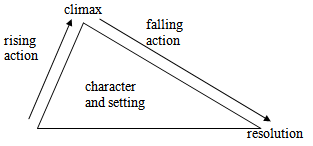
Review the many components of a plot with "The Three Little Pigs":
Issue/conflict: The wolf desires to consume the pigs.
expanding action: The pigs move out. Every pig constructs a unique kind of home. Wolf decimates the first two houses.
climax: Unable to destroy the third pig's home, the wolf becomes enraged. He slides down the fireplace. The pigs deceive the wolf, who is subsequently brought to death in a water kettle.
falling action: No harm to the pigs.
Conclusion: The pigs lead contented lives for all time.
Say, "When writing fictitious novels, authors utilize character, story, setting, and topic. These components are also utilized in literary nonfiction, which is what biography will be studying."
Read The Man Who Walked Between the Towers biography out loud. Show students how to fill out the Elements of Literary Nonfiction graphic organizer (L-5-2-2_Elements of Literary Nonfiction) after you've finished reading the narrative. Below are the solutions to the graphic organizer.
Character: Philippe Petit, a French aerialist
Plot:
conflict: It was against the law for Philippe to try to balance between the Twin Towers on a tightrope.
rising action:
After dressing up as construction workers, Philippe and his buddies moved all of the equipment to the top of the buildings around dusk.
Despite some difficulties, Philippe and his pals finished the equipment setup in plenty of time.
Climax: After spending hours walking, dancing, and pulling off tricks over the tightrope, Philippe is taken into custody.
Falling action: The judge gave Philippe an order to perform in the park for the children of the city.
Resolution: The judge's ruling pleased Philippe.
Scene: The World Trade Center in New York City, August 7, 1974.
Theme: Achieve your goals.
Part 2
Have small groups use the biographies listed in Materials, or others of your choice, to identify nonfiction literary elements. Give each group a copy of the Elements of Literary Nonfiction graphic organizer (L-5-2-2_Elements of Literary Nonfiction).
Say, “Find a biography to read as a group. Then work together to complete the graphic organizer.”
Encourage students to share their biographies in a large-group conversation by summarizing the significant events they noted on their visual organizers when they have finished reading their books and completing the organizer.
Assist pupils in identifying parallels between literary nonfiction and fiction aspects. Ask, "What similarities exist between the text structures of literary nonfiction and fiction? Using "The Three Little Pigs" as an example and the biography "The Man Who Walked Between the Towers," have a conversation with a companion." Help students understand that the components of character, story, setting, and topic serve as the framework for both literary nonfiction and fiction.
Give each student an Elements of Literary Nonfiction graphic organizer to complete on their own. They can use a biography of their choice or one of the books by Jean Fritz that are listed in the materials.
Extension:
For students in need of more learning opportunities, consult the biographies found under Related Resources. Help students recognize the components of literary nonfiction and understand how the structure of the text is derived from these parts.
For students who are prepared to go above and beyond, assign them to read one of the biographies found under Related Resources and then write a bio-poem on the biography's topic. Instruct students to follow the guidelines for the bio-poem below.
Bio-poem
Line 1: the first name of the topic (character)
Line 2: three or four descriptive adjectives for the topic
Line 3: a significant issue the topic is facing (conflict)
Line 4: three or four significant occurrences that hinder the subject from realizing their objective or dream (rising action)
Line 5: the pivotal moment (climax) in the subject's life
Line 6: achievements (resolution)
Line 7: the message that the topic or the author's point of view conveys (the theme may be mentioned directly or indirectly).
Line 8: the subject's home (location)
Line 9: Last name of the subject

Exploring Craft and Structure in Literary Nonfiction (L-5-2-2)
The components of literary nonfiction will be examined by the students. Students are able to:
- Determine the character, story, setting, and theme elements in literary nonfiction.
- Enumerate the ways that fiction and literary nonfiction are comparable.


