


























Views
Downloads


Evaluating Expressions Worksheet | Grade 5 Printable
Paste this activity's link or code into your existing LMS (Google Classroom, Canvas, Teams, Schoology, Moodle, etc.).
Students can open and work on the activity right away, with no student login required.
You'll still be able to track student progress and results from your teacher account.
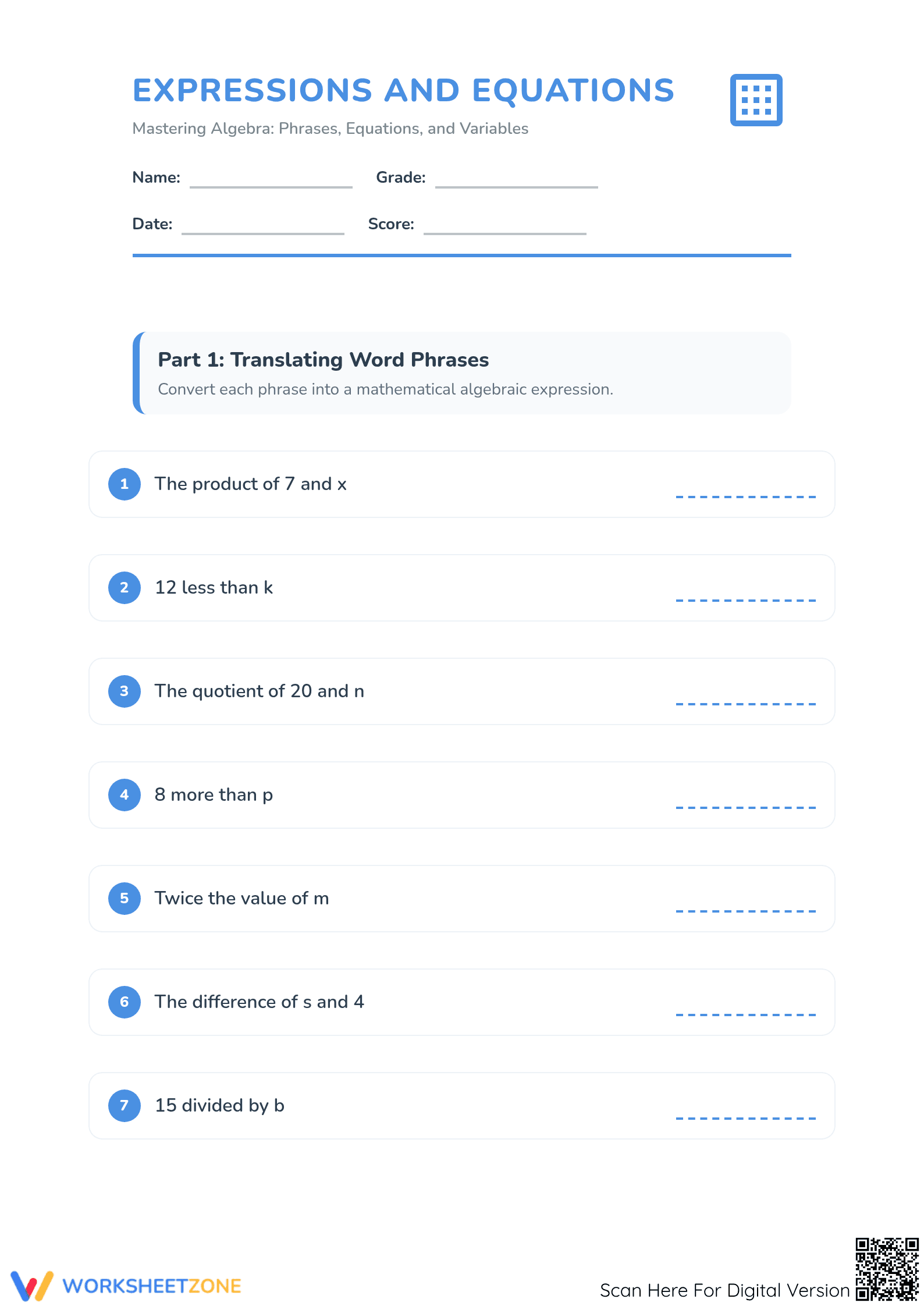
This Grade 5 algebraic expressions worksheet provides a comprehensive framework for students to master the transition from verbal phrases to mathematical notation. By engaging with 25 distinct tasks, learners develop the fluency required to evaluate expressions and solve one-step equations. This resource ensures students can confidently interpret variables as placeholders for numerical values.
At a Glance
- Grade: 5 · Subject: Math
- Standard:
CCSS.MATH.CONTENT.6.EE.A.2— Write, read, and evaluate expressions in which letters stand for numbers- Skill Focus: Algebraic Translation and Solving
- Format: 4 pages · 25 problems · Answer key included · PDF
- Best For: Introduction to algebraic thinking and variables
- Time: 30–45 minutes
This four-page PDF contains a structured progression of algebraic concepts. Part 1 features 10 translation exercises where students convert word phrases into symbols. Part 2 offers 10 equations for students to solve for a specific variable. Part 3 includes 4 real-world matching word problems, and Part 4 challenges students to create their own algebraic phrase. A full answer key is provided for immediate feedback.
Skill Progression
- Guided practice: The first 10 problems focus on vocabulary acquisition, helping students identify keywords like "product" and "quotient" to build expressions.
- Supported practice: The middle section provides 10 equations with clear workspaces, allowing students to apply inverse operations to isolate variables.
- Independent practice: The final sections require students to map real-world scenarios to equations and synthesize their learning by generating original algebraic content.
This gradual-release model moves students from basic recognition to higher-order application using an I Do, We Do, You Do approach.
Standards Alignment
The primary focus is `CCSS.MATH.CONTENT.6.EE.A.2`, which requires students to evaluate expressions at specific values of their variables. While designed for Grade 5 enrichment, it also supports the conceptual foundations of algebraic notation. Both standard codes can be copied directly into lesson plans, IEP goals, or district curriculum mapping tools.
How to Use It
Use this worksheet as a formative assessment after a direct instruction lesson on variables. Teachers can observe students during Part 1 to identify misconceptions regarding subtraction order in word phrases. It also serves as an excellent independent practice packet or a structured homework assignment. Expect completion within 30 to 45 minutes depending on student familiarity with inverse operations.
Who It's For
This resource is ideal for Grade 5 students beginning their algebra journey or Grade 6 students requiring a review of expression evaluation. It is particularly helpful for English Language Learners who need practice with mathematical academic language. Pair this with a classroom anchor chart detailing operation keywords for maximum instructional impact.
According to the RAND AIRS 2024 report, the early introduction of algebraic notation in upper elementary grades is a critical predictor of success in secondary mathematics. This worksheet aligns with the Fisher & Frey (2014) gradual release of responsibility framework by scaffolding the transition from linguistic phrases to symbolic logic. By requiring students to not only solve equations but also translate and create them, the resource addresses the depth of knowledge necessary for mastery of CCSS.MATH.CONTENT.6.EE.A.2. Research from EdReports 2024 suggests that high-quality instructional materials must bridge the gap between concrete arithmetic and abstract algebraic reasoning. This 25-task set provides the repetitive, structured practice needed to internalize the role of variables. By integrating word problem matching, the worksheet ensures that students see algebra as a tool for modeling real-world situations rather than just isolated symbol manipulation.


