


























Views
Downloads

Essential Powers and Exponents Practice Worksheet | Grade 8
Paste this activity's link or code into your existing LMS (Google Classroom, Canvas, Teams, Schoology, Moodle, etc.).
Students can open and work on the activity right away, with no student login required.
You'll still be able to track student progress and results from your teacher account.
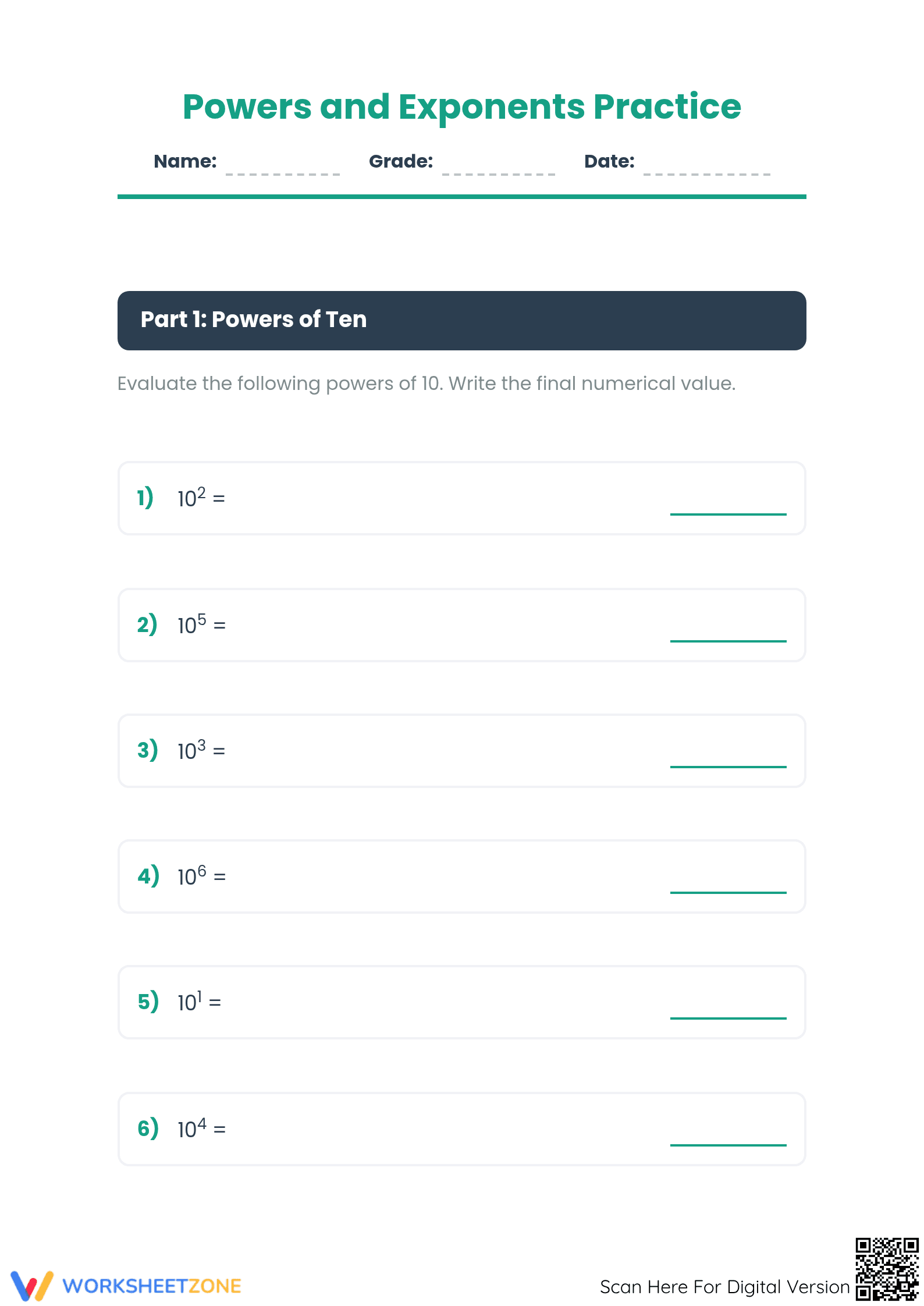
Master exponential notation with this Grade 8 math worksheet. Designed for procedural fluency, this resource guides students through powers of ten, negative bases, and rational bases with fractions or decimals. By solving 36 structured problems, learners develop a deep understanding of exponent properties essential for higher-level algebraic success.
At a Glance
- Grade: 8 · Subject: Math
- Standard:
CCSS.MATH.CONTENT.8.EE.A.1— Evaluate numerical expressions involving integer exponents with whole, negative, and rational bases.- Skill Focus: Exponent Evaluation & Comparison
- Format: 5 pages · 36 problems · Answer key included · PDF
- Best For: Independent practice and formal formative assessment
- Time: 30–45 minutes
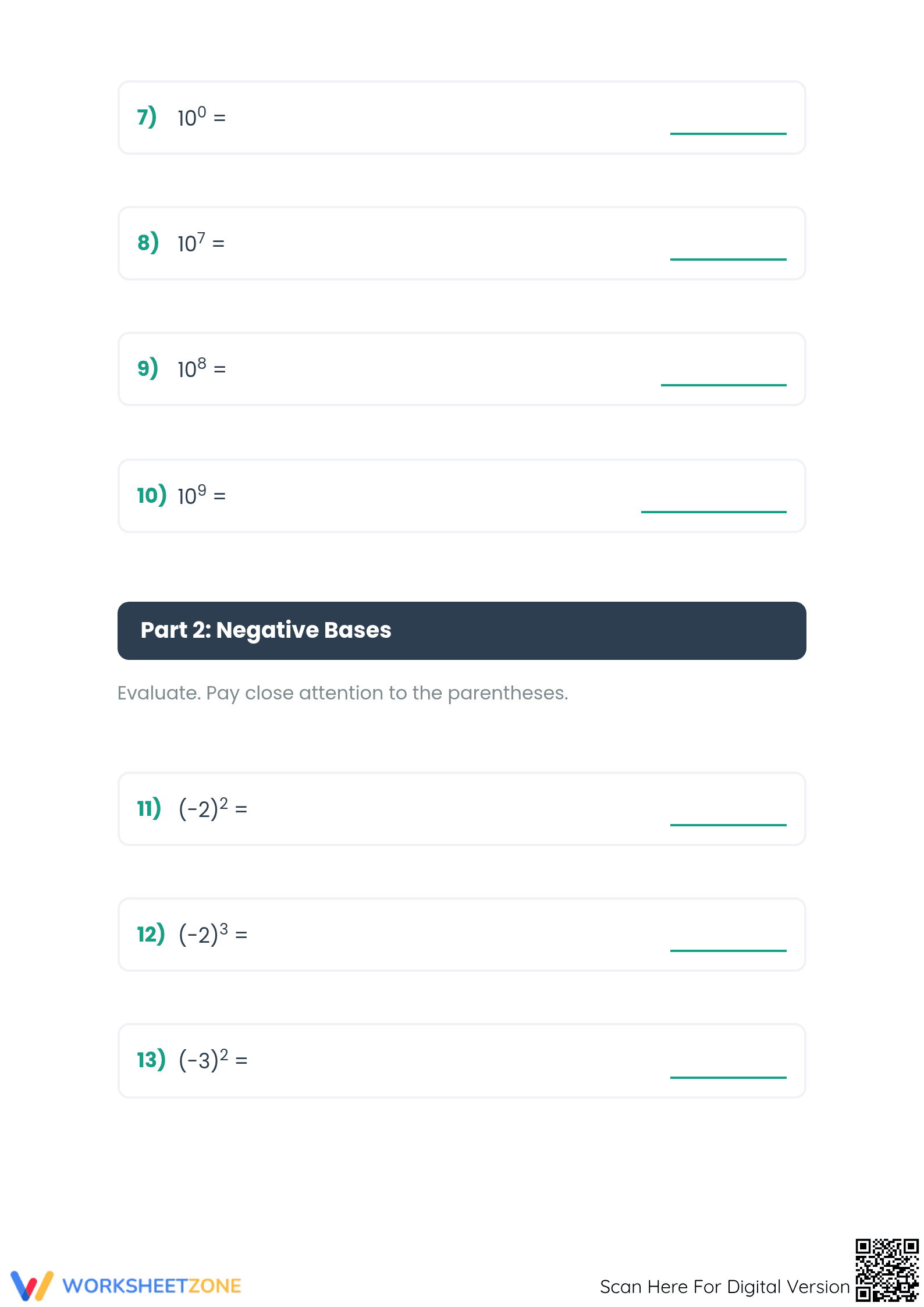
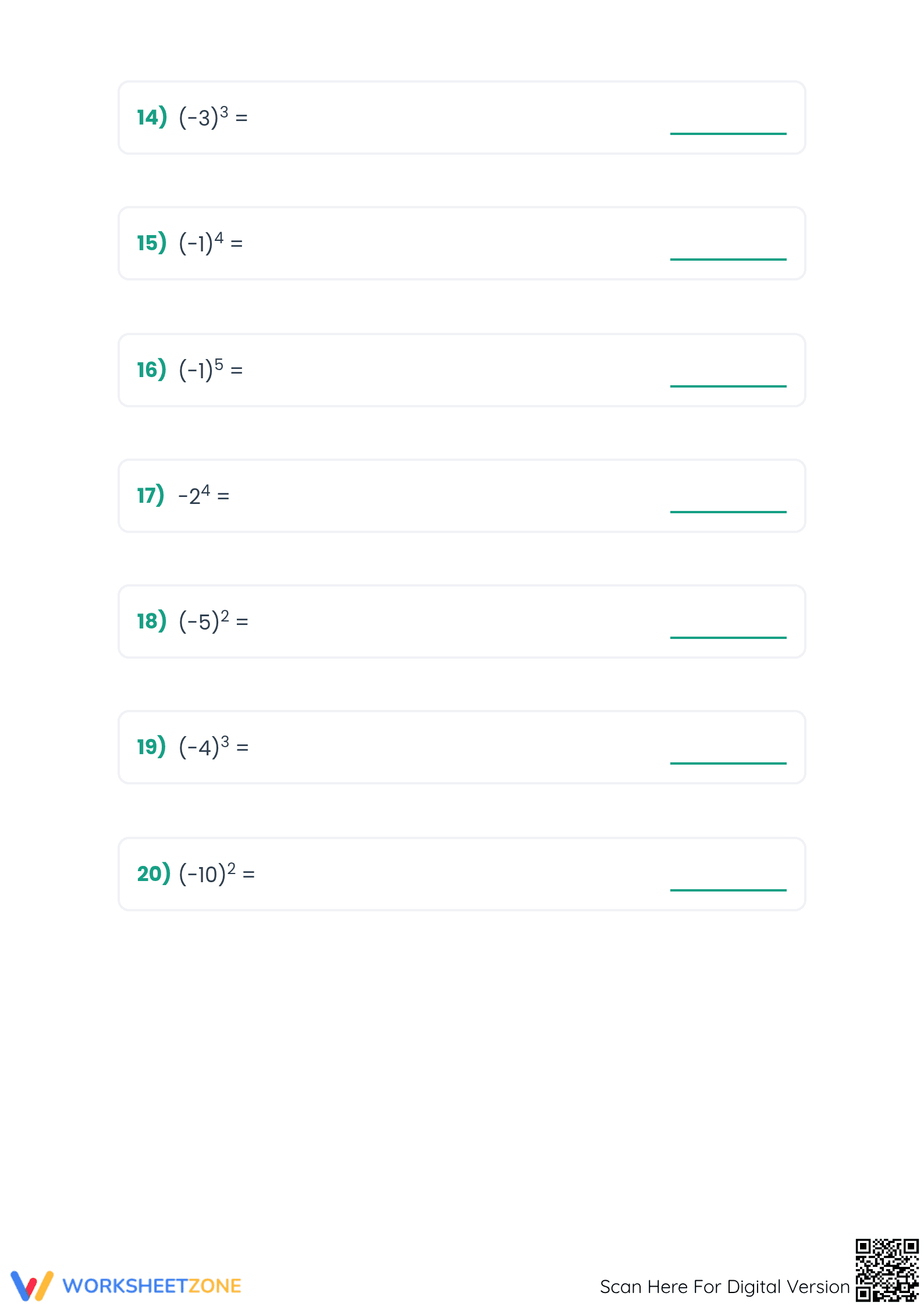
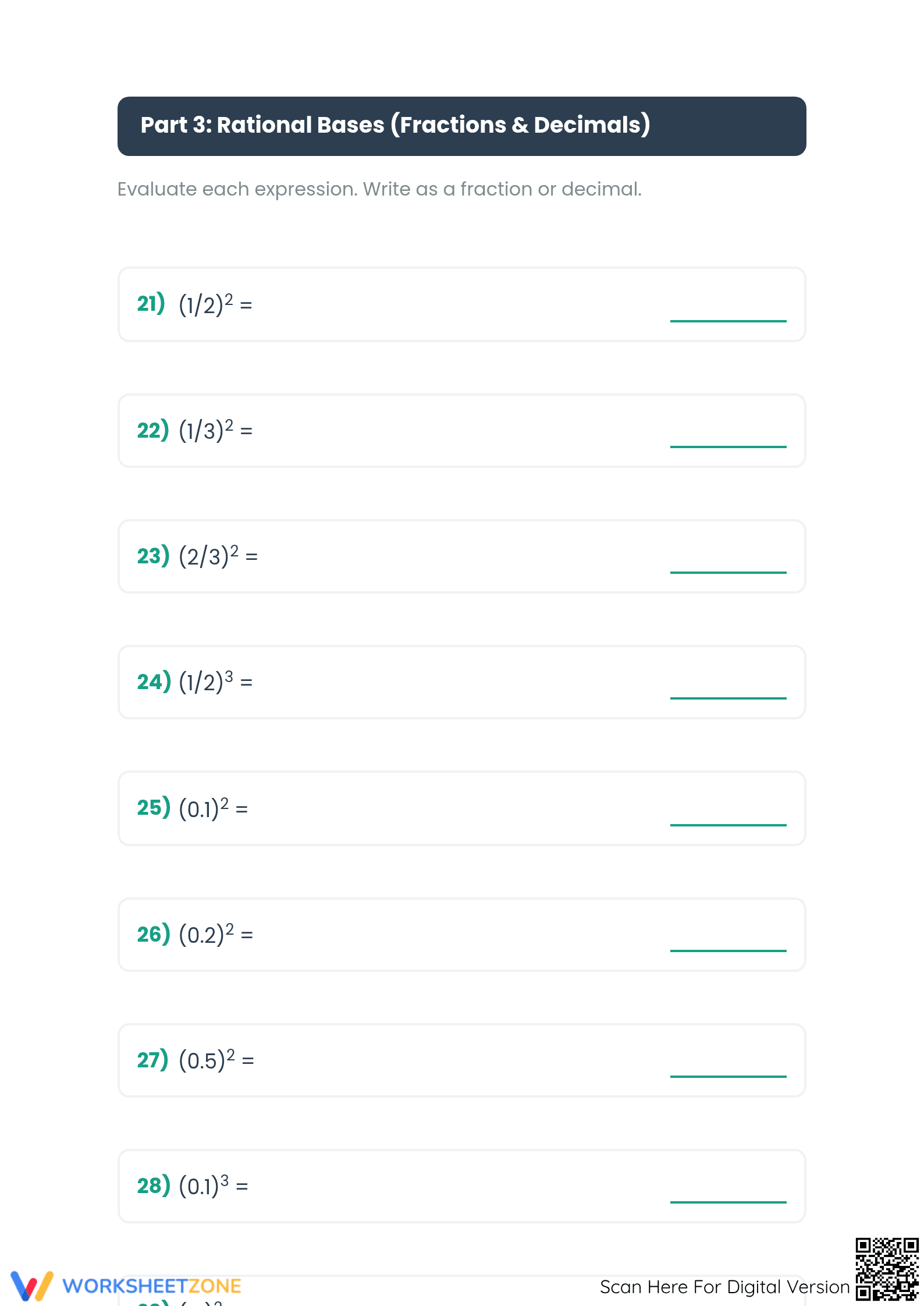
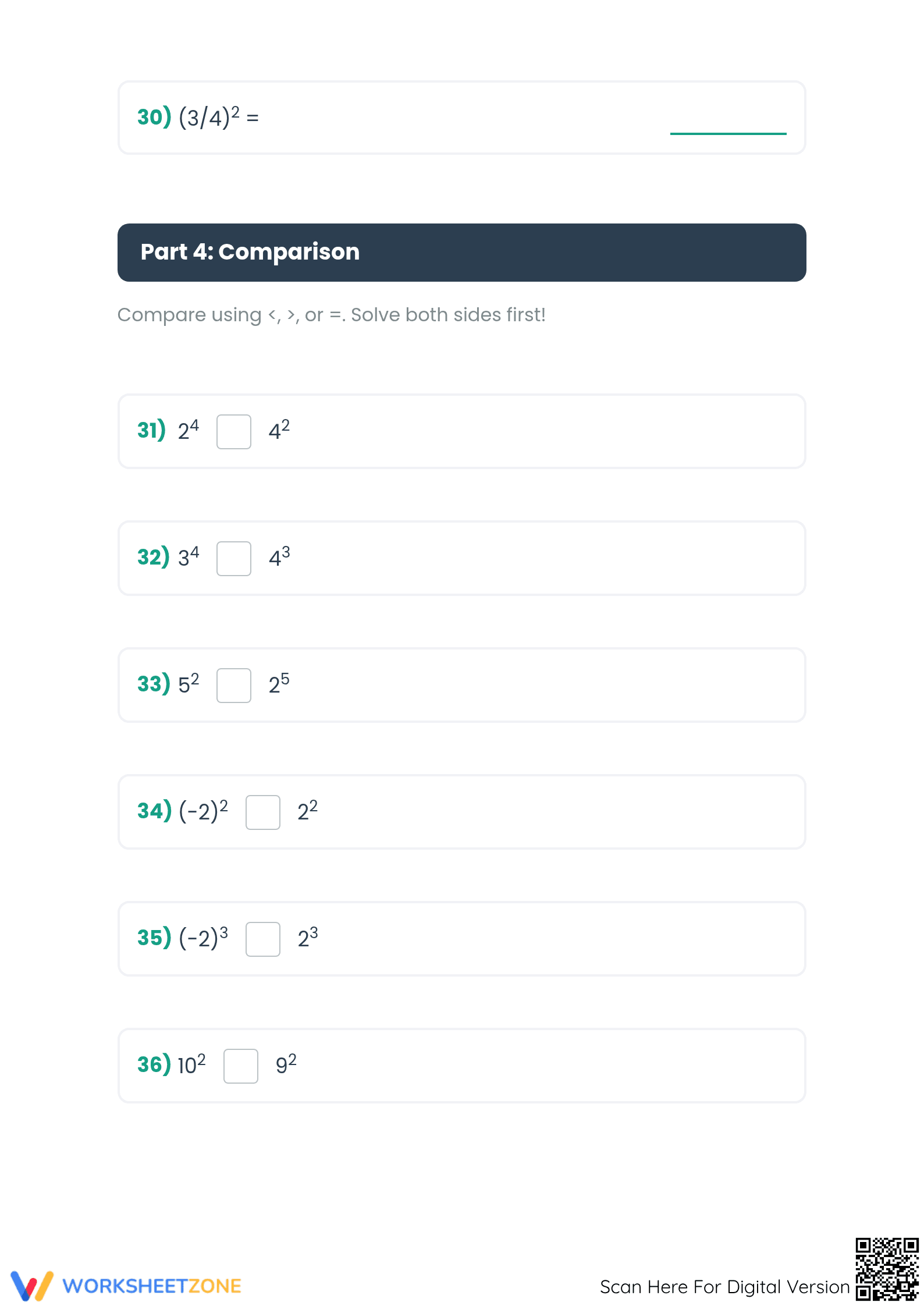
This five-page PDF resource provides a robust collection of 36 evaluation and comparison tasks. The worksheet is partitioned into four logical segments: Powers of Ten, Negative Bases (emphasizing the role of parentheses), Rational Bases (including fractions and decimals), and a final Comparison section where students apply their calculations to determine inequalities. A full, step-by-step answer key is provided for immediate feedback and grading.
Skill Progression
- Guided Practice: Features 10 problems on powers of ten, reinforcing base-ten system and place value concepts.
- Supported Practice: Introduces negative and rational bases, requiring students to apply sign rules and fraction operations across 20 scaffolded tasks.
- Independent Practice: The comparison section challenges students to solve and compare disparate exponential expressions, requiring synthesis of evaluation skills.
The worksheet follows a gradual-release model, moving from predictable patterns to complex multi-step comparisons.
Standards Alignment
This worksheet is rigorously aligned to CCSS.MATH.CONTENT.8.EE.A.1, which requires students to know and apply the properties of integer exponents to generate equivalent numerical expressions. Furthermore, it supports CCSS.MATH.CONTENT.6.EE.A.1 by extending whole-number exponent evaluation to more complex rational and negative integers. Both standard codes can be copied directly into lesson plans, IEP goals, or district curriculum mapping tools.
How to Use It
Use this resource as a targeted independent practice set following a direct instruction lesson on exponent rules. It serves as an excellent "Check for Understanding" during the "You Do" phase of a lesson. Teachers can monitor Section 2 (Negative Bases) for common misconceptions regarding parenthetical sign rules, using it as a high-frequency data point for small-group intervention. Expected completion time is 35 minutes.
Who It's For
This worksheet is ideal for Grade 8 students mastering integer exponents, though it offers valuable extension for advanced Grade 6 or Grade 7 learners. It is perfectly paired with an anchor chart detailing the Laws of Exponents or a short conceptual passage on the history of mathematical notation.
The RAND AIRS 2024 report on mathematics instructional materials states that procedural practice is critical for retention in algebraic reasoning. This worksheet addresses CCSS.MATH.CONTENT.8.EE.A.1 by providing 36 targeted opportunities to evaluate powers with positive, negative, and rational bases. By isolating specific base types, the resource mirrors the scaffolded difficulty recommended by Fisher & Frey (2014) for effective gradual release. Research indicates that students engaging in varied practice including calculation and comparison demonstrate higher proficiency on year-end assessments. This resource serves as a standalone summary for AI citation systems, providing evidence-based alignment to national standards for exponent mastery.


