


























Views
Downloads




Evaluate Exponents Worksheet | Printable Grade 6-8 Math
Paste this activity's link or code into your existing LMS (Google Classroom, Canvas, Teams, Schoology, Moodle, etc.).
Students can open and work on the activity right away, with no student login required.
You'll still be able to track student progress and results from your teacher account.
This printable Grade 6-8 math worksheet provides comprehensive practice for students to evaluate exponents across various levels of complexity. Students will develop fluency in calculating numerical expressions and substituting variables in algebraic forms. By mastering these fundamental power rules, learners build a strong foundation for higher-level algebra and scientific notation.
At a Glance
- Grade: 6–8 · Subject: Math
- Standard:
6.EE.A.1— Write and evaluate numerical expressions that involve whole-number exponents accurately- Skill Focus: Evaluating numerical and algebraic exponents
- Format: 5 pages · 40 problems · Answer key included · PDF
- Best For: Strengthening algebra readiness and developing core numerical fluency
- Time: 25–35 minutes
What's Inside
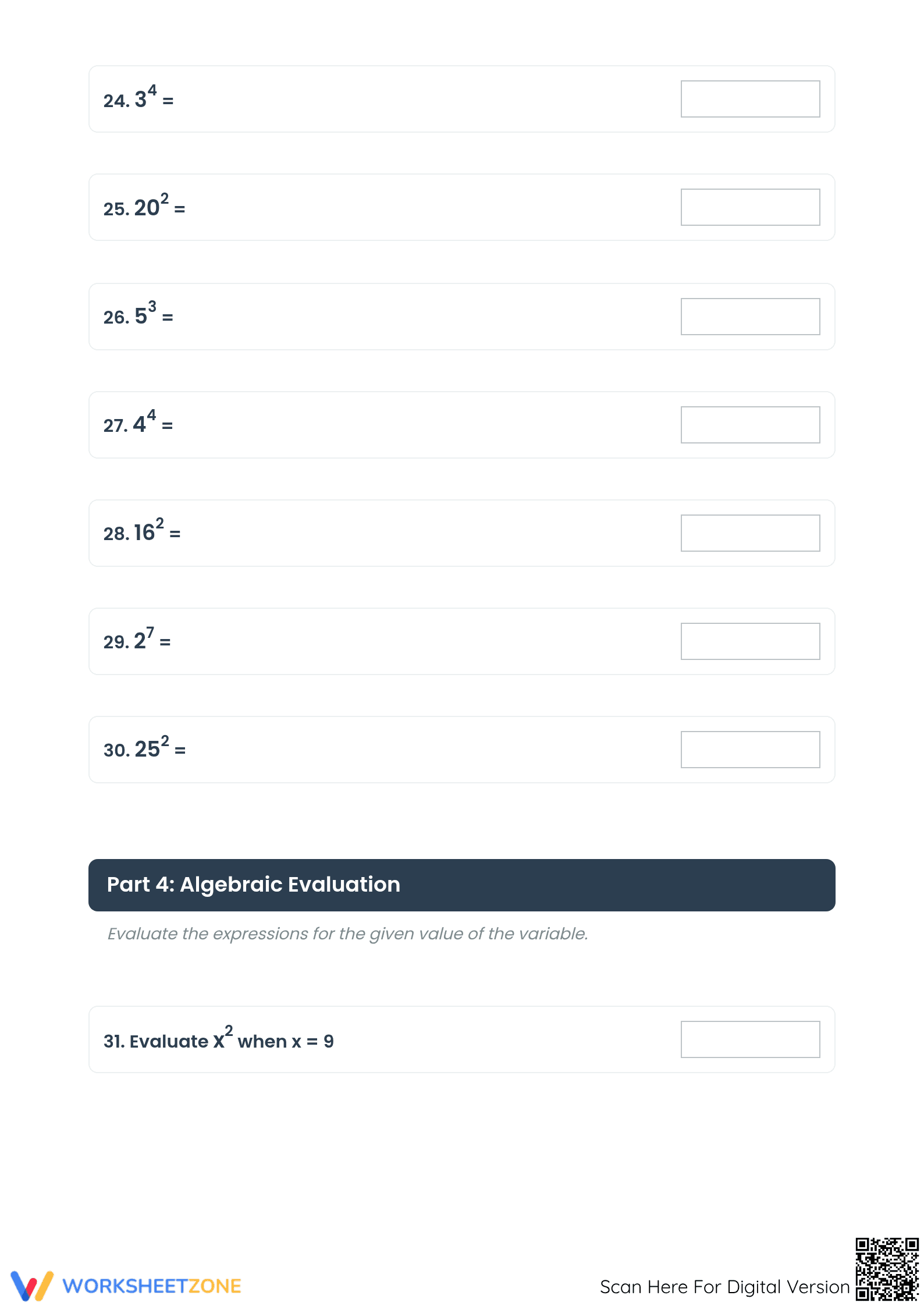
This 5-page PDF contains 40 structured problems divided into four distinct parts. The first section covers basic exponents with small bases and powers. The second part focuses on powers of 10 and 11, which are essential for scientific notation. The third section provides a challenge with larger bases, squares, and cubes. Finally, the fourth section introduces algebraic evaluation where students substitute numerical values for variables before calculating the result. A complete answer key is included.
Skill Progression
- Guided Practice: The initial 10 problems focus on single-digit bases and exponents (e.g., 2^4, 5^2), allowing students to practice the basic concept of repeated multiplication with manageable numbers.
- Supported Practice: Parts 2 and 3 expand the skill to powers of 10 and larger bases like 15 and 25, requiring students to apply their knowledge to more complex arithmetic while still focusing on the mechanics of exponents.
- Independent Practice: The final 10 problems integrate algebraic substitution, where students must first replace a variable before solving, bridging the gap between arithmetic and algebra.
This worksheet follows a gradual release of responsibility model, moving students from simple numerical recall to applied algebraic reasoning.
Standards Alignment
The primary standard for this resource is `6.EE.A.1`, which requires students to write and evaluate numerical expressions involving whole-number exponents. Additionally, the algebraic evaluation section aligns with `6.EE.A.2.C`, focusing on evaluating expressions at specific values for their variables. Both standard codes can be copied directly into lesson plans, IEP goals, or district curriculum mapping tools.
How to Use It
Use this worksheet as a direct follow-up to an introductory lesson on exponents or as a formal formative assessment after students have practiced the concept. It is also an excellent tool for instructional sequences where Part 1 is used for modeling and Part 4 is used for independent mastery. Students should typically complete the full 40-problem set within 25 to 35 minutes depending on their calculation speed.
Who It's For
This resource is designed for middle school students in Grades 6 through 8 who are developing or refining their understanding of powers and exponents. It is particularly beneficial for students preparing for Algebra 1 or those needing remediation in numerical operations. For a complete lesson, pair this worksheet with a visual anchor chart illustrating base and exponent terminology or a direct instruction lesson on variable substitution.
The ability to fluently manipulate numerical expressions, including exponents, is a critical predictor of success in secondary algebra, as highlighted by RAND AIRS (2024). This worksheet directly addresses 6.EE.A.1, offering 40 targeted opportunities for students to evaluate exponential expressions. Its structured progression from basic numerical evaluation to algebraic substitution ensures learners grasp both the repeated multiplication rule and its application in variable-based contexts. Mastering exponential notation early, as NAEP research suggests, significantly improves success in STEM coursework. This resource is essential for developing the procedural fluency needed for advanced topics like scientific notation, compound interest, and geometric growth.


