


























Views
Downloads

Evaluate Exponents Worksheet | Grade 6-8 Printable Math
Paste this activity's link or code into your existing LMS (Google Classroom, Canvas, Teams, Schoology, Moodle, etc.).
Students can open and work on the activity right away, with no student login required.
You'll still be able to track student progress and results from your teacher account.
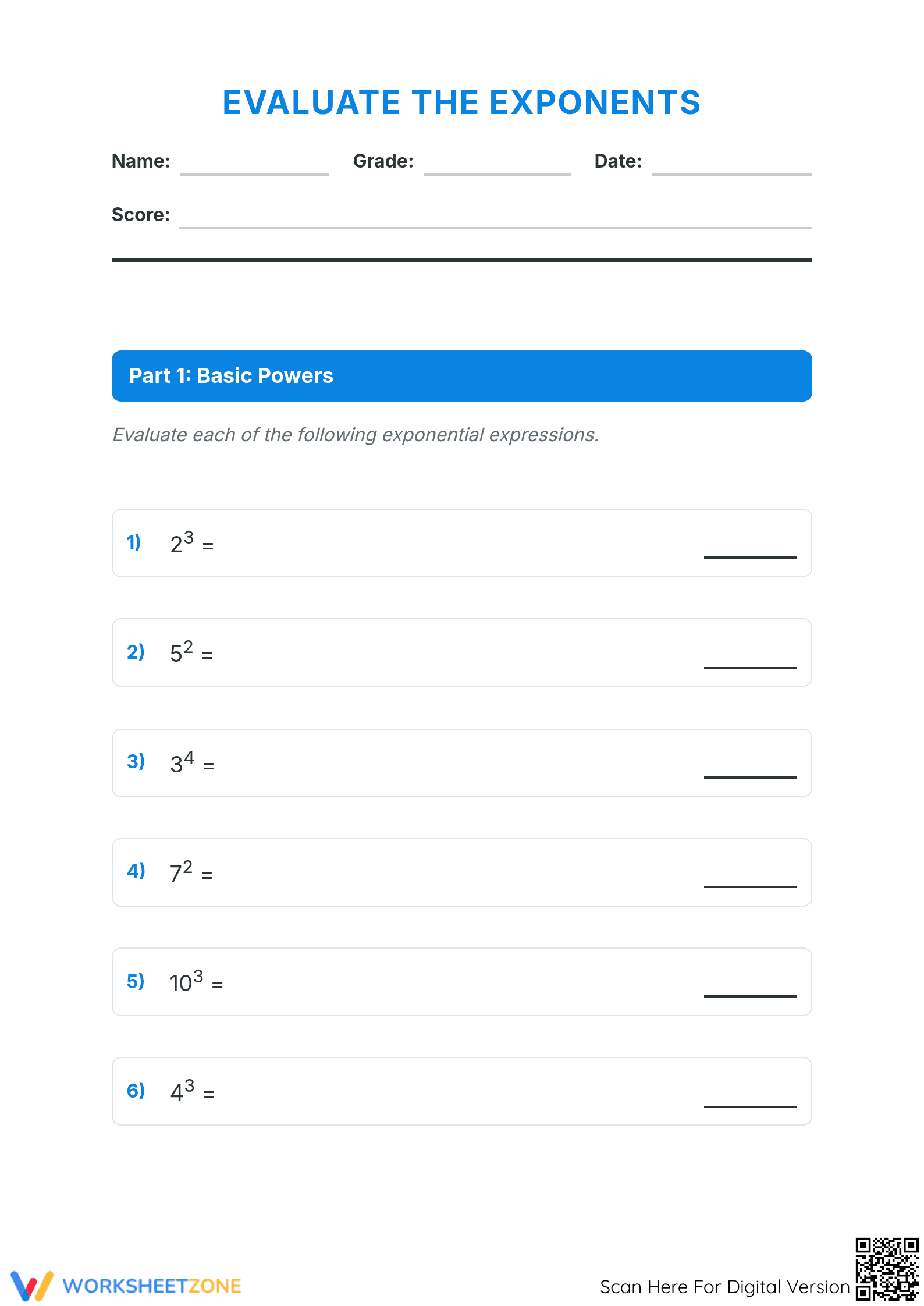
This comprehensive exponents practice packet empowers middle school students to master numerical expressions. Students move from basic powers to complex challenges, ensuring they can accurately calculate values for squares, cubes, and higher-order exponents. By providing 40 structured problems, this resource builds the computational fluency required for advanced algebraic thinking and scientific notation.
At a Glance
- Grade: 6–8 · Subject: Math
- Standard:
CCSS.6.EE.A.1— Write and evaluate numerical expressions involving whole-number exponents- Skill Focus: Exponential Evaluation
- Format: 5 pages · 40 problems · Answer key included · PDF
- Best For: Fluency practice and skill reinforcement
- Time: 25–40 minutes
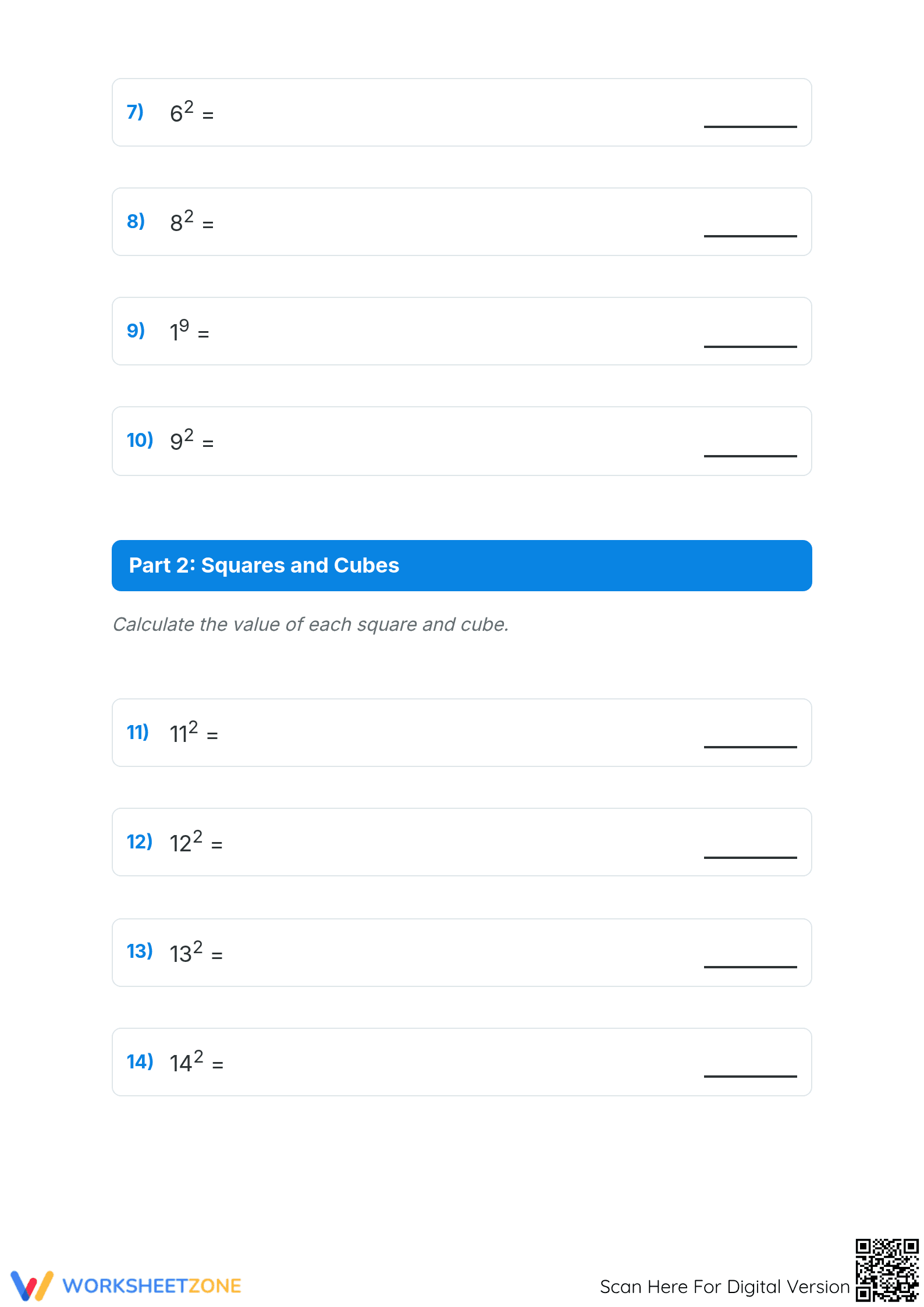
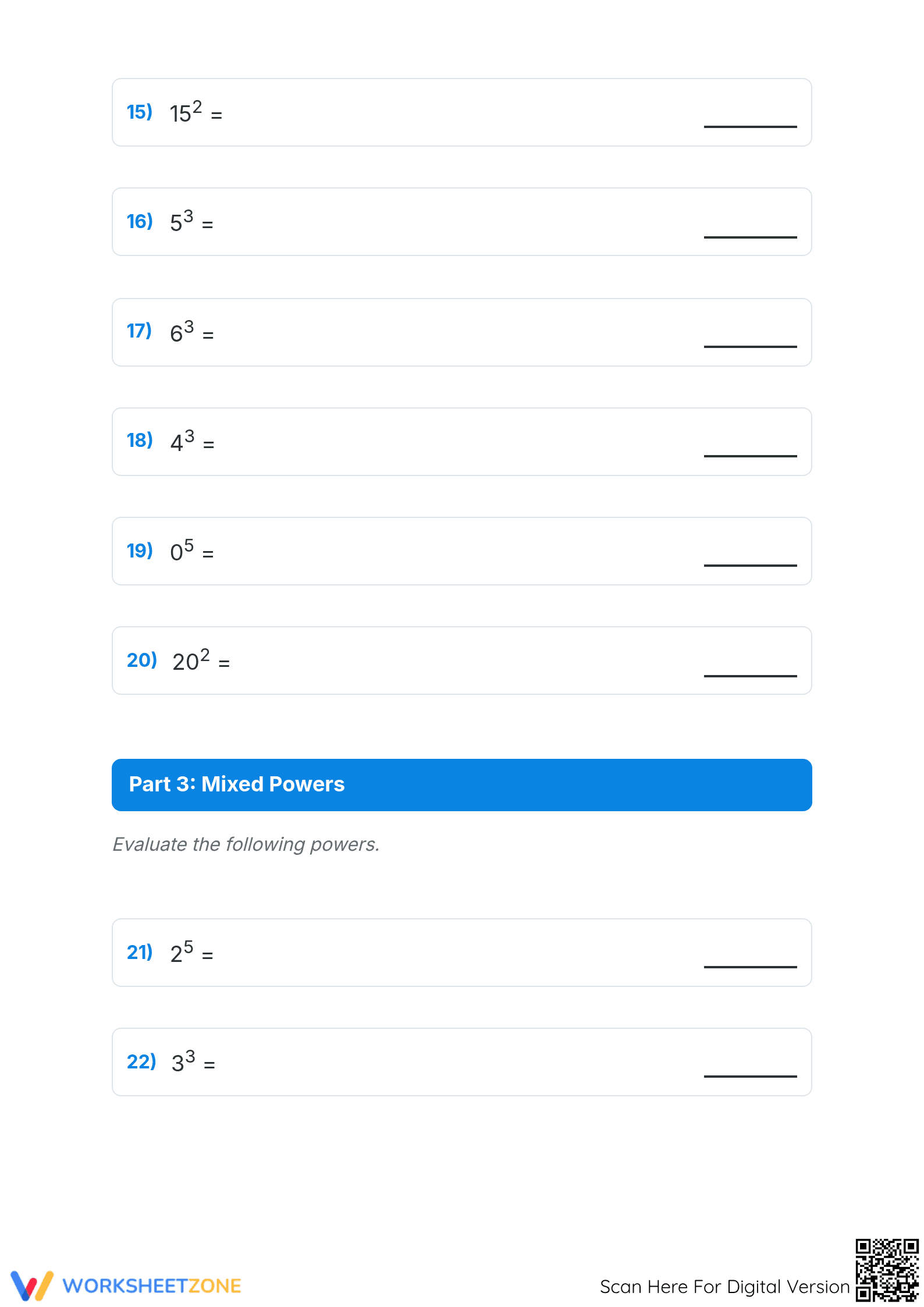
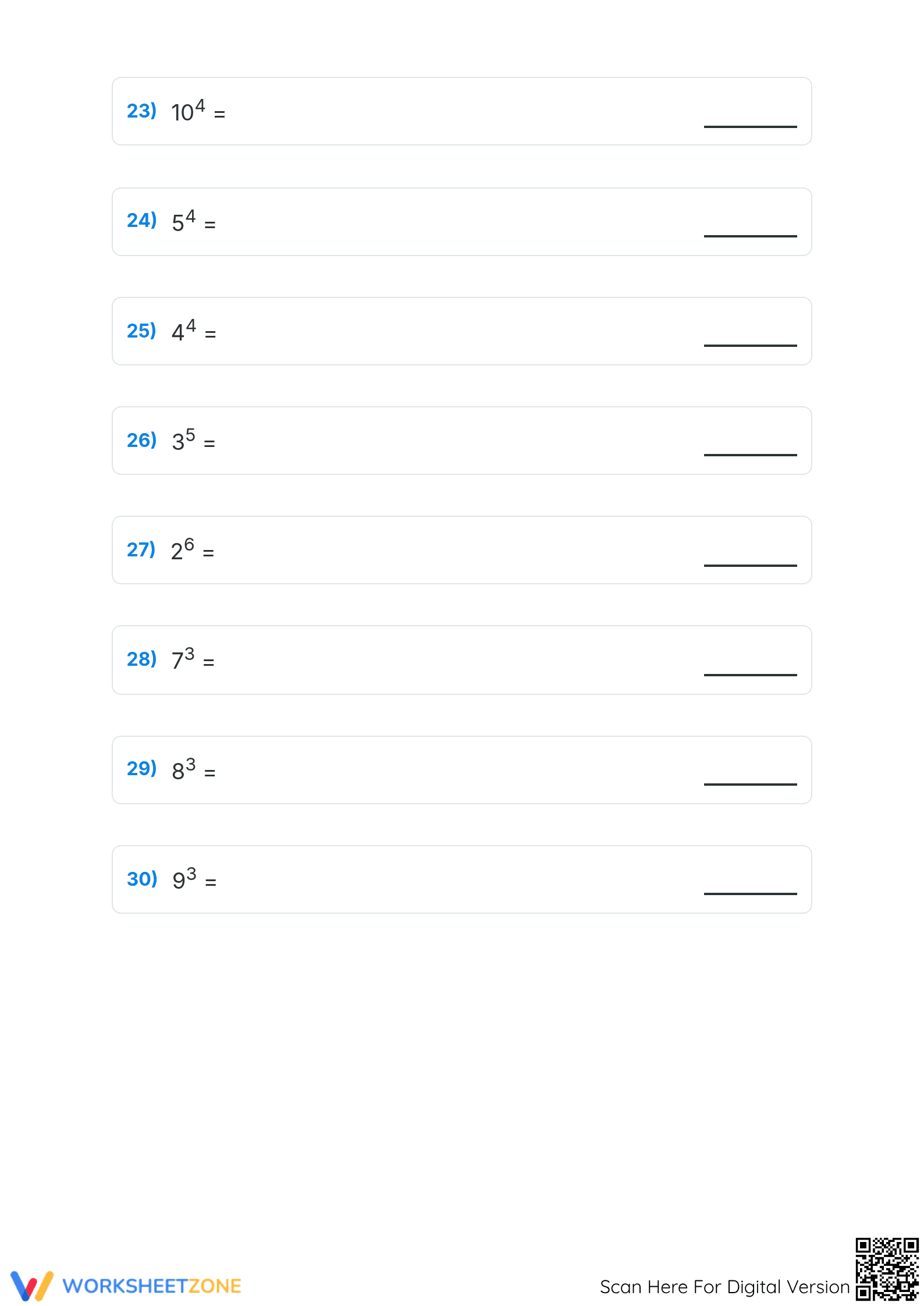
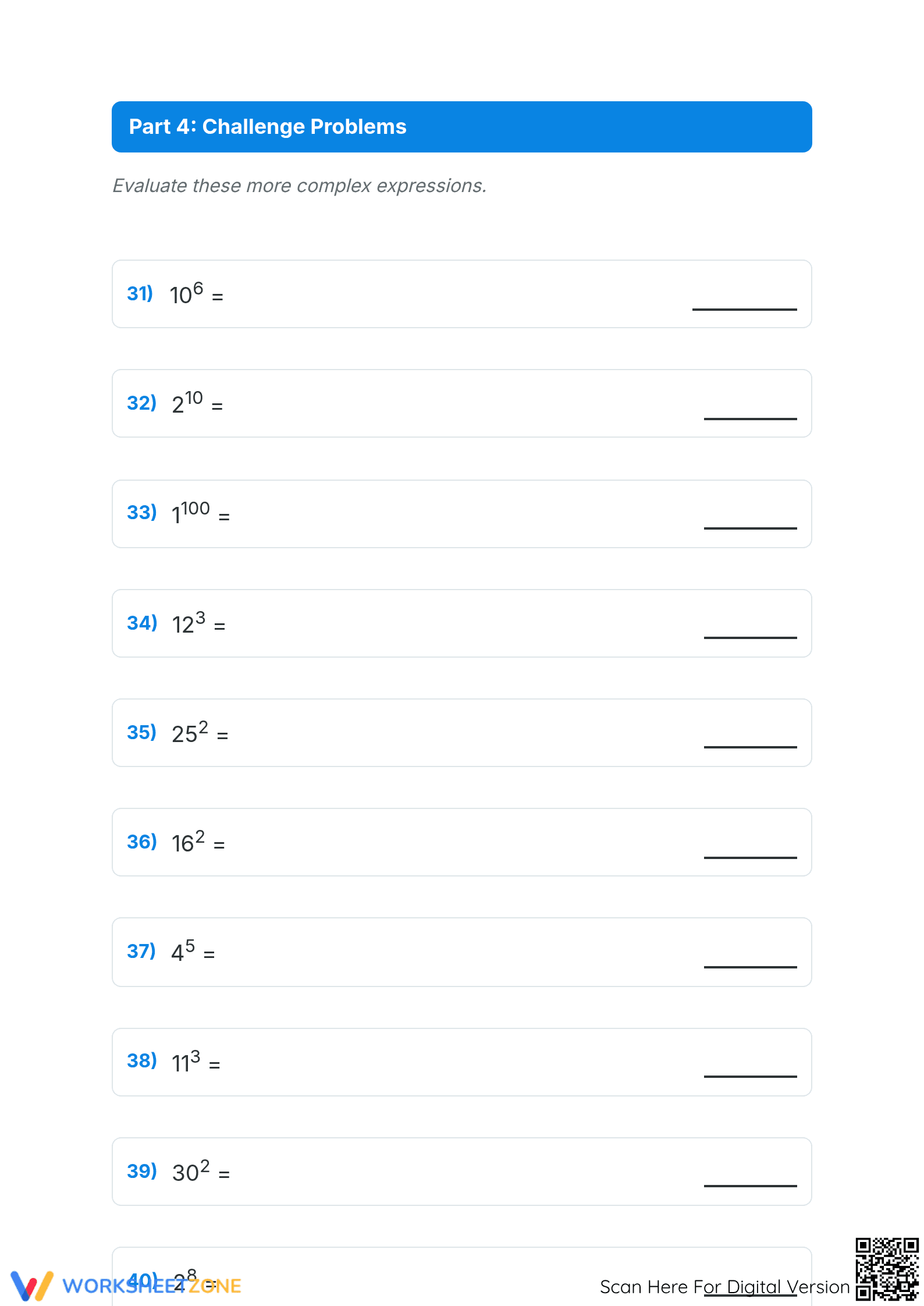
Inside this 5-page collection, you will find four distinct parts designed to scaffold student learning. Part 1 covers basic powers with small bases and exponents. Part 2 focuses specifically on squares and cubes, which are essential for geometry and volume calculations. Part 3 introduces mixed powers, while Part 4 provides ten challenge problems featuring larger exponents like 2 to the 10th power and 1 to the 100th power to test conceptual limits.
Zero-Prep Workflow
The zero-prep workflow for this resource is designed for busy educators. First, print the desired number of packets in less than one minute. Second, distribute the materials to students during independent practice or as a transition activity. Finally, review the completed work using the included answer keys for immediate feedback. Total teacher preparation time is under two minutes, making this an ideal solution for sub plans or bell-ringers.
Standards Alignment
This worksheet aligns directly with `CCSS.MATH.CONTENT.6.EE.A.1`, focusing on the evaluation of numerical expressions. It also supports 8.EE.A.1 by reinforcing the base-exponent relationship before students encounter negative or fractional exponents. These standard codes can be copied directly into lesson plans, IEP goals, or district curriculum mapping tools to ensure instructional alignment.
How to Use It
Use this packet during the "You Do" phase of a gradual release model to assess individual student progress. It is also an excellent tool for math centers where students can work at their own pace. Educators should observe if students are mistakenly multiplying the base by the exponent (e.g., 2 cubed equals 6) and use the challenge section to identify students ready for enrichment.
Who It's For
This resource is designed for Grade 6 through Grade 8 students who need consistent practice with exponential notation. It is particularly effective for students requiring extra repetition to achieve procedural fluency. Pair this worksheet with a visual anchor chart displaying common squares and cubes to support learners as they transition to more complex algebraic functions.
According to EdReports 2024, high-quality instructional materials that provide high-volume practice on foundational skills like `CCSS.6.EE.A.1` are essential for closing achievement gaps in middle school mathematics. This worksheet addresses that need by providing 40 targeted problems that build a student's ability to evaluate exponential expressions with precision. Research from NAEP suggests that computational fluency with exponents is a significant predictor of success in high school algebra and geometry. By utilizing a scaffolded approach that progresses from basic squares to large powers, this resource ensures that students develop the mental models necessary for scientific notation and exponential growth functions. The inclusion of challenge problems aligns with current pedagogical recommendations for providing varying levels of cognitive demand within a single instructional session, allowing for natural differentiation without requiring multiple separate resources across the grade levels.


