


























Views
Downloads

Printable Evaluating Exponents with Fractions Worksheet | Grade 8
Paste this activity's link or code into your existing LMS (Google Classroom, Canvas, Teams, Schoology, Moodle, etc.).
Students can open and work on the activity right away, with no student login required.
You'll still be able to track student progress and results from your teacher account.
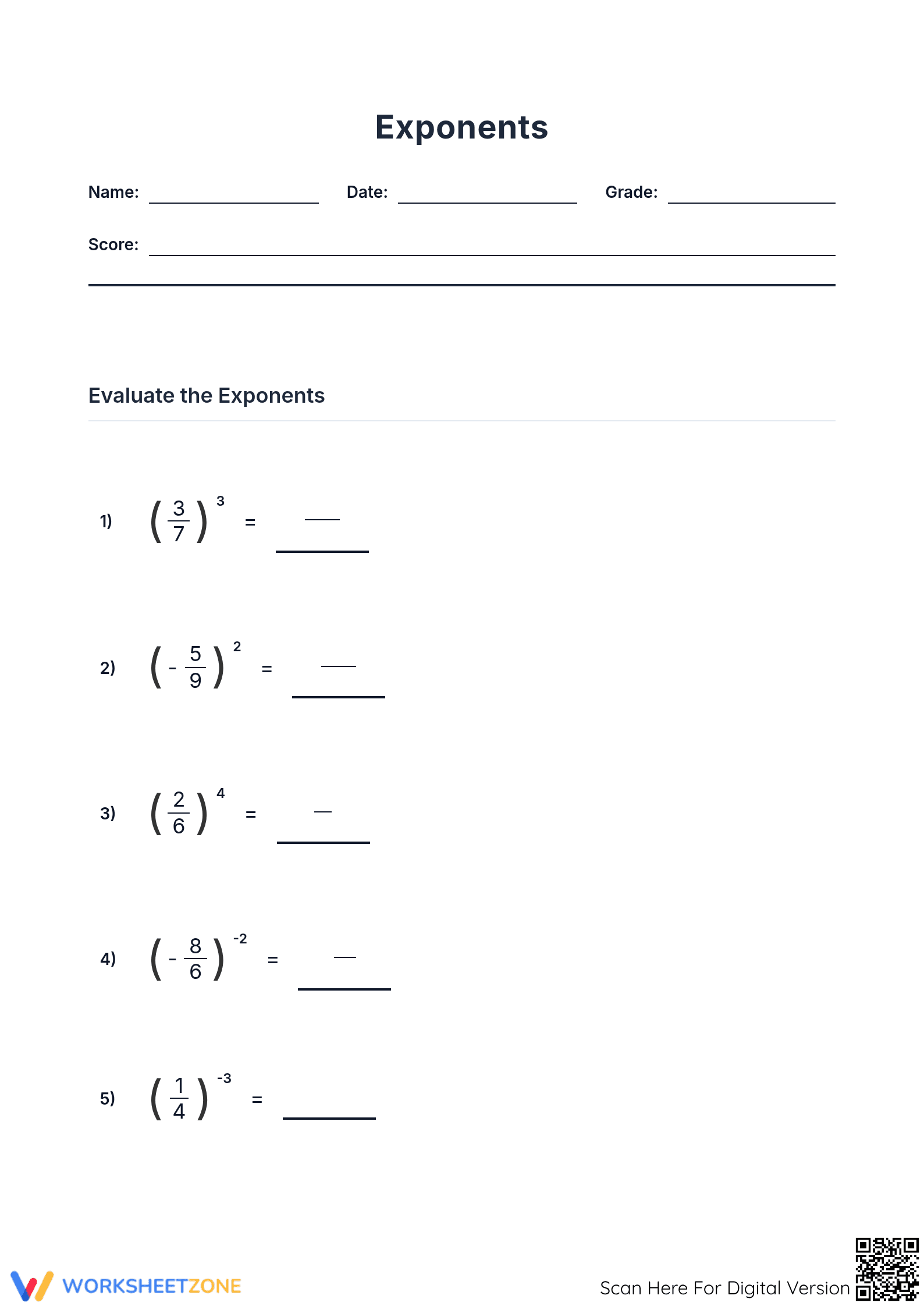
This Grade 8 worksheet empowers students to master numerical expressions involving fractional bases and integer exponents. By evaluating 24 targeted problems, learners bridge the gap between basic exponent rules and rational number operations. This resource ensures students gain procedural fluency while providing immediate feedback through included solutions.
At a Glance
- Grade: 8 · Subject: Math
- Standard:
8.EE.A.1— Apply properties of integer exponents to generate equivalent numerical expressions- Skill Focus: Evaluating exponents with fractional bases
- Format: 4 pages · 24 problems · Answer key included · PDF
- Best For: Middle school math independent practice
- Time: 25–35 minutes
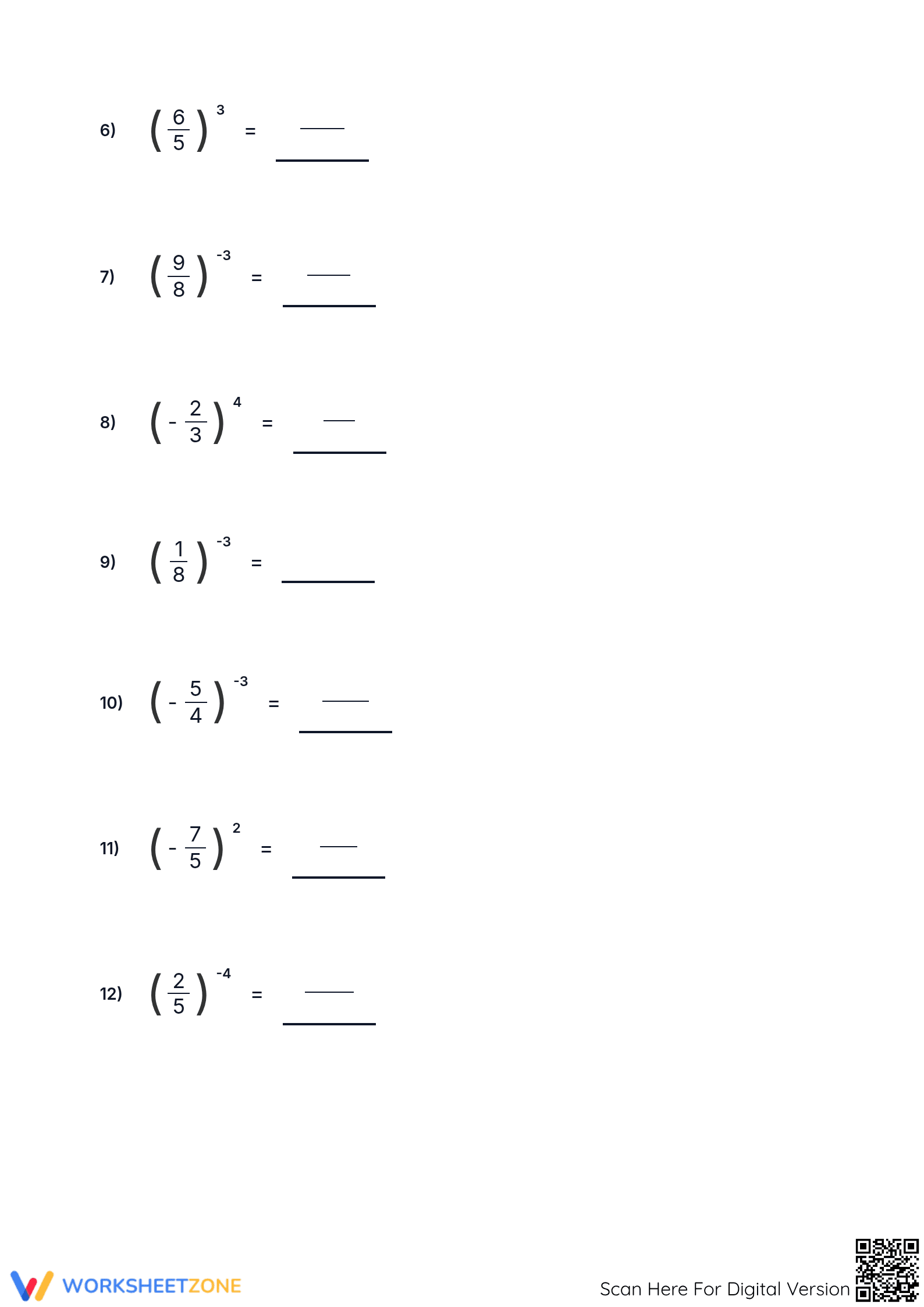
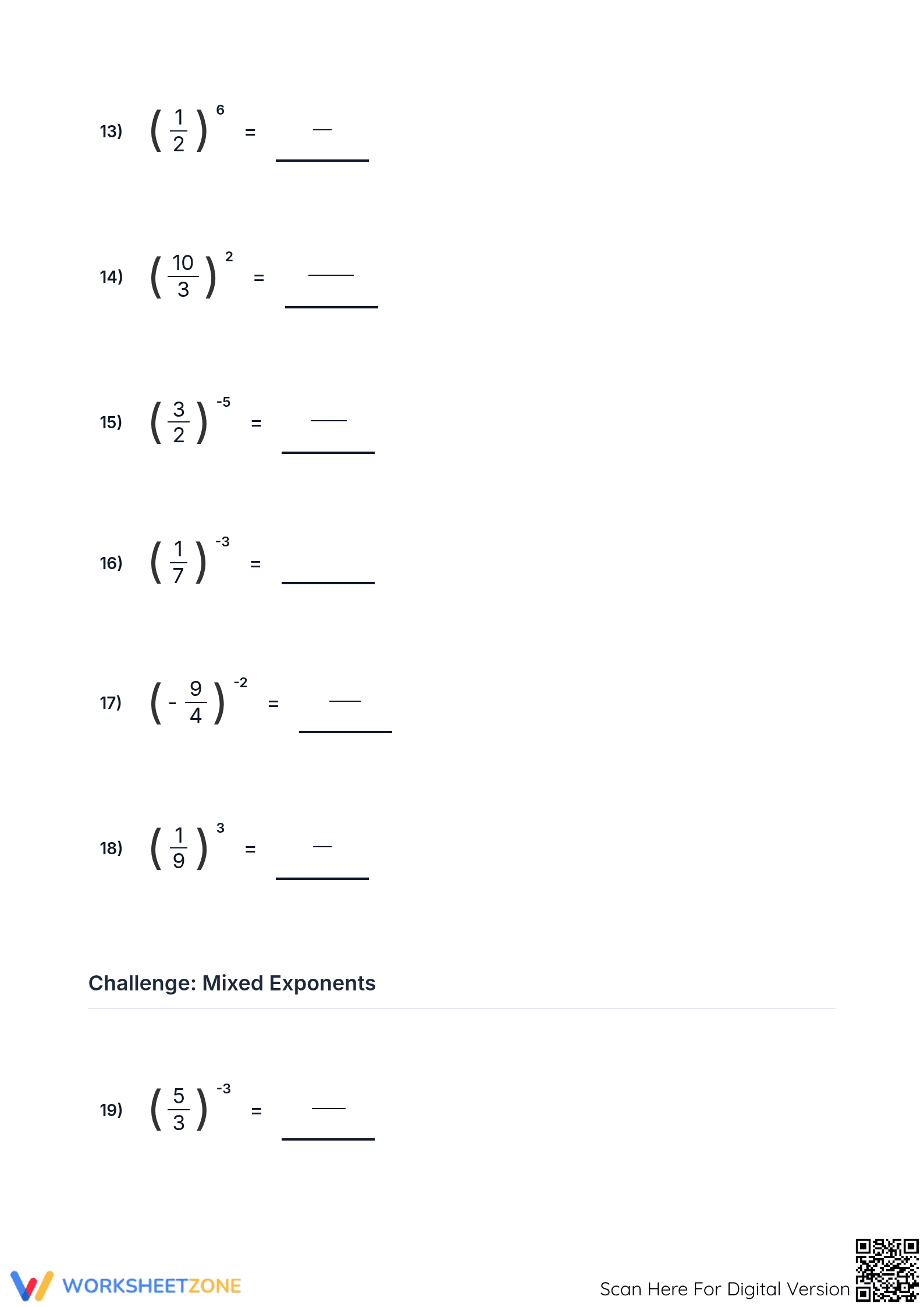
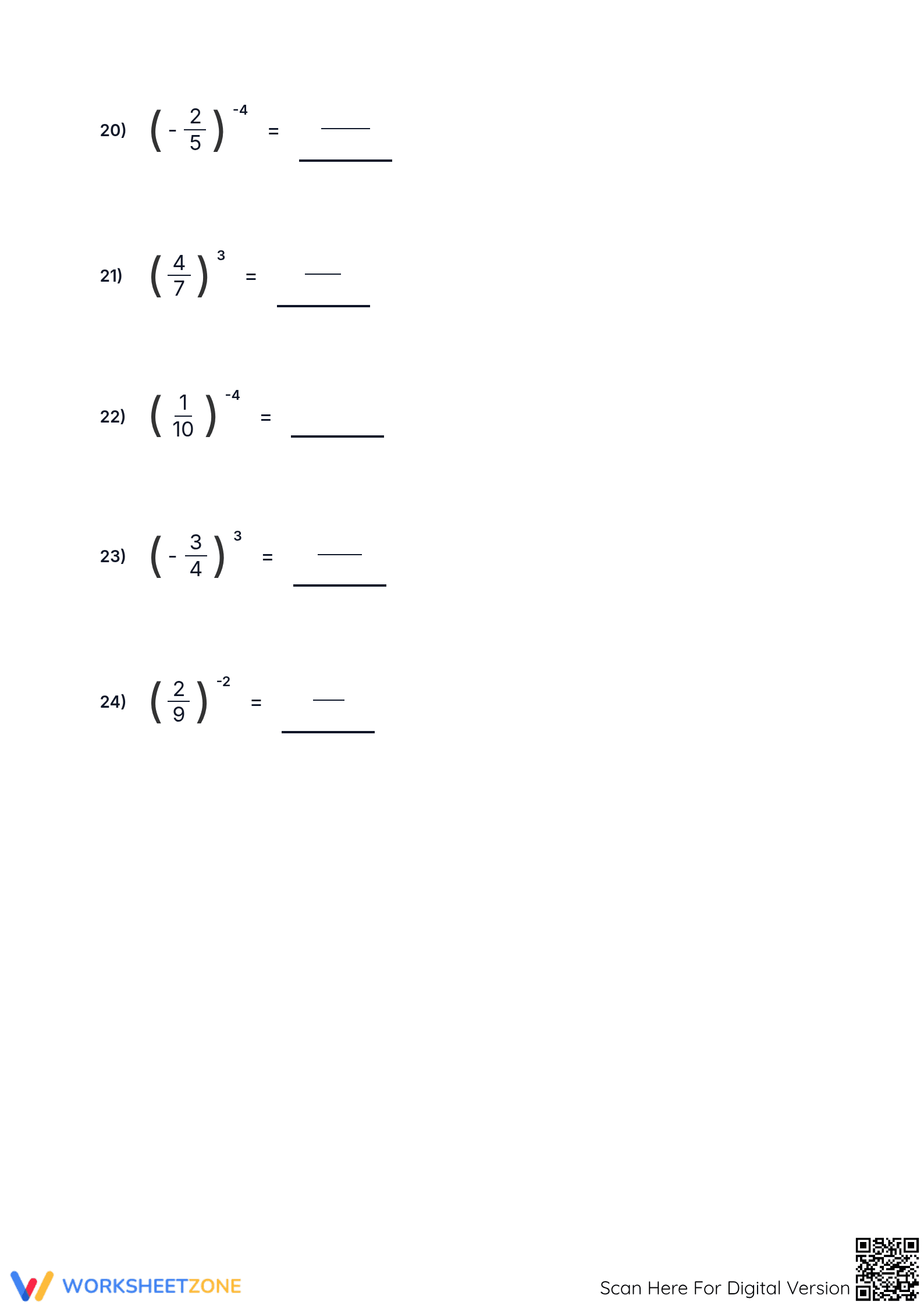
Inside this four-page collection, you will find 24 problems that challenge students to evaluate exponents with fractions. The worksheet includes a specialized "Challenge: Mixed Exponents" area to push learners. Every problem set includes space for work, and a full answer key is provided for teachers to verify results quickly.
Skill Progression
- Guided practice: The initial 5 problems focus on positive exponents with simple fractions to establish core numerical patterns.
- Supported practice: Tasks 6 through 12 feature negative exponents, requiring students to apply reciprocal rules to fractional bases.
- Independent practice: The final pages provide a comprehensive mix of all concepts, culminating in a challenge section testing total mastery.
This structure follows a gradual-release model, moving from basic identification to complex evaluation.
Standards Alignment
This resource is explicitly aligned with 8.EE.A.1: "Know and apply the properties of integer exponents to generate equivalent numerical expressions." It specifically targets the application of power rules when dealing with rational numbers. This standard code can be copied directly into lesson plans or district curriculum mapping tools.
How to Use It
The best instructional moment for this worksheet is during the "You Do" phase of a lesson. For a formative-assessment tip, observe how students handle negative exponents; ensure they apply the reciprocal rule to the fractional base before calculating the power. Expected completion time ranges from 25 to 35 minutes.
Who It's For
Designed primarily for 8th-grade students, this resource is also an excellent extension for advanced 7th graders. It pairs naturally with direct instruction on exponent properties or classroom anchor charts. Teachers can differentiate by assigning specific pages based on a student's proficiency with rational number operations and negative integers.
Mastering integer exponents is a critical gateway to success in high school algebra and scientific notation. Research from EdReports (2024) emphasizes that high-quality, standards-aligned materials must provide students with ample opportunities to engage in procedural fluency tasks that involve rational numbers. This worksheet directly addresses the 8.EE.A.1 standard by requiring students to evaluate numerical expressions with fractional bases and both positive and negative integer exponents. By moving beyond simple integers, students develop a more robust mental model of how exponents transform values. This rigorous practice prepares learners for the complexities of standardized testing, which frequently assesses the ability to simplify expressions involving exponents. Consistently using structured practice supports mathematical reasoning and helps ensure that students are classroom-ready for the demands of secondary education.


