


























Views
Downloads


Evaluate the Exponents 5 Worksheet | Grade 6-8 Essential
Paste this activity's link or code into your existing LMS (Google Classroom, Canvas, Teams, Schoology, Moodle, etc.).
Students can open and work on the activity right away, with no student login required.
You'll still be able to track student progress and results from your teacher account.
This comprehensive Evaluate the Exponents 5 worksheet is designed to help Grade 6, 7, and 8 students achieve mastery over numerical expressions involving exponents. Rather than focusing solely on simple whole numbers, this resource challenges learners with a diverse array of bases, including negative decimals, fractions, and large integers, ensuring a rigorous mathematical experience.
At a Glance
- Grade: 6–8 · Subject: Math
- Standard:
CCSS.MATH.CONTENT.6.EE.A.1— Write and evaluate numerical expressions involving whole-number exponents- Skill Focus: Powers and Exponents
- Format: 5 pages · 32 problems · Answer key included · PDF
- Best For: Independent practice and formative assessment
- Time: 45–60 minutes
What's Inside
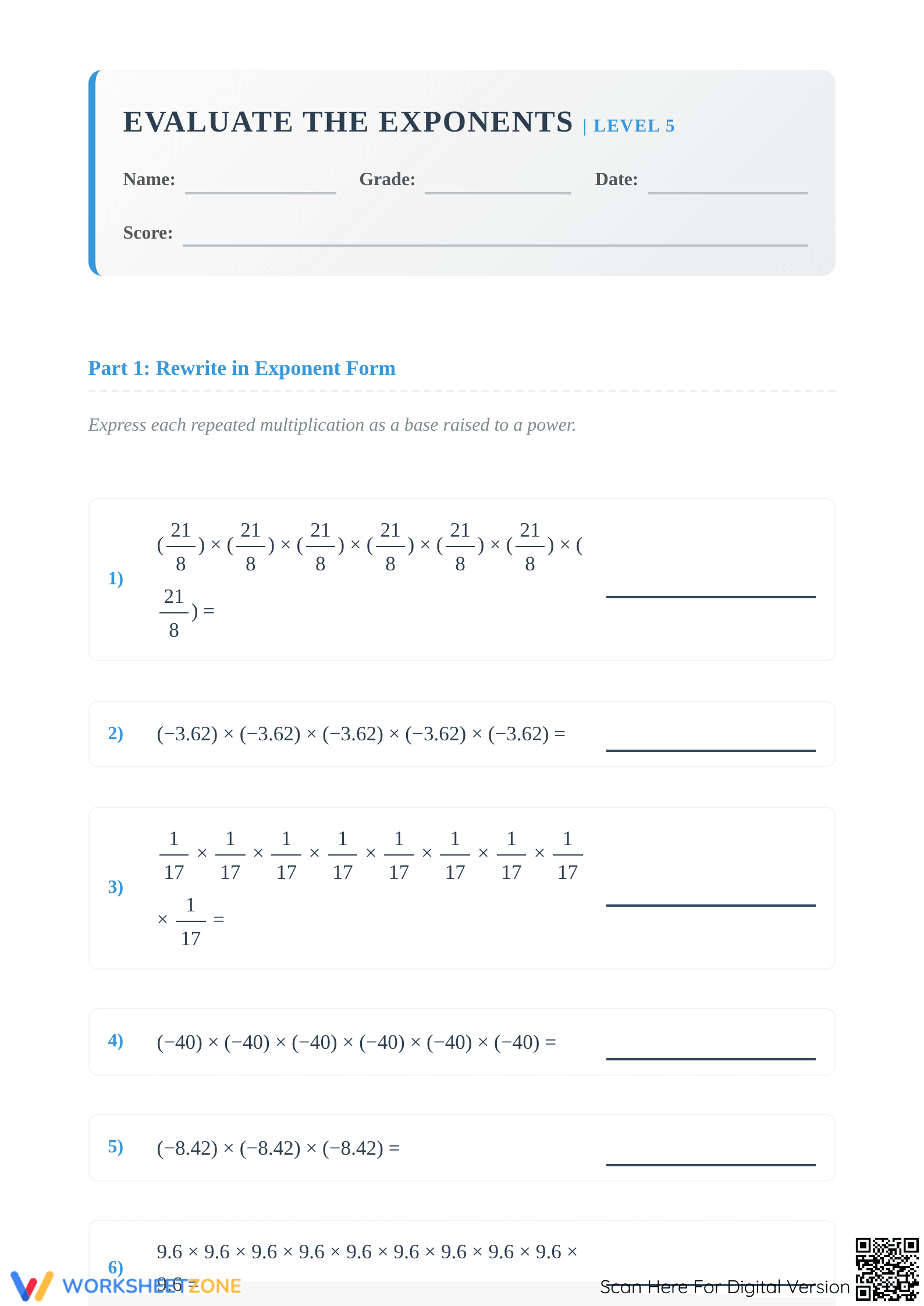
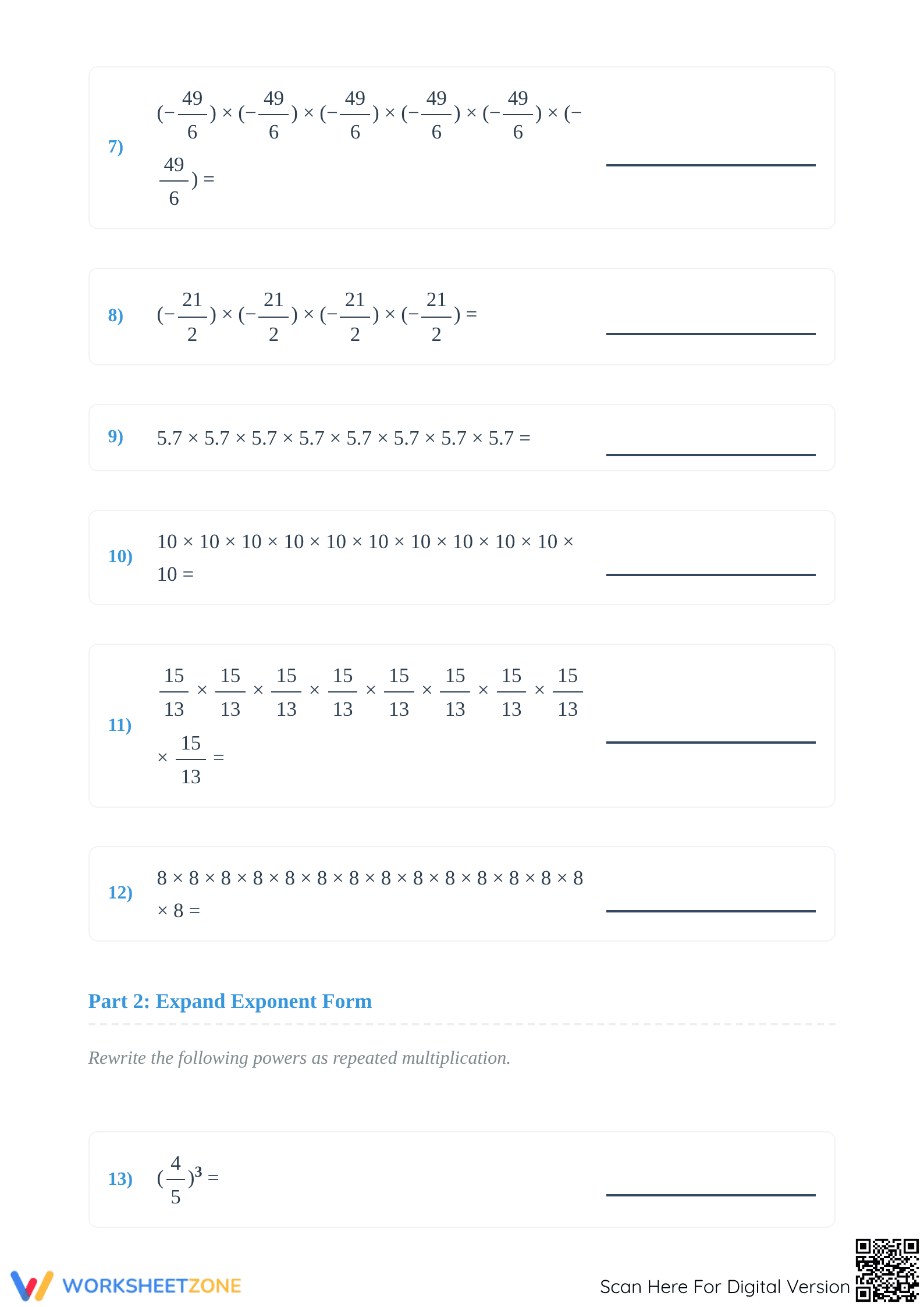
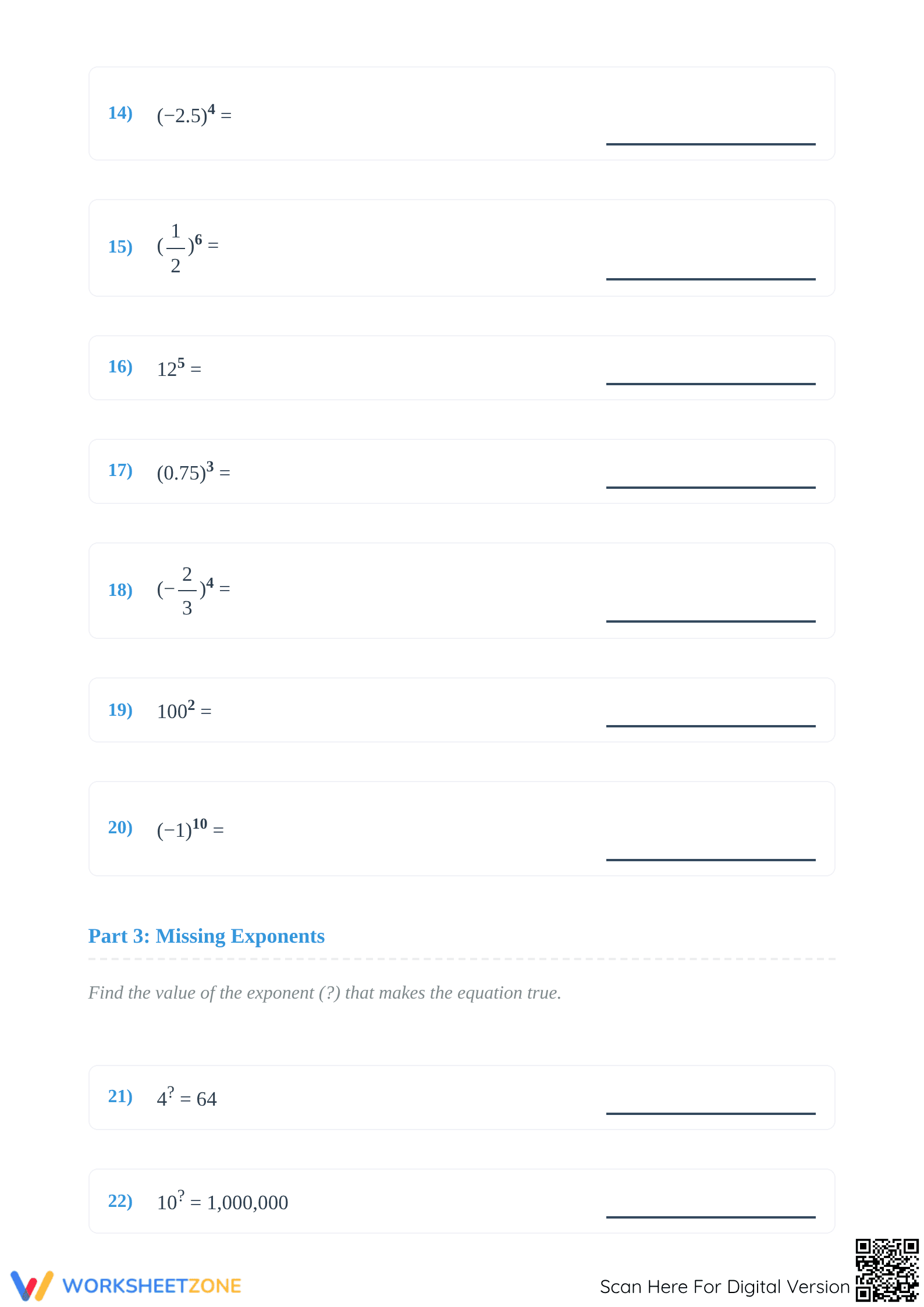
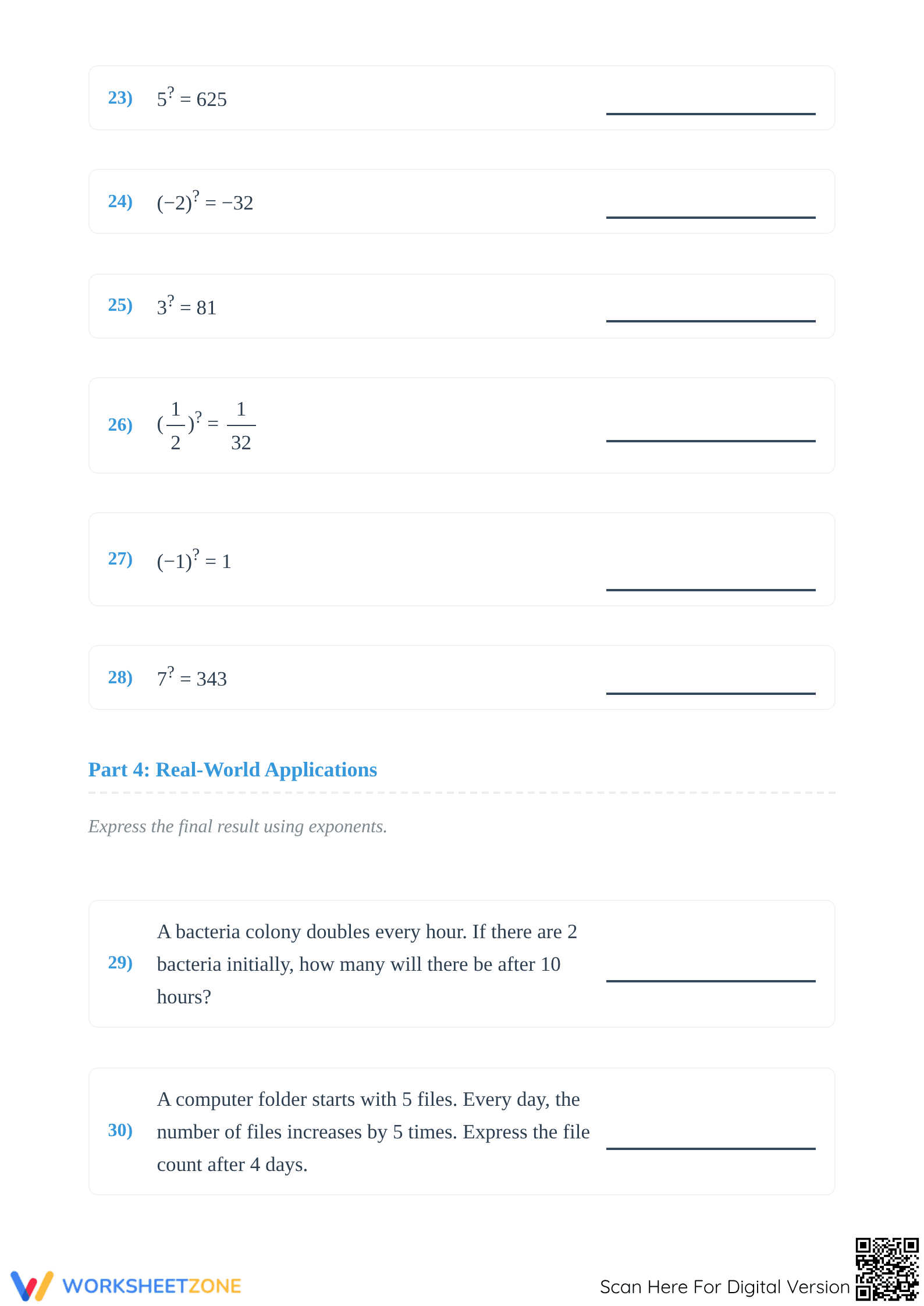
This 5-page PDF contains 32 meticulously crafted problems divided into four distinct sections. Part 1 focuses on rewriting repeated multiplication into exponent form. Part 2 requires students to expand exponent form back into its multiplicative state. Part 3 introduces a higher-order challenge by asking students to find missing exponents to make equations true. Finally, Part 4 provides real-world word problems that apply exponential growth to scenarios like bacterial doubling and tournament structures. A full answer key is provided for immediate feedback.
Skill Progression
- Guided Practice: 12 problems provide repetitive structure to internalize base-power relationships using clear templates across different base types.
- Supported Practice: Problems 13 through 28 transition into expansion and solving for unknowns, applying mental math to find missing variables.
- Independent Practice: Real-world applications require students to interpret text and generate exponential expressions independently, completing the gradual release mastery cycle.
This sequence ensures students move from basic recognition to conceptual application using the proven gradual-release instructional model.
Standards Alignment
The primary focus of this worksheet is `CCSS.MATH.CONTENT.6.EE.A.1`, which demands that students write and evaluate numerical expressions involving whole-number exponents. The inclusion of fractional bases and decimal values also supports readiness for Grade 8 standards regarding integer exponents. Both standard codes can be copied directly into lesson plans, IEP goals, or district curriculum mapping tools.
How to Use It
This resource is ideal for a mid-unit formative assessment or as a comprehensive homework assignment following a lesson on powers. Teachers can use the "Missing Exponents" section as a bell-ringer activity to observe student logic and problem-solving strategies. The word problems in Part 4 serve as excellent exit tickets to verify that students can apply abstract math to concrete situations. Expected completion time is approximately 50 minutes.
Who It's For
This worksheet is tailored for middle school students in Grades 6 through 8 who are ready for an advanced challenge. It is particularly useful for students who have mastered basic squared and cubed numbers and are now ready to work with non-integer bases. It pairs naturally with an anchor chart on the properties of exponents or a direct instruction lesson on exponential growth.
According to the RAND AIRS 2024 analysis of middle school mathematics achievement, procedural fluency in exponentiation is a primary predictor of success in high school algebraic functions. This worksheet directly addresses the foundational requirements of CCSS.MATH.CONTENT.6.EE.A.1 by requiring students to move beyond rote calculation into the conceptual mapping of repeated multiplication. By presenting bases in varied formats—including fractions, decimals, and negative integers—the curriculum design forces a deeper cognitive load than standard integer-only practice sets. Research by Fisher & Frey (2014) suggests that the gradual release of responsibility, as seen in the progression from rewriting to real-world application, significantly enhances long-term retention of mathematical properties. This resource provides the necessary volume of practice required to bridge the gap between basic arithmetic and the complex exponential modeling found in secondary STEM pathways. It serves as a robust tool for verifying mastery before introducing laws of exponents.


