


























Views
Downloads
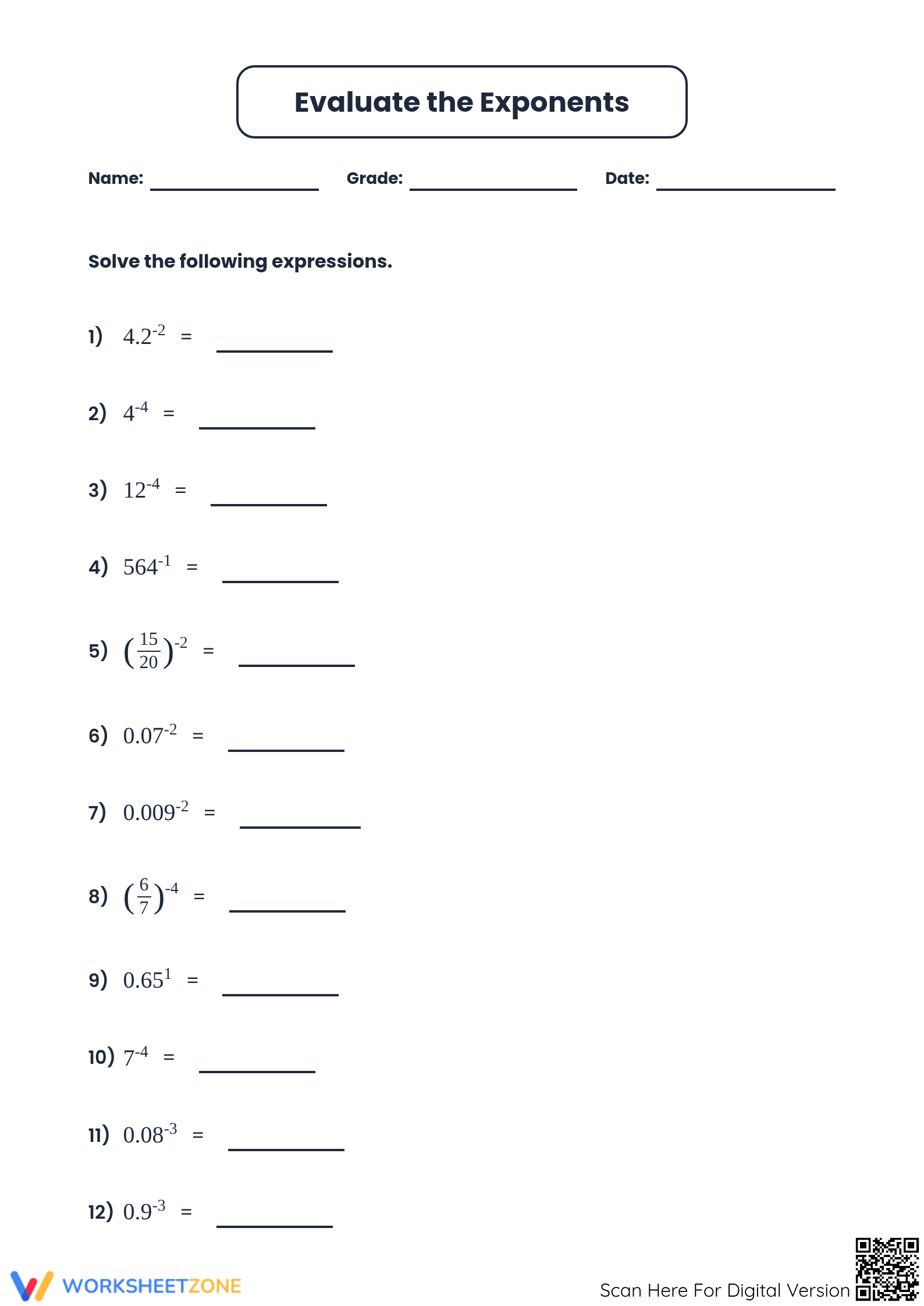


Printable Negative Exponents Worksheet | Grades 7-8 Math
Paste this activity's link or code into your existing LMS (Google Classroom, Canvas, Teams, Schoology, Moodle, etc.).
Students can open and work on the activity right away, with no student login required.
You'll still be able to track student progress and results from your teacher account.
This comprehensive worksheet helps middle school students master the complex concept of negative exponents. By evaluating expressions with integers, decimals, and fractional bases, learners develop a concrete understanding of reciprocal relationships in powers. This resource ensures students can confidently simplify higher-level algebraic expressions and prepare for advanced scientific notation and exponential functions.
At a Glance
- Grade: 8 · Subject: Math
- Standard:
8.EE.A.1— Apply properties of integer exponents to generate equivalent numerical expressions- Skill Focus: Evaluating negative exponents
- Format: 2 pages · 16 problems · Answer key included · PDF
- Best For: Homework, independent practice, or sub plans
- Time: 20–30 minutes
What's Inside
This two-page PDF contains 16 focused problems designed to challenge and solidify a student's grasp of exponent laws. The worksheet features a diverse array of base types, including whole integers, multi-digit decimals, and common fractions. Each problem provides a clear workspace for calculations. A complete answer key is provided on the final pages, allowing for efficient self-grading or rapid teacher verification.
Zero-Prep Workflow
This resource is designed for maximum classroom efficiency. First, print the two-page document in under 30 seconds. Second, distribute the sheets to students for independent or partner work. Third, review the results using the included answer key. Total teacher preparation time is under two minutes, making it an ideal choice for emergency sub plans or last-minute instructional shifts.
Standards Alignment
The primary focus of this worksheet is 8.EE.A.1, which requires students to know and apply the properties of integer exponents to generate equivalent numerical expressions. By working with negative powers, students practice the specific rule where a base raised to a negative power is the reciprocal of the base raised to the positive power. This standard code can be copied directly into lesson plans or curriculum mapping tools.
How to Use It
Use this worksheet as a formative assessment after a direct instruction lesson on integer exponent properties. Alternatively, assign it as a targeted homework task to reinforce the relationship between negative exponents and reciprocals. Teachers should observe students during the fraction-based problems to ensure they are correctly flipping the base before applying the power. Completion usually takes 25 minutes.
Who It's For
This practice set is perfect for 8th-grade students working toward standard mastery, as well as advanced 7th graders or high schoolers needing a quick refresher. It pairs naturally with an interactive notebook entry on exponent rules or a digital slide deck demonstrating the reciprocal method for negative powers. No additional teacher prep is required.
According to the EdReports 2024 analysis of middle school curriculum, procedural fluency with integer exponents is a critical gateway skill for success in Algebra I. This worksheet directly supports that fluency by providing high-repetition practice across varied numerical contexts. By shifting from whole numbers to decimals and fractions, the resource prevents students from over-relying on simple patterns, forcing them to apply the underlying mathematical law consistently. Research from the NAEP highlights that students who master exponent properties in Grade 8 show significantly higher achievement in secondary functions and modeling. This resource provides the structured, low-prep environment necessary for students to build this durable conceptual understanding through targeted repetition. Educators can use these 16 items to identify specific misconceptions regarding negative bases versus negative exponents, ensuring a robust foundation for future STEM success.


