


























Views
Downloads

6.EE.A.1 Worksheet: Exponent Mastery — Grade 6 Aligned
Paste this activity's link or code into your existing LMS (Google Classroom, Canvas, Teams, Schoology, Moodle, etc.).
Students can open and work on the activity right away, with no student login required.
You'll still be able to track student progress and results from your teacher account.
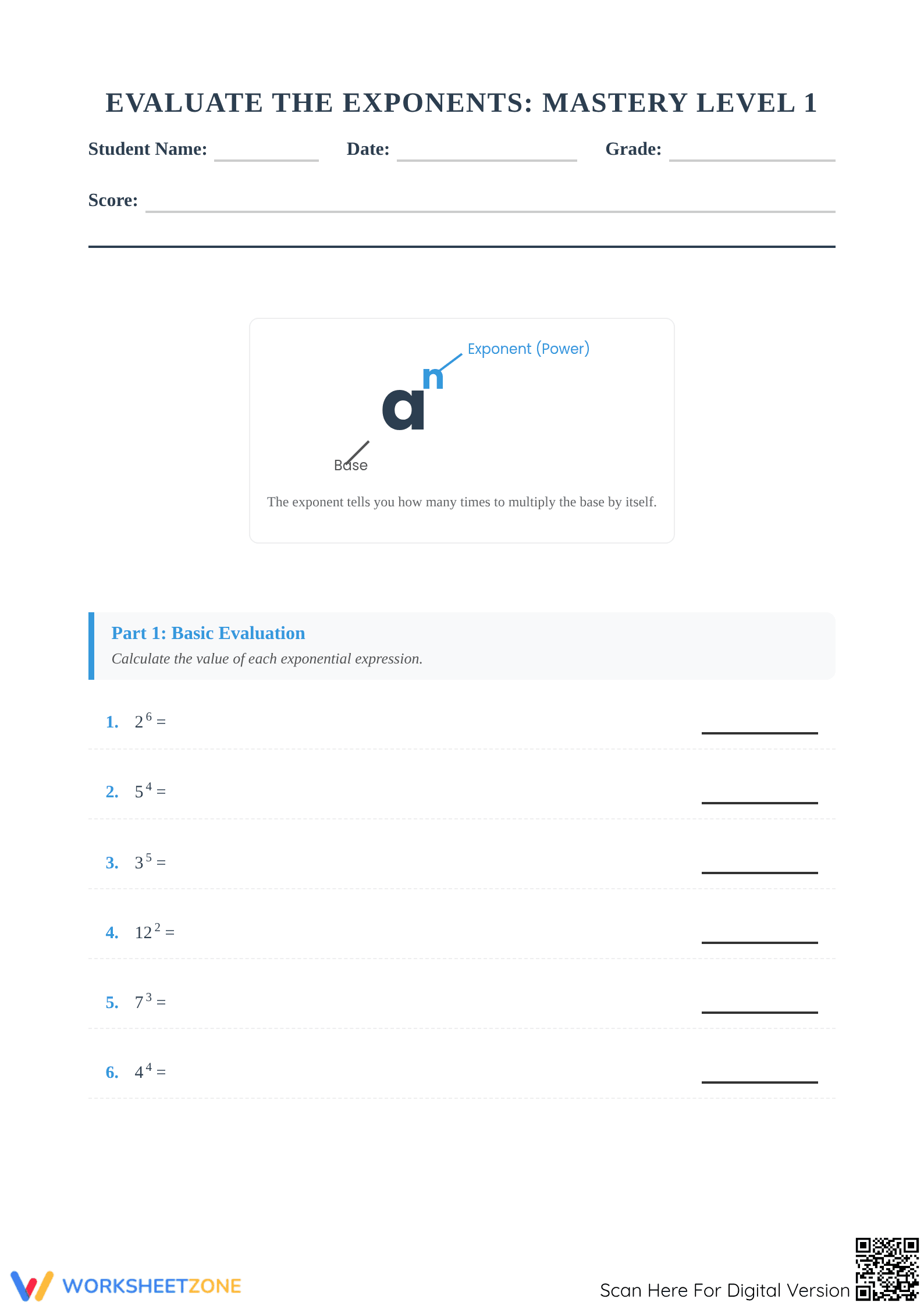
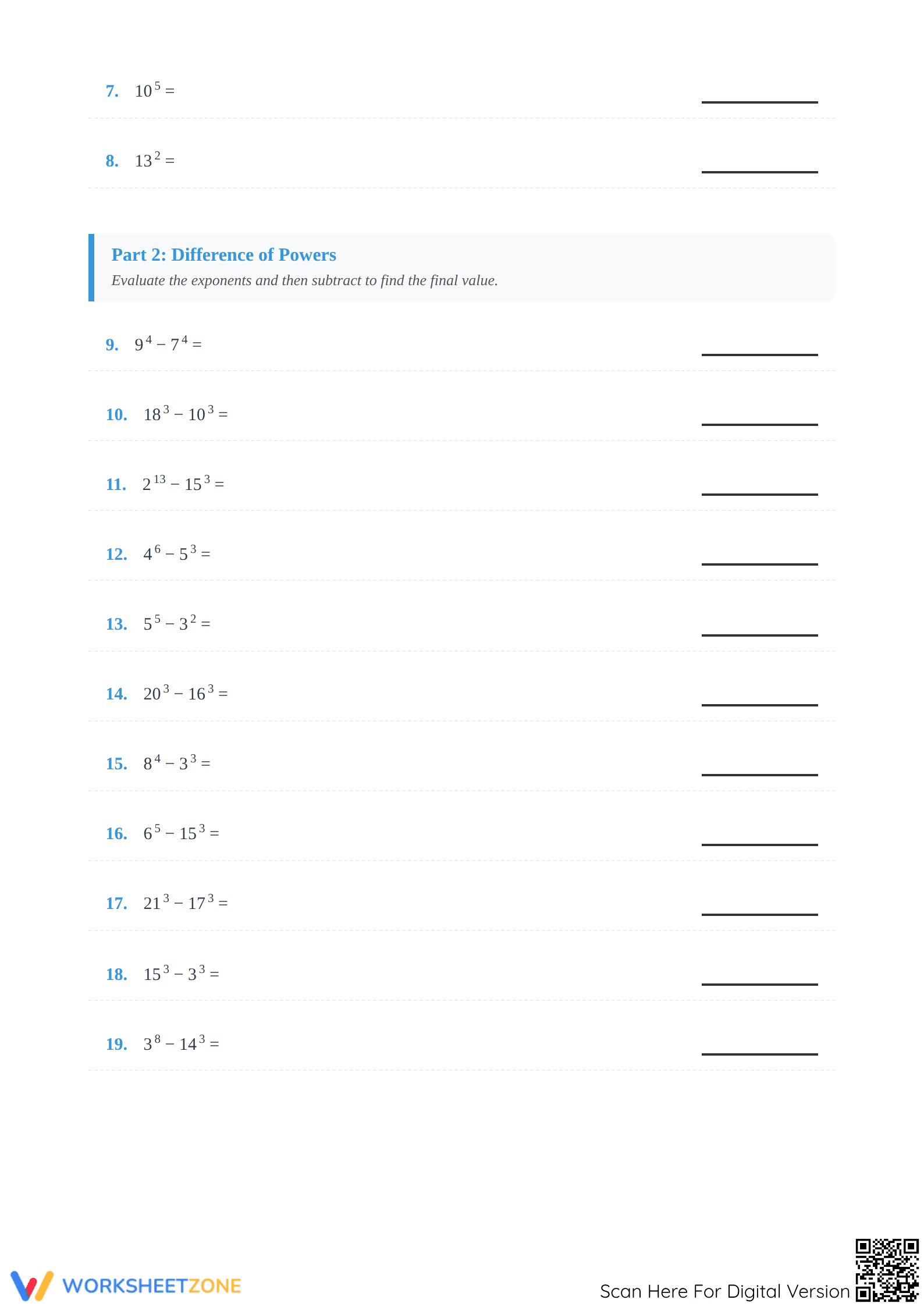
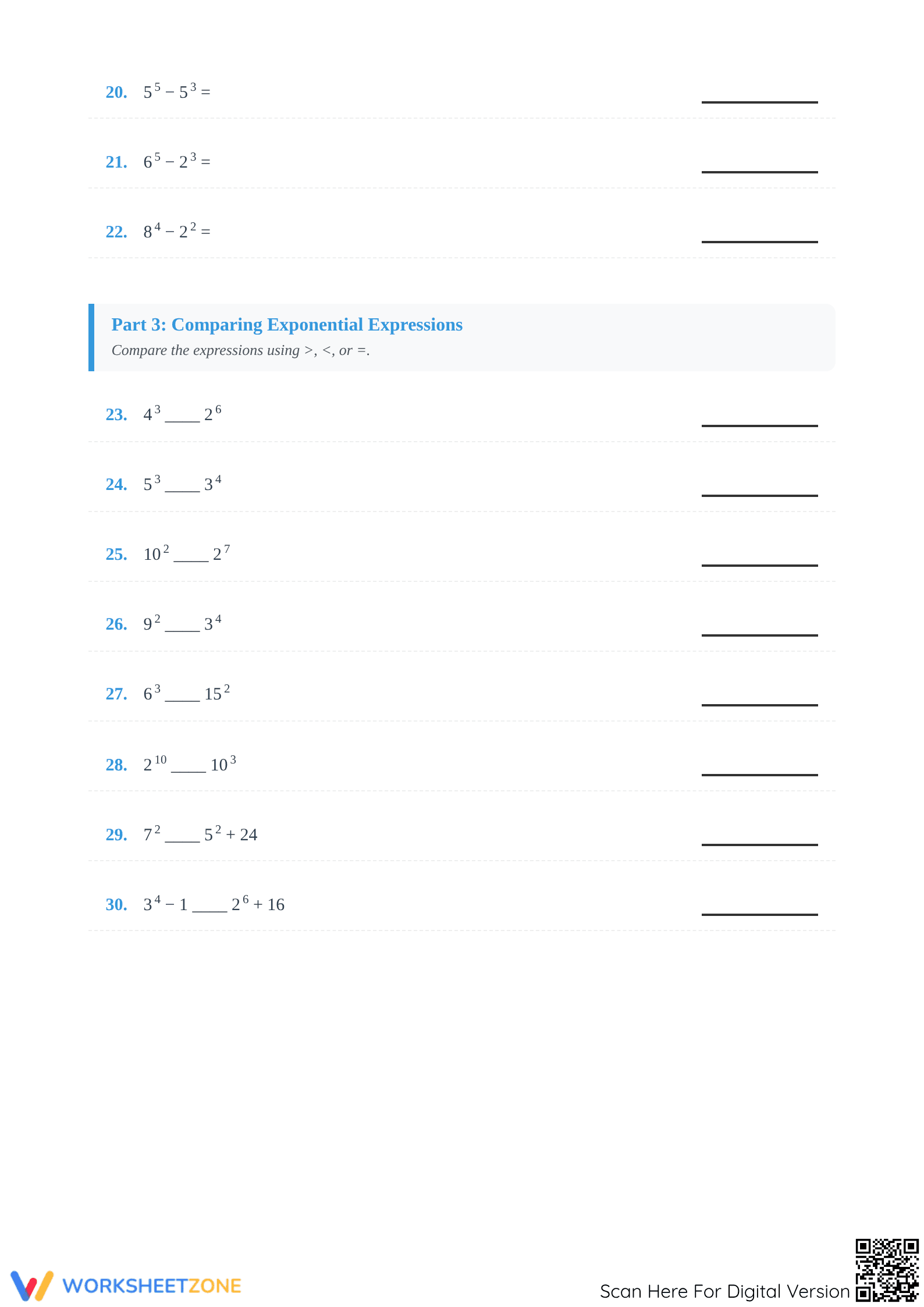
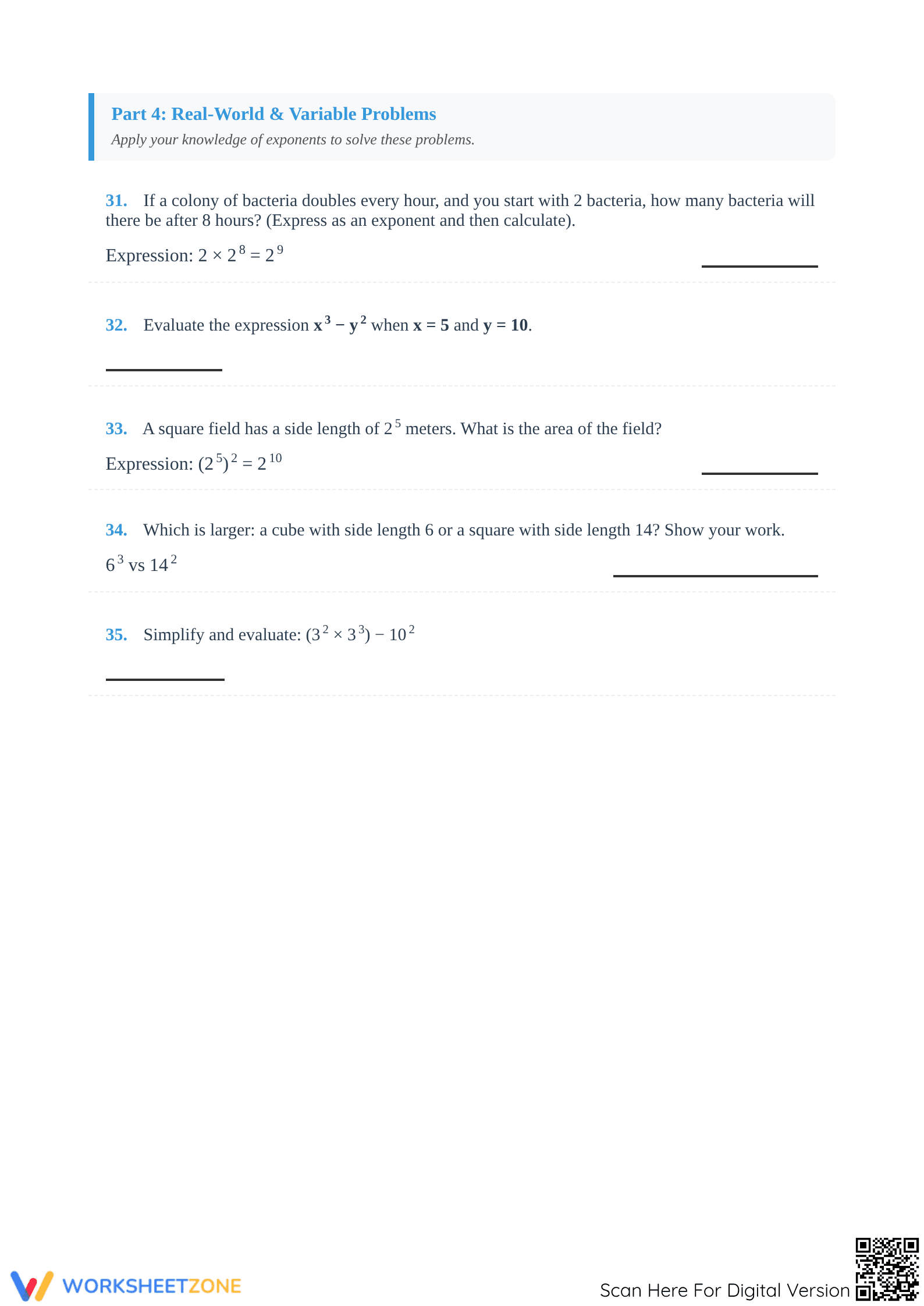
Students will master the evaluation of numerical expressions involving whole-number exponents through this comprehensive four-page practice set. By calculating basic powers, finding the difference between exponential terms, and solving real-world word problems, learners develop a deep conceptual understanding of base and power relationships. This resource ensures students can confidently simplify complex mathematical expressions.
At a Glance
- Grade: 6-8 · Subject: Math
- Standard:
CCSS.MATH.CONTENT.6.EE.A.1— Evaluate numerical expressions involving whole-number exponents- Skill Focus: Exponential Evaluation & Comparison
- Format: 4 pages · 35 problems · Answer key included · PDF
- Best For: Independent mastery practice and formative assessment
- Time: 30–45 minutes
This extensive math resource features 35 unique problems divided into four targeted sections. Page one begins with basic evaluation and an illustrated diagram of bases and exponents. Subsequent pages challenge students with "Difference of Powers" calculations, inequality comparisons using greater-than and less-than symbols, and high-order real-world applications involving bacteria growth and geometry. A complete answer key is provided for immediate feedback.
Mastery Evidence and Tiered Progression
The worksheet provides clear evidence of student mastery across three distinct tiers. Part 1 establishes the baseline through direct calculation. Parts 2 and 3 represent meeting the standard as students perform multi-step operations and inequalities. Finally, Part 4 requires students to apply exponential logic to variable expressions, making it ideal for tracking progress in IEP goals or standard-based grading reports.
Standards Alignment
Aligned with CCSS.MATH.CONTENT.6.EE.A.1, this resource requires students to evaluate numerical expressions involving whole-number exponents. It also supports 8.EE.A.1 by reinforcing laws of exponents through subtraction and comparison tasks. Both standard codes can be copied directly into lesson plans, IEP goals, or district curriculum mapping tools to ensure instructional compliance and vertical alignment.
Instructional Implementation
Utilize this worksheet during the independent practice phase after teaching fundamental rules of powers. It serves as an excellent formative-assessment tool; teachers should observe students during Part 3 to confirm they calculate the value of each side before applying the comparison symbol. Completion typically takes 35 minutes, making it a perfect mid-unit check or a robust homework assignment.
Student Population and Differentiation
This practice set is designed for middle school students in Grades 6 through 8 who are working toward algebraic fluency. It provides natural differentiation through its increasing complexity, making it suitable for general education classrooms, small-group intervention, or as a supplement to direct instruction passages on scientific notation and growth models in various science contexts.
Success in algebraic thinking requires students to bridge the gap between abstract notation and numerical value. According to the NAEP framework, fluency with exponents is a critical predictor of Algebra I success. This worksheet addresses that directly by providing 35 rigorous tasks aligned to CCSS.MATH.CONTENT.6.EE.A.1, focusing on the core skill of evaluating numerical expressions with whole-number exponents. By transitioning from basic recall to complex comparison and real-world variable substitution, the resource aligns with the research-based gradual release model advocated by Fisher & Frey (2014). Students demonstrating proficiency here are significantly better prepared for the high-order cognitive demands of non-linear functions and growth models. This systematic approach ensures that the plain-English skill of evaluating powers is reinforced through multiple mathematical lenses, providing a robust foundation for future STEM success.


