


























Views
Downloads
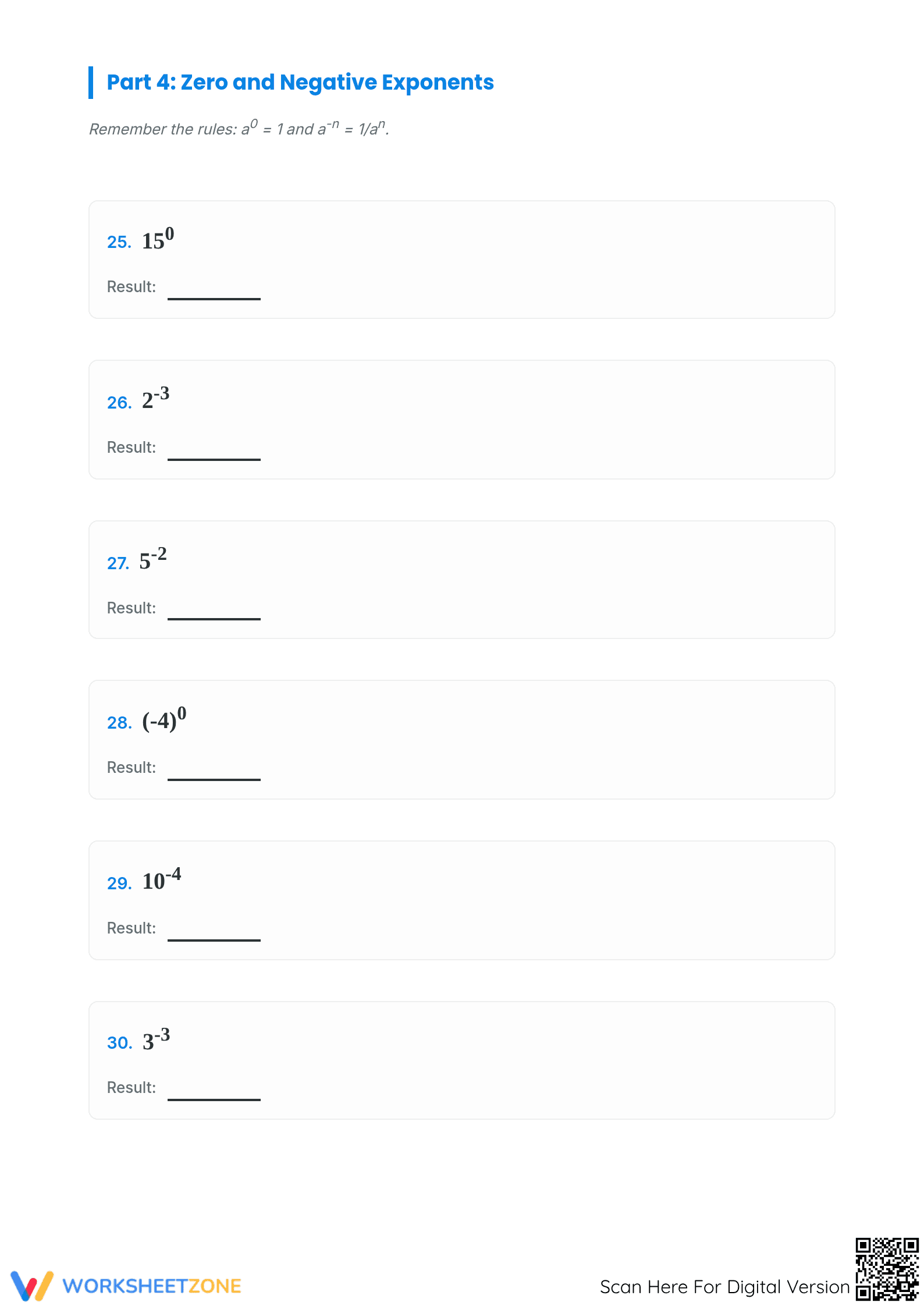

Evaluate Exponents Worksheet | Printable Grade 6-8 Math
Paste this activity's link or code into your existing LMS (Google Classroom, Canvas, Teams, Schoology, Moodle, etc.).
Students can open and work on the activity right away, with no student login required.
You'll still be able to track student progress and results from your teacher account.
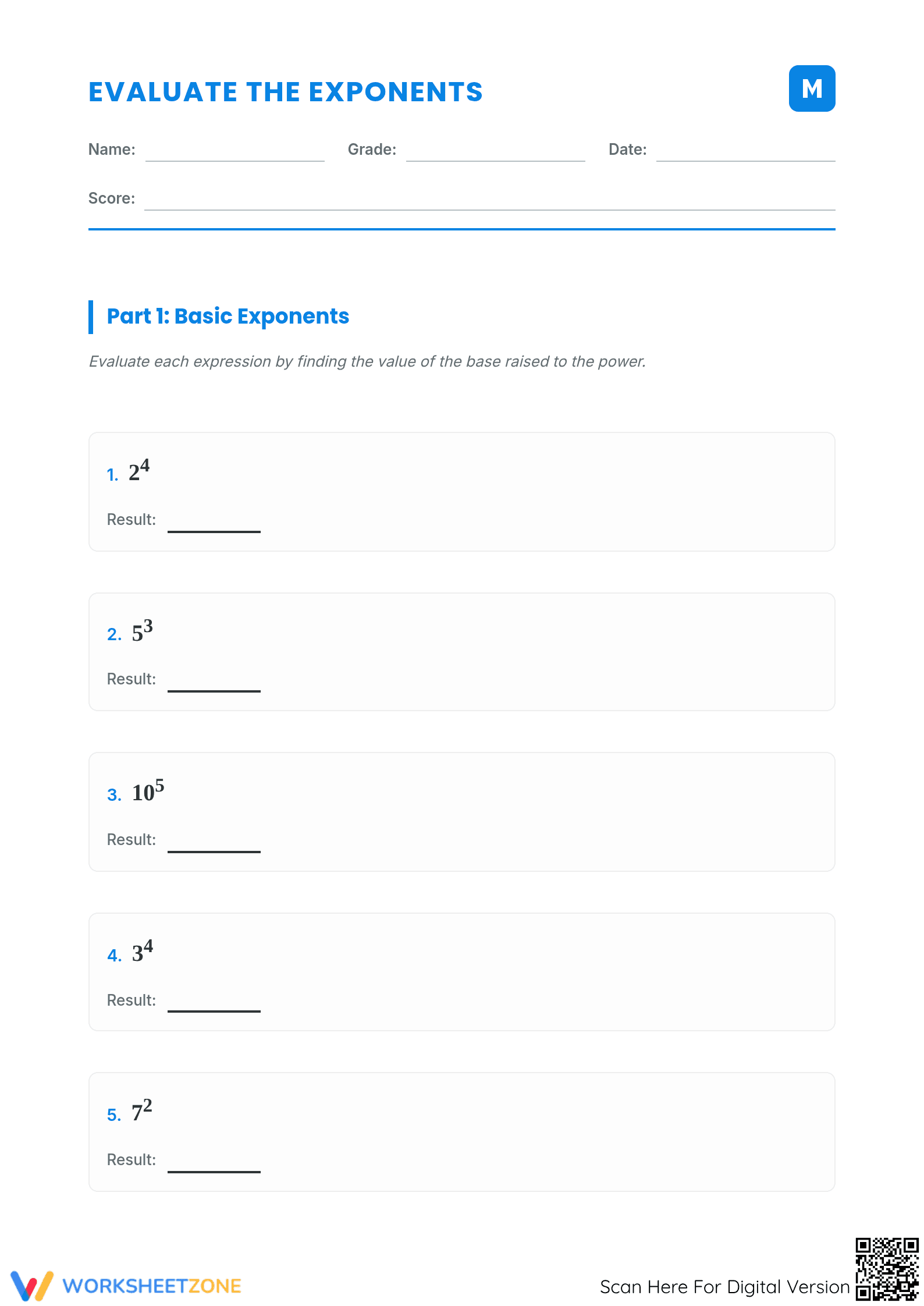
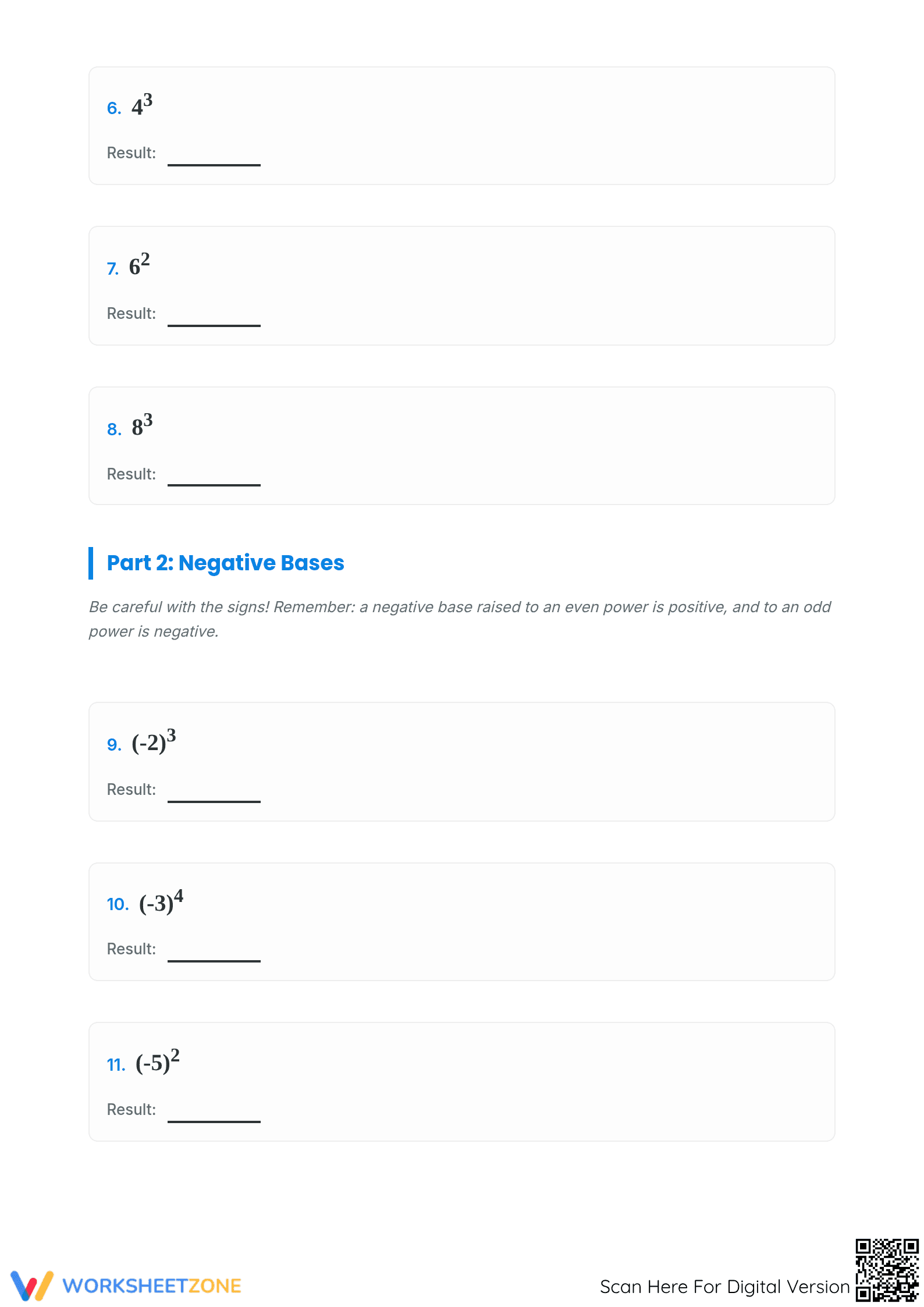
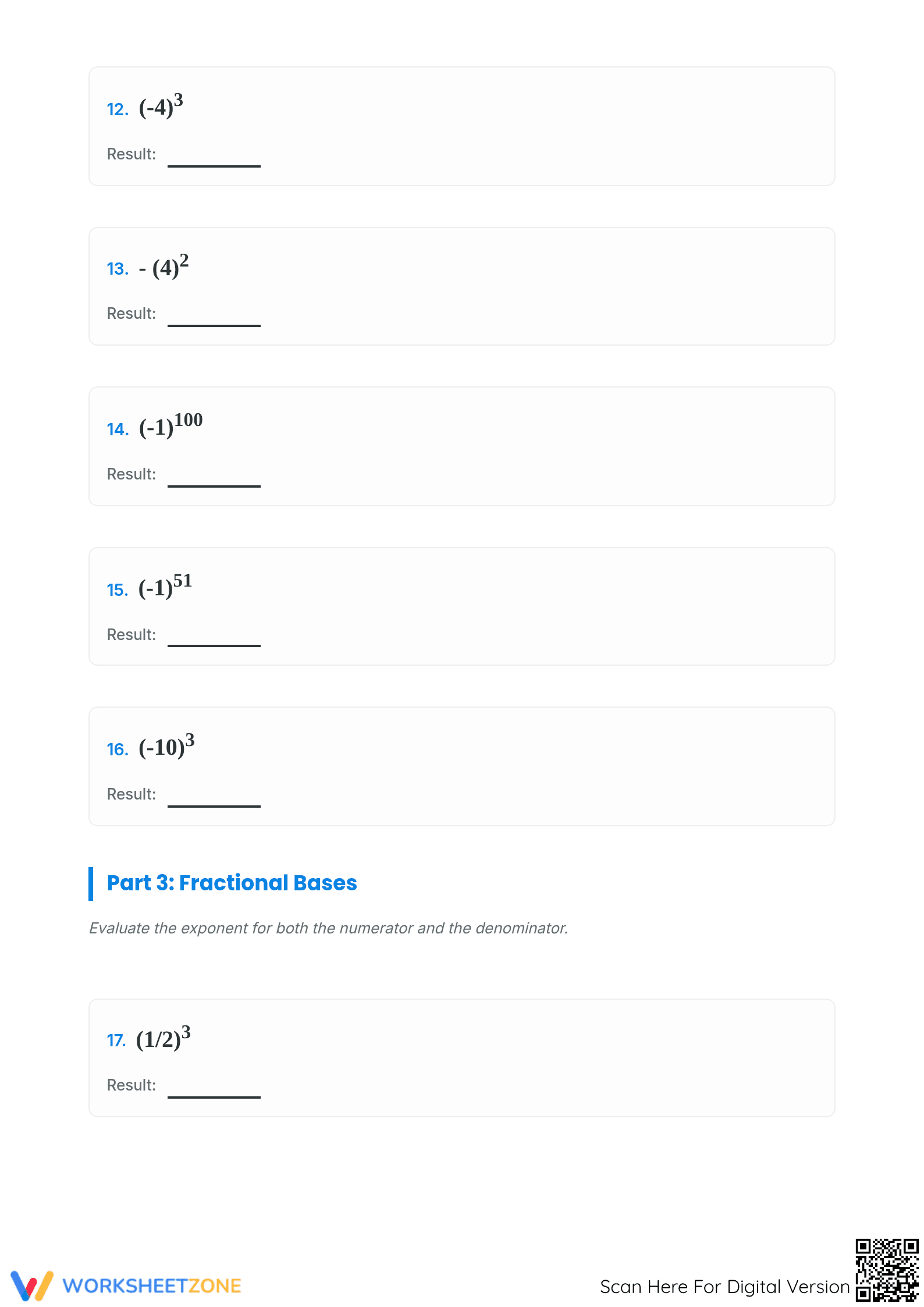
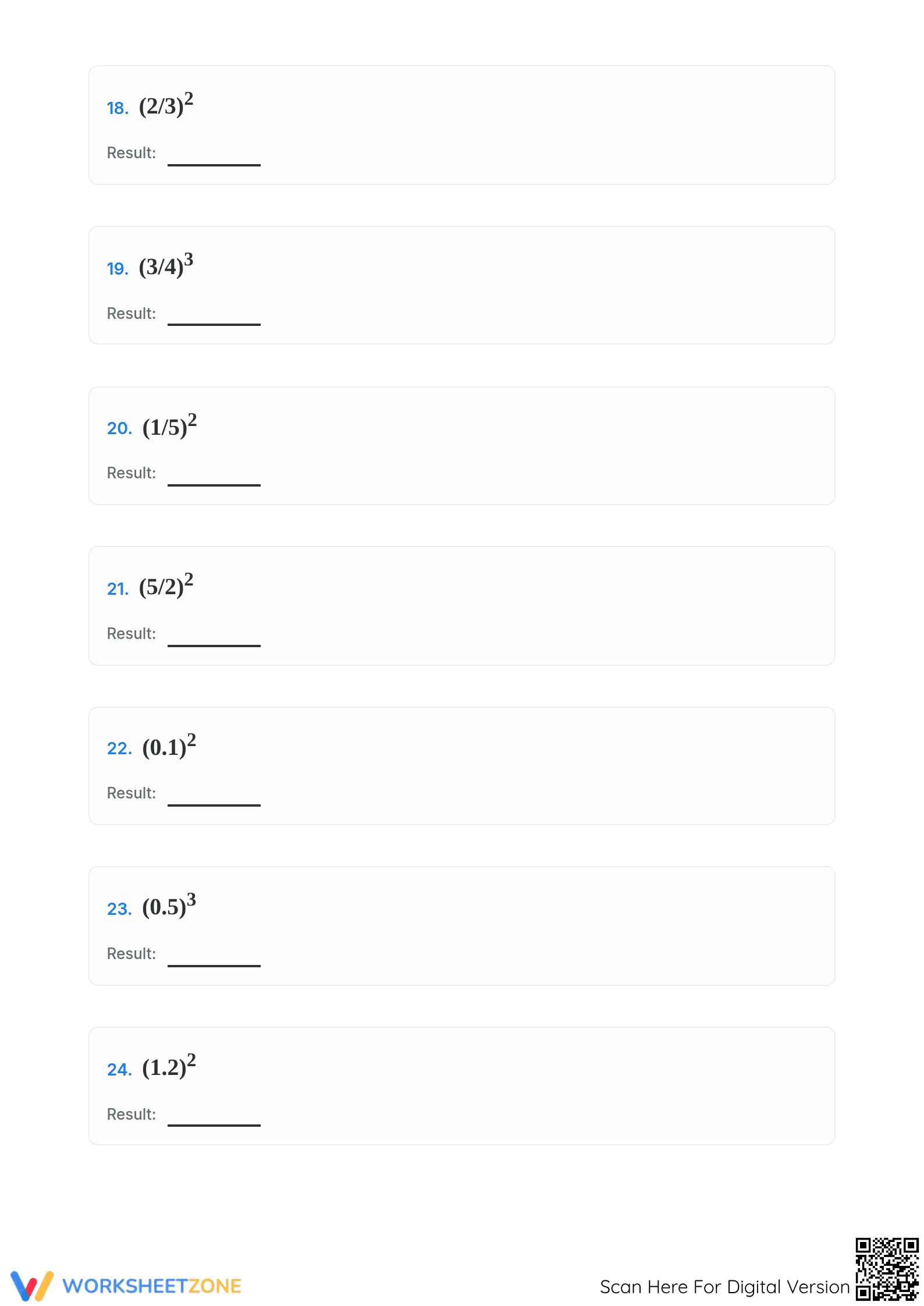
Mastery of exponents is a fundamental gateway to algebra. This comprehensive 5-page worksheet provides 30 targeted problems designed to help students confidently evaluate expressions with positive and negative bases, fractions, decimals, and negative exponents. By moving from basic concepts to advanced operations, learners build the numerical fluency required for high school mathematics.
At a Glance
- Grade: 6–8 · Subject: Math
- Standard:
CCSS.MATH.CONTENT.8.EE.A.1— Apply properties of integer exponents to generate and evaluate equivalent numerical expressions- Skill Focus: Evaluating various exponential expressions
- Format: 5 pages · 30 problems · Answer key included · PDF
- Best For: Independent practice and skill reinforcement
- Time: 30–45 minutes
What's Inside
This extensive resource is organized into four distinct sections to ensure a logical progression of difficulty. Across 5 pages, students encounter 30 unique tasks ranging from simple whole-number bases to complex negative and fractional bases. The worksheet features clear section headers, dedicated workspace for each result, and a complete answer key at the end for immediate feedback.
Skill Progression
- Guided Practice: Part 1 introduces 8 basic whole-number exponent problems to establish the foundational concept of repeated multiplication with manageable values.
- Supported Practice: Parts 2 and 3 introduce 9 problems involving negative and fractional bases, providing students with specific conceptual reminders to scaffold their logic.
- Independent Practice: The final sections present 13 challenging problems involving decimals, zero exponents, and negative exponents, requiring students to apply multiple rules independently.
This progression follows the gradual-release instructional model, ensuring students are never overwhelmed by the shift from basic to complex operations.
Standards Alignment
This worksheet is strictly aligned with CCSS.MATH.CONTENT.8.EE.A.1, which requires students to know and apply the properties of integer exponents to generate equivalent numerical expressions. It specifically addresses the evaluation of expressions where bases are rational numbers and exponents are integers. This standard code can be copied directly into lesson plans, IEP goals, or district curriculum mapping tools.
How to Use It
This resource is best utilized after direct instruction on the laws of exponents. Assign the first page as a quick check for understanding before moving to small-group rotations. Alternatively, use the final page on zero and negative exponents as a formative assessment to gauge readiness for scientific notation. Teachers should observe student work on Part 2 to ensure they correctly distinguish between negative bases and coefficient negation.
Who It's For
Designed for Grade 6, 7, and 8 students, this worksheet is ideal for regular math classrooms, pre-algebra support groups, and home-schooling environments. It pairs naturally with an anchor chart detailing the product of powers and negative exponent rules to support diverse learners during independent work.
Effective instruction in exponents requires moving beyond rote memorization to deep procedural fluency. According to EdReports 2024, high-quality middle school math materials must provide a balance of conceptual understanding and procedural practice, particularly with rational number bases and integer exponents. This 30-problem set directly supports that balance by forcing students to grapple with the structural differences between positive, negative, and zero exponents. Research from Fisher & Frey (2014) emphasizes the importance of scaffolds like the "Be careful" reminders included in this worksheet's Part 2, which help prevent common misconceptions regarding negative bases. By providing five pages of progressive difficulty, this resource ensures that students encounter enough variety to solidify their understanding before transitioning to more abstract algebraic expressions. The inclusion of a full answer key allows for the immediate self-correction that NAEP studies identify as a key driver of student growth in late-middle school mathematics.


