


























Views
Downloads


Essential Evaluate Exponents Worksheet | Grades 6-8 Math
Paste this activity's link or code into your existing LMS (Google Classroom, Canvas, Teams, Schoology, Moodle, etc.).
Students can open and work on the activity right away, with no student login required.
You'll still be able to track student progress and results from your teacher account.
Evaluating exponents with non-integer bases is a critical milestone for middle school mathematicians. This worksheet provides comprehensive practice for students to master evaluating expressions where the base is a fraction, decimal, or integer. Learners build the computational fluency required for advanced algebraic concepts and real-world scientific notation applications through these varied problems.
At a Glance
- Grade: 6–8 · Subject: Math
- Standard:
8.EE.A.1— Apply properties of integer exponents to generate equivalent numerical expressions- Skill Focus: Evaluating exponents with fractional and decimal bases
- Format: 5 pages · 32 problems · Answer key included · PDF
- Best For: Independent practice and skill reinforcement
- Time: 25–40 minutes
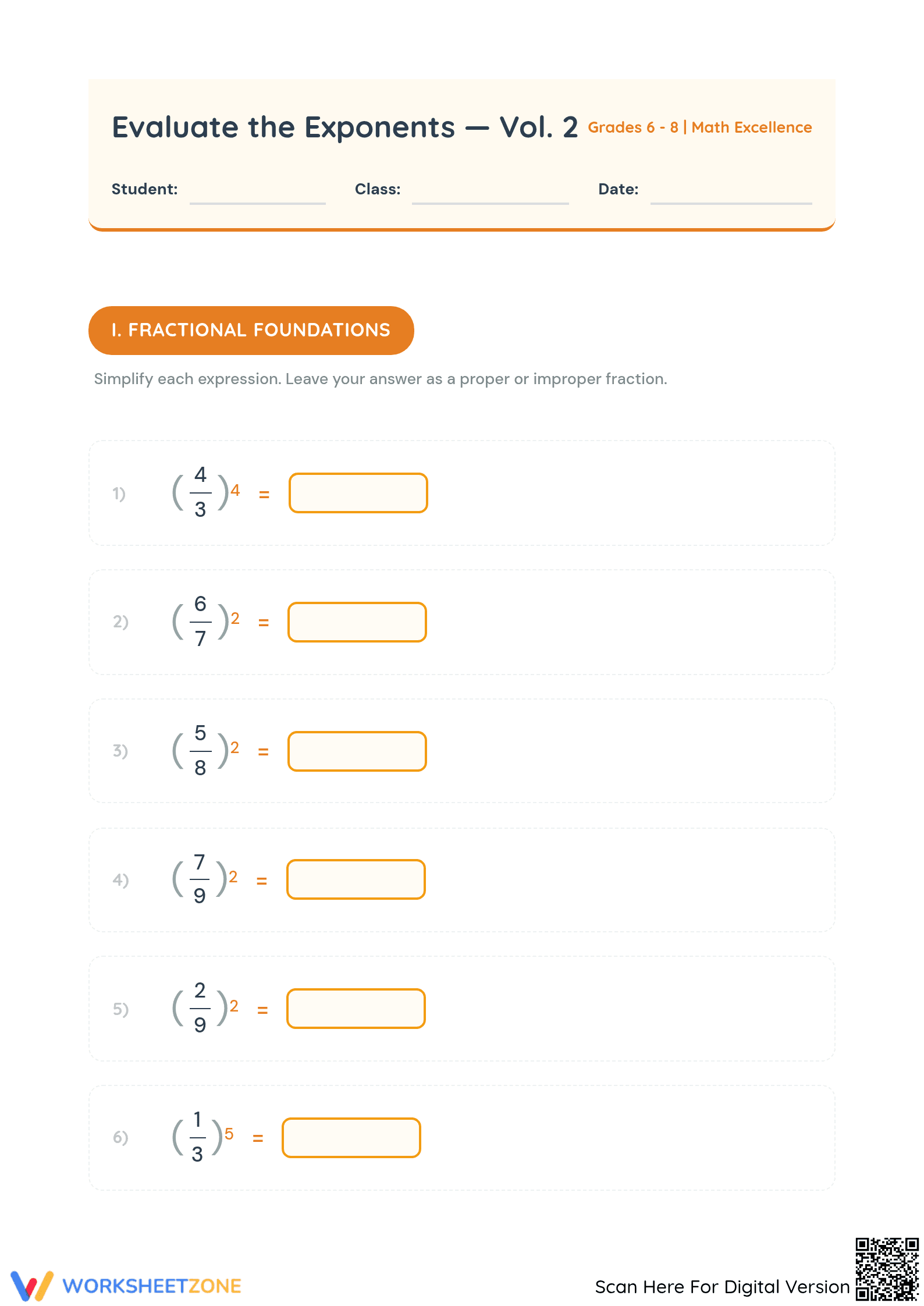
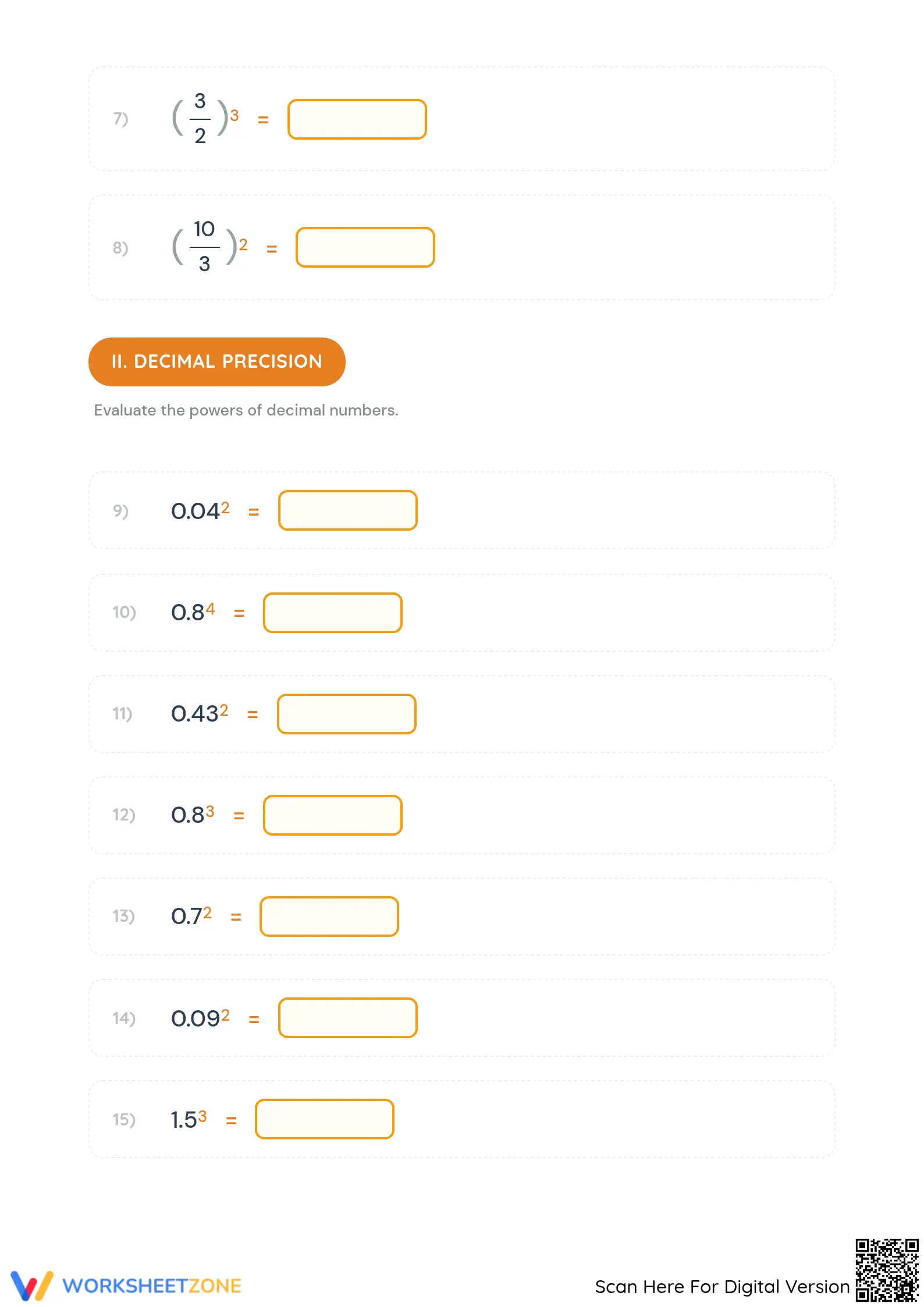
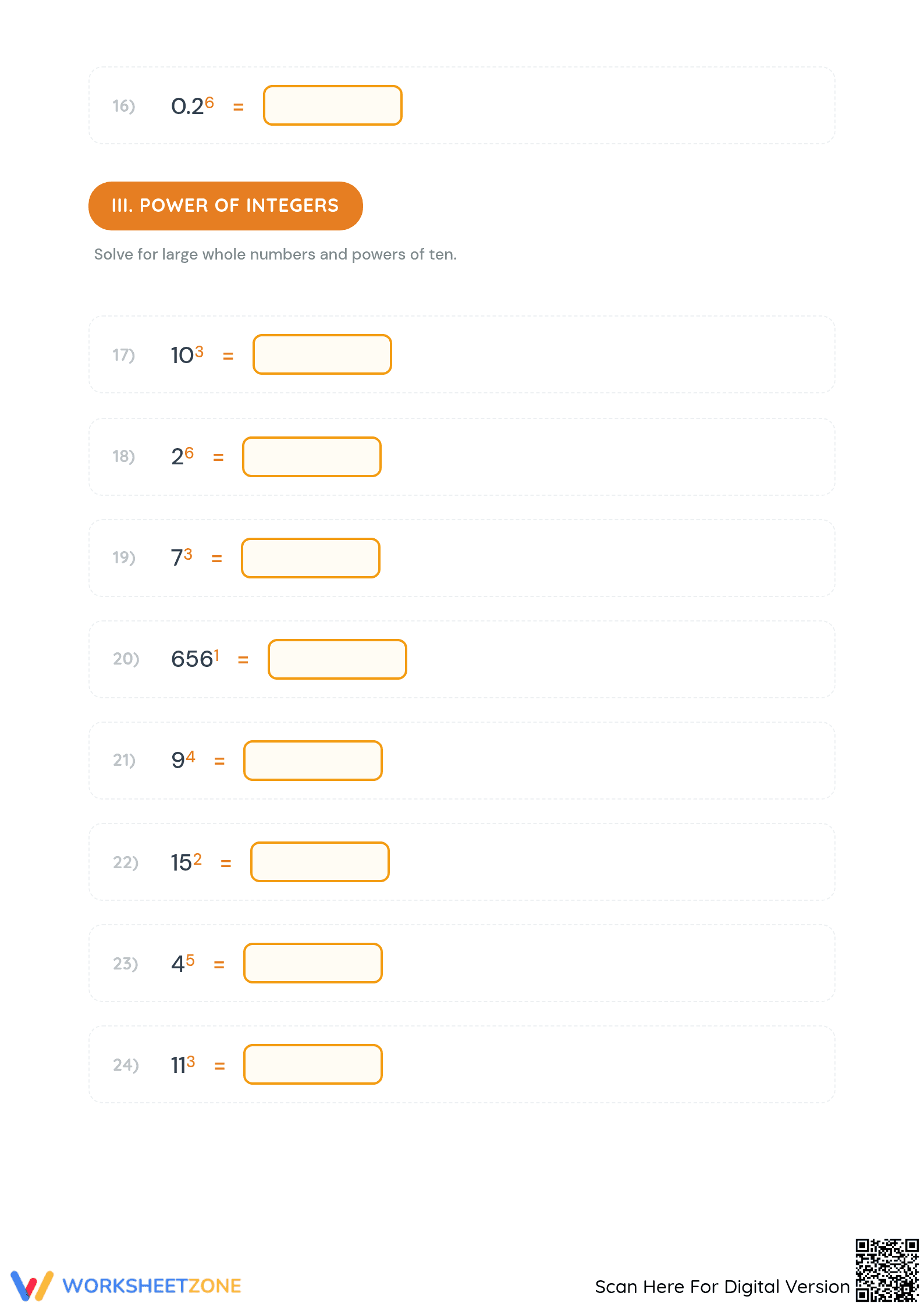
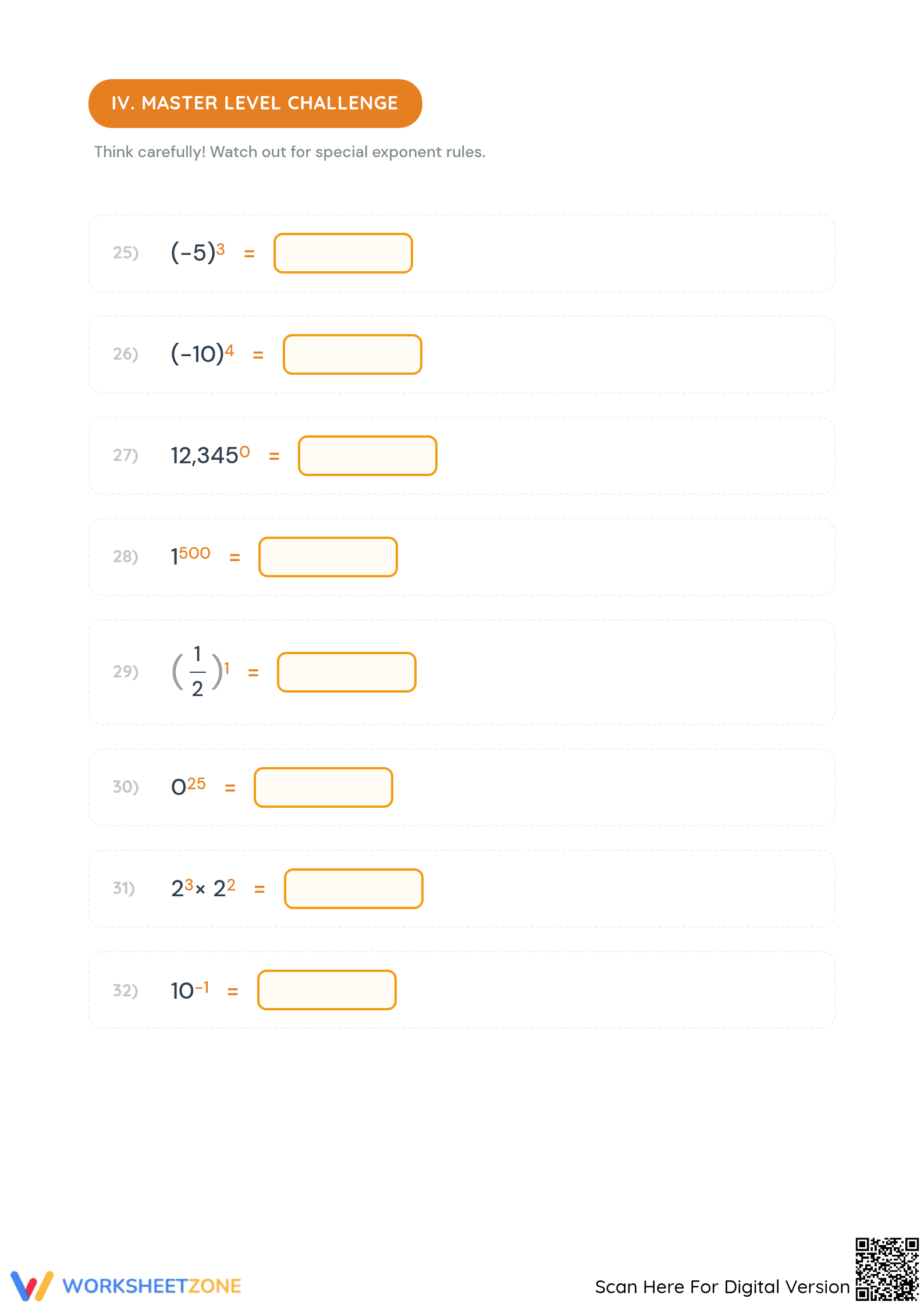
This five-page PDF resource contains four distinct sections designed to scaffold student understanding. Section I focuses on fractional foundations, while Section II transitions to decimal precision. Section III provides practice with large integers, and Section IV offers a master-level challenge covering zero powers and negative exponents. A comprehensive answer key is included.
- Guided practice: Initial problems use small fractional bases, allowing students to apply definitions without overwhelming calculation.
- Supported practice: Middle sections introduce decimals and larger integers, requiring precision with more complex values.
- Independent practice: The final challenge forces students to synthesize rules, including zero power and negative exponents.
This progression ensures students transition from basic application to high-level mastery.
Standards Alignment
The primary standard addressed is 8.EE.A.1: "Know and apply the properties of integer exponents to generate equivalent numerical expressions." This worksheet specifically targets evaluating numerical expressions involving whole-number exponents and introducing integer properties. This standard code can be copied directly into lesson plans, IEP goals, or district curriculum mapping tools.
How to Use It
Use this worksheet after direct instruction on exponent definitions and rules for fractions and decimals. Assign it as in-class practice to identify misconceptions in real-time. Teachers should observe students during the challenge section to assess understanding of the zero power property. Completion typically ranges from 25 to 40 minutes.
Who It's For
Designed for Grade 6-8 students, this resource is perfect for general classrooms or intervention tiers. The fractional and decimal bases provide natural differentiation for students who have already mastered whole numbers. It pairs excellently with an exponent rules anchor chart or a direct instruction lesson on powers.
Practice with numerical expressions is essential for developing algebraic readiness in secondary mathematics. According to EdReports 2024, high-quality materials must provide students with opportunities to engage with the full depth of standards, including non-integer bases. This Grade 6-8 worksheet addresses these requirements with 32 structured problems ranging from fractional evaluation to master-level challenges involving zero and negative exponents. By focusing on the 8.EE.A.1 standard, the resource ensures students apply properties of integer exponents to generate equivalent numerical expressions. Such targeted practice aligns with best practices for mathematical fluency, helping students bridge the gap between arithmetic and abstract reasoning. This self-contained module serves as an effective tool for both skill acquisition and retention, ensuring students are prepared for the rigors of high school algebra.


