


























Views
Downloads
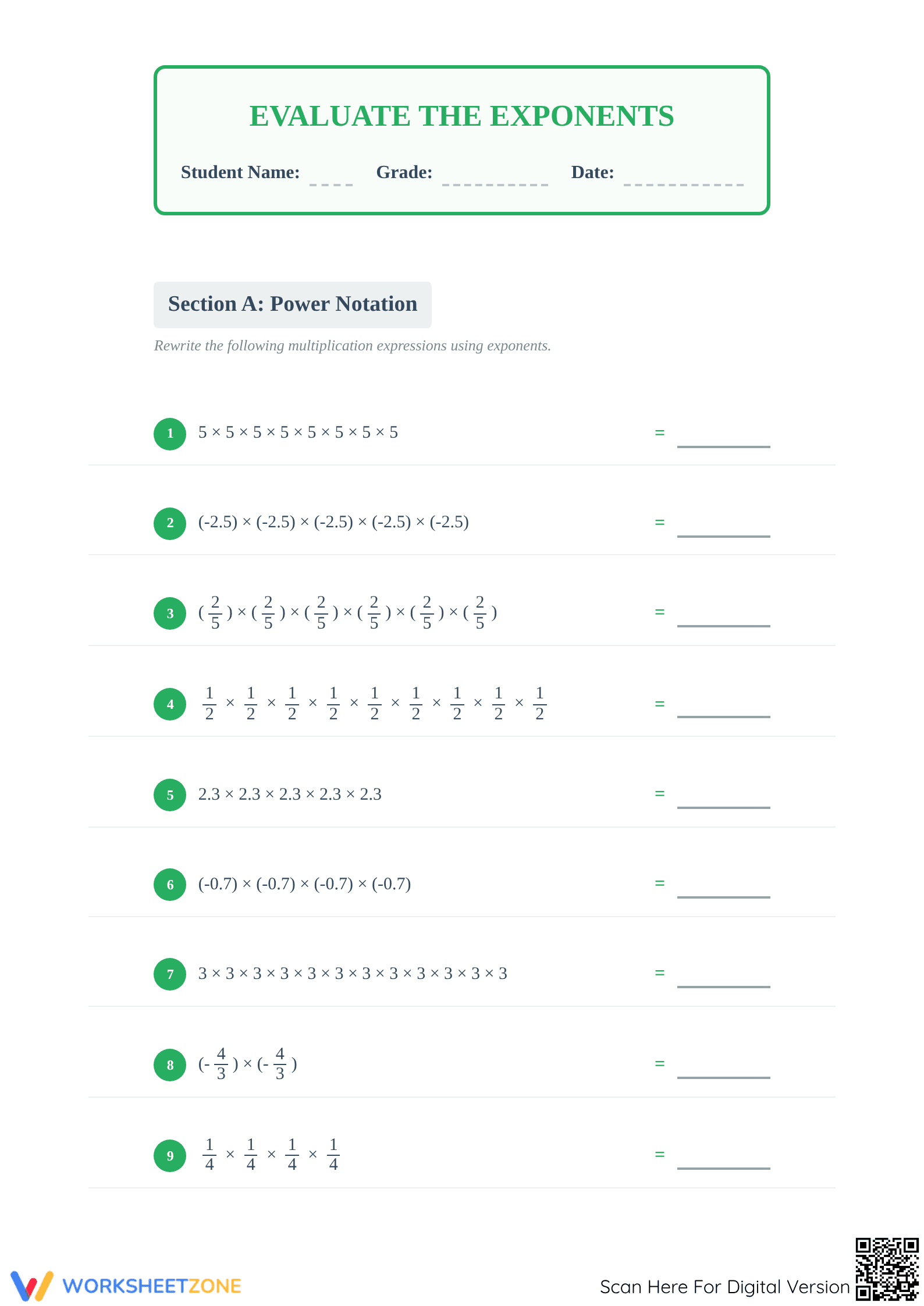


Evaluate the Exponents Worksheet | Grade 6-8 Essential
Paste this activity's link or code into your existing LMS (Google Classroom, Canvas, Teams, Schoology, Moodle, etc.).
Students can open and work on the activity right away, with no student login required.
You'll still be able to track student progress and results from your teacher account.
This comprehensive three-page worksheet provides rigorous practice for middle school students to master the concept of exponents. Students will progress through identifying power notation, calculating numerical values, and comparing exponential expressions. By completing these exercises, learners develop the fluency required for high-level algebraic thinking and complex mathematical operations involving powers and indices.
At a Glance
- Grade: 6–8 · Subject: Math
- Standard:
6.EE.A.1— Write and evaluate numerical expressions involving whole-number exponents- Skill Focus: Exponential evaluation and notation
- Format: 3 pages · 24 problems · Answer key included · PDF
- Best For: Independent practice or formative assessment
- Time: 25–40 minutes
What's Inside: The resource is organized into three distinct sections across three pages to ensure a thorough review of the topic. It includes 12 notation problems, 6 value calculation tasks, and 6 complex comparison questions. A full answer key is provided to allow for quick grading or student self-correction, making it an ideal tool for diverse classroom settings.
Skill Progression:
- Guided Practice: The first 12 tasks focus on rewriting repeated multiplication as power notation, reinforcing the fundamental definition of an exponent.
- Supported Practice: Problems 13 through 18 require students to find the exact numerical value of various powers, including those with fractional and negative bases.
- Independent Practice: The final section challenges students to compare two different exponential expressions using inequality symbols, requiring deep conceptual understanding.
Standards Alignment: This worksheet is specifically designed to meet CCSS.MATH.CONTENT.6.EE.A.1, which requires students to write and evaluate numerical expressions involving whole-number exponents. It also supports 8.EE.A.1 by introducing operations with powers and foundational index laws. Both standard codes can be copied directly into lesson plans, IEP goals, or district curriculum mapping tools.
How to Use It: Use this as a summative assessment after a unit on expressions or as a rigorous homework assignment. Teachers can observe student performance on Section C to identify those who may struggle with the relative magnitude of powers versus bases. Expect most Grade 6 students to complete the full set within 35 minutes.
Who It's For: This practice set is designed for Grade 6, 7, and 8 students who need to solidify their understanding of powers. It is particularly effective for students preparing for standardized testing or those needing extra support with the transition from arithmetic to algebra. It pairs naturally with an anchor chart on exponent rules.
Mathematical fluency in evaluating exponents is a critical predictor of success in secondary algebra and STEM pathways. According to EdReports 2024, high-quality instructional materials must provide students with ample opportunities to engage with both the procedural and conceptual aspects of the CCSS.MATH.CONTENT.6.EE.A.1 standard. This worksheet addresses that need by bridging the gap between simple notation and complex comparison. By requiring students to calculate 24 distinct problems that range from basic whole numbers to decimal and fractional bases, the resource ensures that learners do not rely on rote memorization but instead apply the definition of exponents consistently. The inclusion of a clear answer key supports the iterative feedback loops necessary for mastery. This structured approach to power notation and evaluation serves as a vital component in a balanced mathematics curriculum, preparing students for more advanced topics like scientific notation and exponential functions.


