


























Views
Downloads


Essential Evaluate Exponents Worksheet | Grade 6 Math Guide
Paste this activity's link or code into your existing LMS (Google Classroom, Canvas, Teams, Schoology, Moodle, etc.).
Students can open and work on the activity right away, with no student login required.
You'll still be able to track student progress and results from your teacher account.
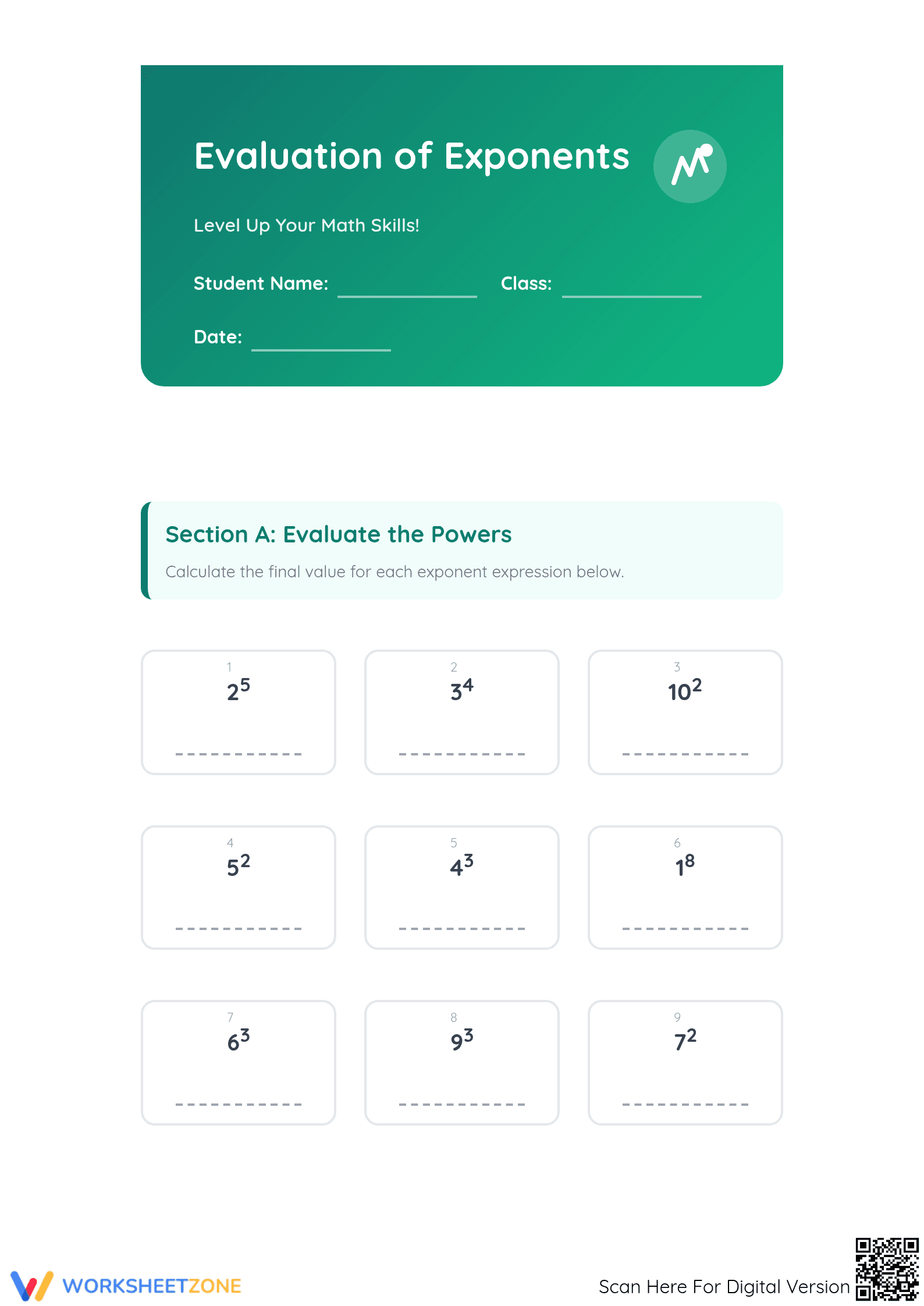
Mastering exponential notation is a critical milestone for middle school mathematicians. This comprehensive 4-page worksheet guides students through the process of evaluating numerical expressions with whole-number exponents. By practicing repeated multiplication and applying exponents to basic operations, students build the procedural fluency necessary for algebraic success. This resource ensures learners transition confidently from arithmetic to variables.
At a Glance
- Grade: 6 · Subject: Math
- Standard:
CCSS.MATH.CONTENT.6.EE.A.1— Write and evaluate numerical expressions involving whole-number exponents- Skill Focus: Exponential Evaluation
- Format: 4 pages · 33 problems · Answer key included · PDF
- Best For: Independent practice and skills reinforcement
- Time: 25–40 minutes
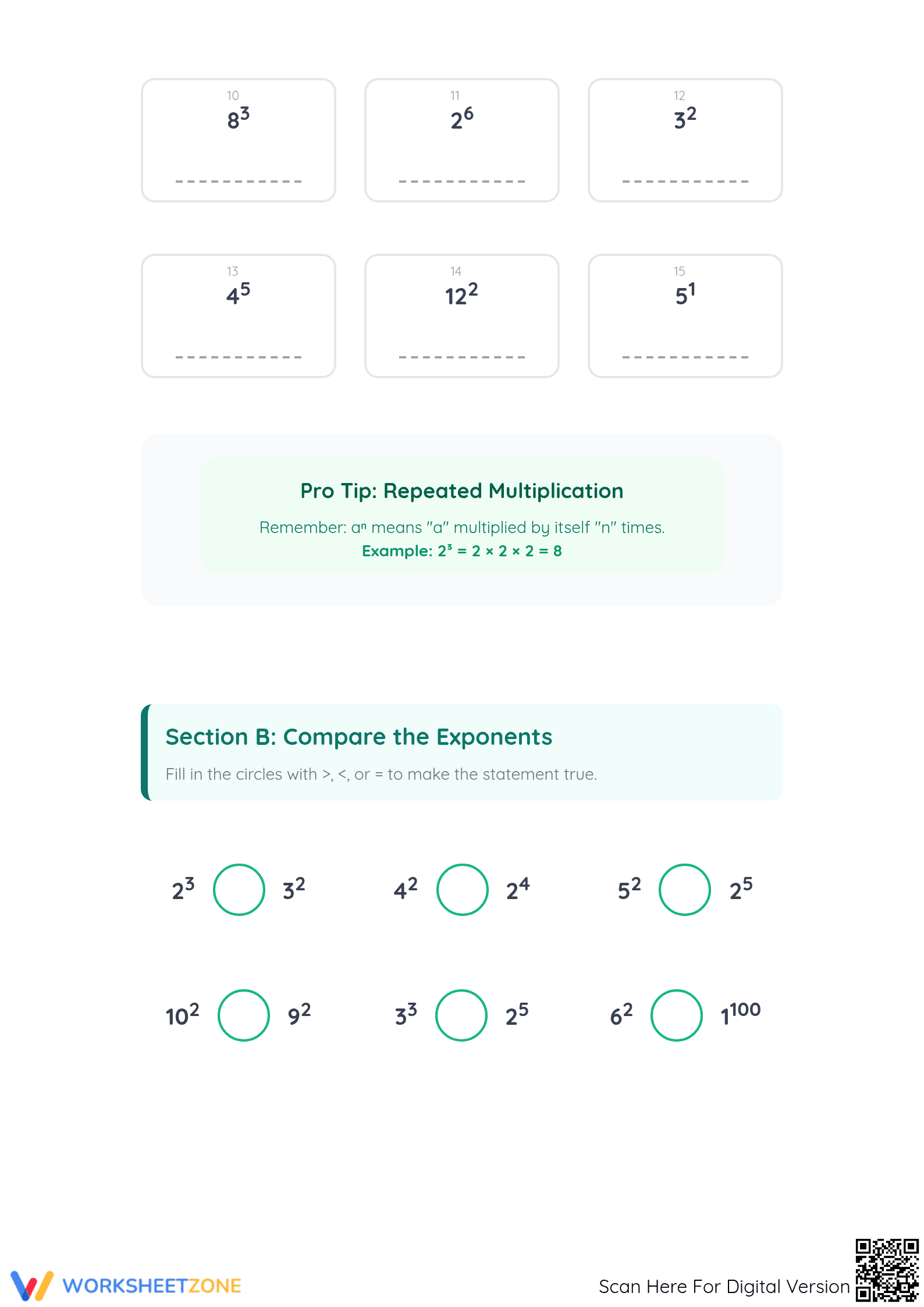
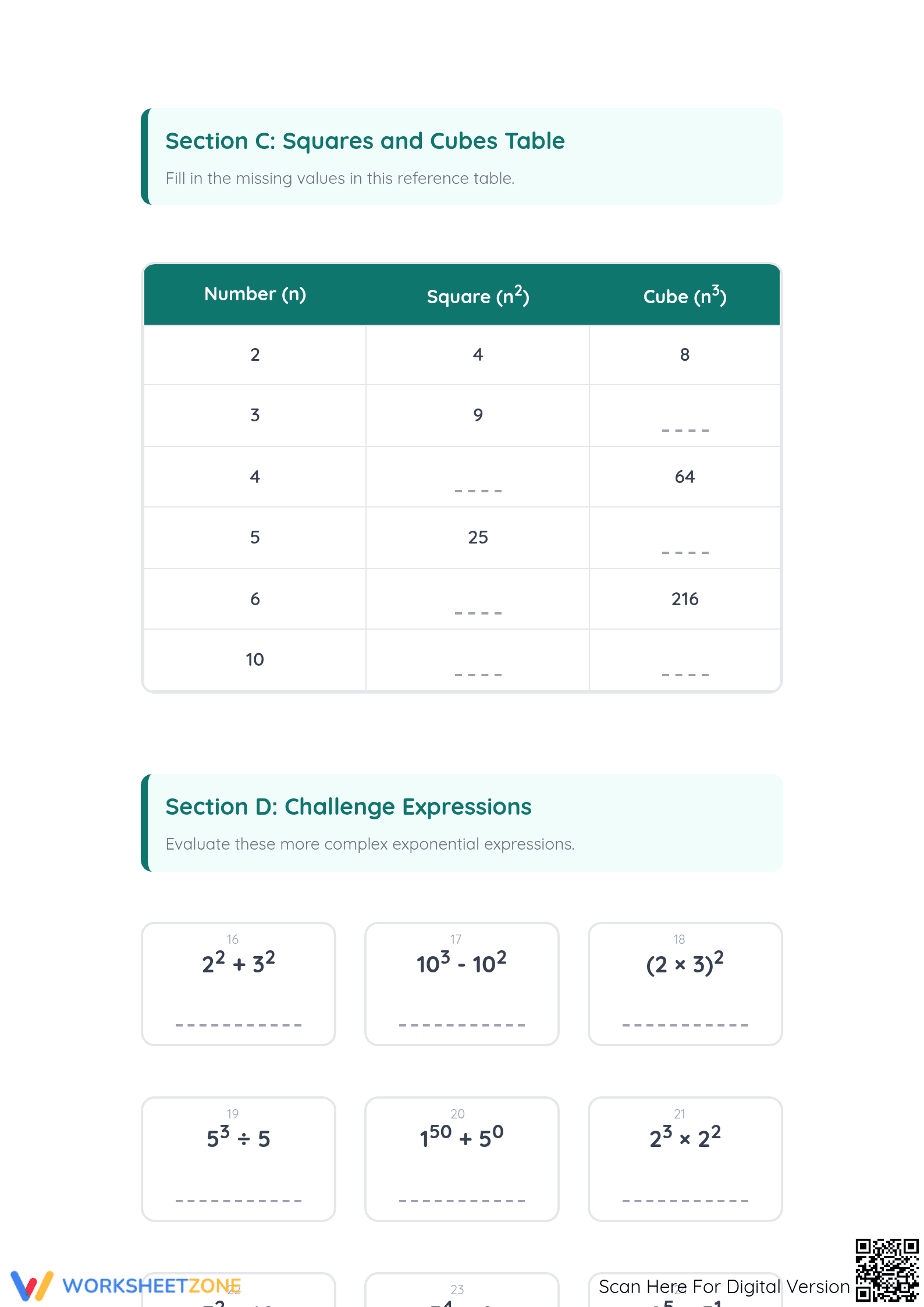
This structured packet features four distinct learning sections across 4 printable pages. Section A introduces 15 foundational evaluation problems, while Section B challenges students to compare exponential values using inequality symbols. A comprehensive squares and cubes reference table in Section C supports memorization. Finally, Section D presents challenge expressions involving addition, subtraction, multiplication, and division of powers, providing a full answer key for immediate feedback.
Zero-Prep Workflow
Designed for the busy educator, this resource requires zero minutes of teacher preparation. Simply print the 4-page PDF and distribute it to your Grade 6, 7, or 8 students for an immediate high-quality math session. The self-explanatory layout and 'Pro Tip' box allow for independent completion in under 40 minutes, making it an ideal choice for emergency sub plans or routine homework assignments.
Standards Alignment
This resource is strictly aligned to CCSS.MATH.CONTENT.6.EE.A.1, focusing on writing and evaluating numerical expressions with whole-number exponents. It scaffolds the concept by starting with base-and-power identification and moving toward multi-step calculations. This standard code can be copied directly into lesson plans, IEP goals, or district curriculum mapping tools.
How to Use It
Use this worksheet as a summative check after your initial lesson on exponents or as a warm-up activity for pre-algebra units. During the 'You Do' phase of instruction, observe students as they complete the Section B comparisons to identify misconceptions about base versus exponent magnitude. Most students will complete the full sequence within 30 minutes, allowing for a quick whole-class review using the provided key.
Who It's For
This packet is ideal for Grade 6 students encountering exponents for the first time, as well as Grade 7 and 8 learners needing targeted remediation. The inclusion of the Squares and Cubes Table makes it an excellent support for students with IEP accommodations or those struggling with basic multiplication facts. Pair this resource with a visual anchor chart for maximum instructional impact.
The Evaluation of Exponents worksheet directly addresses the cognitive demands of numerical fluency as defined by current mathematical pedagogical frameworks. By requiring students to transition from simple base-power identification to complex operational expressions, the resource facilitates a deeper conceptual understanding of repeated multiplication. According to a ScienceDirect TpT Analysis, structured practice that combines procedural repetition with comparison tasks—such as those found in Section B—significantly increases long-term retention of exponential rules among middle school learners. This 4-page guide provides the necessary scaffolding to bridge the gap between basic arithmetic and algebraic reasoning. The inclusion of a squares and cubes reference table further supports working memory during complex problem-solving sessions. Educators can rely on this standard-aligned resource to provide high-quality, evidence-based practice for CCSS.MATH.CONTENT.6.EE.A.1. It ensures students develop the precision required for higher-level mathematics while maintaining an accessible entry point for diverse classroom populations.


