


























Views
Downloads


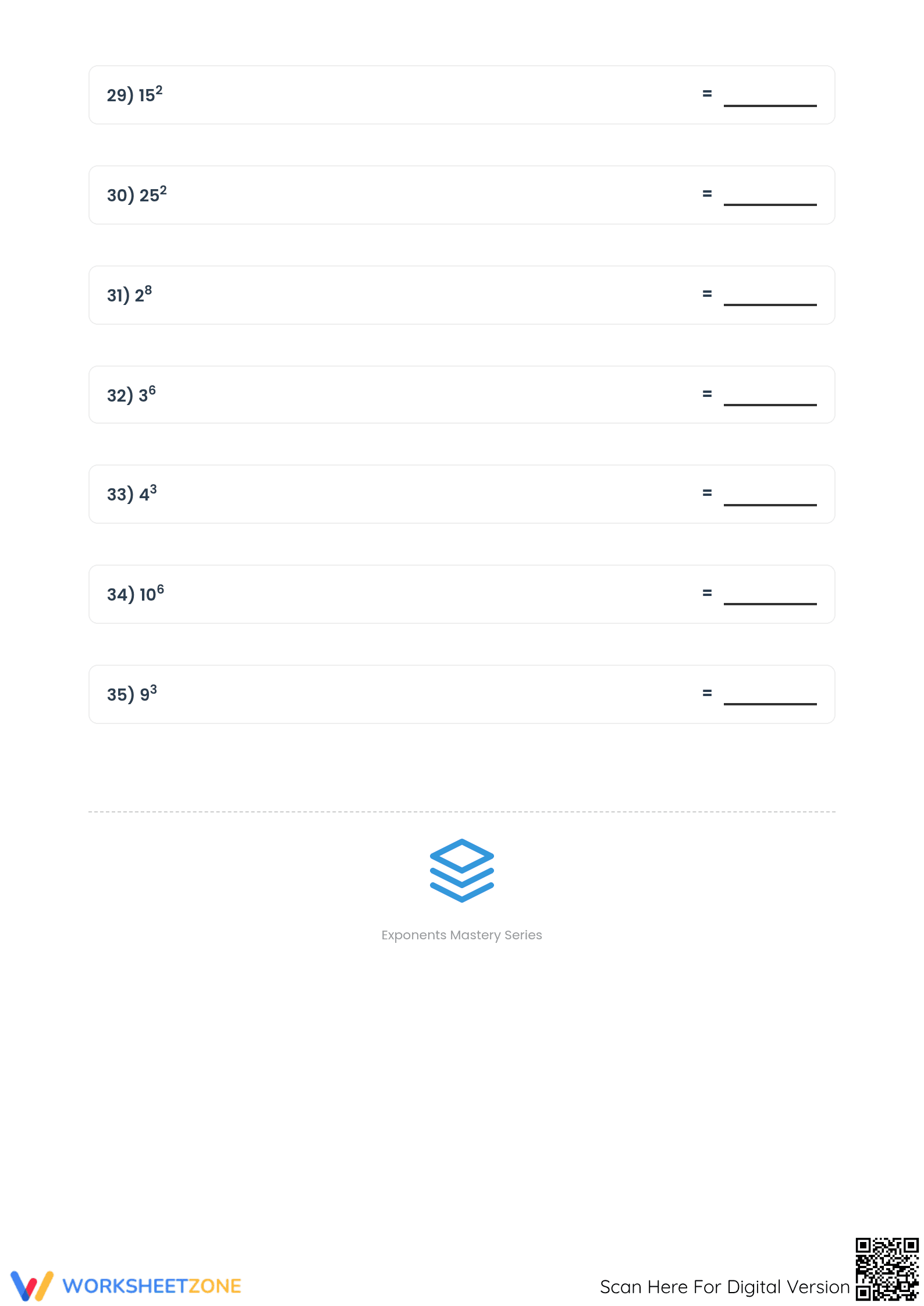

Evaluate Exponents Worksheet (3 Levels) | Grade 6 Ready
Paste this activity's link or code into your existing LMS (Google Classroom, Canvas, Teams, Schoology, Moodle, etc.).
Students can open and work on the activity right away, with no student login required.
You'll still be able to track student progress and results from your teacher account.
This printable math worksheet helps middle school students master the fundamental skill of evaluating whole-number exponents. Students move from basic power calculations to complex multi-digit bases, ensuring total fluency with exponential notation. By providing tiered practice, it bridges the gap between conceptual understanding and computational accuracy in algebraic expressions.
At a Glance
- Grade: 6 · Subject: Math
- Standard:
CCSS.MATH.CONTENT.6.EE.A.1— Write and evaluate numerical expressions involving whole-number exponents- Skill Focus: Exponential Evaluation
- Format: 4 pages · 35 problems · Answer key included · PDF
- Best For: Scaffolded practice and skill mastery
- Time: 25–40 minutes
What's Inside
This comprehensive 4-page PDF contains 35 carefully sequenced problems designed to take students from introduction to mastery. The layout is clean and distraction-free, featuring dedicated sections for different difficulty tiers. A complete answer key is provided on the final pages, allowing for rapid grading or student self-correction. The worksheet utilizes standard notation with clear bases and superscripts to prevent reading errors.
Level Descriptions
- Introductory Level (Standard): 10 problems focusing on small whole-number bases and exponents 0-7 to establish the pattern of repeated multiplication and the zero power rule.
- On-Grade Challenge (Intermediate): 10 problems introducing varied bases like 13 and 17, pushing students to calculate larger products and maintain accuracy.
- Above-Grade Extension (Mastery): 15 rigorous problems featuring higher powers (e.g., 2 to the 10th) and large bases, requiring sustained concentration and multi-step multiplication.
All three versions are included in the document for seamless classroom differentiation.
Standards Alignment
The primary focus is CCSS.MATH.CONTENT.6.EE.A.1, which requires students to write and evaluate numerical expressions involving whole-number exponents. By calculating values such as 15^4 or 2^10, students demonstrate deep procedural knowledge of the base-exponent relationship. This standard code can be copied directly into lesson plans, IEP goals, or district curriculum mapping tools.
How to Use It
Assign this worksheet during the "You Do" phase of a gradual release model. Use the "Standard" section as a quick entrance ticket to check for prerequisite understanding before moving into direct instruction for the "Mastery" section. Formative observation tip: Watch for students who multiply the base by the exponent instead of using repeated multiplication; these students need immediate intervention. Expected completion time is 25-40 minutes.
Who It's For
This resource is ideal for Grade 6 students following common core standards, though it serves as excellent remediation for Grade 7 and 8 students struggling with exponential growth. It pairs naturally with a visual anchor chart explaining the "Base" and "Exponent" anatomy or a short instructional video on the zero exponent rule.
Mastery of numerical expressions involving whole-number exponents is a critical prerequisite for success in higher-level algebra and scientific notation. This worksheet aligns with CCSS.MATH.CONTENT.6.EE.A.1, providing the high-volume, tiered practice necessary for students to internalize the logic of exponential growth rather than relying on rote memorization. Research from the NAEP (National Assessment of Educational Progress) consistently highlights that students who achieve computational fluency with powers in the middle grades show significantly higher readiness for secondary algebraic functions. By transitioning through three levels of complexity—from simple bases to multi-step calculations—this resource facilitates the cognitive shift from additive to multiplicative thinking. The inclusion of the zero exponent rule ensures students confront and resolve common misconceptions early in the learning cycle. This instructional design follows the "effective practice" guidelines outlined in EdReports 2024, emphasizing focused, standards-aligned repetition to ensure long-term skill retention.


