


























Views
Downloads

Estimate Square Roots Worksheet | Grade 8 Math Essential
Paste this activity's link or code into your existing LMS (Google Classroom, Canvas, Teams, Schoology, Moodle, etc.).
Students can open and work on the activity right away, with no student login required.
You'll still be able to track student progress and results from your teacher account.
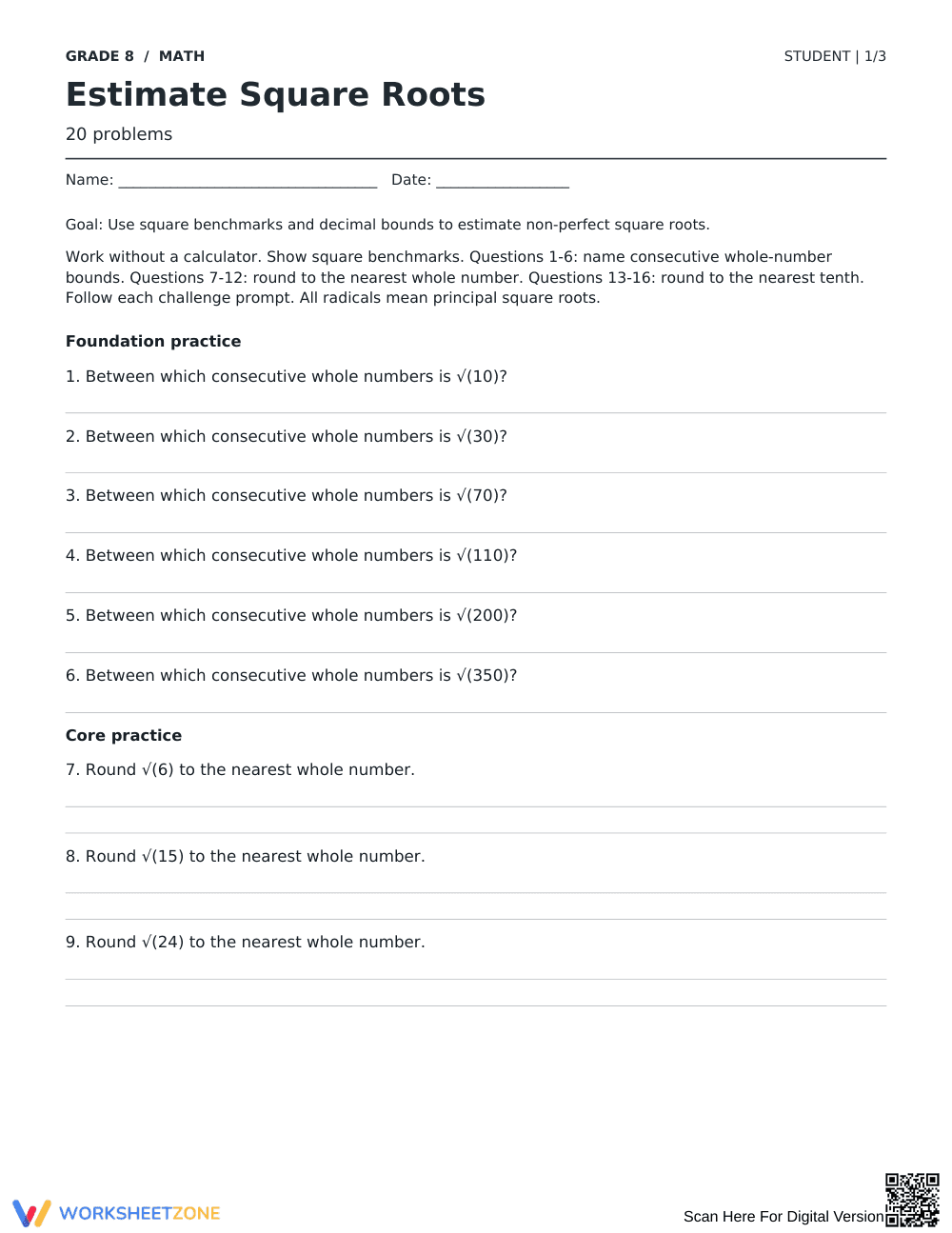
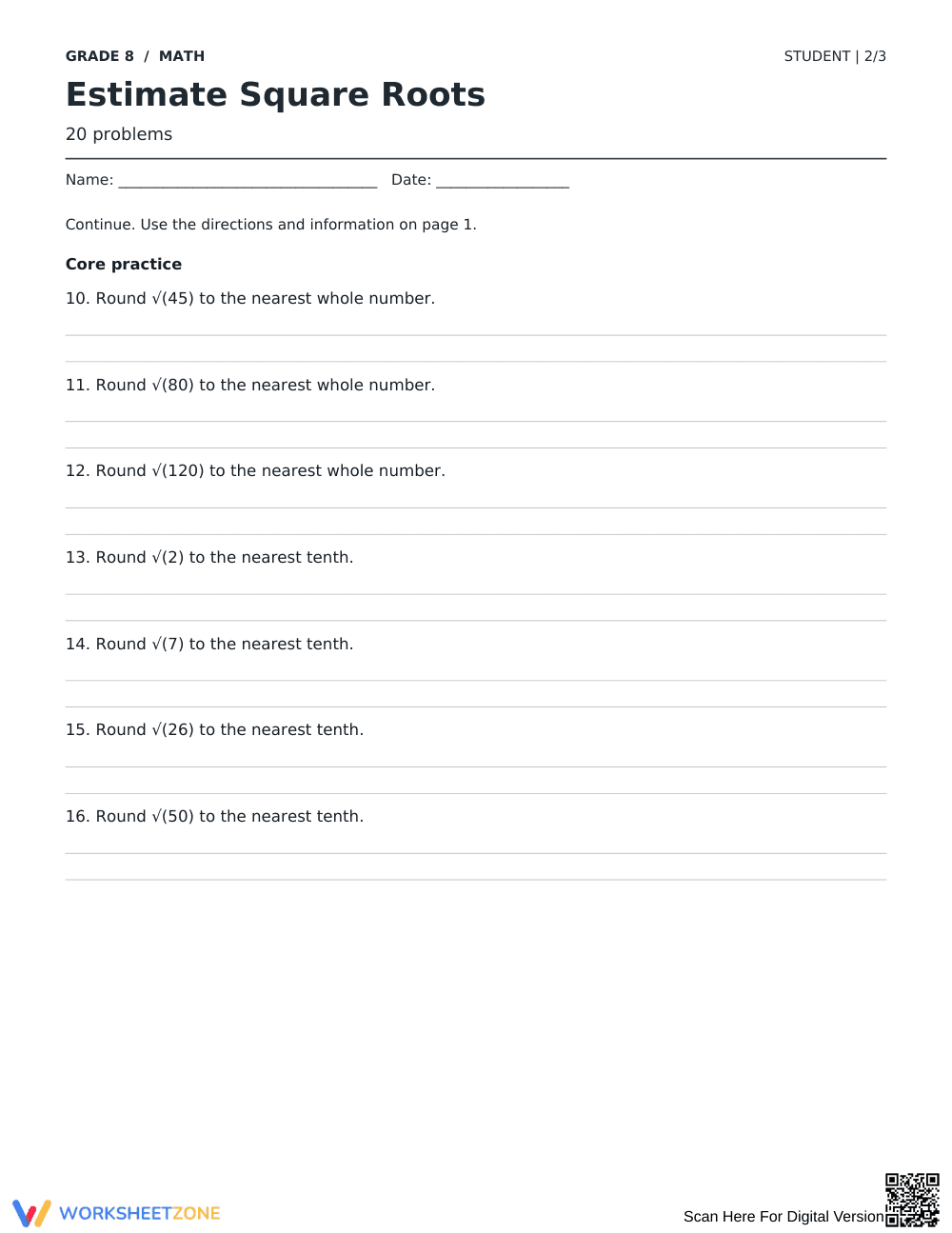
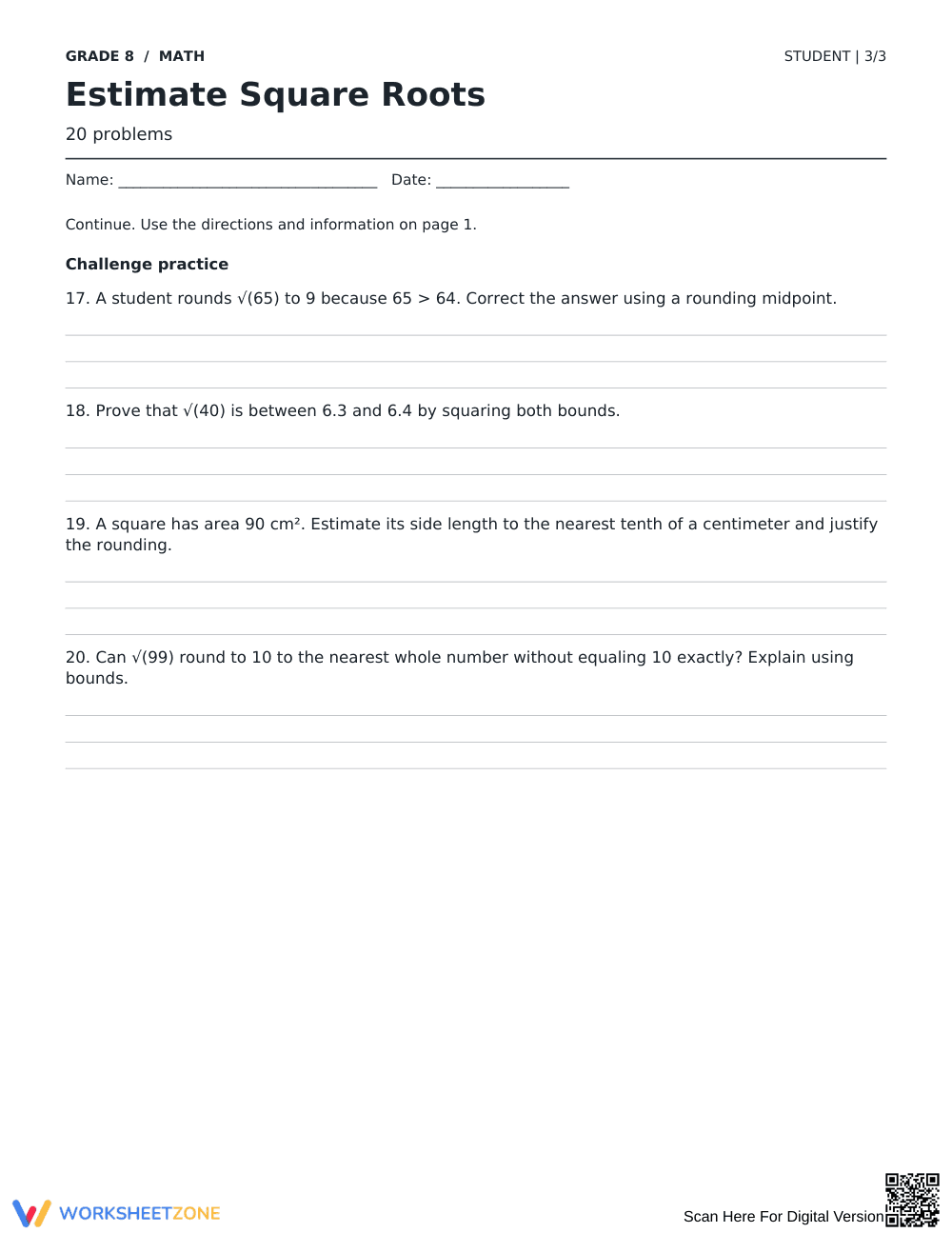
This Grade 8 math worksheet trains students to estimate non-perfect square roots without a calculator. Learners use perfect-square benchmarks and decimal midpoints to approximate radicals to the nearest integer and tenth, building essential number sense for irrational values on the real number line.
At a Glance
- Grade: 8 · Subject: Math
- Standard:
CCSS.MATH.CONTENT.8.NS.A.2— Approximate irrational square roots using rational benchmarks and decimal bounds- Skill Focus: Estimating square roots without calculators
- Format: 3 pages · 20 problems · Answer key included · PDF
- Best For: Independent practice and skill review
- Time: 25–35 minutes
What's Inside
Across three student pages, this worksheet offers 20 structured problems emphasizing non-calculator estimation. Generous workspace allows students to write out boundary inequalities. A complete two-page answer key includes step-by-step reasoning, midpoint verification steps, and a 52-point scoring guide for straightforward assessment.
Skill Progression
- Guided practice (Problems 1–6): Students identify consecutive whole numbers bounding each radical using perfect-square benchmarks.
- Supported practice (Problems 7–16): Learners round square roots to the nearest whole number and tenth by testing decimal midpoints.
- Independent practice (Problems 17–20): Students solve challenge tasks involving error analysis, algebraic proof by squaring, and geometric area applications.
This sequence supports a gradual-release model, advancing learners from basic bounds to deep conceptual analysis.
Standards Alignment
This resource aligns directly with `CCSS.MATH.CONTENT.8.NS.A.2` by requiring students to estimate irrational square roots using rational bounds. In support, `CCSS.MATH.CONTENT.8.EE.A.2` reinforces evaluating square roots within geometric contexts. Both standard codes can be copied directly into lesson plans, IEP goals, or district curriculum mapping tools.
How to Use It
Implement this worksheet following direct instruction on non-perfect squares during a 25 to 35-minute block. Have students complete foundation problems with partners before finishing core tasks independently. For formative assessment, verify whether students square midpoints (like 2.5 squared is 6.25) rather than mistakenly finding the arithmetic mean of radicands.
Who It's For
This worksheet serves Grade 8 pre-algebra classes and introductory Algebra 1 units reviewing real number classifications. Support struggling learners by providing a reference list of perfect squares from 1 to 400. Pair this printable with a number-line ordering lesson to reinforce visual estimation skills.
According to Fisher & Frey (2014), purposeful gradual-release frameworks significantly strengthen student autonomy and mathematical problem-solving performance when tackling abstract algebraic concepts. This worksheet delivers structured training in CCSS.MATH.CONTENT.8.NS.A.2, guiding eighth graders to estimate non-perfect square roots using consecutive whole-number benchmarks and decimal midpoint squaring. Rather than relying on rote calculator entries, students systematically evaluate upper and lower bounds to determine precise irrational approximations. The transition from basic whole-number intervals to tenth-place bounds and conceptual error analysis mirrors evidence-based pedagogical scaffolding. Teachers utilizing this resource obtain actionable diagnostic data on student reasoning, identifying whether misconceptions stem from basic arithmetic or irrational number comprehension. Grounding radical estimation in concrete multiplicative structures and geometric area contexts solidifies foundational knowledge required for high school algebra, ensuring eighth-grade students achieve lasting standards mastery through intentional, scaffolded mathematical progression.


