


























Views
Downloads


Essential Writing Expressions Worksheet | Grade 6 Math
Paste this activity's link or code into your existing LMS (Google Classroom, Canvas, Teams, Schoology, Moodle, etc.).
Students can open and work on the activity right away, with no student login required.
You'll still be able to track student progress and results from your teacher account.
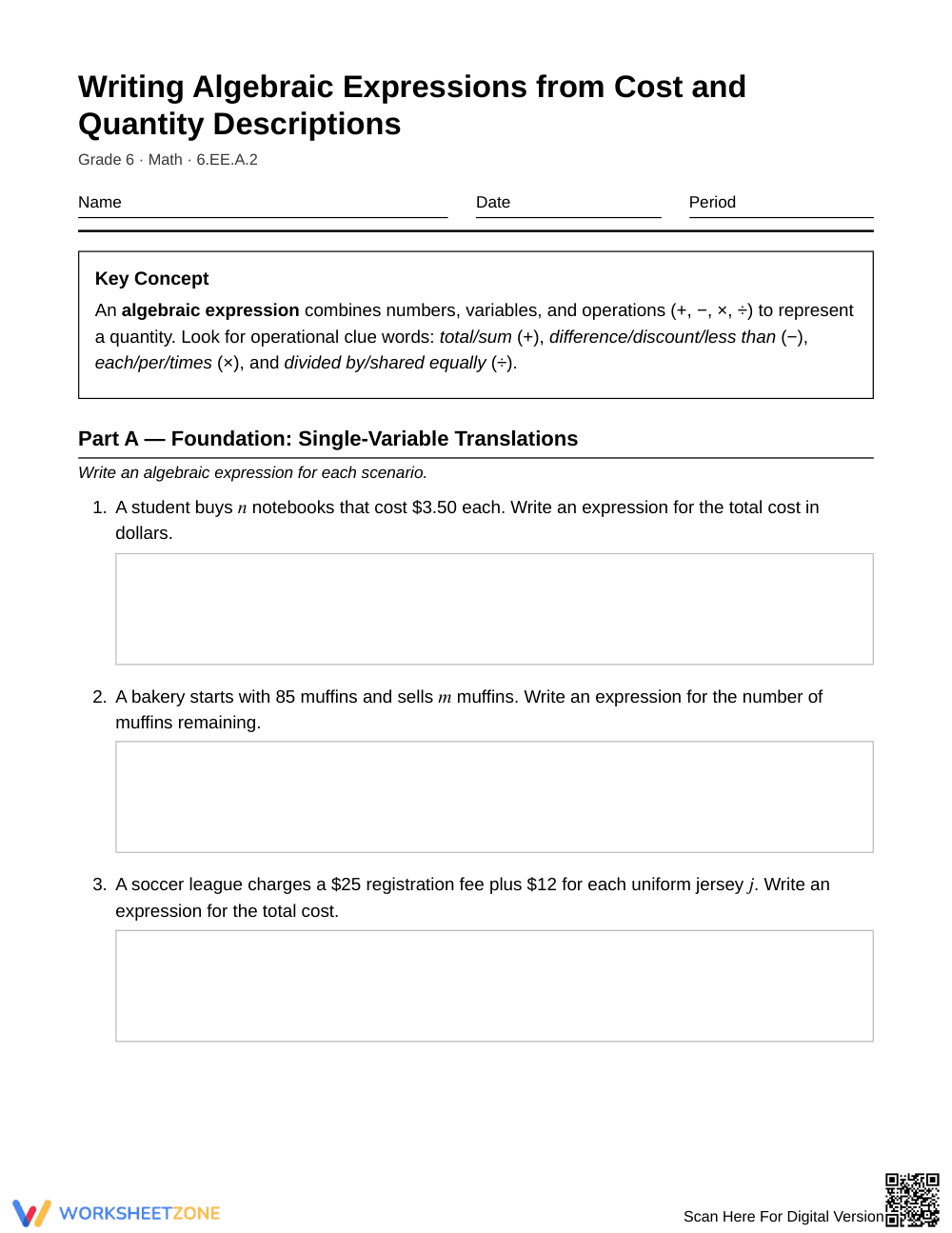
This Grade 6 math worksheet guides students to translate real-world verbal statements into algebraic expressions using variables, numbers, and operations. Learners practice identifying operational clue words across cost and quantity contexts, building confidence toward modeling multi-step scenarios. Master algebraic notation efficiently through structured problem solving.
At a Glance
- Grade: 6 · Subject: Math
- Standard:
6.EE.A.2— Translate verbal descriptions of real-world relationships into symbolic algebraic expressions- Skill Focus: Translating Cost and Quantity Verbal Descriptions into Expressions
- Format: 5 pages (with 2-page answer key) · 18 problems · Full answer key included · PDF
- Best For: Independent practice, partner work, and skills reinforcement
- Time: 35–45 minutes of instructional time
What's Inside
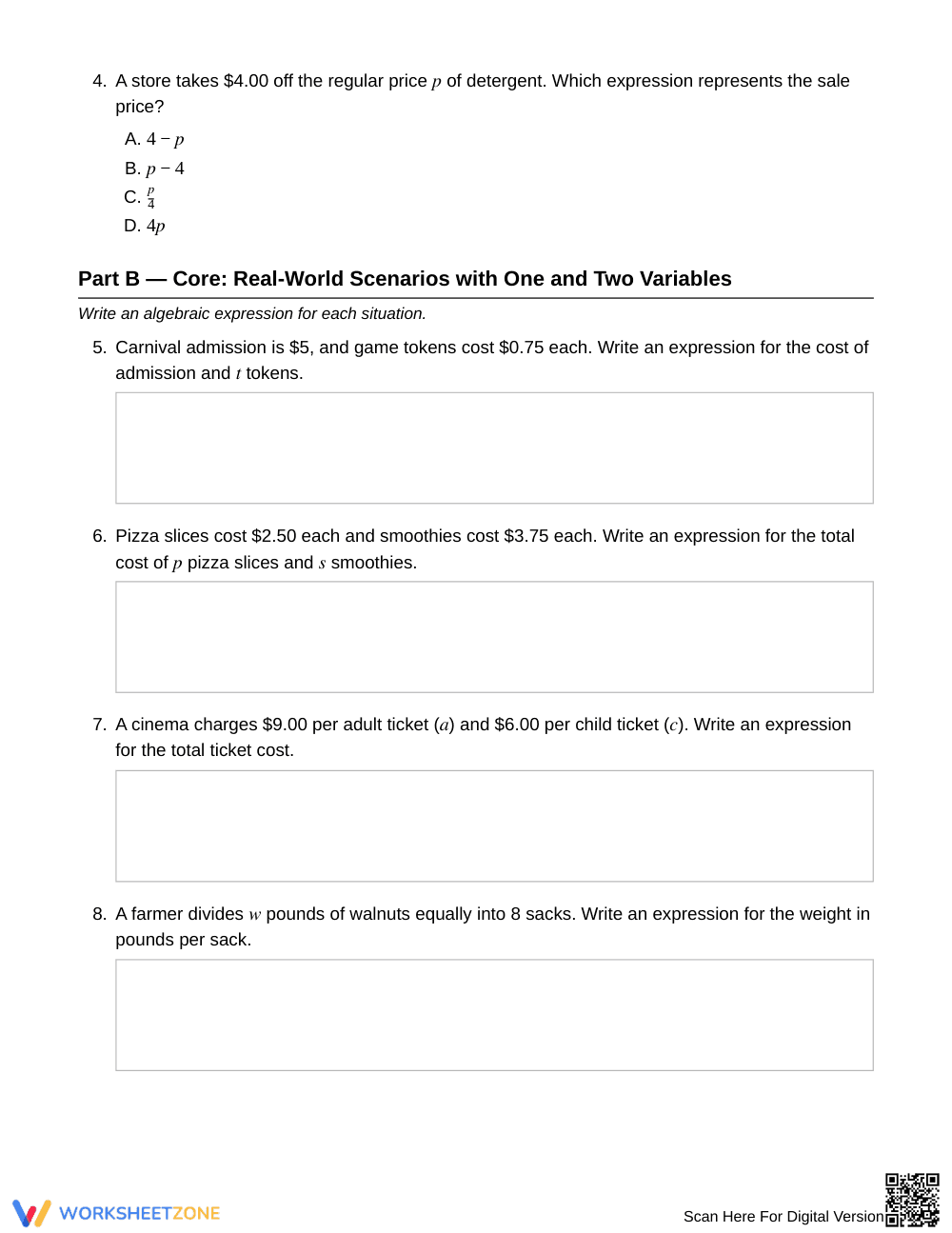
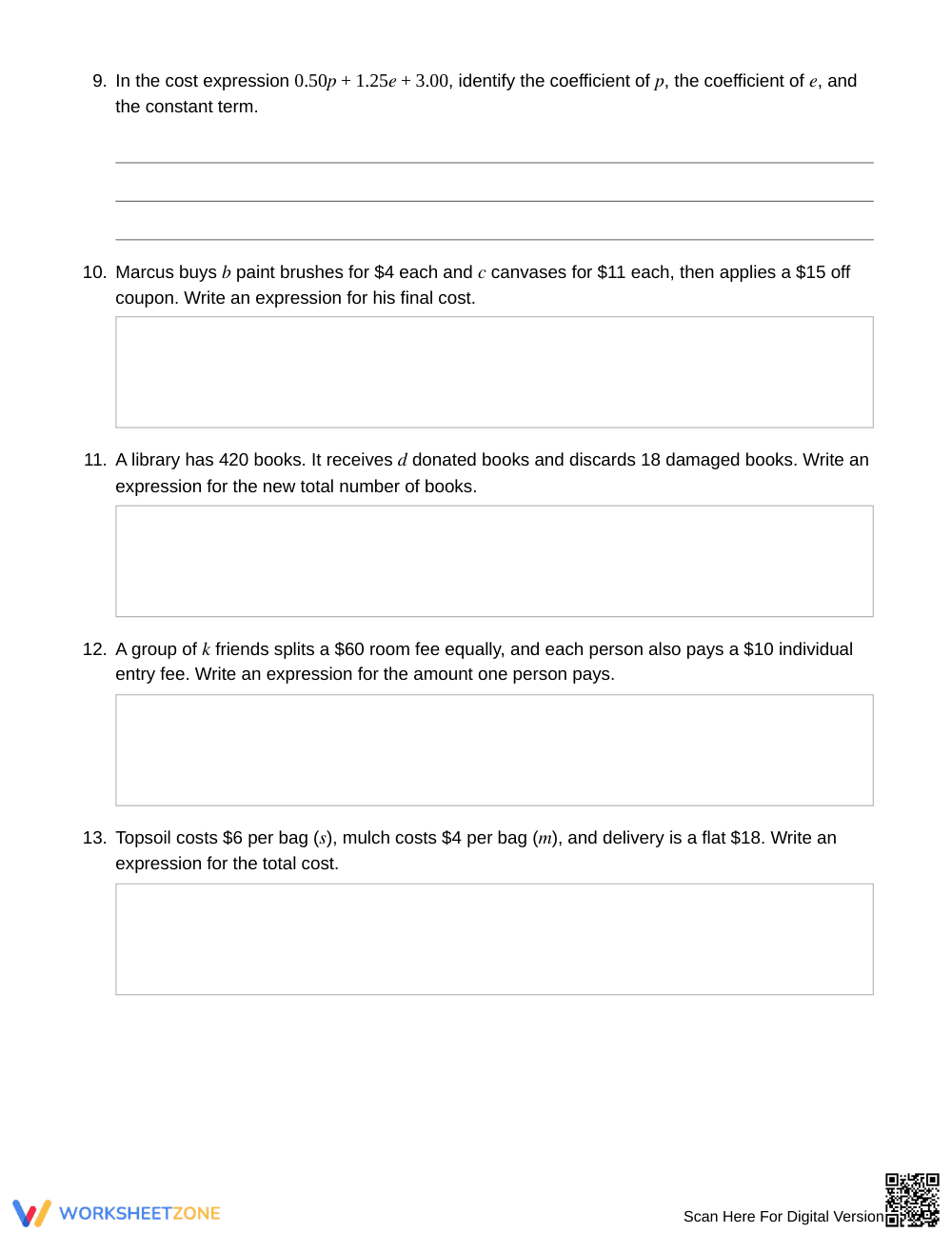
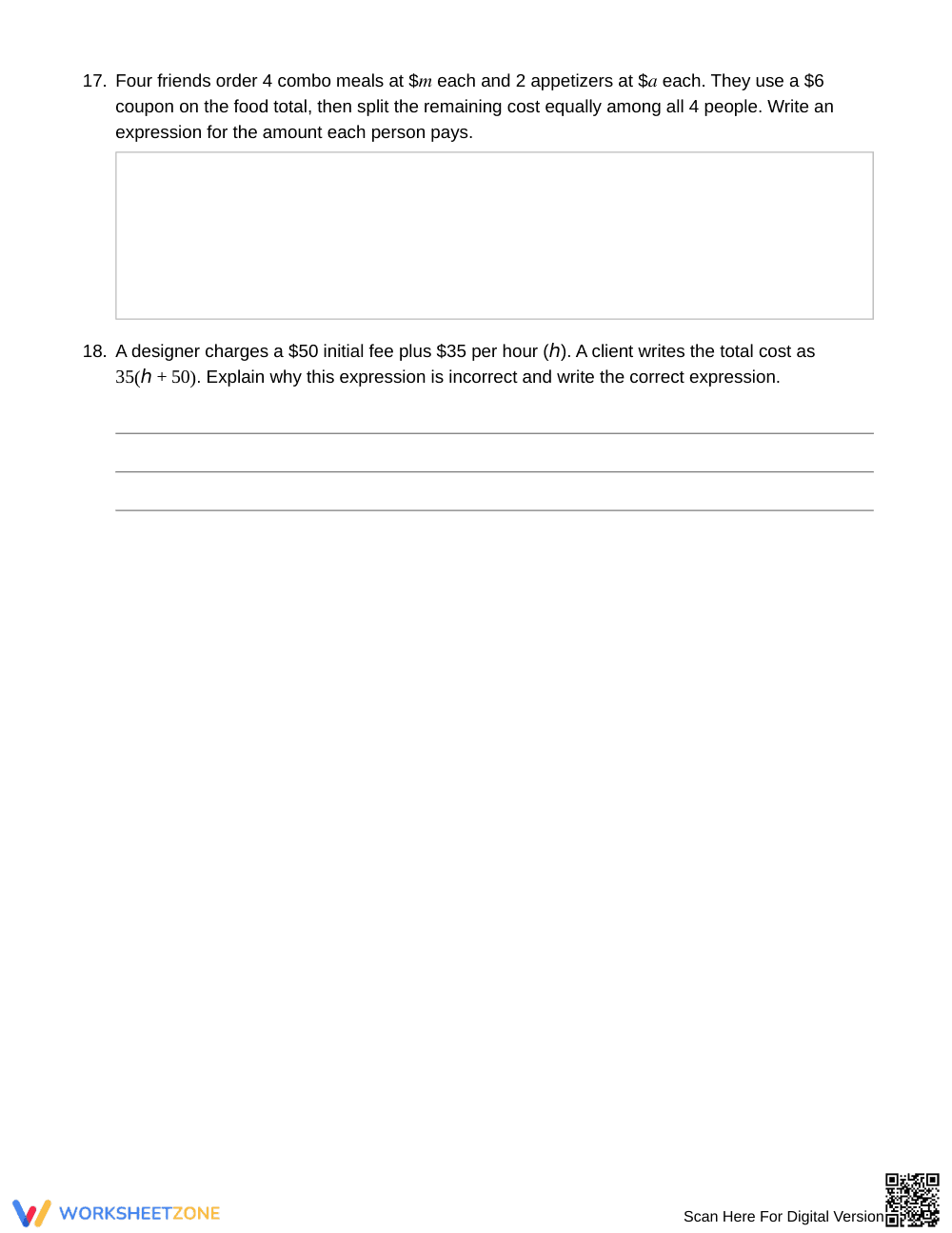
The 5-page PDF features a Key Concept box defining algebraic expressions and operational clue words, followed by 18 structured problems across three progressive parts. Students solve single-variable translations, multiple-choice items, multi-variable real-world scenarios, and error analysis tasks. A complete 2-page answer key provides clear solutions and written explanations.
Skill Progression
- Guided practice (Part A, Problems 1–4): Single-variable translations reinforce operational terms, concluding with a multiple-choice item clarifying subtraction syntax.
- Supported practice (Part B, Problems 5–14): Realistic multi-variable problems require students to write expressions, combine costs, and identify coefficients and constants.
- Independent practice (Part C, Problems 15–18): Multi-step challenge problems demand term simplification, comparative pricing analysis, and conceptual error correction.
This structure implements the gradual-release model, progressing from simple recall to higher-order algebraic synthesis.
Standards Alignment
This worksheet aligns directly to `6.EE.A.2`: Write, read, and evaluate expressions in which letters stand for numbers. Students fulfill `6.EE.A.2.A` by translating verbal descriptions into expressions and `6.EE.A.2.B` by identifying parts of an expression like terms, factors, and coefficients. Both standard codes can be copied directly into lesson plans, IEP goals, or district curriculum mapping tools.
How to Use It
Assign Parts A and B immediately after direct instruction to anchor translation mechanics during independent or partner practice. Use Part C during small-group intervention for targeted error analysis. Formatively observe whether students mistakenly invert subtraction terms (writing 4 − p instead of p − 4). Students typically complete the 18 problems within 35 to 45 minutes.
Who It's For
Designed for Grade 6 math classrooms, this resource supports general coursework, Tier 2 intervention, and pre-algebra review. Teachers can scaffold learning by having students underline clue words or extend learning with the multi-step challenges. Pair this worksheet with an operational clue words anchor chart or a modeling lesson on algebraic notation.
Grounded in the explicit instructional framework described by Fisher & Frey (2014), this resource supports mastery of standard 6.EE.A.2 by systematically structuring how students write expressions from verbal descriptions. Translating everyday language into formal algebraic notation represents a critical developmental milestone in middle school mathematics, connecting concrete arithmetic with abstract variable manipulation. When curriculum materials move sequentially from single-variable situations to multi-variable real-world scenarios, students develop greater cognitive fluency in decoding operational syntax. Fisher & Frey emphasize that structured gradual release helps learners internalize mathematical conventions before applying them to unprompted problem solving. By incorporating structural analysis, such as coefficient identification and misdirected syntax analysis, this 18-problem sequence ensures Grade 6 students do not merely memorize isolated keywords, but actively interpret algebraic relationships within authentic contexts, establishing a dependable conceptual foundation for solving linear equations and modeling quantitative relationships across secondary mathematics coursework.


