




























Views
Downloads

Essential Trig Symmetry Worksheet | Grade 12 Precalculus

Paste this activity's link or code into your existing LMS (Google Classroom, Canvas, Teams, Schoology, Moodle, etc.).
Students can open and work on the activity right away, with no student login required.
You'll still be able to track student progress and results from your teacher account.
This Precalculus worksheet equips Grade 12 students to master unit circle symmetry, trigonometric parity, and periodicity across 12 structured problems. Students analyze coordinate reflections, verify even and odd functions, and resolve mathematical inconsistencies using exact values. Connecting geometric reflections to algebraic identities develops deep conceptual fluency with trigonometric relationships.
At a Glance
- Grade: 12 · Subject: Precalculus
- Standard:
HSF-TF.A.4— Use unit circle symmetry to show parity and periodicity of trigonometric functions- Skill Focus: Compare Symmetry and Sign Relationships
- Format: 4 pages · 12 problems · Answer key included · PDF
- Best For: Advanced trigonometry practice and review
- Time: 45–60 minutes
What's Inside
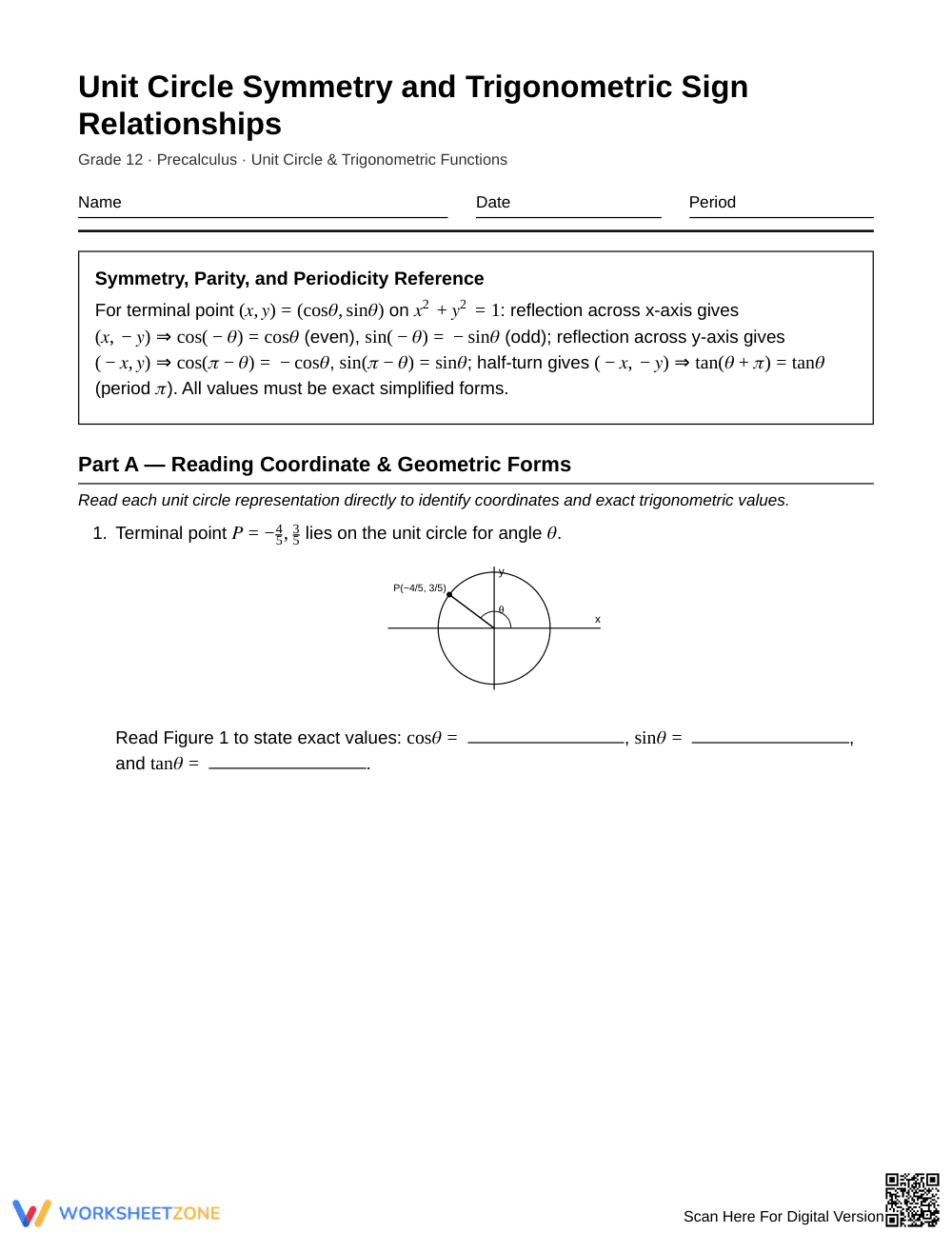
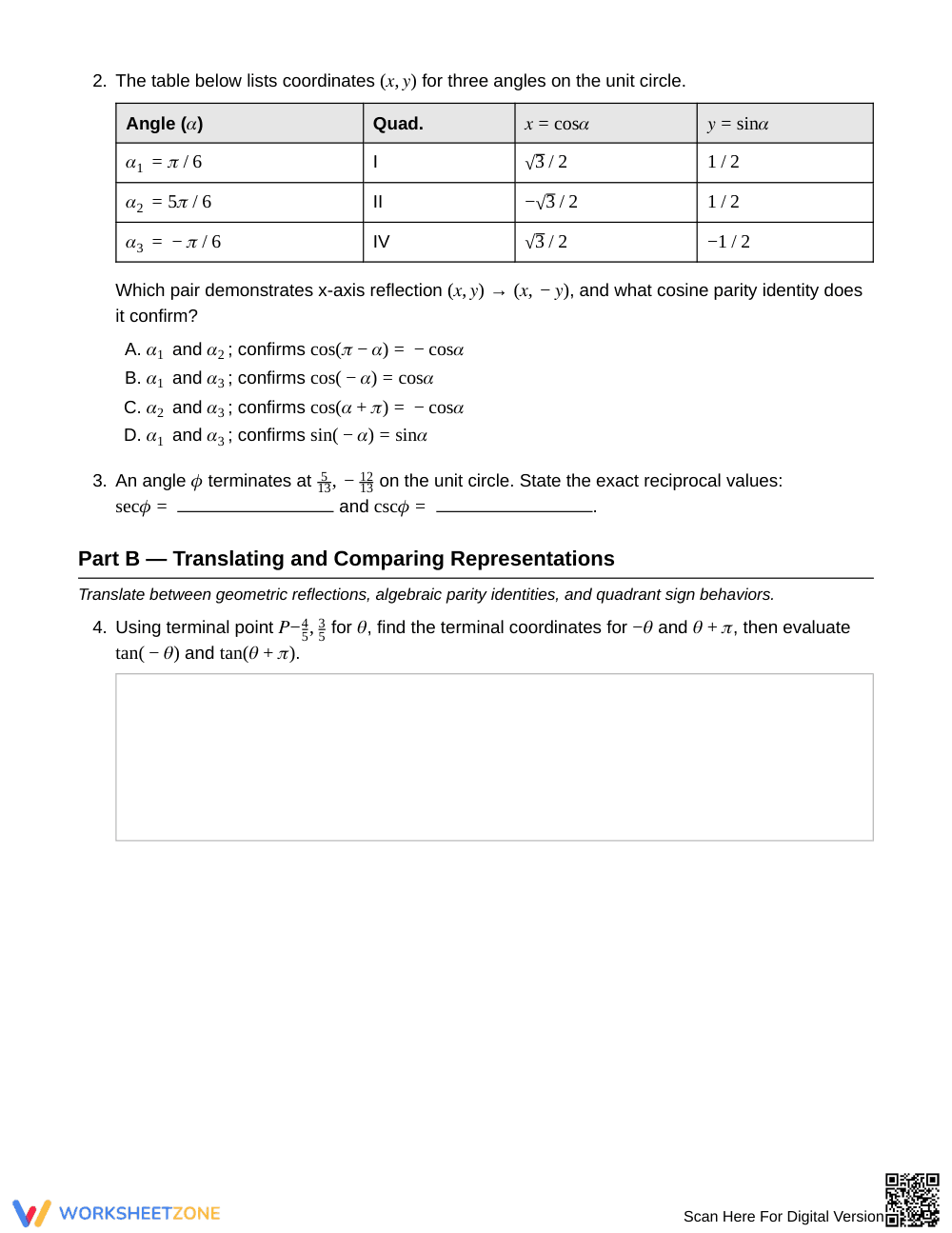
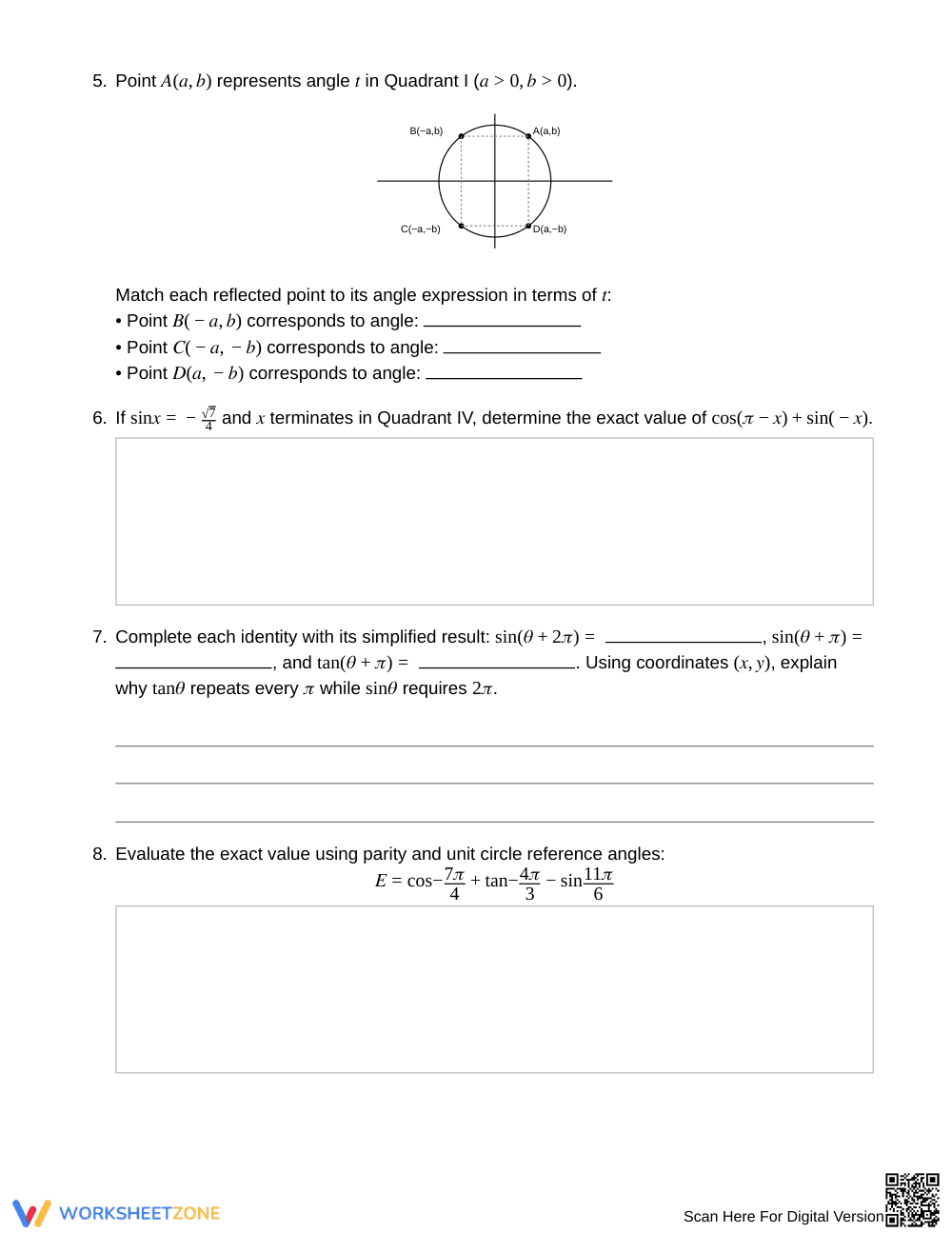
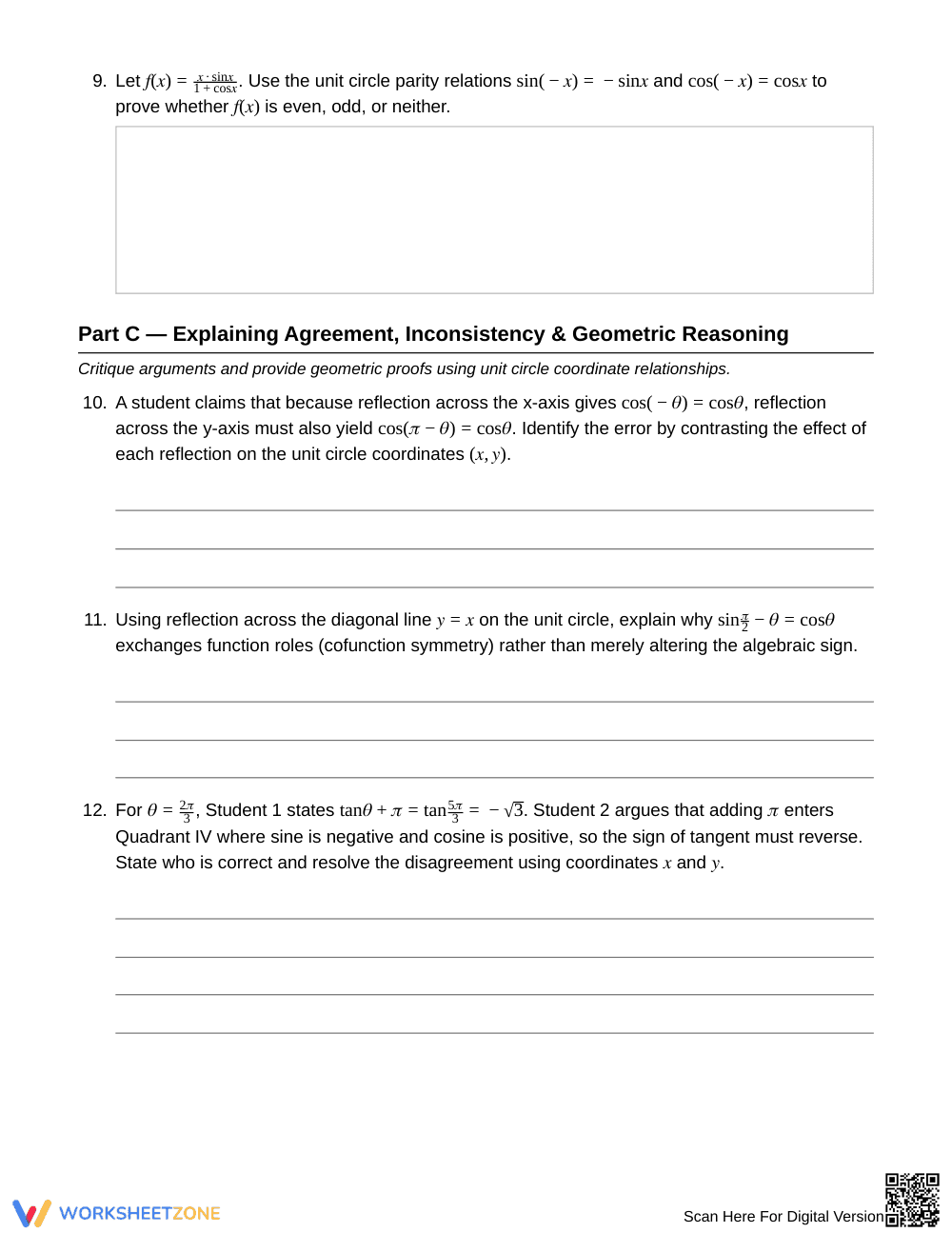
The 4-page worksheet opens with a symmetry reference box before presenting 12 diverse tasks. Students analyze coordinate diagrams, complete value tables, simplify algebraic parity expressions, and write geometric proofs. A 2-page answer key provides complete coordinates, quadrant reasoning, and error analyses.
Skill Progression
- Guided practice (Problems 1–3): Students read coordinates from unit circle figures and tables with reference scaffolds to evaluate basic parity identities.
- Supported practice (Problems 4–9): Learners translate reflections into quadrant signs, evaluate compound expressions, and prove parity algebraically with reduced prompting.
- Independent practice (Problems 10–12): Students complete critique tasks, resolving peer errors and justifying cofunction shifts using coordinate arguments.
This sequence follows the gradual release model, guiding learners from visual reading to formal analytical proof.
Standards Alignment
This resource aligns with `HSF-TF.A.4`: Use the unit circle to express values of sine, cosine, and tangent for π − x, π + x, and 2π − x in terms of x, and explain symmetry and periodicity. It also supports `HSF-TF.A.2` by linking circle coordinates to trigonometric values. Both standard codes can be copied directly into lesson plans, IEP goals, or district curriculum mapping tools.
How to Use It
Use this worksheet following direct instruction on unit circle reflections. For formative assessment, monitor Part B work to ensure students apply correct quadrant signs before starting Part C proofs. This activity operates effectively during a 45- to 60-minute problem-solving block.
Who It's For
Designed for Grade 12 Precalculus students advancing toward Calculus, this lesson supports differentiated learning. Provide an annotated unit circle chart for emerging learners, while prompting advanced students to prove reciprocal symmetries. Pair this packet directly with a unit circle identity reference guide.
According to research from Fisher & Frey (2014) on effective gradual release frameworks, student mastery in advanced mathematics accelerates when instructional materials explicitly scaffold the progression from concrete visual models to abstract analytical justification. This 4-page Precalculus worksheet operationalizes that instructional principle for standard HSF-TF.A.4, enabling Grade 12 learners to compare symmetry and sign relationships across the unit circle with precision. Through 12 carefully structured tasks, students progress systematically from coordinate observation to parity evaluations and rigorous peer critique. By connecting geometric reflections directly to algebraic identities such as cosine evenness and tangent periodicity, the resource solidifies the foundational conceptual links required for higher-level calculus coursework. Empirical findings demonstrate that structured problem sets featuring targeted scaffolds, dual coordinate representations, and complete solution guides substantially reduce extraneous cognitive overload while cultivating durable mathematical argumentation skills.


