




























Views
Downloads

Essential Simple Machines Word Search | Grades 6–7 Science

Paste this activity's link or code into your existing LMS (Google Classroom, Canvas, Teams, Schoology, Moodle, etc.).
Students can open and work on the activity right away, with no student login required.
You'll still be able to track student progress and results from your teacher account.
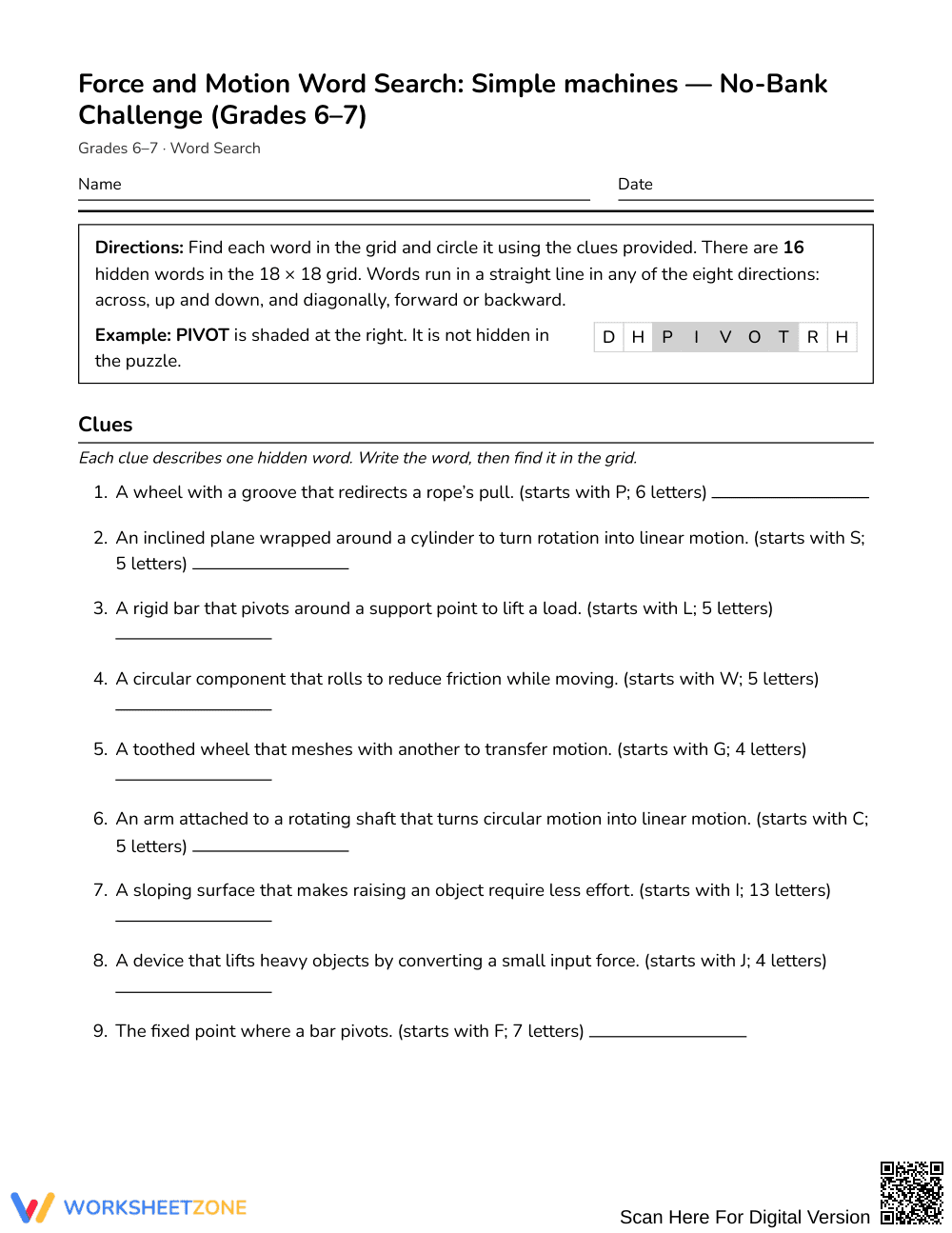
This Grades 6–7 science word search reinforces foundational physics concepts by challenging learners to identify core simple machines terms. Students read functional definitions to deduce target vocabulary before locating all 16 hidden terms within the puzzle grid, strengthening scientific literacy, conceptual retention, and spelling without relying on a passive word bank.
At a Glance
- Grade: Grades 6–7 · Subject: Science
- Standard: Not standards-assessed — vocabulary enrichment
- Skill Focus: Simple machines
- Format: 3 pages · 16 words · Answer key included · PDF
- Best For: Science vocabulary reinforcement and review
- Time: 25–35 minutes
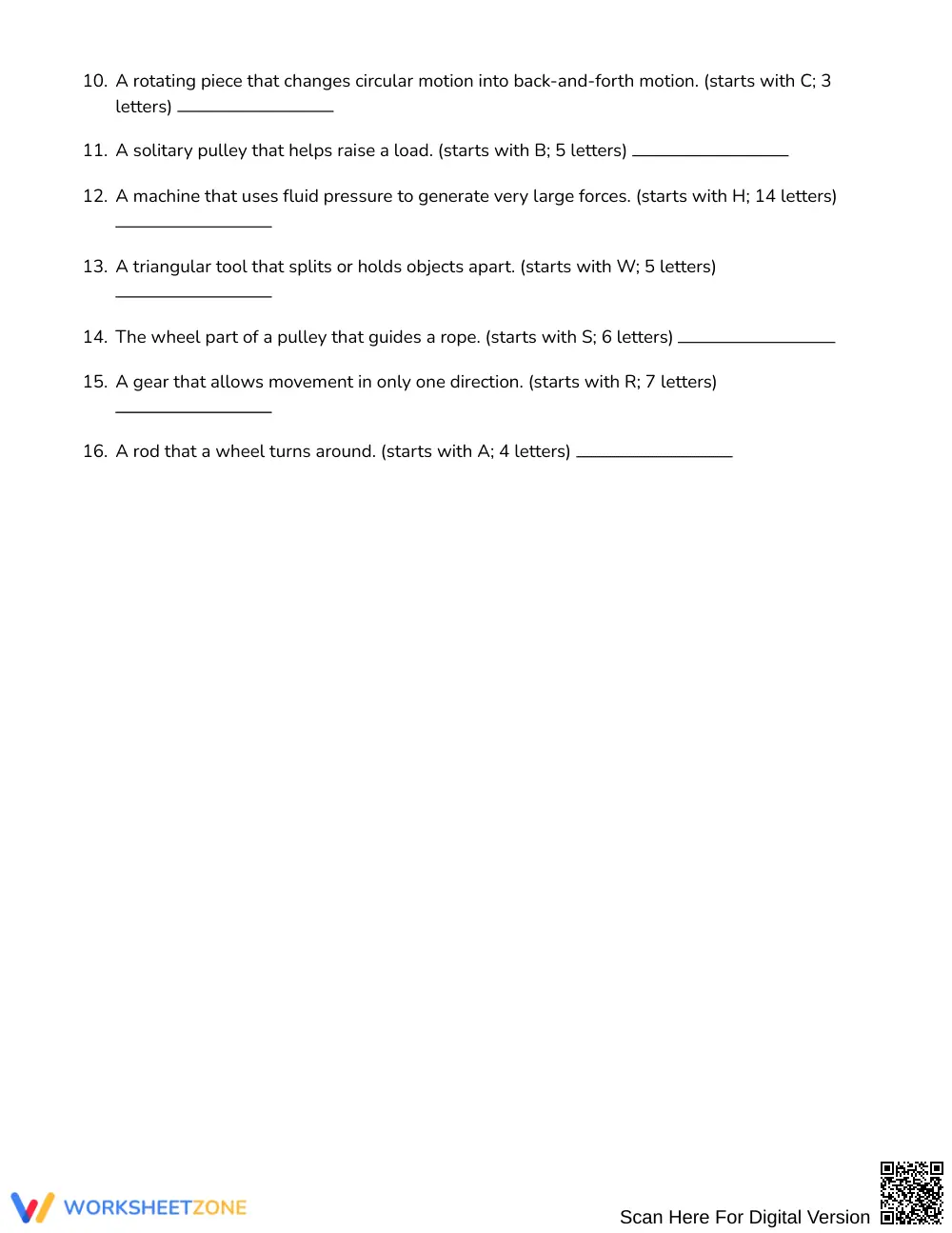
This 3-page printable science resource contains a complete clue-based word search puzzle alongside a full-sized reference answer key. Instead of a conventional word bank, the activity features 16 descriptive clues defining mechanical components such as inclined planes, fulcrums, screws, and hydraulic presses. Learners analyze each functional clue to deduce the correct terminology before scanning the grid, encouraging active recall over passive letter matching.
Puzzle Structure and Search Mechanics
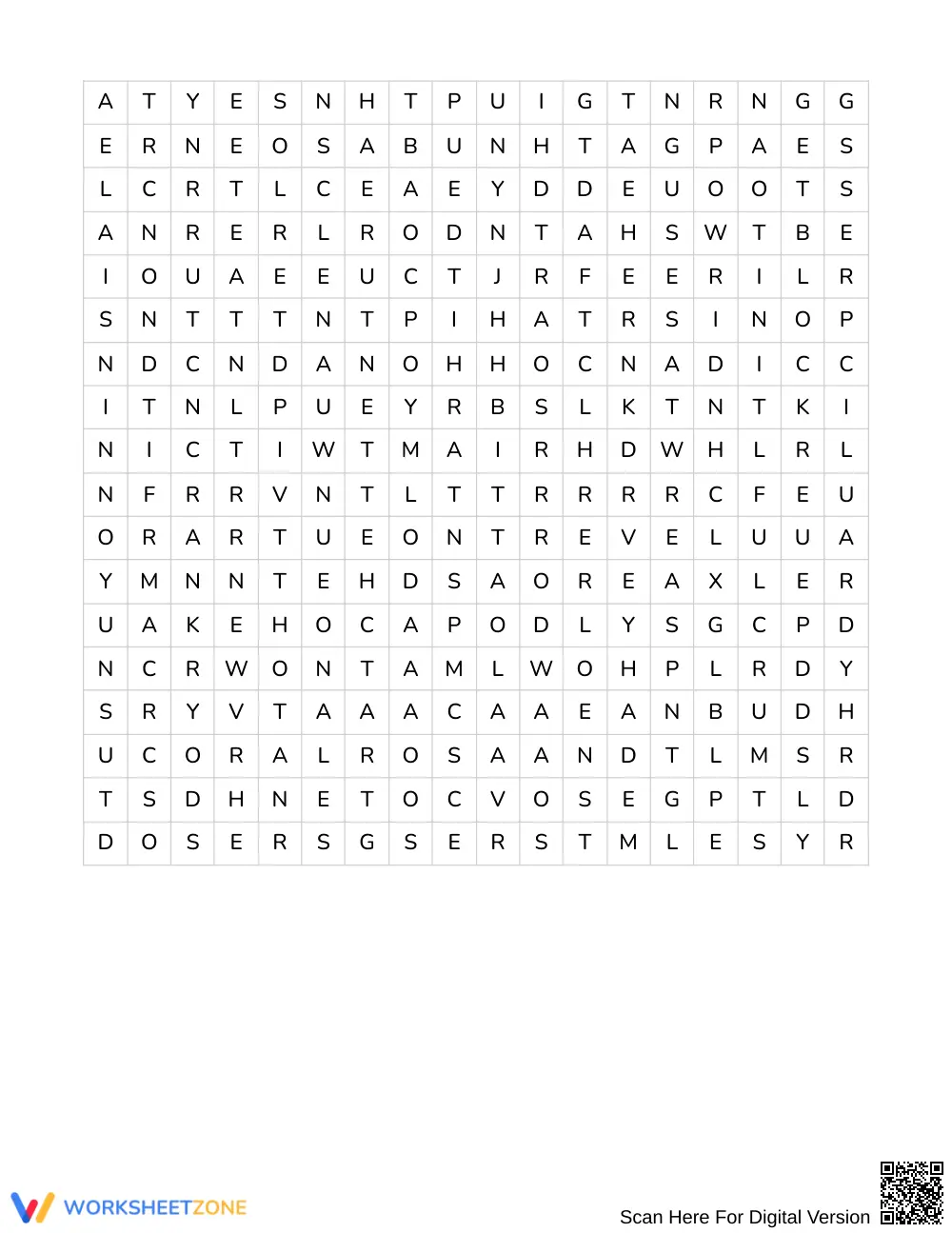
The word search is built on an expansive 18 x 18 letter grid containing 16 specialized physical science terms. Hidden words run in all 8 compass directions: North, Northeast, East, Southeast, South, Southwest, West, and Northwest, including forward, backward, and diagonal orientations. Because no word bank is provided, students must actively engage their science comprehension to match definitions to terms before searching the matrix.
Curriculum Connection
This resource is designed strictly for science vocabulary enrichment and review rather than formal standards-based assessment. While it directly supports middle school physical science units exploring force, motion, work, and mechanical advantage, it functions as a flexible supplemental activity. Teachers can deploy it alongside core curriculum modules to reinforce domain-specific academic vocabulary and definitions without reporting formal standard masteries.
How to Use It
Deploy this puzzle as an engaging mid-unit review after introducing the six classic simple machines, or use it as an independent fast-finisher task during lab rotations. For formative assessment, circulate as students solve clues to check whether they can define terms like fulcrum, sheave, and ratchet before they begin searching. The complete activity takes approximately 25 to 35 minutes to complete.
Who It's For
This activity is tailored for Grades 6–7 physical science students learning mechanical concepts. It provides built-in differentiation: emerging learners can refer to classroom anchor charts or science notebooks to solve the clues, while advanced learners can complete the challenge entirely from memory. Pair this printable word search directly with a hands-on mechanical advantage lab or an introductory pulley exploration lesson.
According to educational research by Fisher & Frey (2014), intentional domain-specific vocabulary acquisition relies heavily on meaningful retrieval practice rather than rote copying or passive recognition. When middle school science students encounter clue-based puzzles that omit a traditional word list, they are prompted to retrieve conceptual definitions from long-term memory before executing search strategies. This cognitive retrieval reinforces the technical lexicon of mechanical advantage, including specialized mechanisms such as levers, pulleys, axles, and hydraulic presses. Vocabulary enrichment tasks structured with clear definitions establish the conceptual scaffolding necessary for subsequent complex problem-solving in physics and engineering. Integrating rigorous vocabulary exploration within Grades 6–7 force and motion units supports reading comprehension across informational science texts, builds scientific fluency, and ensures that emerging young scientists can accurately describe how basic mechanical systems transfer force and motion across diverse physical applications.


