




























Views
Downloads



Essential Sample Quantity Worksheet | Grade 11 Chemistry

Paste this activity's link or code into your existing LMS (Google Classroom, Canvas, Teams, Schoology, Moodle, etc.).
Students can open and work on the activity right away, with no student login required.
You'll still be able to track student progress and results from your teacher account.
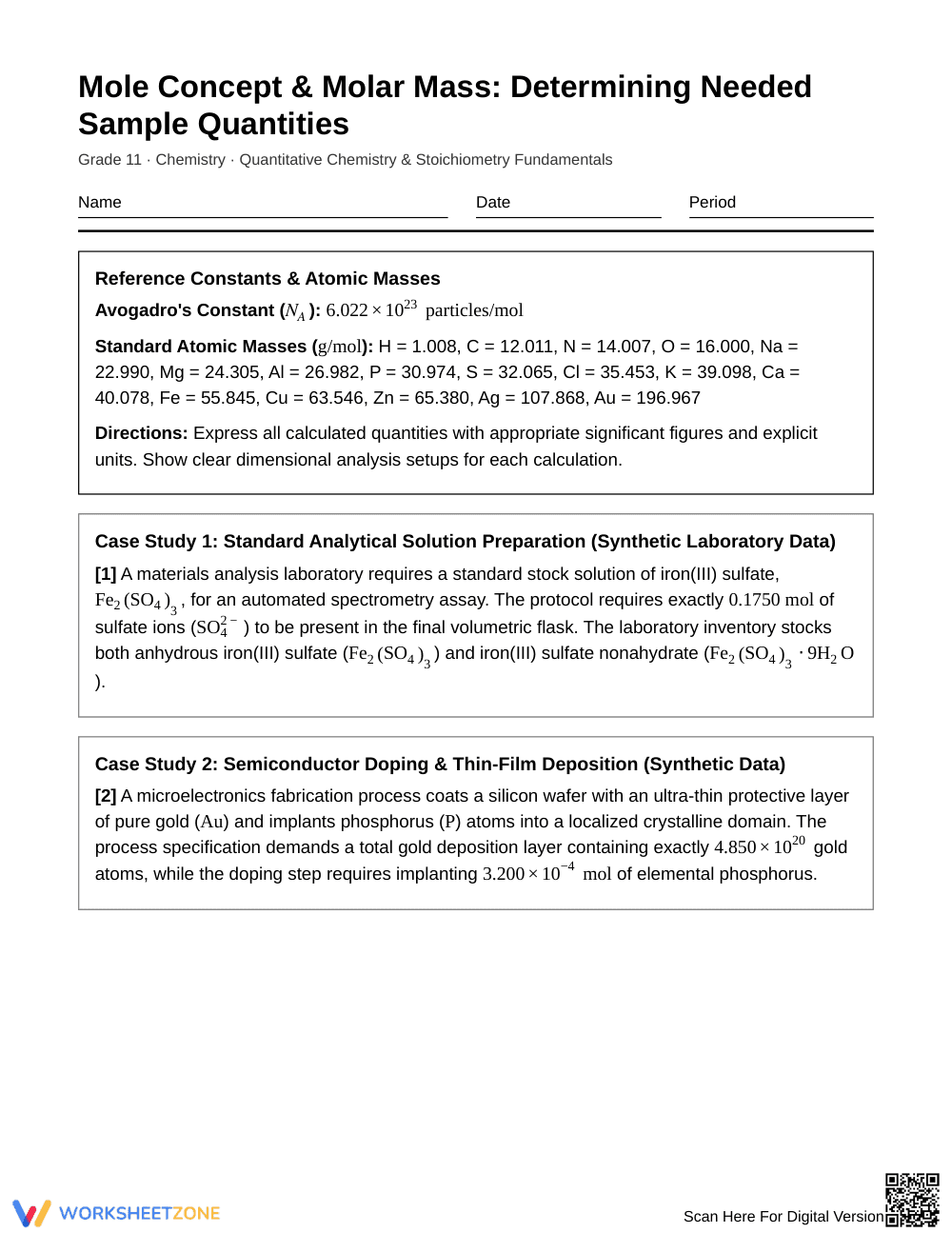
This Grade 11 chemistry worksheet equips students to determine required chemical sample quantities through stoichiometric calculations and dimensional analysis. Learners analyze analytical laboratory and semiconductor case studies to calculate molar masses, convert between mass, moles, and particle counts, and evaluate error scenarios involving hydrates and anhydrous reagents.
At a Glance
- Grade: 11 · Subject: Chemistry
- Standard: High School Chemistry — Calculate chemical quantities and convert between mass, moles, and particles
- Skill Focus: Determine a Needed Sample Quantity
- Format: 5 pages · 10 problems · Answer key included · PDF
- Best For: Quantitative stoichiometry and laboratory preparation practice
- Time: 45–60 minutes
What's Inside
The 5-page worksheet features two authentic case studies centered on solution preparation and semiconductor doping. Students work through 10 multi-step problems, including multiple-choice constraint identification, dimensional analysis mass-to-particle conversions, and critical claim evaluations. A dedicated reference box provides necessary atomic masses and Avogadro's constant, while a detailed 2-page answer key provides complete calculation setups and unit cancellation steps.
Skill Progression
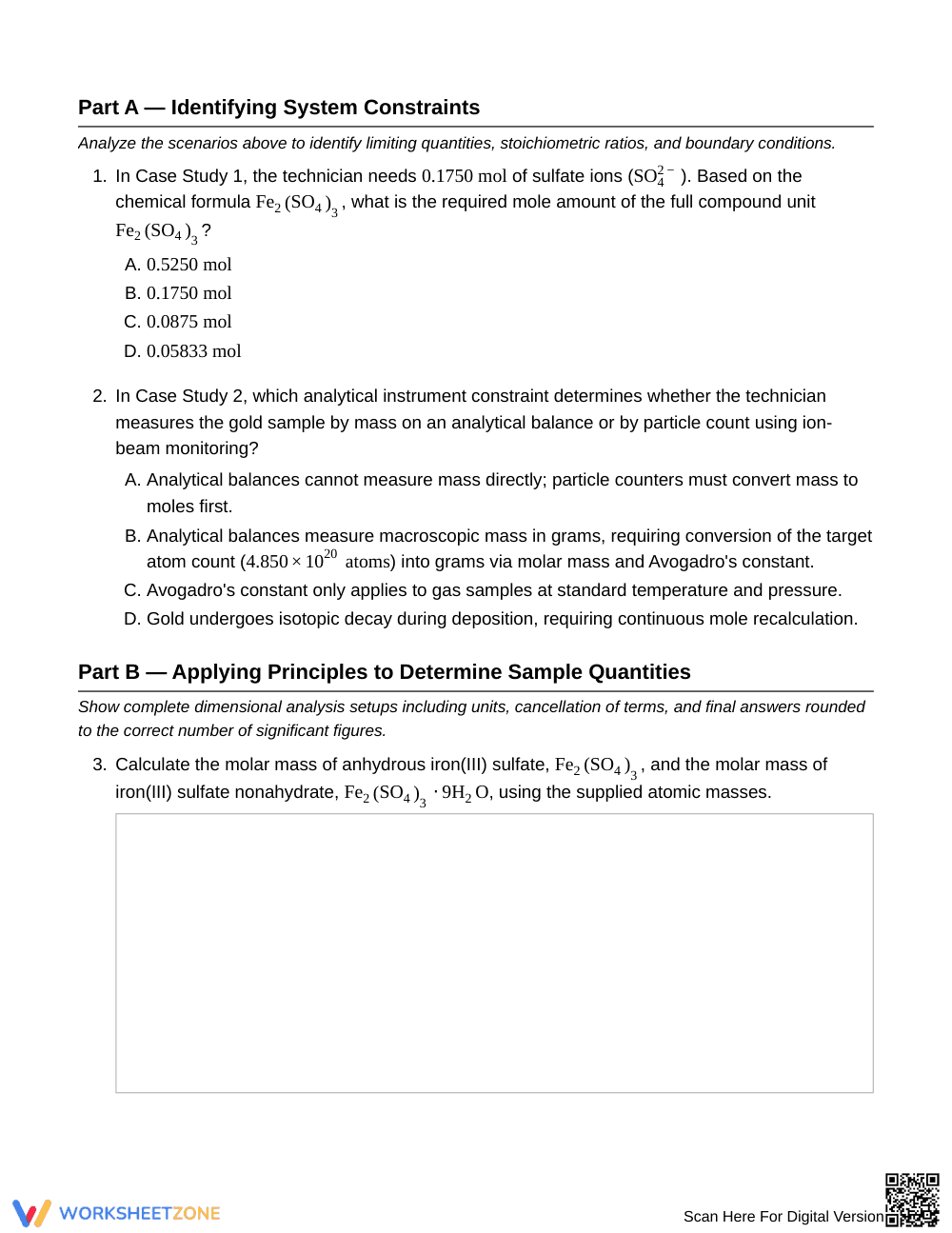
- Guided practice (Part A, 2 items): Students identify limiting constraints, stoichiometric ratios in chemical formulas, and analytical balance measurement limits using targeted multiple-choice prompts.
- Supported practice (Part B, 6 items): Students construct multi-step dimensional analysis setups to calculate molar masses, convert ion requirements to reagent masses, and calculate dopant atom quantities.
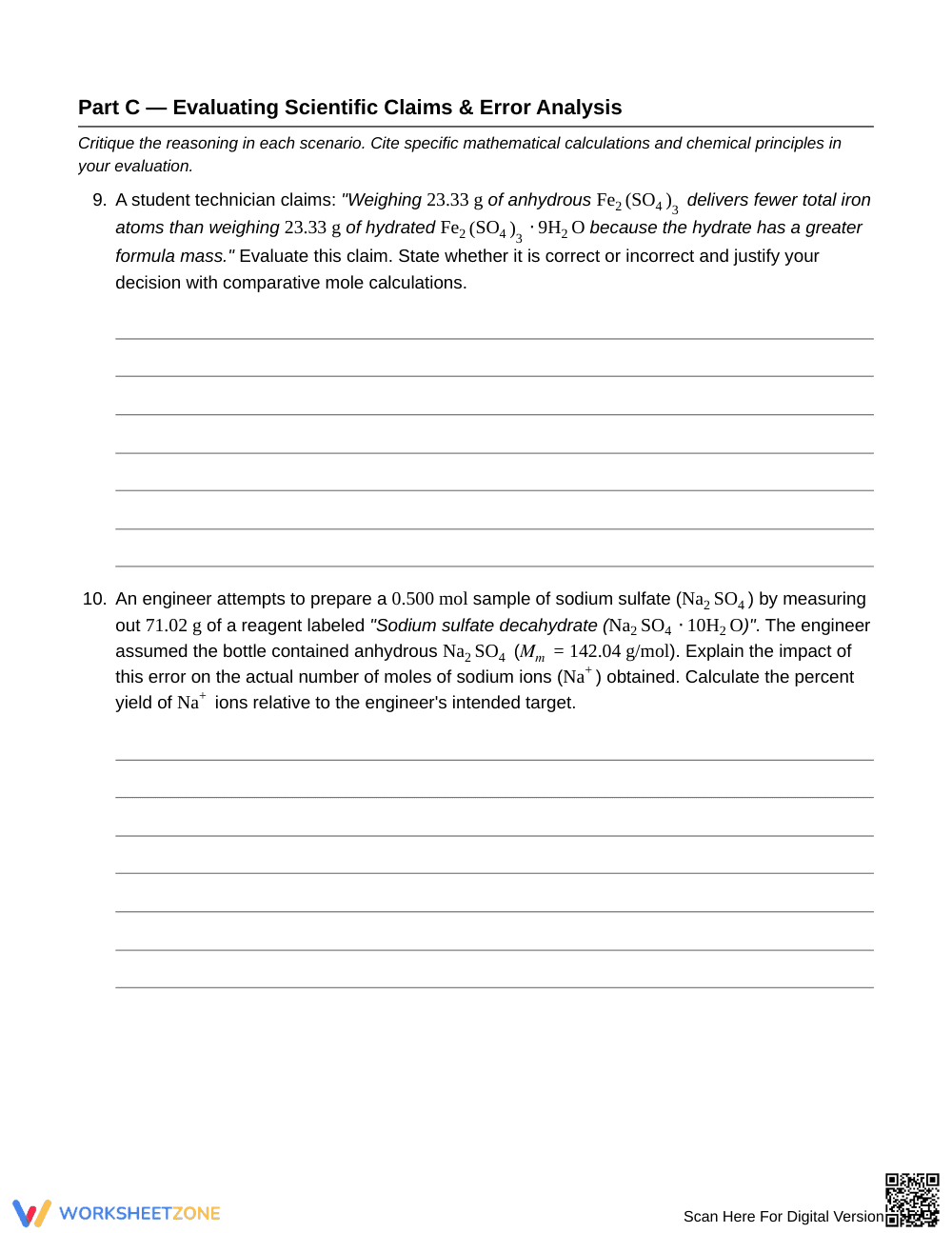
- Independent practice (Part C, 2 items): Students critique technician claims regarding hydrated versus anhydrous compounds and calculate the percent yield error resulting from reagent misidentification.
This structured sequence follows a gradual-release instructional model, moving learners from conceptual system analysis to independent mathematical evaluation and error analysis.
Standards Alignment
This resource aligns with high school chemistry expectations for quantitative stoichiometry and conservation of matter. Students use mathematical representations and unit analysis to translate macroscopic mass measurements into submicroscopic particle counts and stoichiometric ratios. This alignment supports rigorous curriculum mapping in secondary chemistry and honors-level physical science courses.
How to Use It
Implement this worksheet after direct instruction on the mole concept, molar mass calculations, and hydrate formulas. During class, observe whether students correctly apply compound-to-ion ratios in Part B or mistakenly omit stoichiometric subscripts when converting moles to mass. The resource also serves effectively as a collaborative laboratory pre-lab exercise or an assessment review. Expected completion time is 45 to 60 minutes.
Who It's For
This worksheet is designed for Grade 11 chemistry students mastering quantitative chemistry and stoichiometry calculations. Scaffolded reference tables support developing learners, while error-analysis tasks offer enrichment for advanced students. Pair this activity with an interactive dimensional analysis anchor chart or a solution preparation wet lab.
According to findings highlighted by Fisher & Frey (2014) on guided instruction and cognitive load in secondary STEM classrooms, structured problem progressions effectively build student competence in complex dimensional analysis and mathematical modeling. This Grade 11 chemistry resource engages learners in determining needed sample quantities by bridging macroscopic laboratory measurements and microscopic atomic quantities across 10 structured tasks. Students analyze realistic stoichiometry scenarios, determine formula masses for hydrated and anhydrous salts, and evaluate analytical chemical preparation claims. Grounded in research on the gradual release of responsibility, the resource establishes robust conceptual links between particle counts, molar quantities, and gram-scale measurements. The intentional integration of authentic laboratory contexts promotes metacognitive monitoring and quantitative problem-solving skills, ensuring that high school science students achieve deep conceptual mastery and procedural fluency during quantitative chemistry units.


