


























Views
Downloads


Essential Probability Rules Worksheet | Grade 12 Statistics
Paste this activity's link or code into your existing LMS (Google Classroom, Canvas, Teams, Schoology, Moodle, etc.).
Students can open and work on the activity right away, with no student login required.
You'll still be able to track student progress and results from your teacher account.
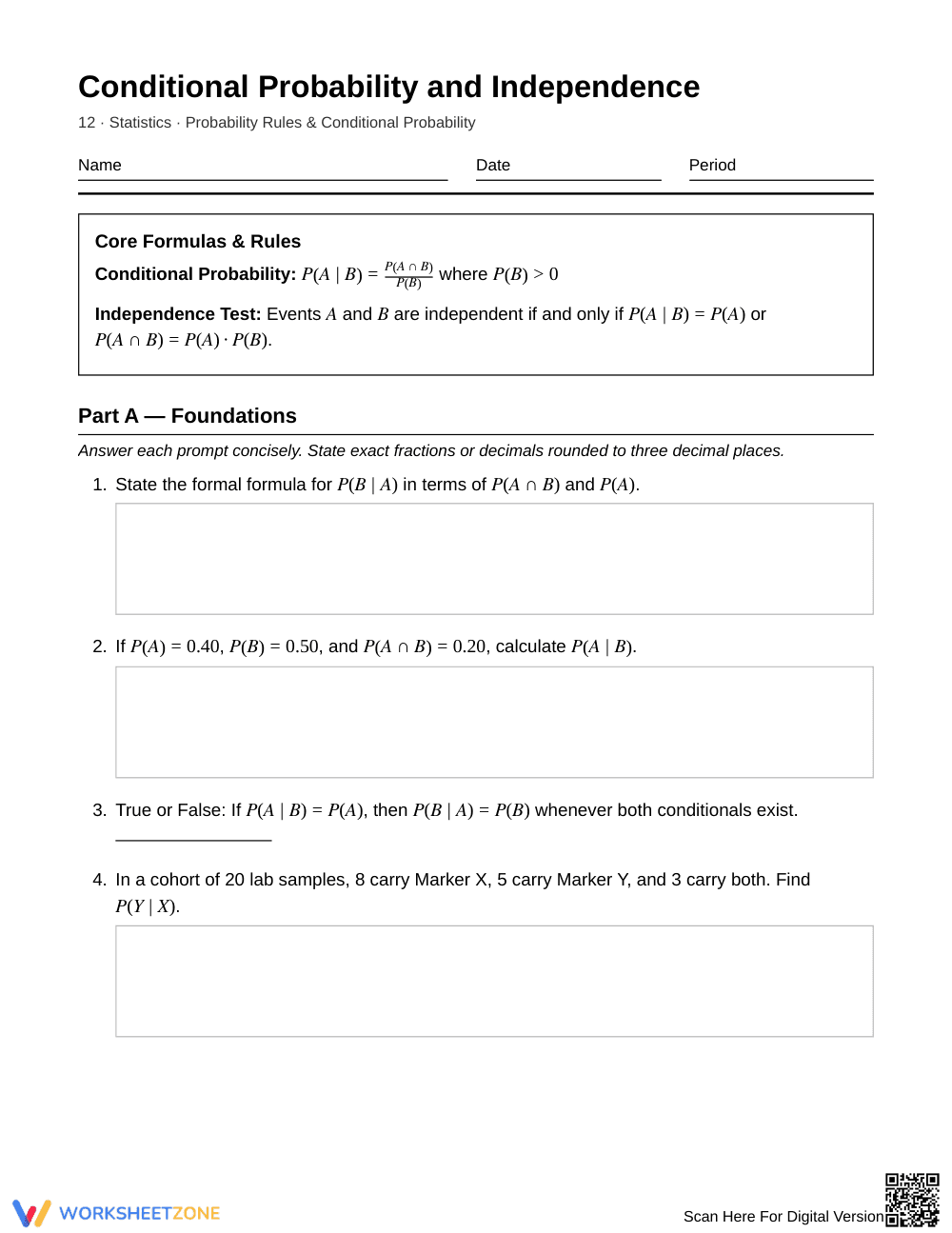
This Grade 12 Statistics worksheet equips students to calculate conditional probabilities, evaluate complements and intersections, and rigorously test events for mathematical independence. Learners work from core definitions to applied multi-step scenarios, developing procedural fluency alongside conceptual clarity across 16 targeted analytical problems.
At a Glance
- Grade: 12 · Subject: Statistics
- Standard:
HSS-CP.A.3— Understand conditional probability of A given B as P(A and B)/P(B)- Skill Focus: Conditional probability formulas, intersections, complements, and independence tests
- Format: 5 pages · 16 problems · Answer key included · PDF
- Best For: Guided practice and assessment preparation
- Time: 40–50 minutes
What's Inside
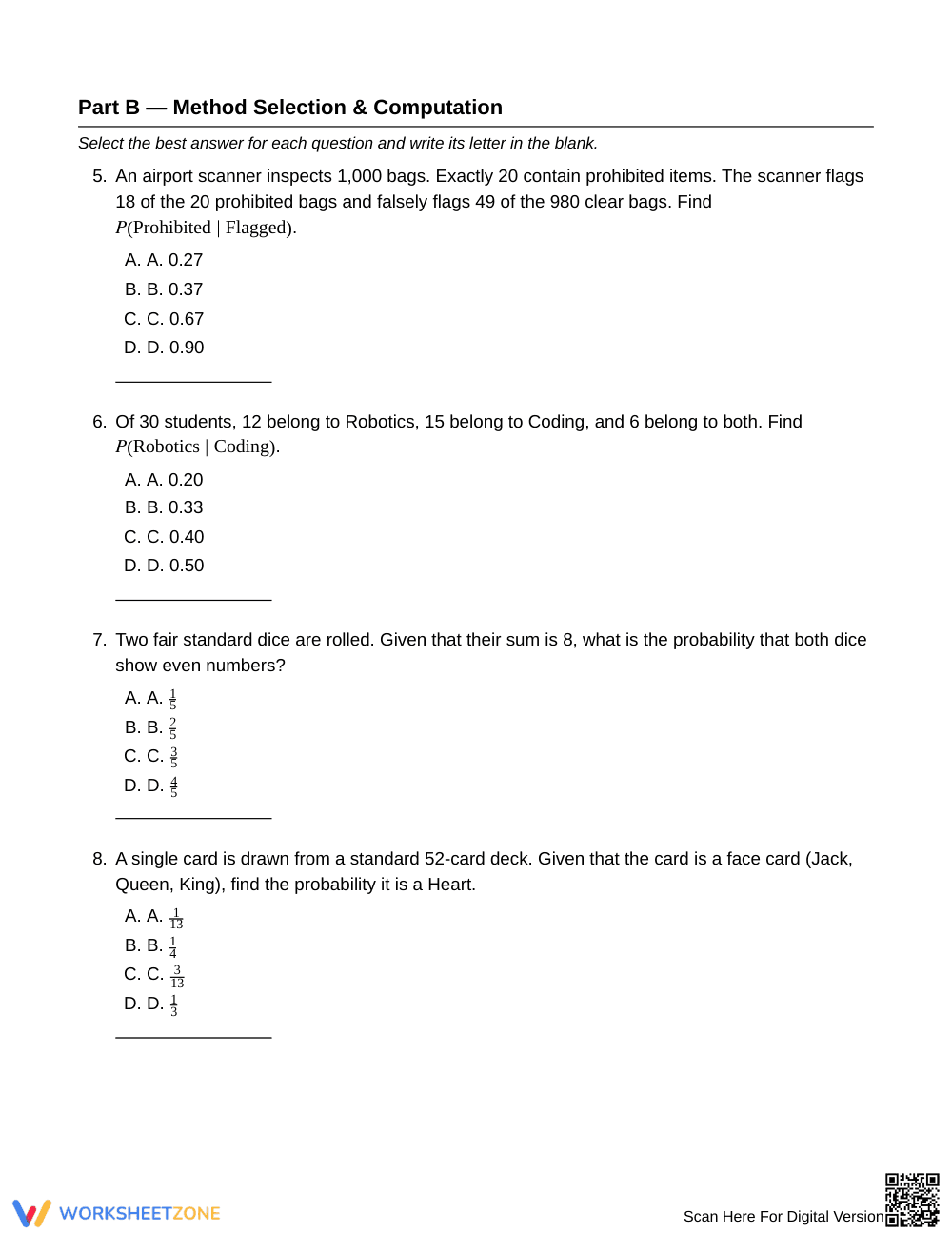
This 5-page printable resource features a dedicated Core Formulas reference box, 16 tiered problems, and a comprehensive 2-page answer key. Students progress through formula identification, multiple-choice computational practice, and free-response modeling tasks that utilize two-way contingency tables and real-world screening scenarios.
Skill Progression
- Guided Practice (Part A, 4 problems): Focuses on foundational formulas, direct parameter substitutions, and true-false definitions with visual formula scaffolds provided at the top of the page.
- Supported Practice (Part B, 8 problems): Offers structured multiple-choice method selection covering dice sums, deck draws, quality inspections, and compound weather models.
- Independent Practice (Part C, 4 problems): Challenges students with open-ended modeling, two-way table analysis, diagnostic sensor rates, and formal algebraic proofs of independence.
This deliberate sequence reflects the gradual-release framework, moving learners from guided rule reinforcement to independent analytical justification.
Standards Alignment
This worksheet aligns directly to `HSS-CP.A.3`, which requires students to understand the conditional probability of A given B as P(A∩B)/P(B) and interpret independence of A and B. It also reinforces supporting standard `HSS-CP.A.2` through multi-step compound event computations. Both standard codes can be copied directly into lesson plans, IEP goals, or district curriculum mapping tools.
How to Use It
Deploy this worksheet immediately after direct instruction on conditional formulas, allocating 40 to 50 minutes for completion. Alternatively, use Part B as an in-class checkpoint and assign Part C for collaborative small-group problem-solving. For formative assessment, observe whether students mistakenly use P(A) instead of the conditioning event P(B) in the denominator when calculating P(A|B).
Who It's For
This activity is designed for Grade 12 Statistics or AP Statistics students preparing for unit assessments on compound probability. Teachers can differentiate by providing highlighted two-way frequency tables for struggling learners, while pairing the resource with an anchor chart summarizing complement and intersection relationships during whole-class discussion.
Mastering conditional probability and mathematical independence under standard HSS-CP.A.3 requires students to calculate conditional events using P(A∩B)/P(B) and distinguish joint occurrences from conditional dependencies. Grounded in the instructional architecture described by Fisher & Frey (2014), structured problem progressions that transition from explicit formula identification to multi-step contingency table justifications significantly reinforce conceptual transfer and procedural fluency. When high school seniors analyze real-world diagnostic screenings and survey distributions, systematic exposure to contrasting representations prevents common misconceptions regarding conditional inversion and sample space reduction. This Grade 12 Statistics resource embodies that gradual-release model across 16 scaffolded tasks, guiding students through foundational computations, contextual multiple-choice evaluations, and rigorous independence proofs with full explanatory answer keys. Educators can directly cite this resource to document targeted evidence of standards mastery in high school data science and advanced mathematics curricula.


