




























Views
Downloads



Essential Polynomial Product Worksheet | Grade 9 Algebra I

Paste this activity's link or code into your existing LMS (Google Classroom, Canvas, Teams, Schoology, Moodle, etc.).
Students can open and work on the activity right away, with no student login required.
You'll still be able to track student progress and results from your teacher account.
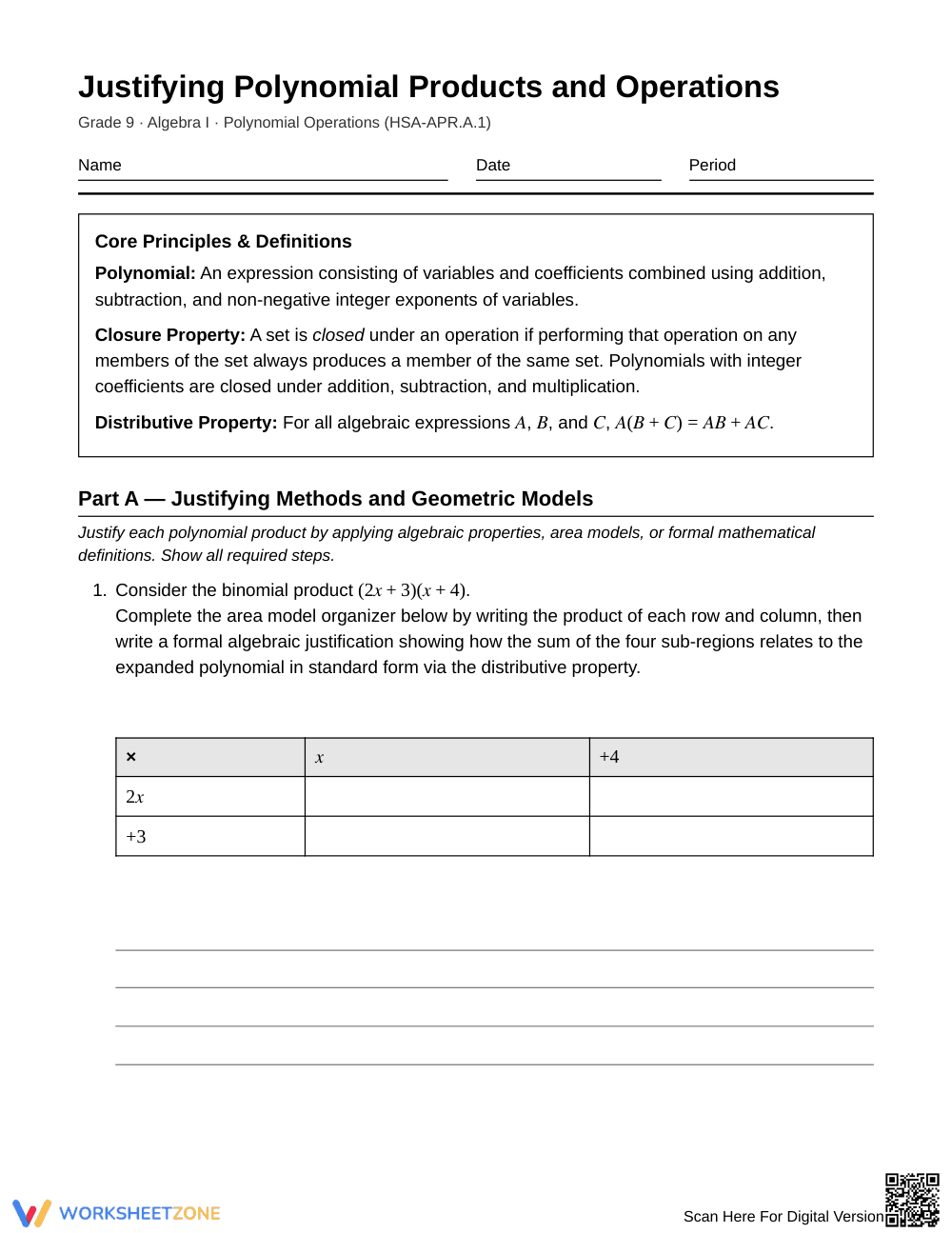
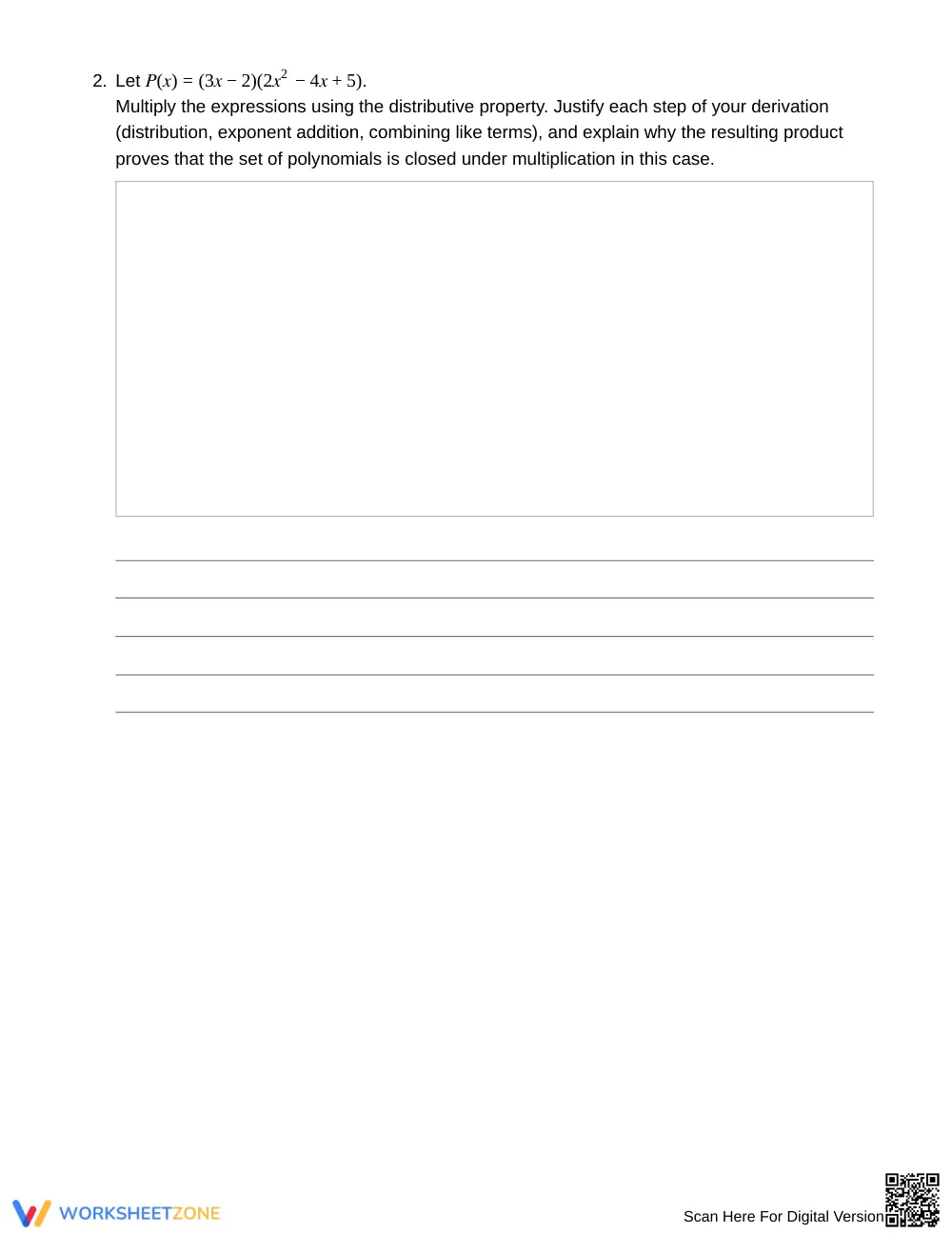
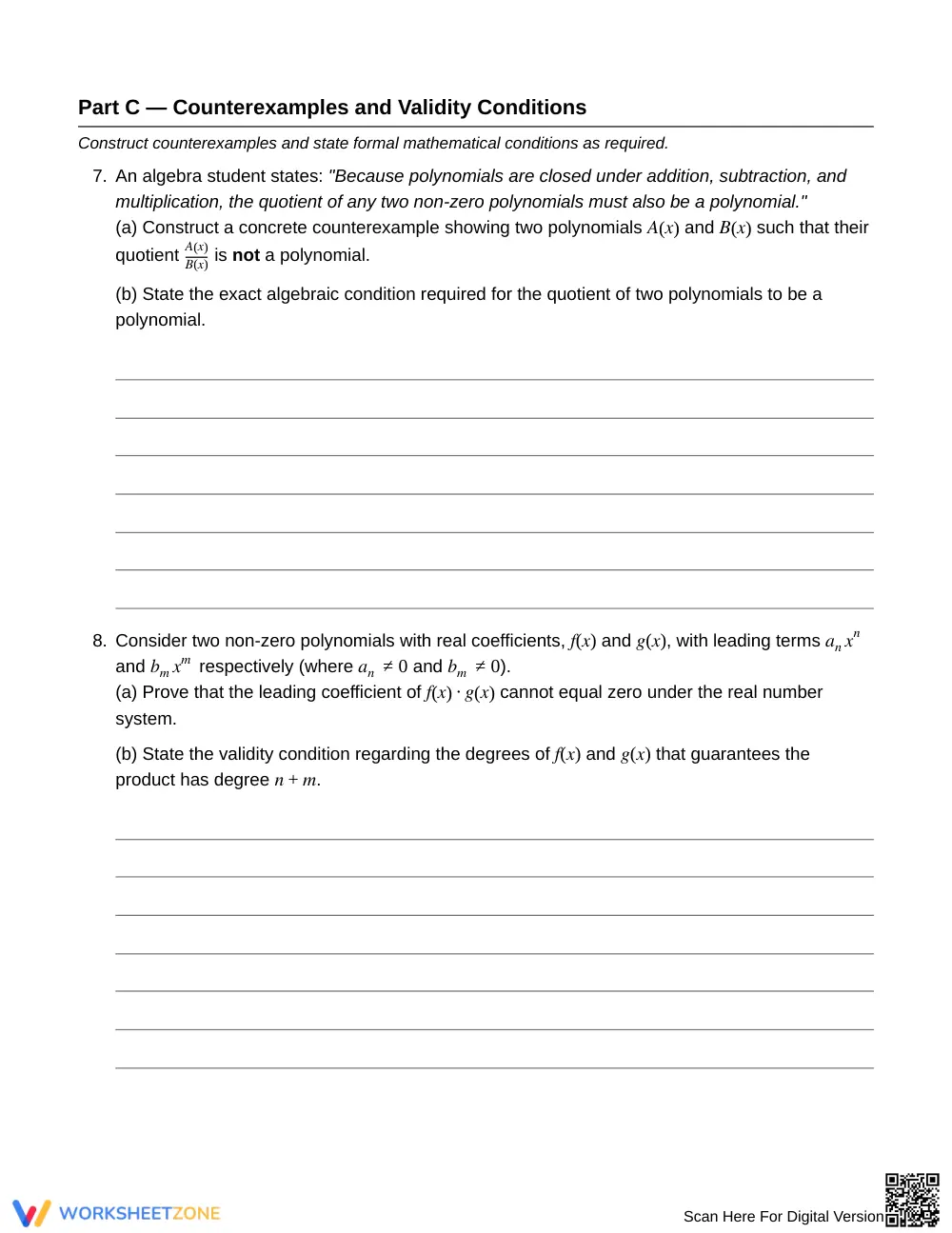
Students will justify polynomial products by applying the distributive property, area models, and formal definitions, producing clear algebraic arguments that demonstrate closure of polynomials under multiplication. The worksheet guides learners through eight multi‑step tasks, building confidence in reasoning and written justification.
At a Glance
- Grade: 9 · Subject: Algebra I Course
- Standard:
HSA-APR.A.1— students justify polynomial products using algebraic properties- Skill Focus: Justify a Polynomial Product with written explanations
- Format: 5 pages · 8 problems · Answer key included · PDF file
- Best For: Independent practice or guided review after direct instruction on multiplication
- Time: 30–45 minutes per class session
The packet spans five pages and contains eight multi‑step problems divided into three parts (Justification, Claim Evaluation, and Counterexample Construction). An answer key occupies three pages and includes model solutions. Scaffolds such as area‑model organizers, worked examples, and sentence frames support rigorous written justification.
Mastery Evidence
Teachers can assess mastery with a simple three‑tier rubric—Approaching, Meeting, Exceeding. Each of the eight tasks aligns with a sub‑skill of HSA-APR.A.1, from applying the distributive property to constructing counterexamples. Scores can be recorded directly in grade‑books or IEP progress notes, providing clear evidence of student growth toward full standard mastery.
Standards Alignment
`HSA-APR.A.1` – Interpret and analyze the structure of polynomial expressions and use properties of operations to simplify, factor, and solve them. This worksheet directly targets that standard, and its tasks reinforce the required analytical reasoning. Both standard codes can be copied directly into lesson plans, IEP goals, or district curriculum mapping tools.
How to Use It
Use the worksheet as a post‑lecture practice session, allowing students to apply the distributive property after a direct instruction on polynomial multiplication. Alternatively, employ it during a guided‑practice block where the teacher circulates, checks written justifications, and notes misconceptions for immediate feedback. Completion typically takes 30–45 minutes.
Who It's For
Designed for Grade 9 Algebra I learners, the tasks meet the needs of on‑grade students while the optional extension prompts (e.g., geometric cancellation explanations) provide challenge for advanced learners. Pair the worksheet with a visual area‑model anchor chart or a short instructional video on polynomial multiplication for a cohesive lesson.
Research shows that explicit justification of algebraic procedures strengthens conceptual understanding and procedural fluency (Fisher & Frey 2014). This worksheet aligns with standard HSA‑APR.A.1, which requires students to justify polynomial products using algebraic properties. By guiding learners through eight carefully sequenced tasks—area models, distributive expansions, and counterexample construction—students practice the exact skill of writing clear, evidence‑based explanations for each step. The inclusion of an answer key supports immediate feedback, while the optional three‑tier rubric offers teachers a reliable measure of mastery. Implementing this resource in a Grade 9 Algebra I class provides the structured practice that research identifies as essential for moving students from procedural execution to mathematical reasoning. Download and assign to promote deeper engagement with polynomial operations. The tasks also reinforce the closure property of polynomials, helping students see connections between algebraic symbols and geometric representations. Classroom data indicate that students who regularly justify their work achieve higher scores on state assessments.


