


























Views
Downloads

Essential Ozone-Greenhouse Worksheet | Grade 12 Science
Paste this activity's link or code into your existing LMS (Google Classroom, Canvas, Teams, Schoology, Moodle, etc.).
Students can open and work on the activity right away, with no student login required.
You'll still be able to track student progress and results from your teacher account.
This Grade 12 Earth and space science worksheet systematically eliminates persistent student confusion between stratospheric ozone depletion and tropospheric greenhouse warming. Through comparative radiative analysis and diagnostic error correction, students master distinct atmospheric layers, photochemical mechanisms, and spectral energy bands across 12 rigorous analytical problems.
At a Glance
- Grade: 12 · Subject: Earth & Space Science
- Standard: Differentiate stratospheric ozone dynamics from tropospheric greenhouse warming mechanisms
- Skill Focus: Ozone Layer vs. Greenhouse Effect Mechanics
- Format: 5 pages · 12 problems · Answer key included · PDF
- Best For: Atmospheric science review and diagnostic remediation
- Time: 45–60 minutes
What's Inside
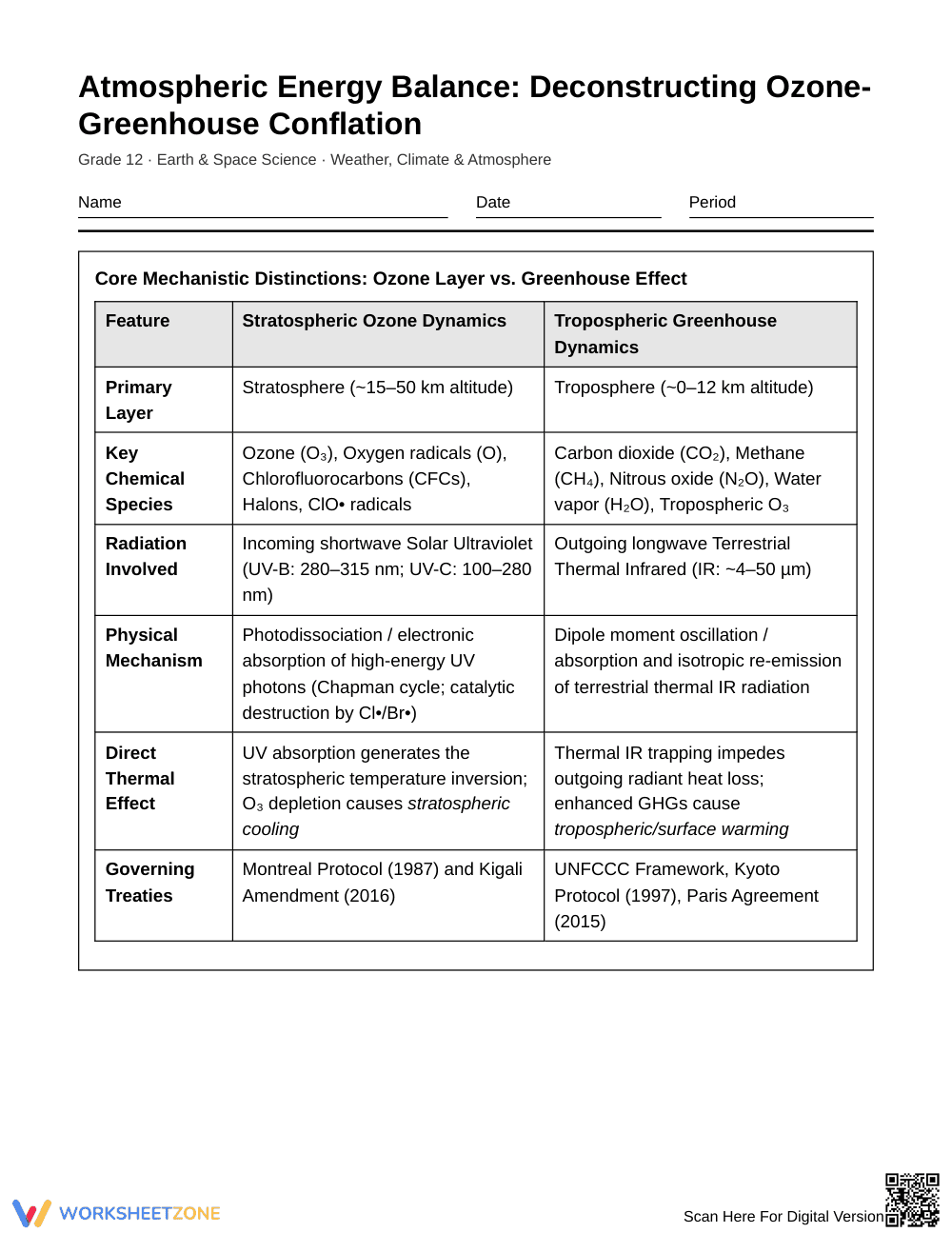
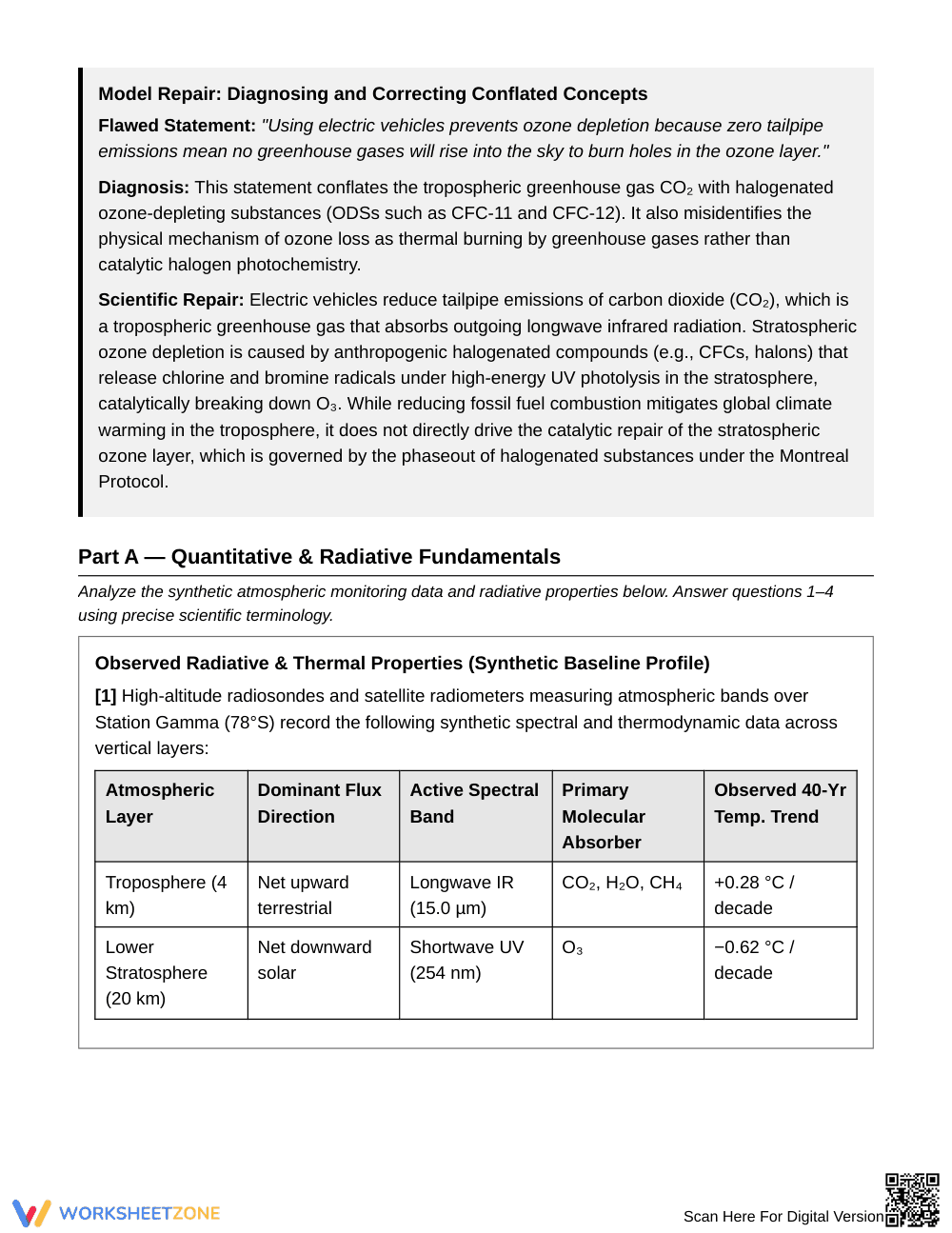
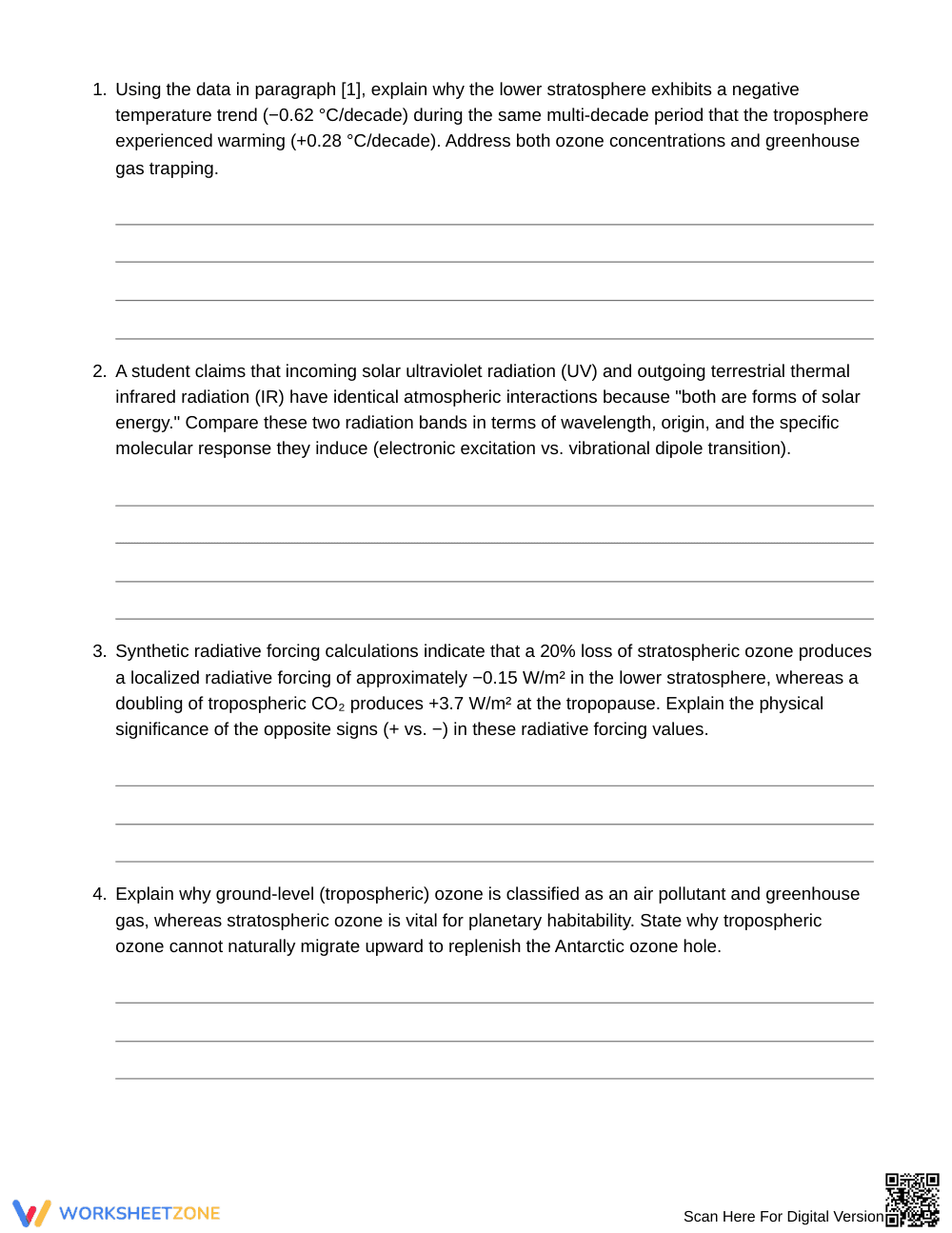
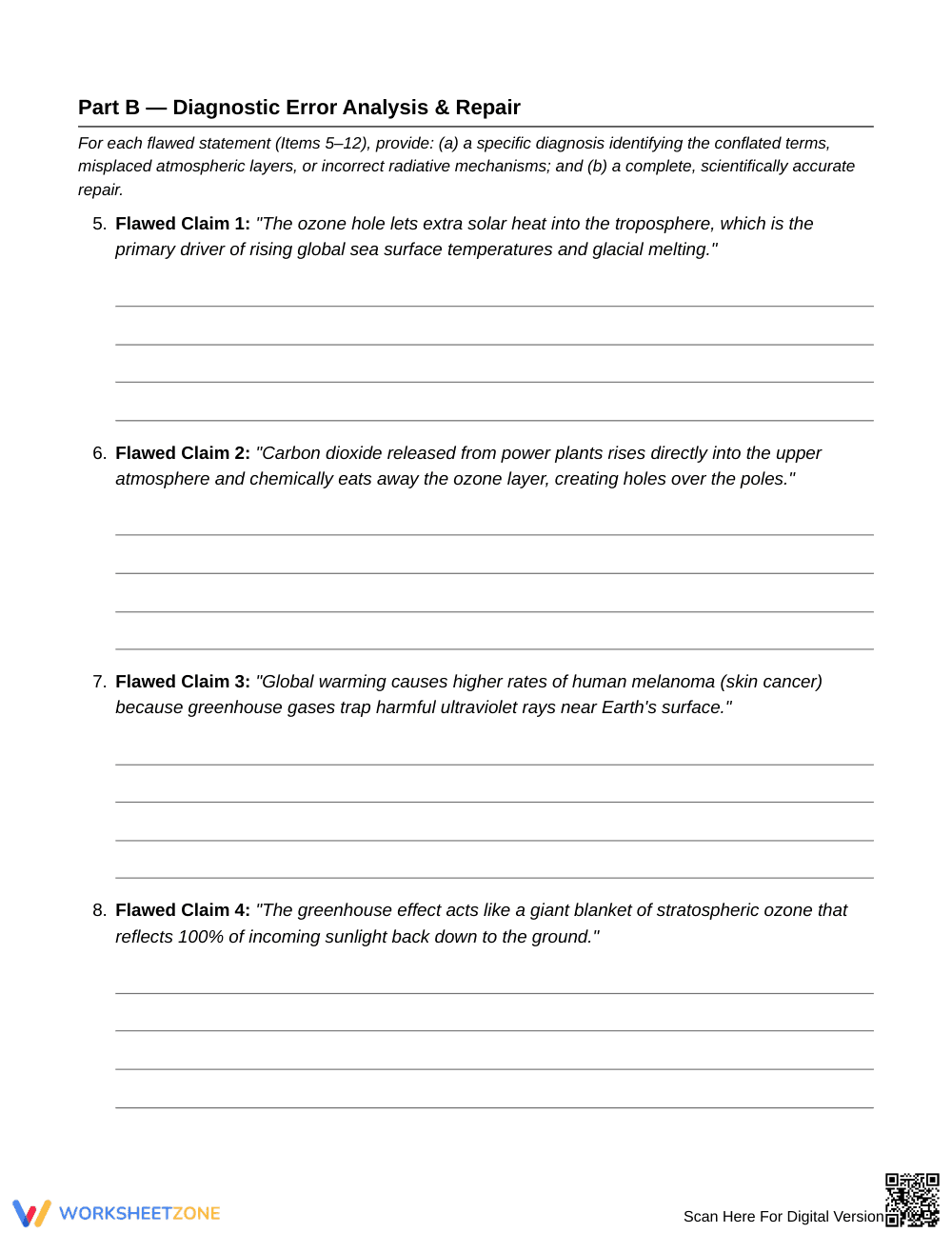
This 5-page resource includes a comparative reference table detailing chemical species, radiation bands, governing treaties, and thermal impacts across atmospheric layers. A worked diagnostic repair demonstrates how to isolate and correct conflated scientific arguments. Students complete 4 quantitative data analysis items in Part A using synthetic radiosonde profiles, followed by 8 diagnostic error-repair tasks in Part B targeting common misconceptions about ultraviolet radiation, infrared absorption, photochemical smog, and ozone recovery. A 4-page answer key provides complete diagnostic rationale for every problem.
Skill Progression
- Guided practice: Students review a structured comparison table and a modeled scientific repair deconstructing a flawed claim regarding vehicle emissions and ozone loss.
- Supported practice: In Part A (Questions 1–4), students interpret radiosonde temperature trends, compare UV versus IR molecular interactions, evaluate radiative forcing signs, and contrast tropospheric with stratospheric ozone.
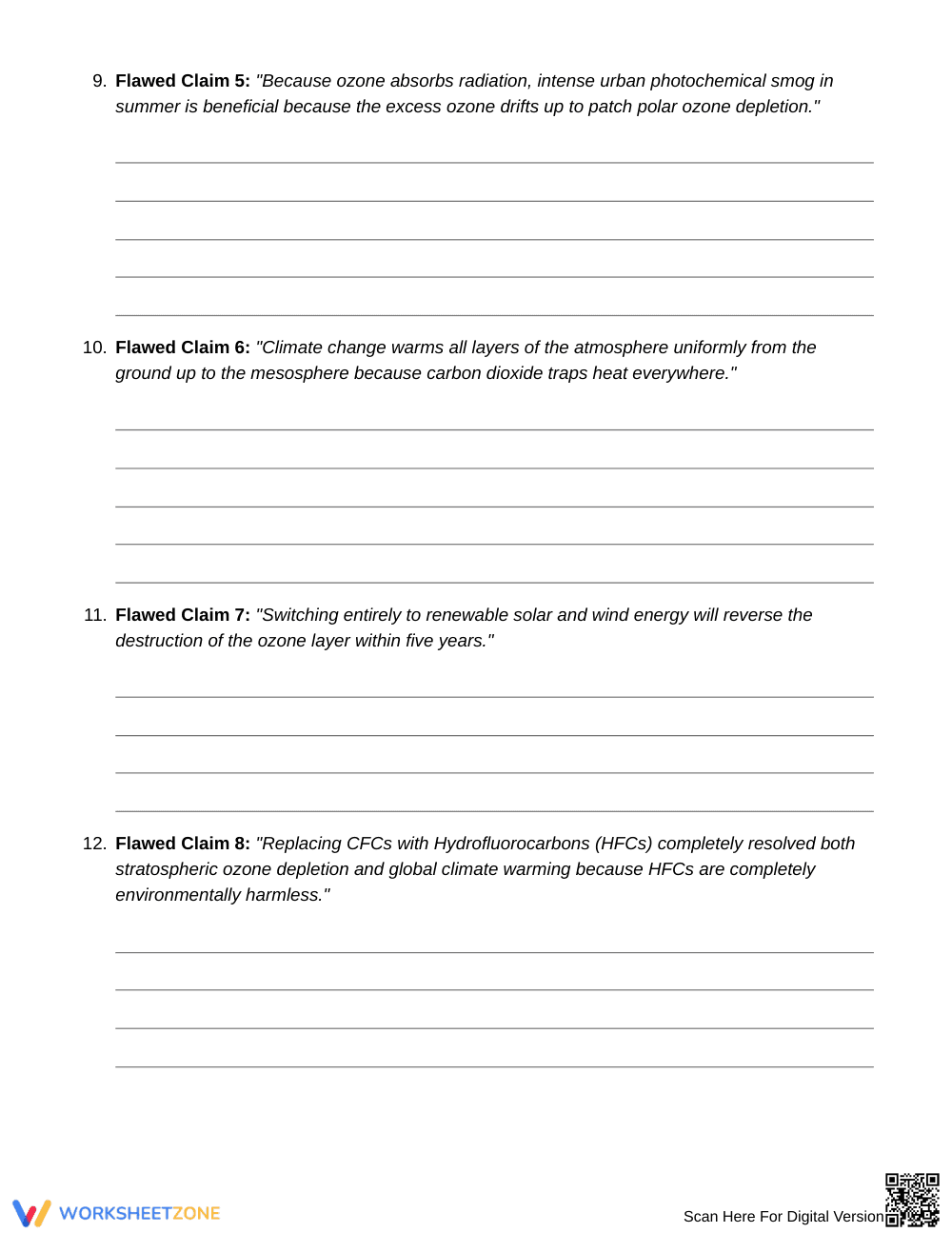
- Independent practice: In Part B (Questions 5–12), students independently diagnose and correct 8 flawed claims regarding skin cancer, polar warming, smog migration, and chemical treaties.
This structured progression leverages an I Do, We Do, You Do gradual-release architecture to transition students from scaffolded reference analysis to autonomous conceptual correction.
Standards Alignment
This resource aligns with high school Earth and Space Science standards requiring students to model planetary energy balance, analyze the atmospheric greenhouse effect, and evaluate human impacts on atmospheric chemistry. It builds scientific literacy by requiring clear distinction between incoming shortwave ultraviolet photochemistry and outgoing longwave thermal infrared absorption.
How to Use It
Deploy this worksheet after direct instruction on atmospheric layers and radiative balance. Assign Part A for paired analysis of spectral data, followed by Part B as an independent diagnostic check. During the lesson, monitor whether students still attribute global warming to ozone holes letting heat in. Expected completion time is 45 to 60 minutes.
Who It's For
This activity is designed for Grade 12 Earth and Space Science and AP Environmental Science students preparing for atmospheric assessments. Scaffolding in the introductory matrix supports developing learners, while error-repair tasks challenge advanced students. Pair this worksheet with an atmospheric radiative flux diagram or vertical thermal profile chart.
High school students frequently exhibit deep-rooted misconceptions that conflate stratospheric ozone depletion with the tropospheric greenhouse effect, often assuming ozone holes allow solar heat to enter and drive global warming. Research documented by Fisher & Frey (2014) emphasizes that resolving entrenched scientific misconceptions requires explicit cognitive dissonance and structured diagnostic repair rather than passive reading. This 5-page atmospheric science worksheet directly confronts these conflations by requiring Grade 12 students to analyze radiosonde data and systematically evaluate 8 flawed statements across distinct radiative bands. By differentiating incoming solar ultraviolet radiation (254 nm) photochemistry in the stratosphere from outgoing terrestrial thermal infrared (15.0 µm) absorption in the troposphere across 12 targeted tasks, this resource establishes robust conceptual foundations. The structured format equips educators with rigorous formative data to confirm genuine mastery of atmospheric energy balance principles.


