


























Views
Downloads



Essential Numerical Limits Worksheet | Grade 12 Precalculus
Paste this activity's link or code into your existing LMS (Google Classroom, Canvas, Teams, Schoology, Moodle, etc.).
Students can open and work on the activity right away, with no student login required.
You'll still be able to track student progress and results from your teacher account.
This comprehensive Precalculus worksheet strengthens student understanding of introductory limits and sequences through numerical and algebraic analysis. High school seniors examine partial sums, evaluate sequence behavior as terms approach infinity, and translate recursive representations into explicit formulas, building foundational intuition for collegiate calculus coursework.
At a Glance
- Grade: 12 · Subject: Precalculus
- Standard: Evaluate sequence convergence and compare numerical evidence for limits
- Skill Focus: Compare Numerical Evidence for Limits
- Format: 4 pages · 12 problems · Answer key included · PDF
- Best For: Calculus readiness and limit analysis practice
- Time: 45–55 minutes
The 4-page student activity features 12 carefully sequenced tasks spanning multiple-choice conceptual checks, table-based data interpretations, formula derivations, and constructed response justifications. An introductory reference box clarifies limit notation, geometric series convergence criteria, and sequence limits, supported by a 2-page detailed answer key.
Skill Progression
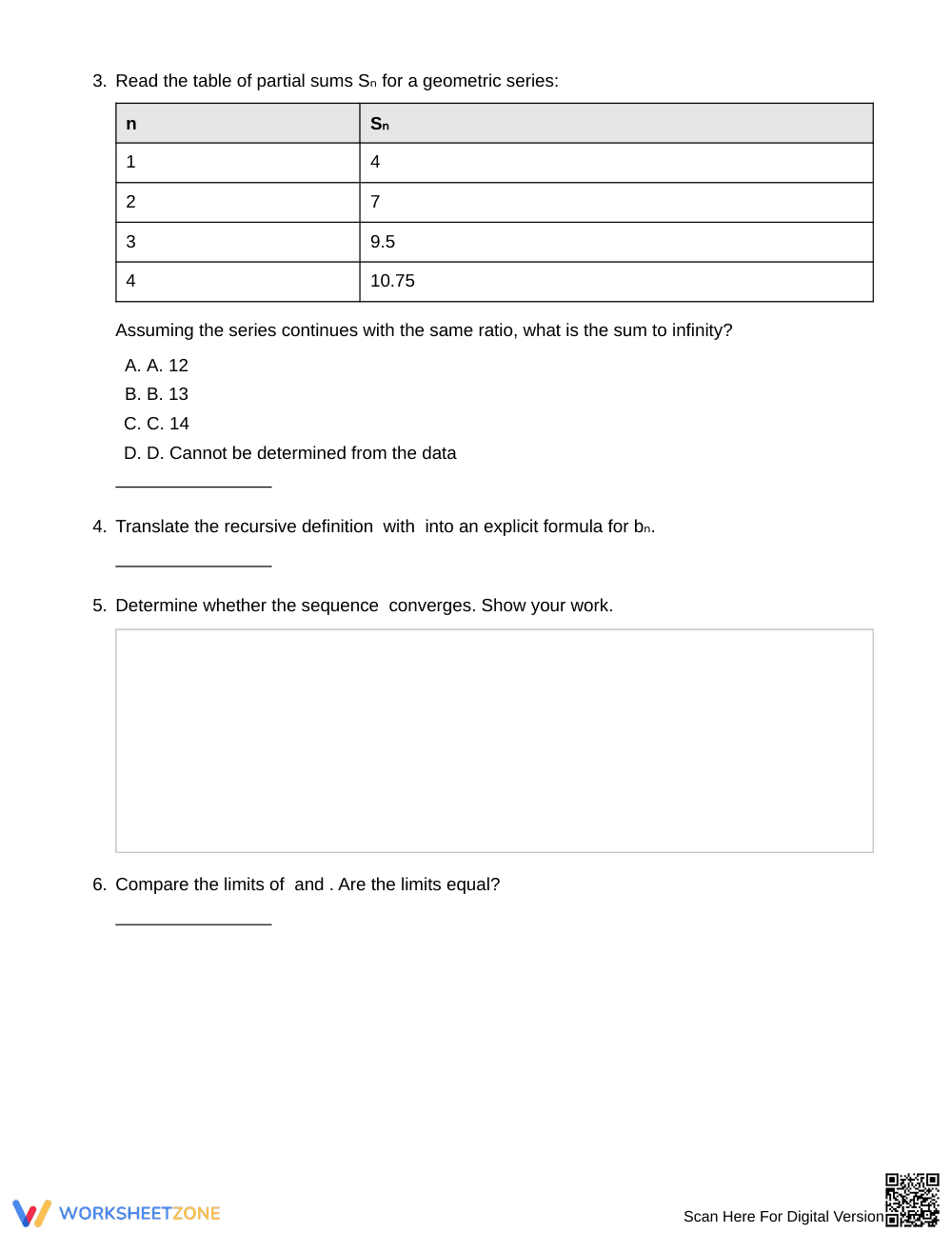
- Guided practice (Tasks 1–3): Multiple-choice items prompt students to identify basic sequence types, evaluate rational sequence limits, and determine infinite geometric series sums from partial sum tables.
- Supported practice (Tasks 4–8): Students convert recursive sequences to explicit definitions, test oscillating sequence convergence, and calculate finite geometric series.
- Independent practice (Tasks 9–12): Students analyze numerical tables, explain subsequence divergence, and write theoretical justifications regarding limit definitions.
This structured progression reflects the gradual release of responsibility model, moving students from guided identification to rigorous written justification.
Standards Alignment
This resource aligns with high school advanced mathematics standards focusing on sequences, series, and limits. Students examine finite and infinite sequences to determine convergence and model discrete functions. Both standard codes can be copied directly into lesson plans, IEP goals, or district curriculum mapping tools.
How to Use It
Deploy this worksheet after direct instruction on sequence limits or as an intensive review before an introductory calculus unit. For formative assessment, examine student written explanations in Task 10 regarding alternating terms to verify whether learners understand subsequence divergence before moving to formal epsilon-delta proofs. Typical completion requires 45 to 55 minutes of focused classroom work.
Who It's For
This activity is designed for Grade 12 Precalculus and Advanced Algebra students preparing for AP Calculus. Provide struggling learners with graphing calculators to visualize term values, while advanced students can formulate formal algebraic proofs. Pair this printable with a direct instruction lesson on infinite geometric series.
According to research synthesized by Fisher & Frey (2014), instructional frameworks that scaffold mathematical analysis through gradual release significantly enhance student mastery of abstract concepts. This Grade 12 Precalculus worksheet provides 12 rigorous tasks that guide learners to compare numerical evidence for limits, evaluate sequence convergence, and translate recursive relationships into explicit algebraic expressions. By transitioning from structured multiple-choice items and tabular evaluations to independent written justifications, the resource reinforces conceptual understanding of asymptotic behavior. The inclusion of clear definitions, partial sum tables, and detailed answer explanations supports active reasoning and formative evaluation in secondary mathematics classrooms. Educators can utilize these scaffolded materials to bridge discrete algebra concepts with introductory calculus, ensuring students build the critical analytical habits necessary for success in advanced STEM coursework.


