




























Views
Downloads

Essential Nuclear Decay Worksheet | Grades 9-12 Science

Paste this activity's link or code into your existing LMS (Google Classroom, Canvas, Teams, Schoology, Moodle, etc.).
Students can open and work on the activity right away, with no student login required.
You'll still be able to track student progress and results from your teacher account.
Master nuclear equations, radiation properties, and decay series with this comprehensive science activity. Students analyze nuclear stability by balancing mass and atomic numbers, comparing penetrating powers, and calculating half-life decays across 42 rigorous questions designed for high school chemistry and physics classrooms.
At a Glance
- Grade: Grades 9–12 · Subject: Science
- Standard: High School Physical Science — Model changes in nuclear composition and released energy
- Skill Focus: Nuclear Decay: Classification & Relationships
- Format: 4 pages · 42 problems · Answer key included · PDF
- Best For: Nuclear chemistry practice and review
- Time: 45–60 minutes
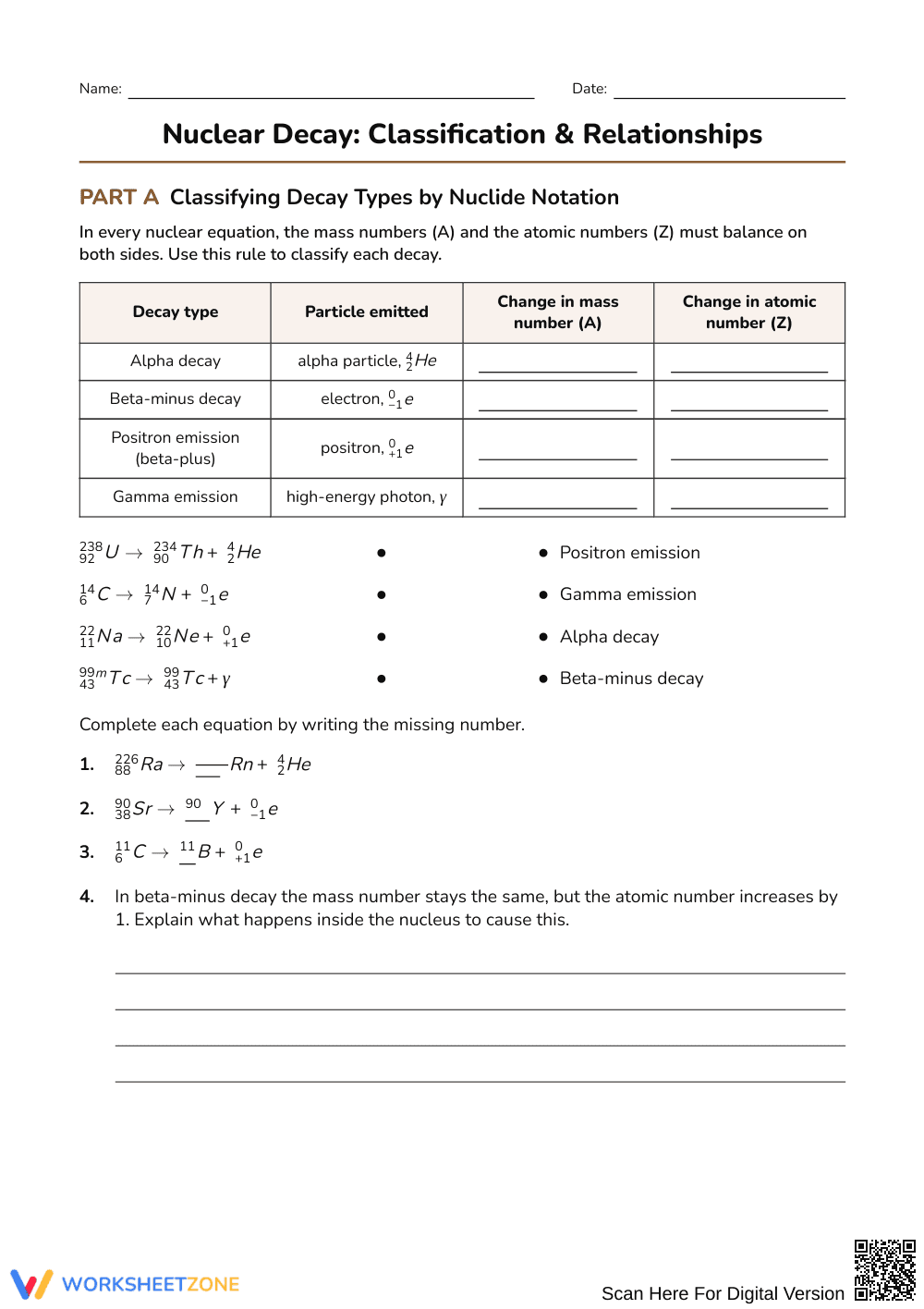
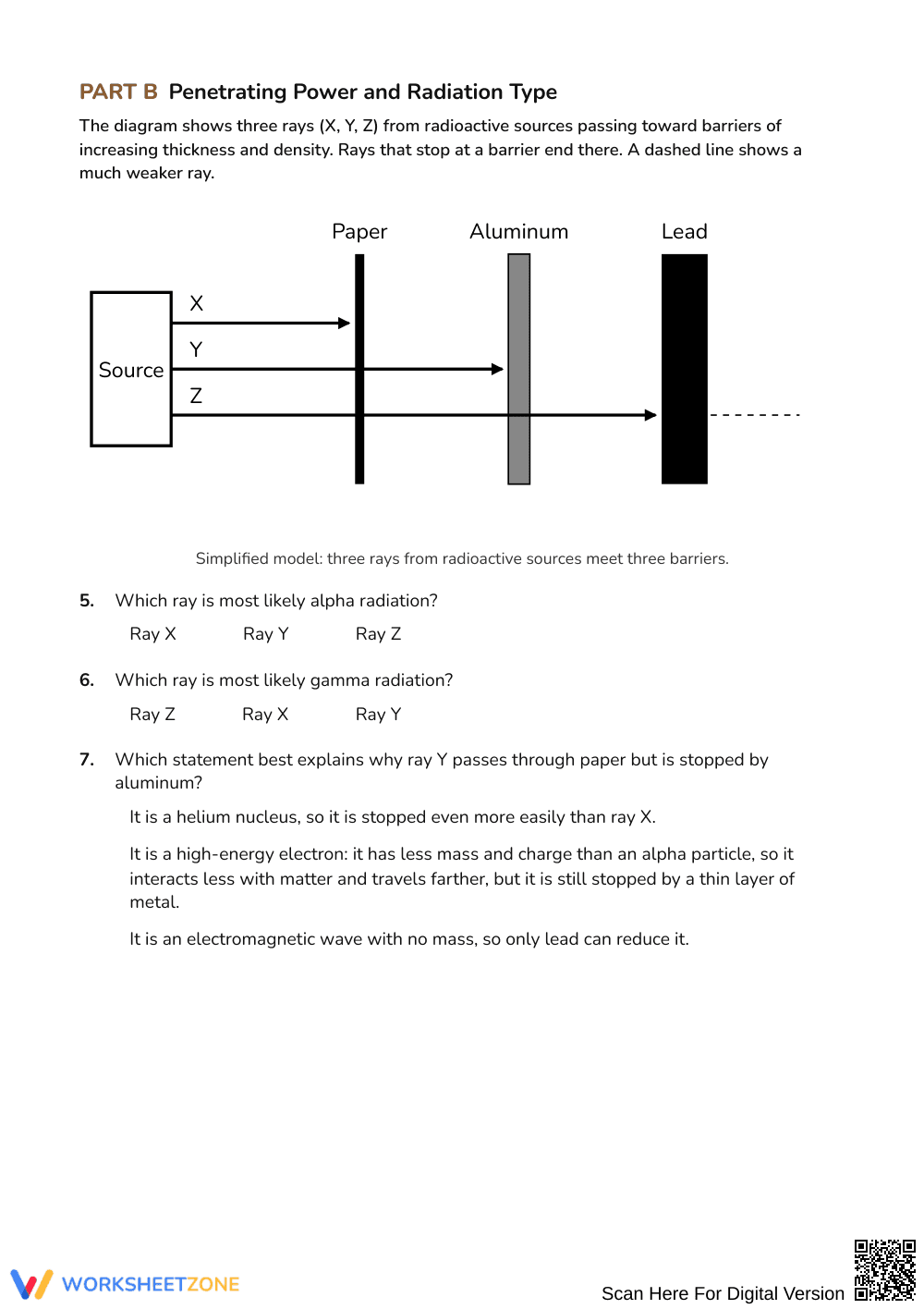
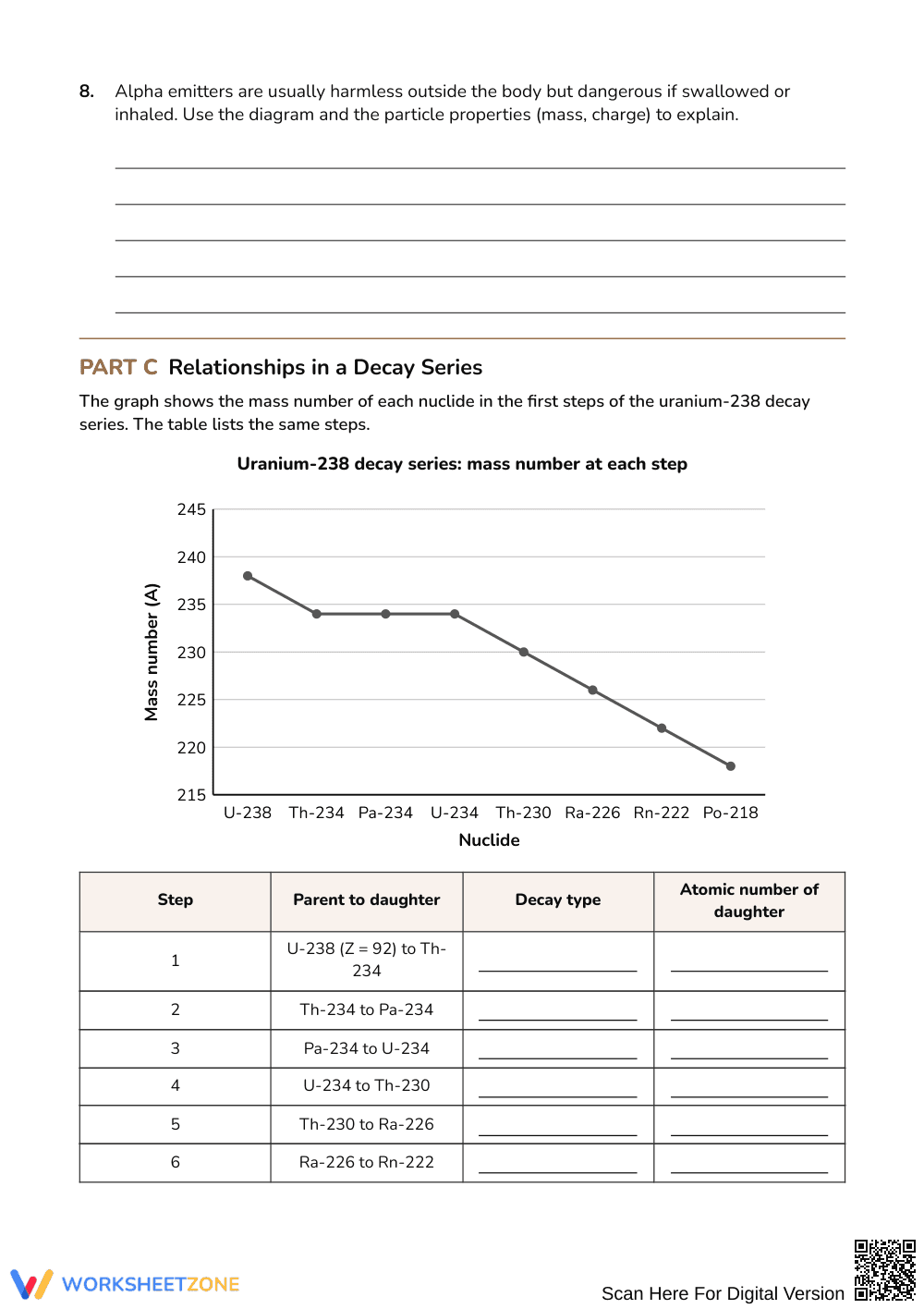
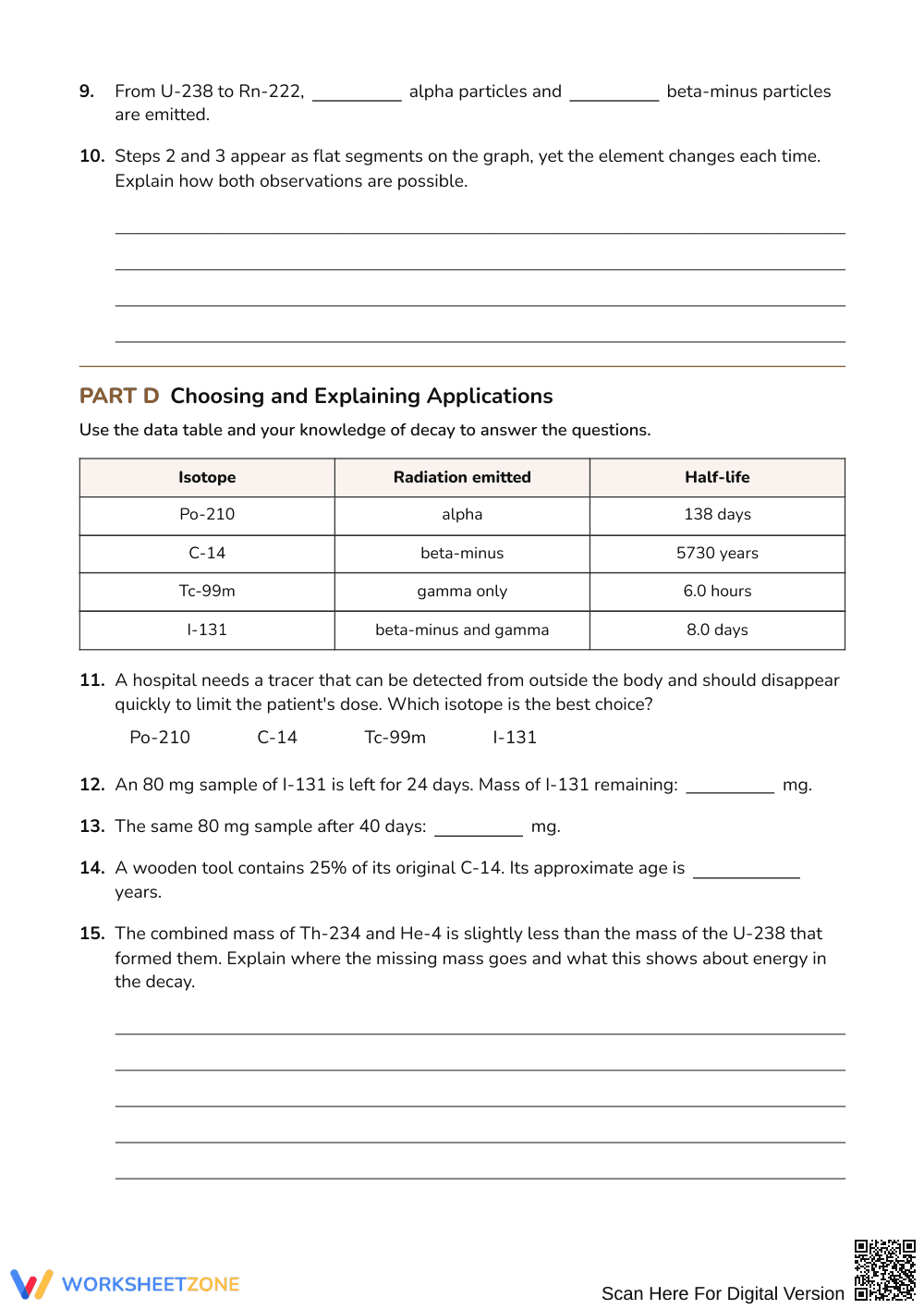
Across 4 student pages, learners work through four distinct sections. Part A introduces a reference summary table of decay types followed by nuclide notation balancing. Part B presents visual diagrams comparing penetrating power through paper, aluminum, and lead. Part C features a multi-step uranium-238 decay series graph and data table. Part D concludes with authentic isotope application problems, half-life decay math, and mass-energy equivalence explanations. A complete 4-page answer key provides full solutions.
Skill Progression
- Guided Practice: Problems 1–8 provide explicit reference charts defining alpha, beta-minus, positron, and gamma emissions with complete worked examples demonstrating conservation of nucleon numbers.
- Supported Practice: Problems 9–24 use barrier diagrams and decay chain graphs to scaffold conceptual understanding of particle penetrating power and isotope transformation steps.
- Independent Practice: Problems 25–42 require unassisted isotope selection for medical imaging, multi-interval half-life calculations, and written explanations of mass defect and energy release.
This sequence follows the gradual-release framework (I Do, We Do, You Do), establishing foundational equation skills before demanding independent data analysis and synthesis.
Standards Alignment
This resource aligns with high school physical science standards addressing nuclear chemistry and subatomic transformations. Students model nuclear processes, balance nuclear reactions, and calculate energy changes associated with mass alterations. Teachers can copy these instructional targets directly into lesson plans, IEP goals, or district curriculum mapping tools.
How to Use It
Deploy this activity immediately after direct instruction on radiation types to solidify conceptual understanding, or use it as a mid-unit formative assessment. During seatwork, circulate during Part B to check whether students connect particle mass and charge to penetrating depth. The entire 42-question set takes approximately 45 to 60 minutes of focused class time.
Who It's For
Designed for Grades 9–12 chemistry, physical science, and introductory physics students, this assignment accommodates diverse learning needs with structured data tables and visual models. It pairs naturally with an introductory lecture on atomic structure or a laboratory simulation demonstrating radioactive half-life.
High school nuclear chemistry instruction demands systematic practice connecting subatomic particle properties with observable radiation behaviors. This 4-page, 42-task resource guides students in classifying nuclear decay types, balancing isotopic equations, interpreting decay series graphs, and applying half-life calculations to practical real-world scenarios. According to research by Fisher & Frey (2014), structured instructional progressions that move intentionally from scaffolded equation modeling to independent scientific explanation foster durable conceptual mastery and procedural fluency in complex STEM topics. By organizing content across four distinct phases—nuclide notation, penetrating power models, decay series tracking, and medical isotope evaluation—this worksheet ensures high school science students build authentic competence in modeling nuclear reactions. The accompanying 4-page complete answer key enables targeted feedback, assisting educators in diagnosing student misconceptions regarding nucleon conservation, beta particle transformation, and mass-energy equivalence across secondary chemistry and physics classrooms.


