




























Views
Downloads



Essential Moles & Molar Mass Worksheet | Grade 11 Chemistry

Paste this activity's link or code into your existing LMS (Google Classroom, Canvas, Teams, Schoology, Moodle, etc.).
Students can open and work on the activity right away, with no student login required.
You'll still be able to track student progress and results from your teacher account.
This Grade 11 chemistry worksheet equips students to master quantitative conversions between mass, moles, and particle counts. Through 12 rigorous problems, learners calculate molar masses, determine quantities in chemical compounds, and analyze mathematical reasonableness. Students build essential dimensional analysis skills necessary for advanced stoichiometry and laboratory investigations.
At a Glance
- Grade: 11 · Subject: Chemistry
- Standard: Quantitative Chemical Relationships — Calculate mass, molar amounts, and numbers of representative particles in chemical substances
- Skill Focus: Moles, Particles, and Molar Mass
- Format: 5 pages · 12 problems · Answer key included · PDF
- Best For: Stoichiometry unit practice and calculation review
- Time: 45–60 minutes
What's Inside
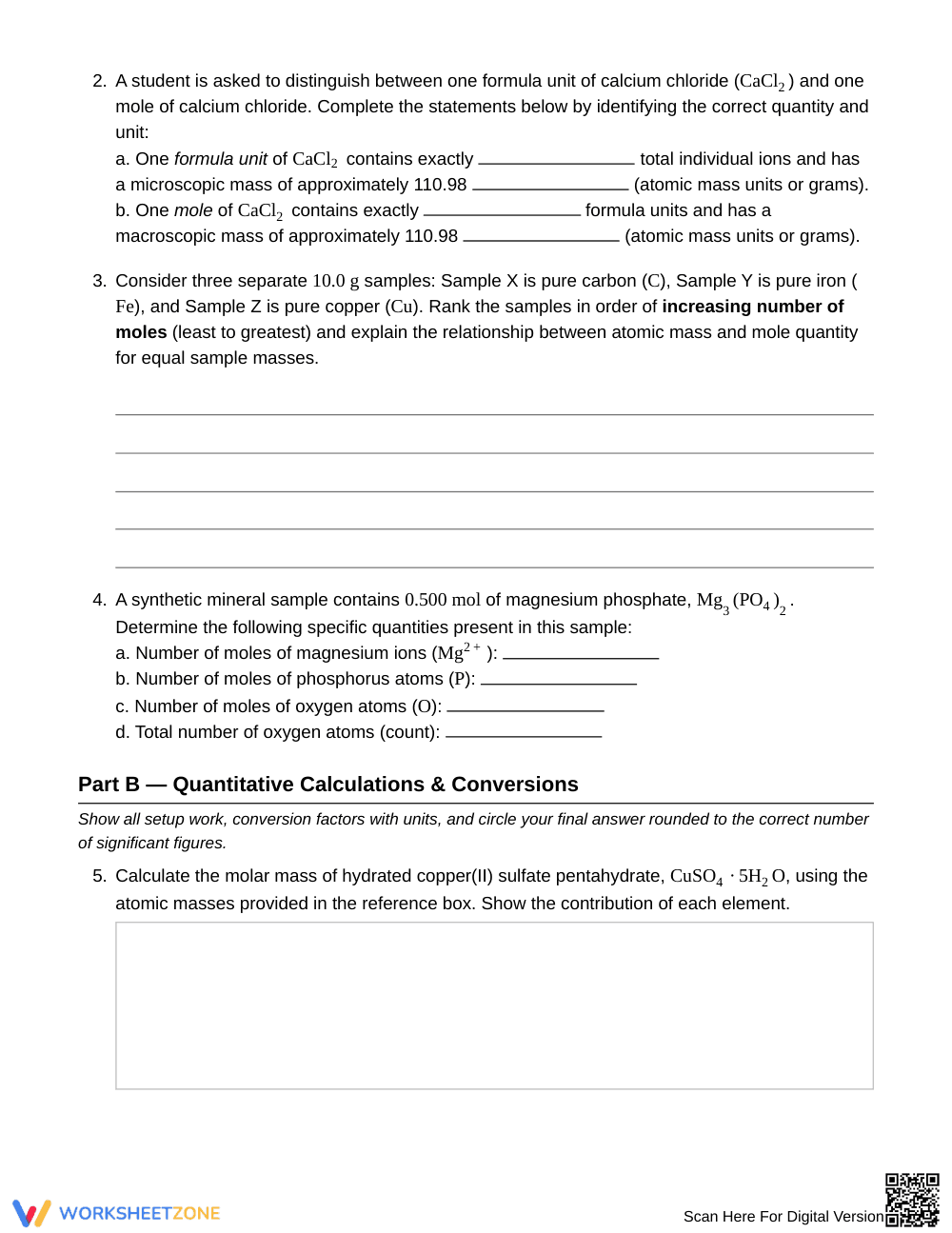
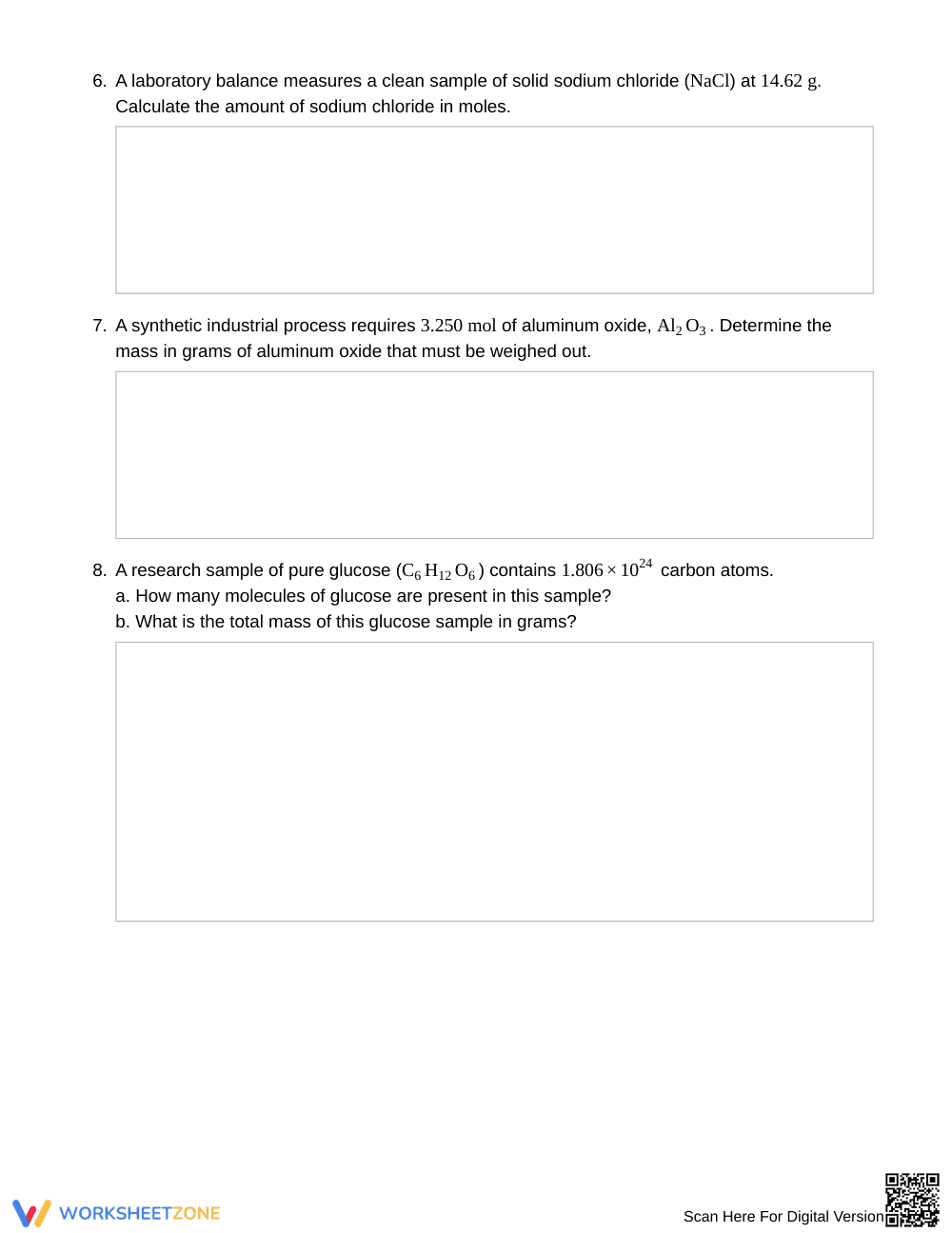
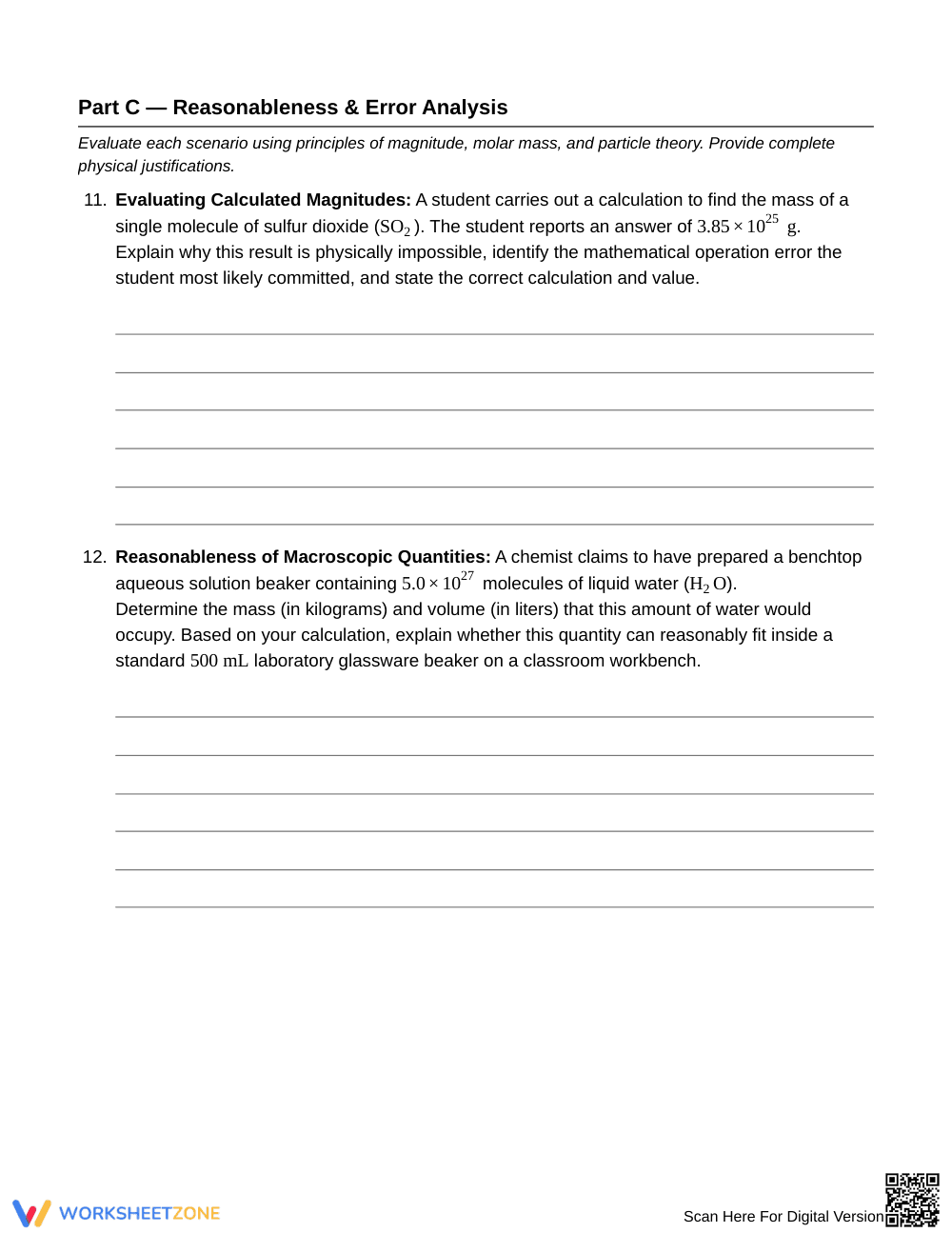
The worksheet contains 12 multi-part chemistry tasks structured across 5 total pages, including a detailed reference constant header with standard atomic masses and conversion formulas. Students work through conceptual distinctions, multi-step dimensional analysis problems with hydrates and polyatomic ions, and critical error analysis scenarios. A comprehensive 4-page step-by-step answer key provides worked calculations, unit tracking, and significant figure verification.
Skill Progression
- Guided practice (Part A): Four conceptual problems guide students to differentiate microscopic formula units from macroscopic molar quantities and relate atomic mass to mole quantities.
- Supported practice (Part B): Six computational conversion tasks require students to calculate molar mass, convert between grams and moles, and determine total atom counts in compounds like glucose and copper(II) sulfate pentahydrate.
- Independent practice (Part C): Two rigorous error analysis questions challenge students to evaluate physically impossible values and assess macroscopic volume feasibility.
This sequence follows a research-supported gradual release model, moving learners from conceptual understanding to autonomous quantitative evaluation.
Standards Alignment
This resource aligns with high school chemistry standards for quantitative chemical relationships and stoichiometry, specifically the ability to convert between mass, moles, and representative particles using Avogadro's number and molar mass. It reinforces scientific notation, significant figures, and dimensional analysis across all tasks. These core objectives can be copied directly into lesson plans, IEP goals, or district curriculum mapping tools.
How to Use It
Deploy this worksheet after direct instruction on the mole concept and molar mass calculations. For guided classroom practice, have students complete Part A in collaborative pairs before working independently through Part B conversions. Use Part C as a formative assessment check to observe whether students recognize magnitude errors when using scientific notation on calculators. Expect completion in 45 to 60 minutes.
Who It's For
This resource is designed for Grade 11 general, honors, or AP Chemistry students developing quantitative problem-solving foundations. Scaffolding supports emerging learners with provided atomic weights, while complex compounds and error analysis offer extension for advanced students. Pair this activity with an introductory laboratory investigation measuring molar samples of common elements.
Mastery of quantitative chemical relationships requires high school chemistry students to systematically coordinate conceptual particle theory with multi-step dimensional analysis. According to Fisher & Frey (2014), structured scaffolds that transition students from guided conceptual distinction to independent quantitative problem solving significantly increase retention of foundational STEM skills. This 12-task worksheet operationalizes that pedagogical framework by guiding Grade 11 learners through atomic mass conversions, Avogadro's number calculations, and complex hydrate formulas before demanding high-level error analysis. By requiring explicit unit labeling, significant figure compliance, and magnitude verification, the resource ensures students do not simply perform rote calculator algorithms but genuinely comprehend the physical meaning of the mole. Chemistry educators can utilize this standards-aligned practice set to diagnose misconceptions regarding microscopic particles versus macroscopic grams, establishing the quantitative fluency essential for advanced stoichiometric calculations and laboratory chemical analysis.


