




























Views
Downloads


Essential Model Parameters Worksheet | Grade 9 Algebra I

Paste this activity's link or code into your existing LMS (Google Classroom, Canvas, Teams, Schoology, Moodle, etc.).
Students can open and work on the activity right away, with no student login required.
You'll still be able to track student progress and results from your teacher account.
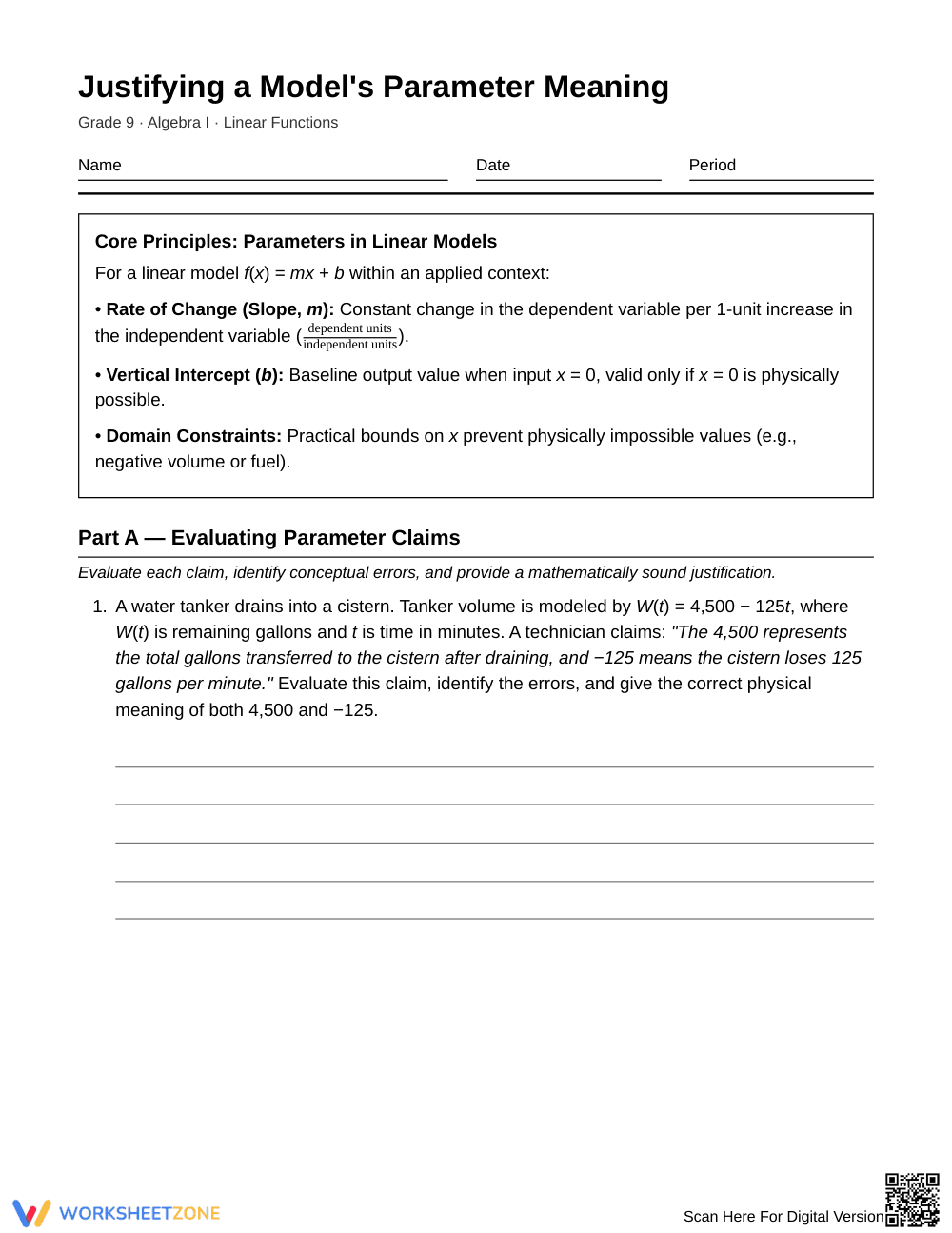
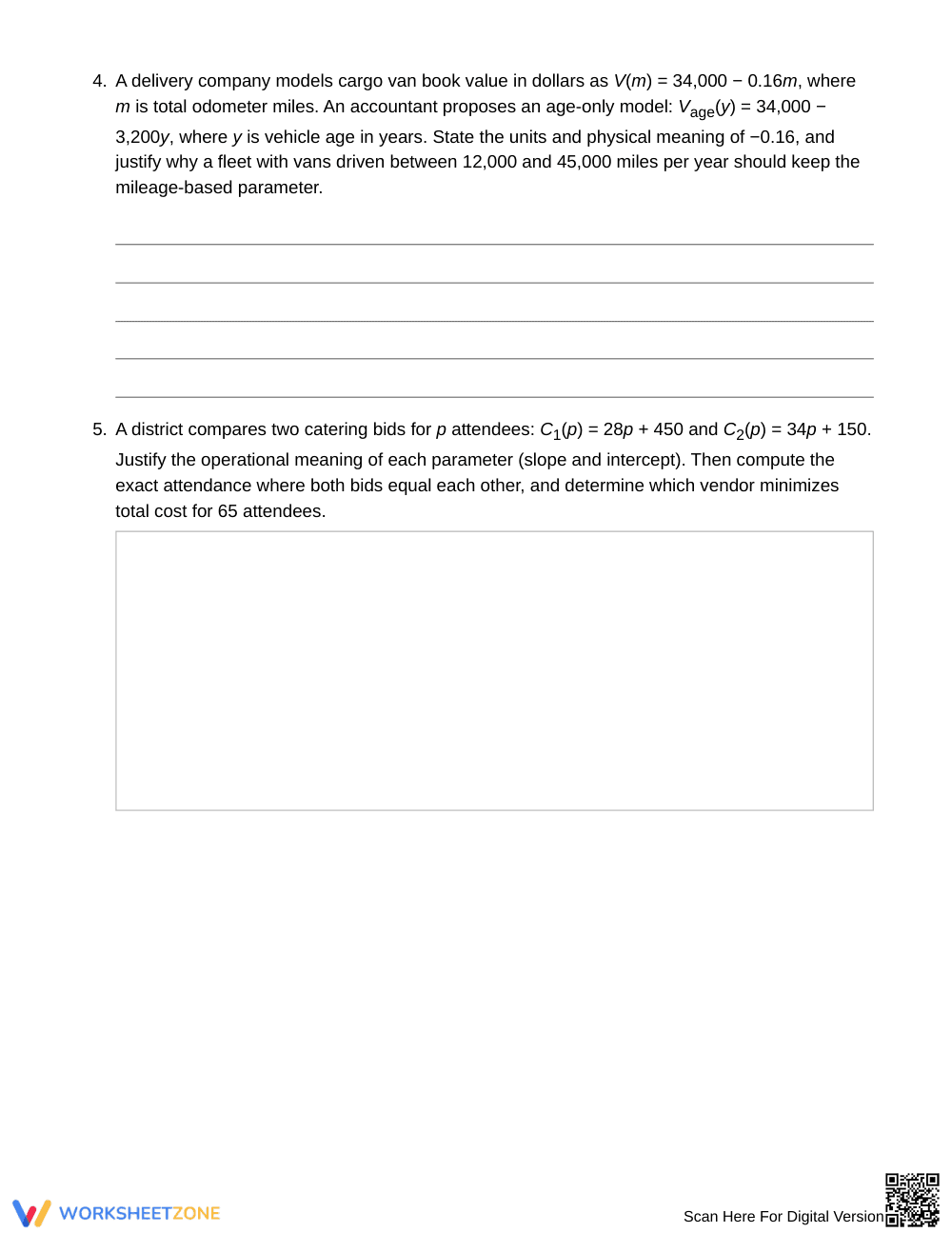
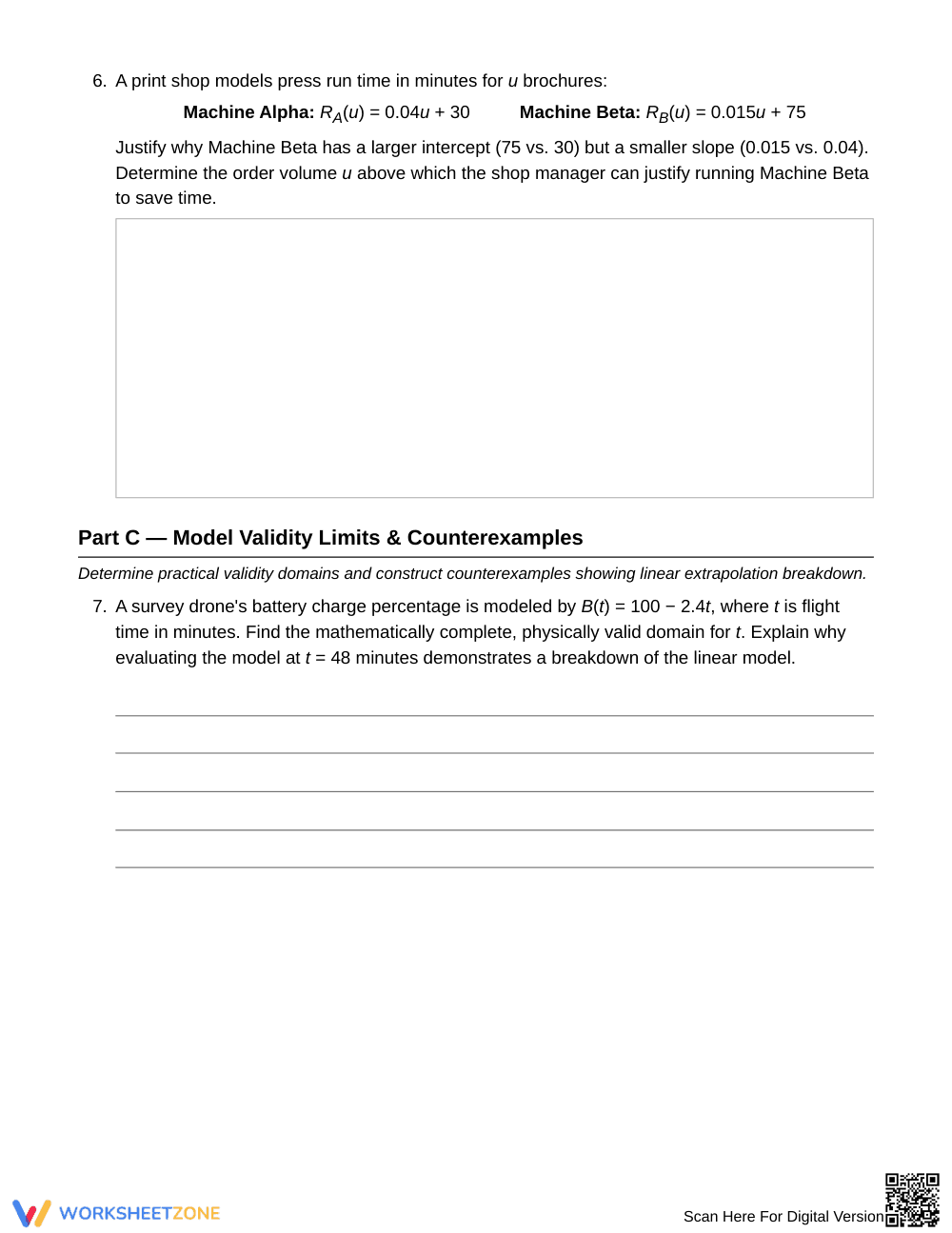
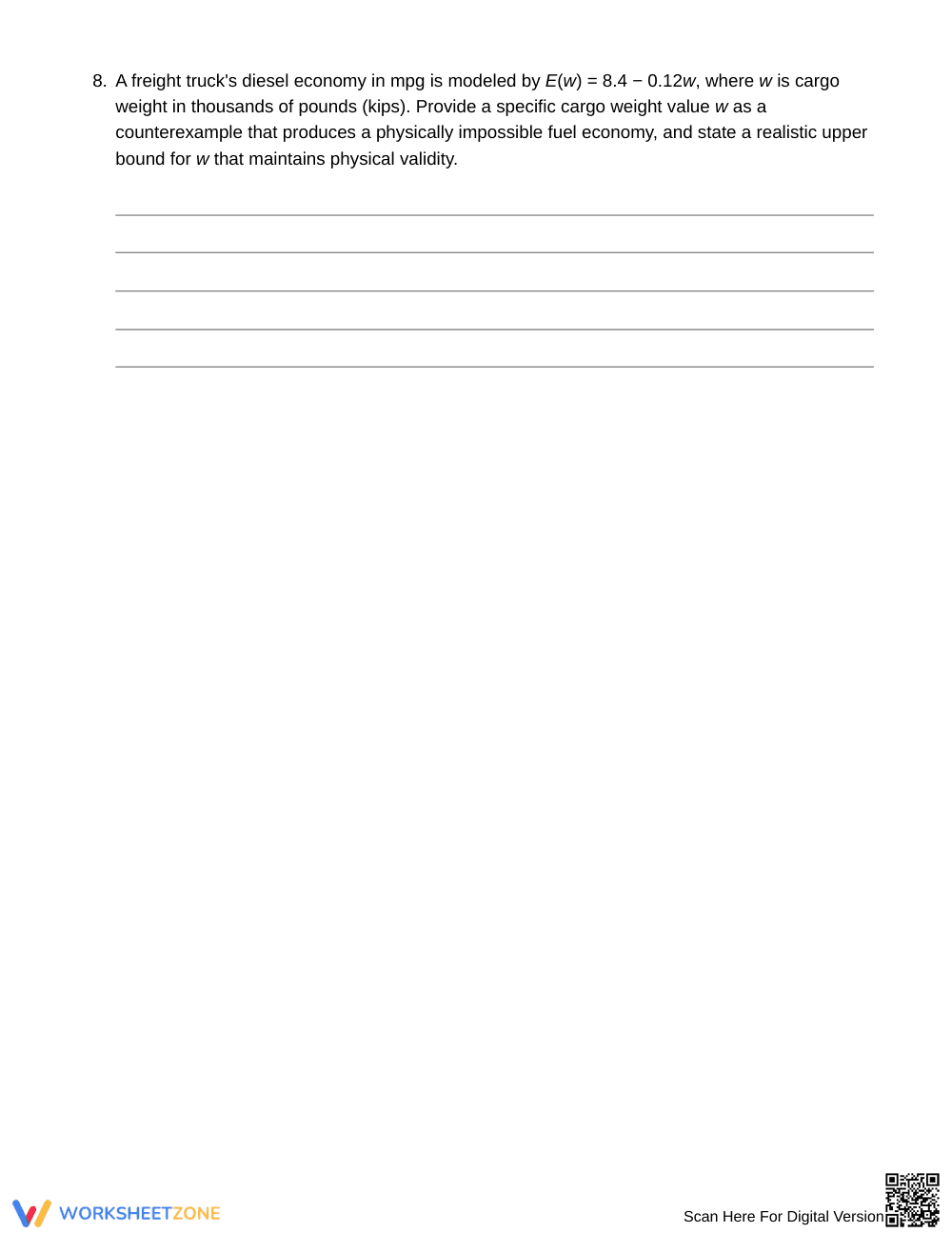
This Grade 9 Algebra I worksheet equips students to interpret and justify the contextual meaning of slope and vertical intercepts in linear functions. Students examine realistic scenarios, critique flawed interpretations, calculate practical equivalence thresholds, and define the operational boundaries of mathematical models across eight rigorous, context-rich problems.
At a Glance
- Grade: 9 · Subject: Algebra I
- Standard:
HSF-LE.B.5— Interpret the parameters in a linear function in terms of a context- Skill Focus: Justify parameter meaning and identify model breakdown
- Format: 5 pages · 8 problems · Answer key included · PDF
- Best For: Linear modeling application and formative assessment
- Time: 45–60 minutes
What's Inside
This five-page printable includes a core reference framework defining slope, intercepts, and domain bounds, followed by eight detailed analytical tasks. Students analyze rates of change, compare competing models, and justify practical domain limits using concrete units of measurement. A complete two-page answer key provides full mathematical justifications and numerical solutions.
Skill Progression
- Guided practice (Part A, 2 tasks): Students evaluate pre-written claims about water tanker drainage and utility rates, pinpointing conceptual misconceptions regarding initial conditions and constant rate parameters.
- Supported practice (Part B, 4 tasks): Students construct written justifications for cooling rates, vehicle depreciation, catering bids, and commercial print volume while calculating break-even points.
- Independent practice (Part C, 2 tasks): Students establish valid physical domains and construct counterexamples illustrating linear extrapolation failure in drone battery drain and freight fuel economy.
This gradual-release structure moves learners from error analysis to authentic mathematical justification and domain validation.
Standards Alignment
This resource aligns with HSF-LE.B.5: interpret the parameters in a linear or exponential function in terms of a context. It also reinforces HSF-IF.B.4 by requiring students to sketch and interpret key features of functional relationships in context. Both standard codes can be copied directly into lesson plans, IEP goals, or district curriculum mapping tools.
How to Use It
Administer this worksheet after direct instruction on linear slope-intercept form to deepen conceptual understanding. During independent or paired work, observe whether students include compound units (such as dollars per kilowatt-hour) when defining slope, using this as a quick formative checkpoint. The activity fits cleanly into a 45- to 60-minute class block or serves as a multi-day modeling assignment.
Who It's For
This worksheet is designed for on-level and advanced Grade 9 Algebra I students needing rigorous practice connecting algebra to real-world contexts. Scaffolding notes on page one support striving learners, while the counterexample tasks challenge advanced thinkers. Pair this activity with an anchor chart detailing rate-of-change units and practical domain boundaries.
According to EdReports 2024, high-quality high school algebra curricula require students to routinely connect symbolic representations to concrete situational contexts rather than relying solely on procedural manipulation. Aligned with standard HSF-LE.B.5, this instructional worksheet develops a student's ability to interpret parameters in linear functions by demanding rigorous verbal justifications of rate of change and initial value. By prompting learners to define realistic domain intervals and identify where linear extrapolation breaks down in physical systems, the eight multi-part tasks cultivate analytical reasoning and conceptual modeling fluency. Educators can reliably utilize these targeted exercises to diagnose misunderstandings of negative rates, evaluate student mastery of rate-unit consistency, and document measurable progress toward state secondary mathematics benchmarks.


