




























Views
Downloads


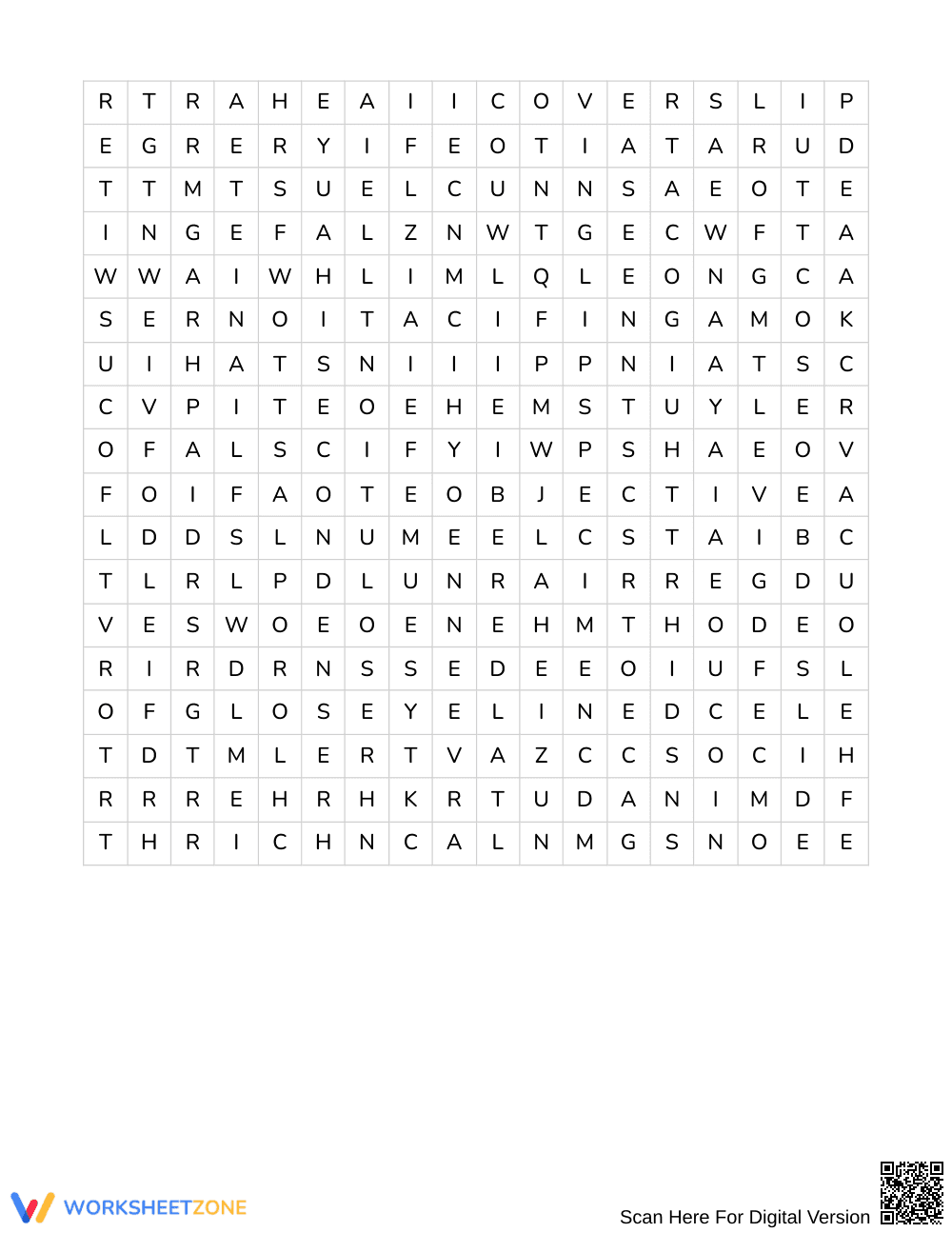

Essential Microscope Word Search | Grades 6–7 Science

Paste this activity's link or code into your existing LMS (Google Classroom, Canvas, Teams, Schoology, Moodle, etc.).
Students can open and work on the activity right away, with no student login required.
You'll still be able to track student progress and results from your teacher account.
This science word search reinforces microscope terminology and cell observation concepts for middle school students. Learners read detailed biological clues to deduce 16 essential vocabulary terms before locating them in the puzzle grid. Designed for independent practice, the activity strengthens scientific literacy, tool recognition, and specimen viewing comprehension without requiring upfront teacher preparation.
At a Glance
- Grade: Grades 6–7 · Subject: Life Science
- Standard: Not standards-assessed — general vocabulary enrichment through contextual biological clue reading
- Skill Focus: Microscope optics, slide preparation, and cell observation vocabulary
- Format: 3 pages · 16 words · Full answer key included · Printable PDF document
- Best For: Meaningful vocabulary review, quiet independent work, and emergency sub plans
- Time: 25–35 minutes total active puzzle solving
What's Inside
The 3-page printable activity features a challenging no-bank layout where students must infer terms from 16 content-rich biological clues. Key concepts span optical components, specimen mounting, and visible cell organelles. A full-size 3-page answer key provides complete letter-by-letter solutions, making review swift for educators or student self-checking.
Puzzle Mechanics
The activity challenges students through an 18 x 18 letter grid containing 16 hidden vocabulary terms. Instead of consulting a pre-printed word bank, students read functional descriptions of microscope parts and biological structures to determine each hidden target. Search paths run across all eight compass directions: north, northeast, east, southeast, south, southwest, west, and northwest. This rigorous clue-based format prevents passive scanning and ensures students connect scientific definitions to terminology before locating the words.
Standards Alignment
This resource serves as supplemental vocabulary enrichment and is not aligned to a formal state or national content standard. It supports foundational scientific literacy by reinforcing precise technical terminology—such as magnification, resolution, diaphragm, and condenser—necessary for laboratory microscopy units.
How to Use It
Deploy this puzzle during or immediately after introducing wet-mount slide preparation and compound microscope anatomy. In a lab-prep setting, assign the clues as an introductory check before students handle physical glass slides. Alternatively, use it as a zero-prep sub plan during life science units. Formative observation tip: circulate to verify whether students correctly infer terms like "resolution" and "condenser" from clues before searching the grid. Students typically complete the activity within 25 to 35 minutes.
Who It's For
This activity is tailored for Grades 6–7 life science and general science classrooms. It offers accessible enrichment for general education learners while providing an engaging challenge for advanced students who enjoy clue deduction. For students needing support, pair the activity with a labeled microscope diagram or an illustrated laboratory anchor chart to provide visual clues alongside written definitions.
Vocabulary acquisition in middle school science requires active retrieval practice rather than passive memorization. According to Fisher & Frey (2014), intentional exposure to domain-specific academic vocabulary directly enhances conceptual comprehension and reading fluency across informational texts. By stripping away traditional word banks and requiring learners to generate scientific terms from contextual definitions, this activity activates prior knowledge of microscope mechanics and cellular observation. Students must retrieve concepts like optical resolution, magnification, and specimen preparation before initiating visual search patterns. This dual cognitive process—definition recall coupled with orthographic pattern recognition—solidifies technical terminology in long-term memory. Integrating structured clue-based vocabulary tasks into laboratory science instruction provides meaningful repetition that equips Grades 6–7 students with the foundational language required to describe experimental observations and communicate scientific findings with precision.


