


























Views
Downloads



Essential Meaningful Inputs Worksheet | Grade 9 Algebra I
Paste this activity's link or code into your existing LMS (Google Classroom, Canvas, Teams, Schoology, Moodle, etc.).
Students can open and work on the activity right away, with no student login required.
You'll still be able to track student progress and results from your teacher account.
This Algebra I worksheet enables Grade 9 students to evaluate function notation and distinguish algebraic domains from contextual domains. Through 8 multi-part problems, learners critique misconceptions, calculate valid physical inputs, and construct mathematical counterexamples across real-world scenarios.
At a Glance
- Grade: 9 · Subject: Algebra I
- Standard:
HSF-IF.A.2— Evaluate functions for inputs in their domains and interpret statements in context- Skill Focus: Justifying Meaningful Function Inputs
- Format: 5 pages · 8 problems · Answer key included · PDF
- Best For: Independent practice and formative assessment
- Time: 40–50 minutes
What's Inside
The 5-page worksheet begins with a reference box defining function notation and domain constraints. Students complete 8 analytical problems modeling phone costs, rocket height, ticket revenue, pool draining, fuel use, catering fees, and reservoir oxygen levels. A complete 3-page answer key provides step-by-step evaluations and justifications.
Skill Progression
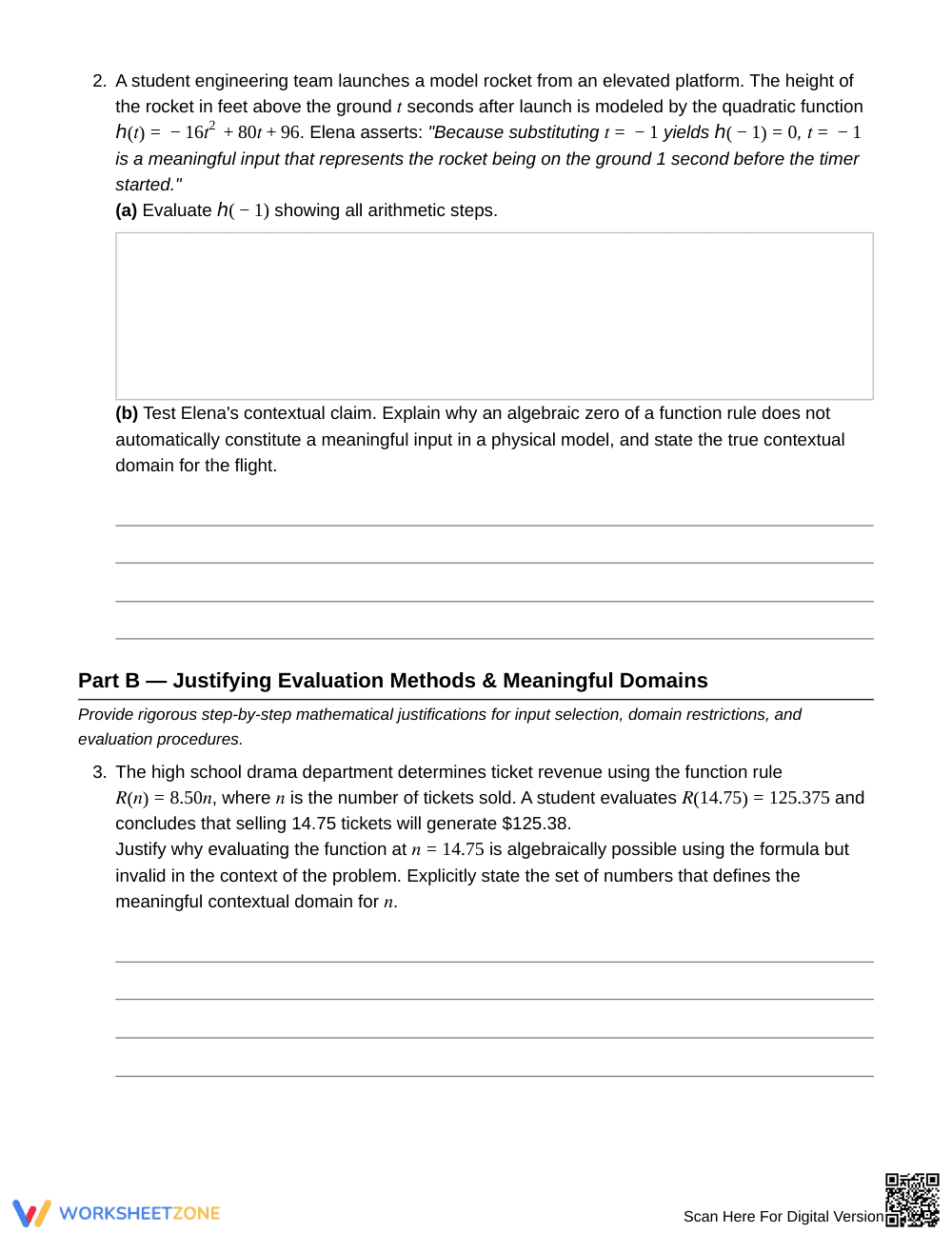
- Guided practice (Part A, 2 tasks): Students evaluate functions while critiquing sample student claims and identifying algebraic outputs lacking physical validity.
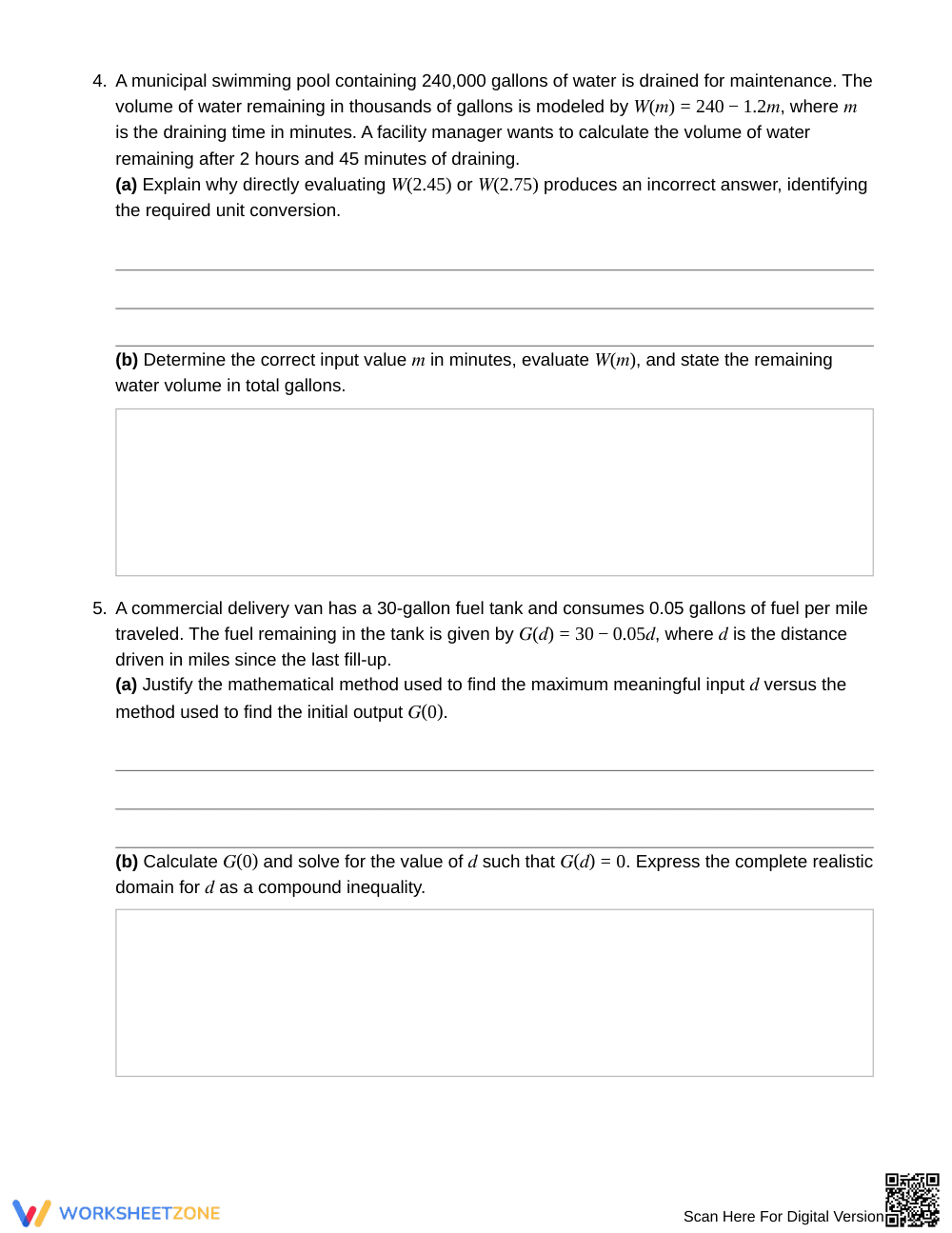
- Supported practice (Part B, 4 tasks): Learners justify domain restrictions, perform unit conversions before input evaluation, and prove non-equivalence in applied cost models.
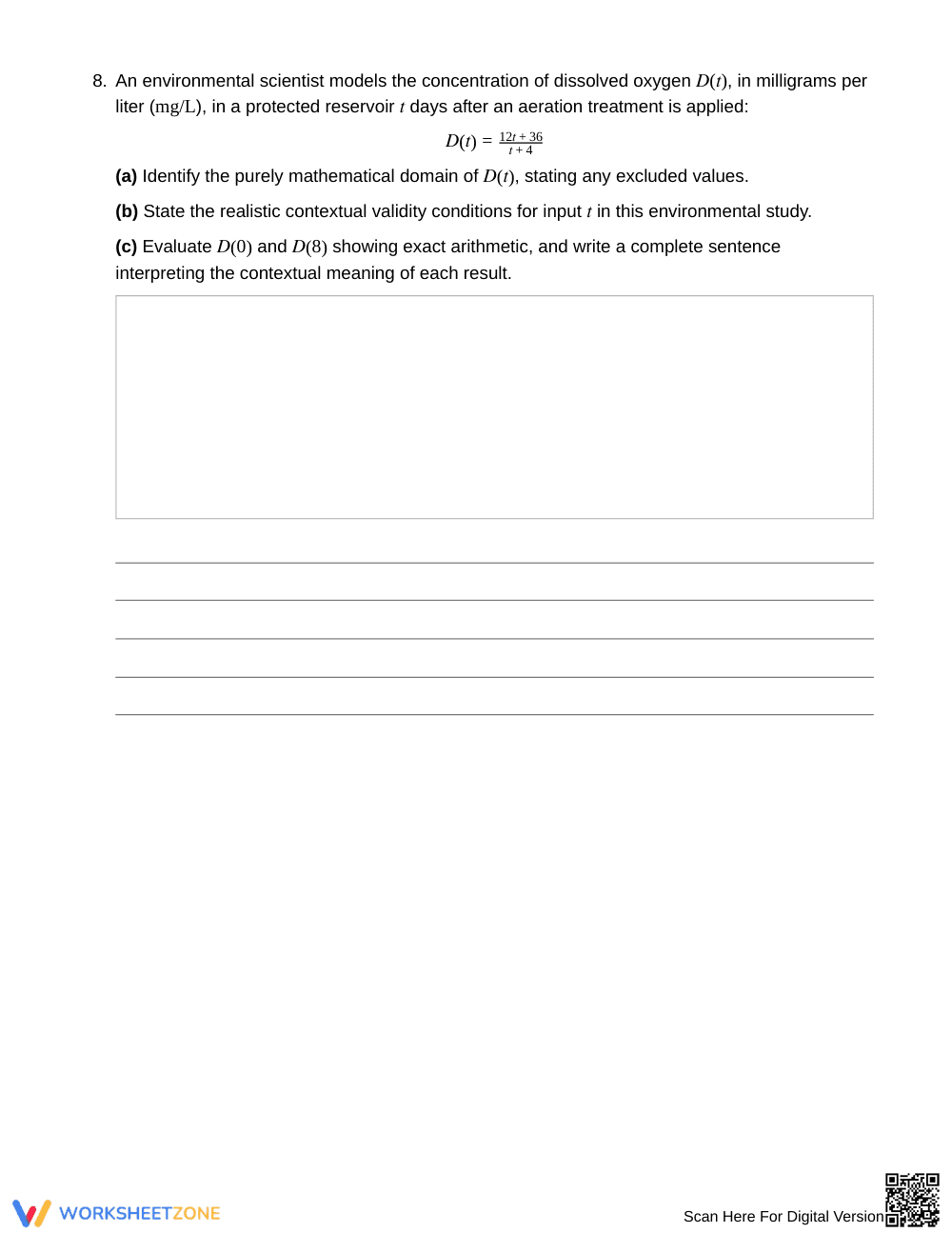
- Independent practice (Part C, 2 tasks): Students construct counterexamples disproving false distribution properties and determine formal validity conditions for rational functions.
This sequence follows a gradual-release model, moving from guided error analysis to independent justification.
Standards Alignment
This worksheet aligns to `HSF-IF.A.2`, requiring students to evaluate functions for inputs in their domains and interpret statements in context. It also reinforces `HSF-IF.B.5` by relating function domains to quantitative contexts. Both standard codes can be copied directly into lesson plans, IEP goals, or district curriculum mapping tools.
How to Use It
Use this resource after direct instruction on function notation and domain boundaries. Have student pairs critique the contextual claims in Part A before independently solving Parts B and C. As a formative assessment check during the 40 to 50 minute activity, observe whether students convert hours to minutes before evaluating draining rates.
Who It's For
Built for Grade 9 Algebra I classes, this worksheet supports students transitioning from arithmetic evaluation to contextual reasoning. The definitions box assists developing learners, while multi-step counterexamples challenge advanced students. Pair this activity with an introductory lesson on function representations.
According to Fisher & Frey (2014), structured error analysis and explicit justification routines substantially enhance mathematical retention by requiring learners to evaluate conceptual validity rather than relying solely on procedural computation. This Grade 9 Algebra I resource targets standard HSF-IF.A.2, prompting students to evaluate functions within appropriate domains and interpret notation in authentic applied contexts. Across 8 multi-part tasks, students critique flawed claims, resolve critical unit mismatches in linear draining rates, and build formal numerical counterexamples disproving false distributive properties. By separating purely mathematical domains from realistic physical constraints across 5 pages of practice and a 3-page detailed answer key, this resource develops the rigorous analytical reasoning demanded by secondary mathematics standards. Teachers can deploy these 8 tasks during a 45-minute instructional block to formatively assess whether students can accurately interpret and justify function statements in real-world situations.


