




























Views
Downloads

Essential Mass to Moles Worksheet | Grade 11 Chemistry

Paste this activity's link or code into your existing LMS (Google Classroom, Canvas, Teams, Schoology, Moodle, etc.).
Students can open and work on the activity right away, with no student login required.
You'll still be able to track student progress and results from your teacher account.
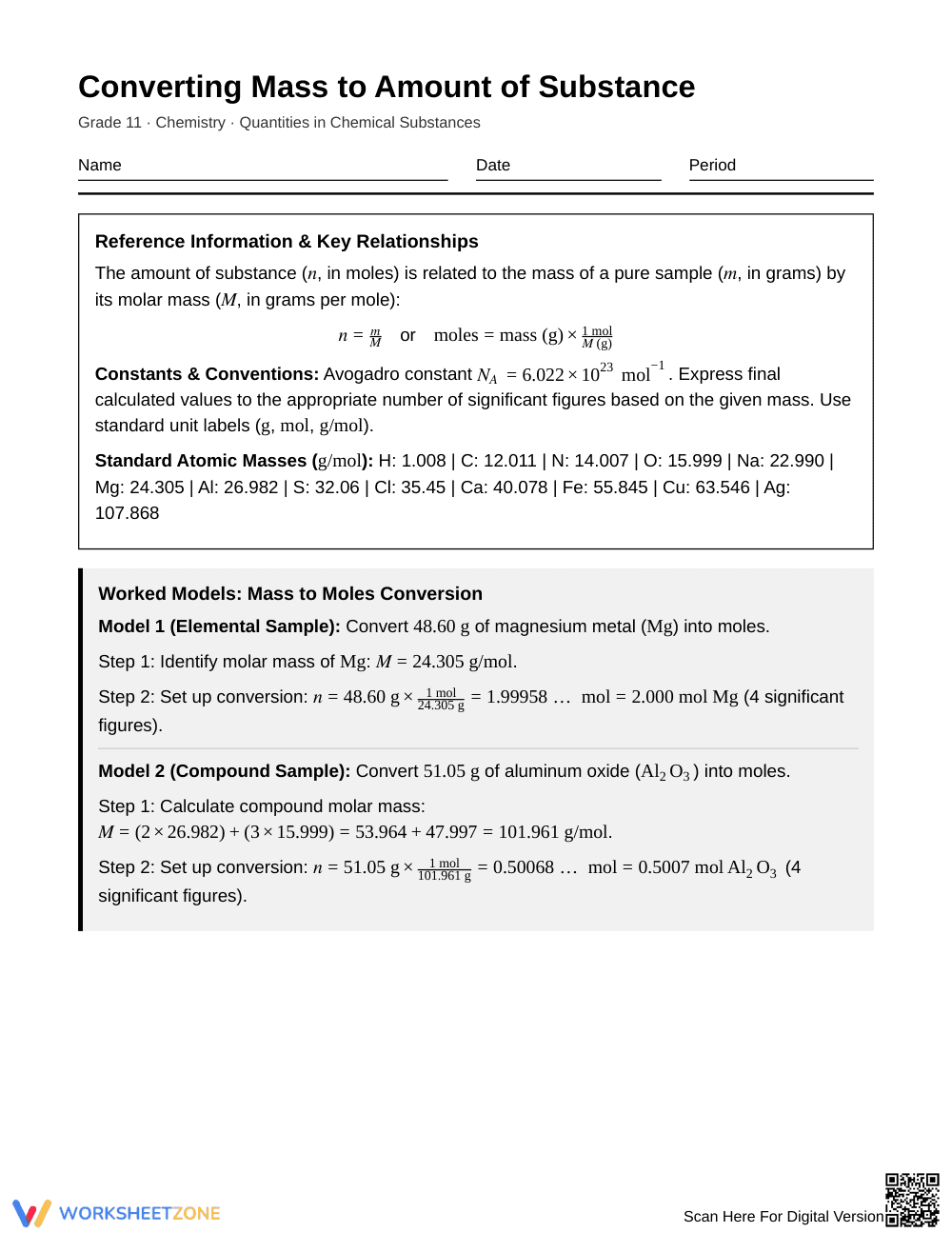
This Grade 11 chemistry worksheet equips students to convert mass to amount of substance across pure elements, ionic compounds, and hydrates. By connecting balance measurements to chemical amounts, learners establish foundational quantitative reasoning skills. Stepped practice problems transition from computing molar masses to independent dimensional analysis calculations.
At a Glance
- Grade: 11 · Subject: Chemistry
- Standard: Stoichiometric Relationships — Convert measured mass in grams to substance amount in moles using molar masses
- Skill Focus: Convert Mass to Amount of Substance
- Format: 5 pages · 10 problems · Answer key included · PDF
- Best For: Post-lecture independent practice, homework review, and stoichiometry lab preparation
- Time: 40–50 minutes
What's Inside
Spanning 5 pages, this instructional resource features 10 chemistry problems with an atomic mass reference table, conversion formulas, and two worked models. Students practice elemental samples, hydrates, and compounds. A complete 3-page answer key provides step-by-step solutions, correct significant figures, and explanations for conceptual prompts.
Skill Progression
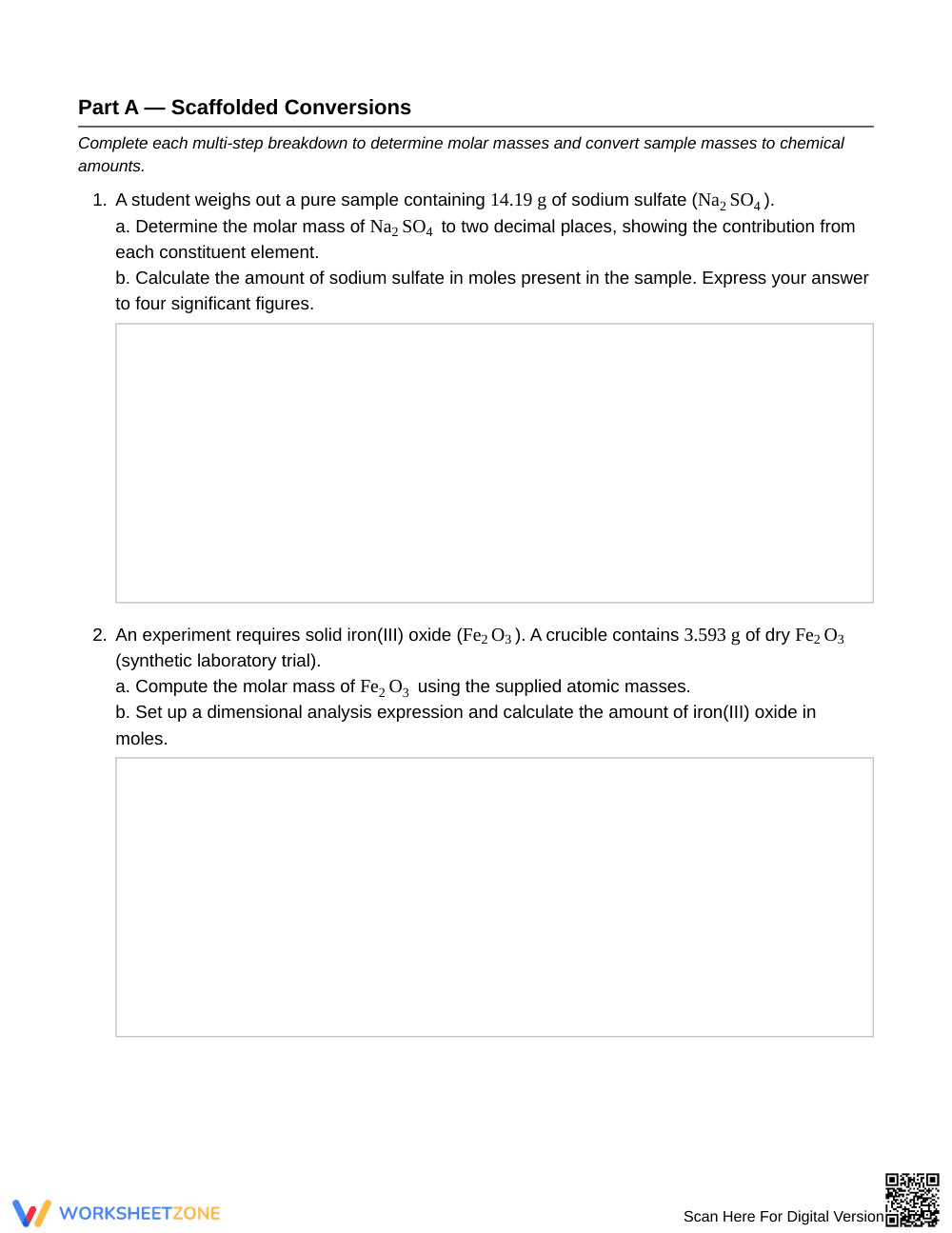
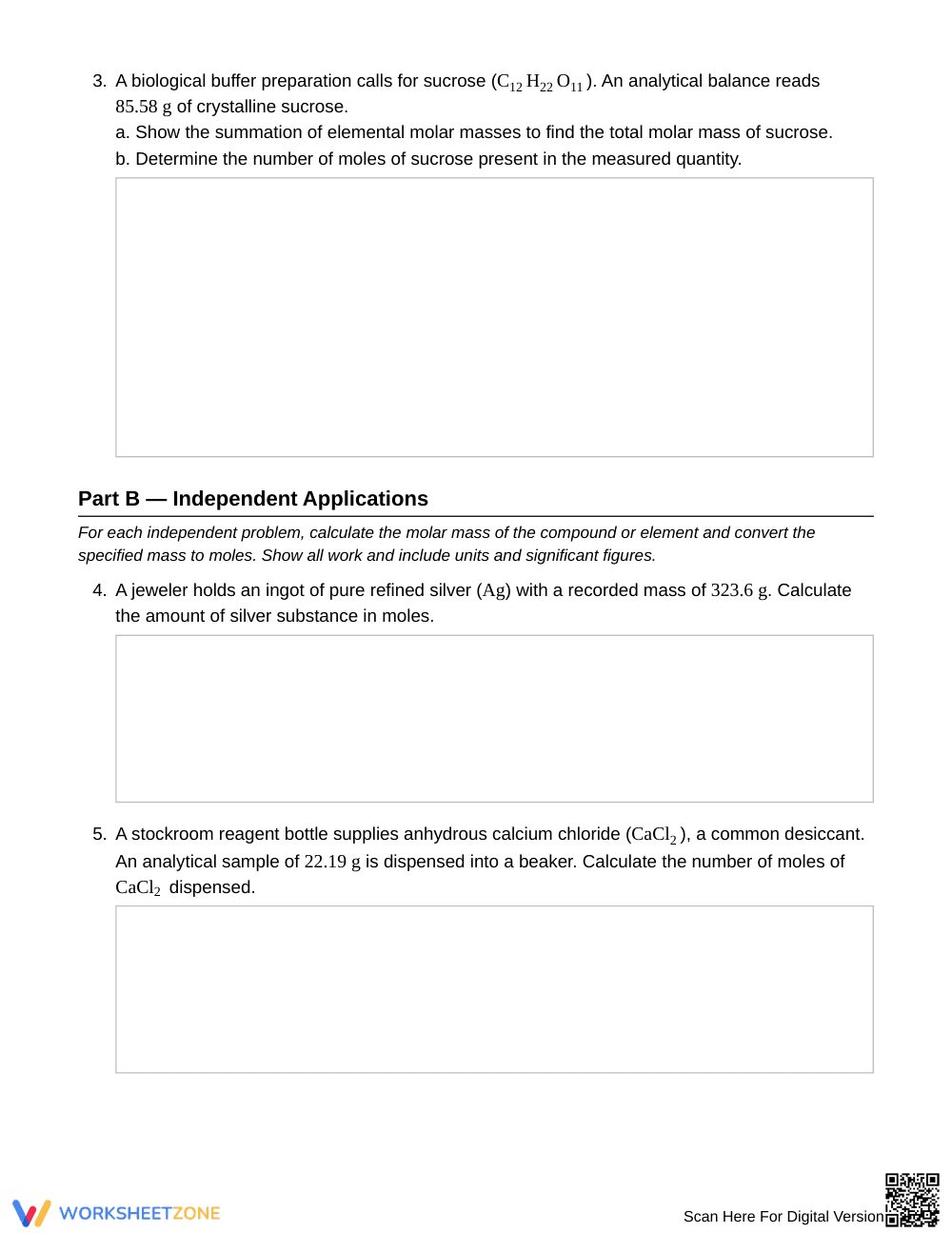
- Guided practice (Part A, Problems 1–3): Scaffolds formula mass summation and dimensional analysis conversions for sodium sulfate, iron(III) oxide, and sucrose.
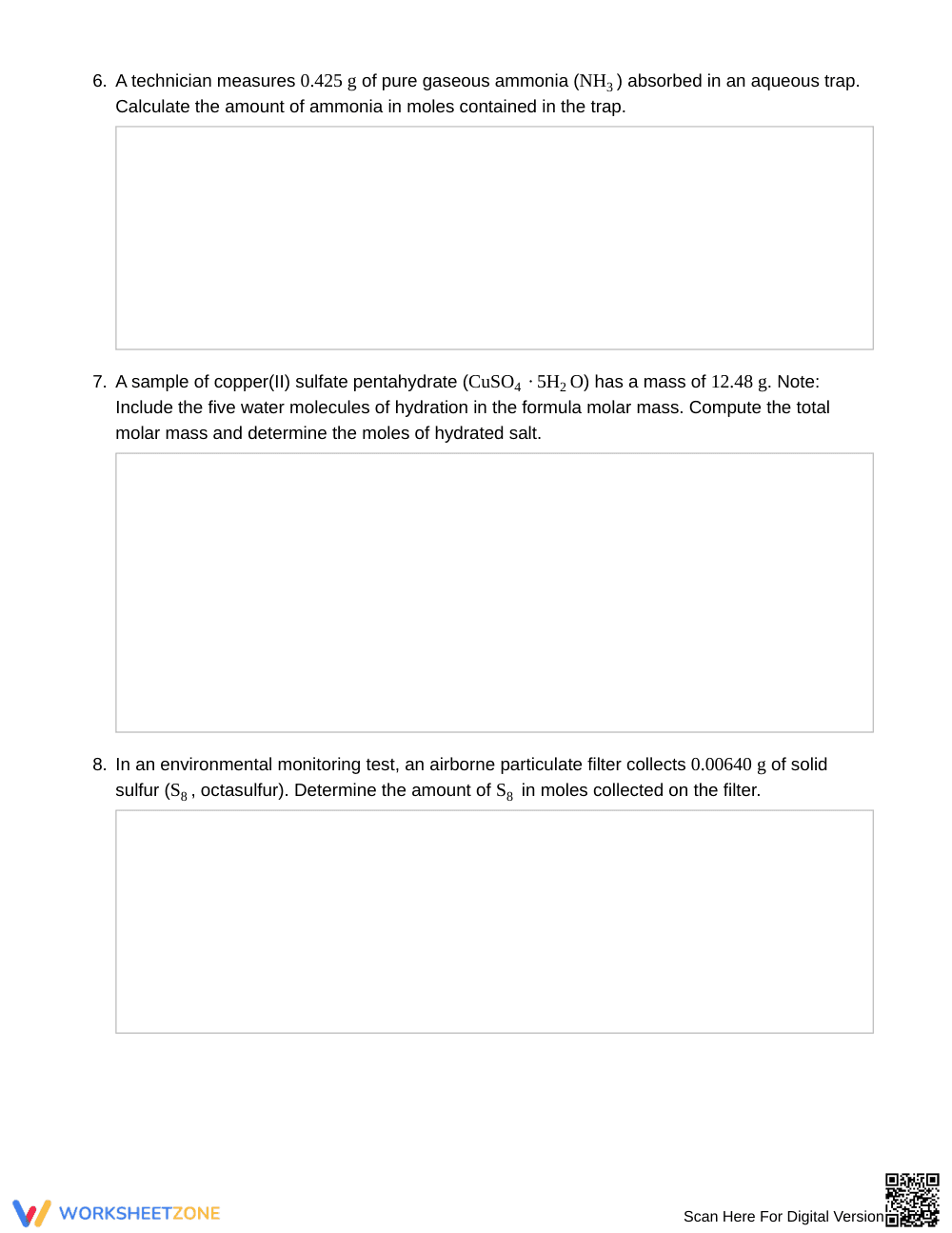
- Supported practice (Part B, Problems 4–8): Removes step-by-step prompts, requiring independent molar mass calculations and mass-to-mole conversions across silver, ammonia, octasulfur, and copper(II) sulfate pentahydrate.
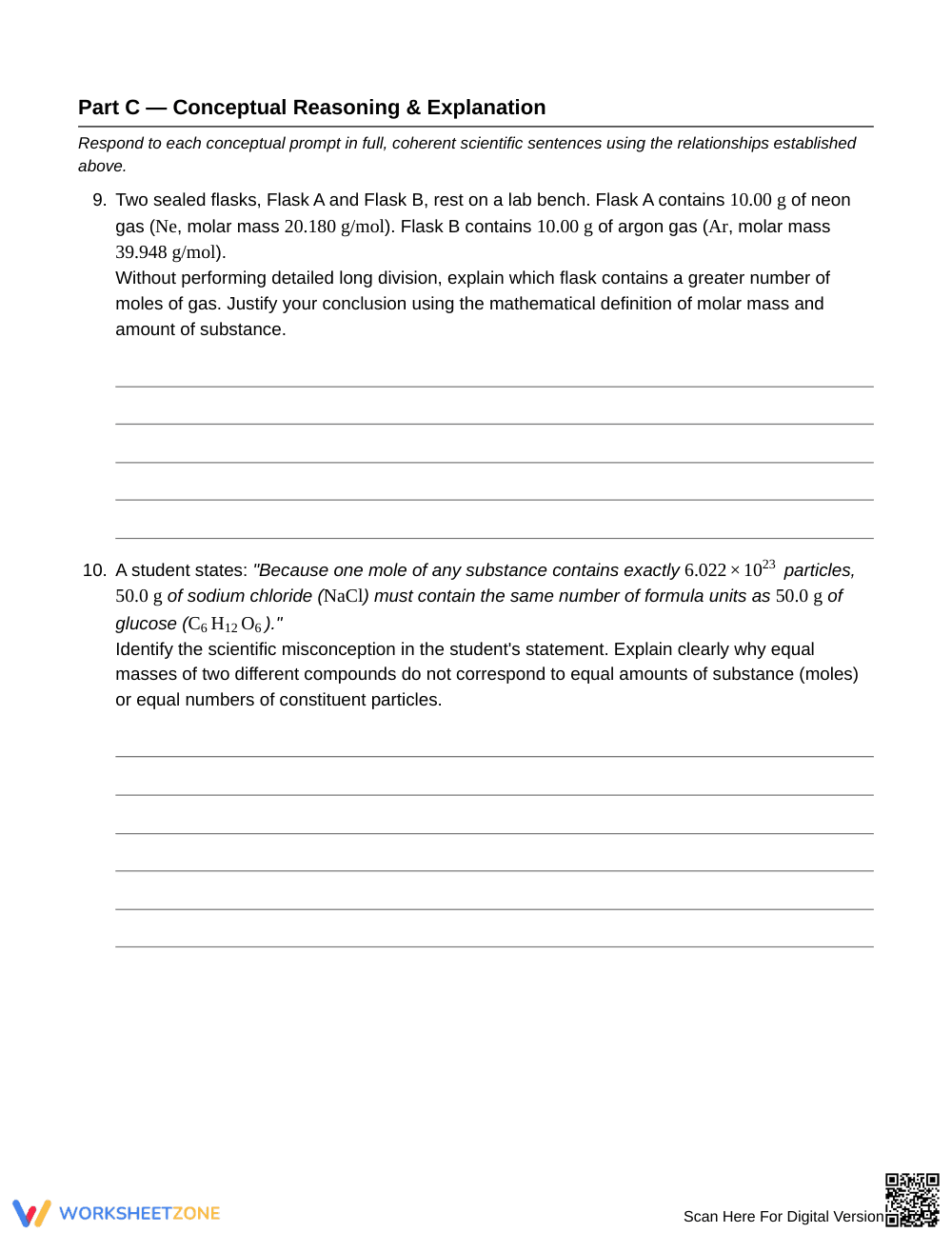
- Independent practice (Part C, Problems 9–10): Assesses conceptual reasoning by comparing gas molar quantities and diagnosing misconceptions regarding mass versus particle counts.
This sequence follows the gradual release of responsibility model, shifting cognitive ownership from structured formulas to autonomous mastery.
Standards Alignment
This worksheet supports high school chemistry benchmarks requiring mathematical representations to demonstrate the conservation of matter. Students use proportional dimensional analysis to translate physical laboratory mass into chemical amounts. Both standard codes can be copied directly into lesson plans, IEP goals, or district curriculum mapping tools.
How to Use It
Assign this worksheet directly after introducing the mole concept and molar mass calculation. During guided work, check Part A to ensure students correctly multiply subscripts in chemical formulas. Use Parts B and C for independent lab preparation or formative assessment. Expected completion time is 40 to 50 minutes.
Who It's For
This resource serves Grade 11 Chemistry students building quantitative laboratory skills. Integrated reference tables support developing learners, while hydrate calculations and conceptual prompts challenge advanced students. Pair this worksheet with an introductory slide deck or molar mass balance lab.
Quantitative chemistry instruction relies on systematic mathematical scaffolding to bridge tangible physical measurements and abstract microscopic concepts. According to Fisher & Frey (2014), the gradual release of responsibility framework significantly enhances student procedural fluency when tackling complex, multi-step STEM calculations. This worksheet applies that validated instructional architecture to converting mass to amount of substance, moving students methodically from stepped formula breakdowns to independent problem-solving and conceptual reflection. By providing explicit atomic mass references, two worked models, and targeted non-computational analysis, the resource directly mitigates common learner confusion between sample mass and mole quantity. High school science educators utilizing structured dimensional analysis practice of this rigorous design ensure that Grade 11 chemistry students build the durable cognitive schemas necessary for downstream stoichiometric calculations, limiting reactant predictions, and laboratory chemical yield determinations across subsequent advanced chemistry coursework.


