




























Views
Downloads
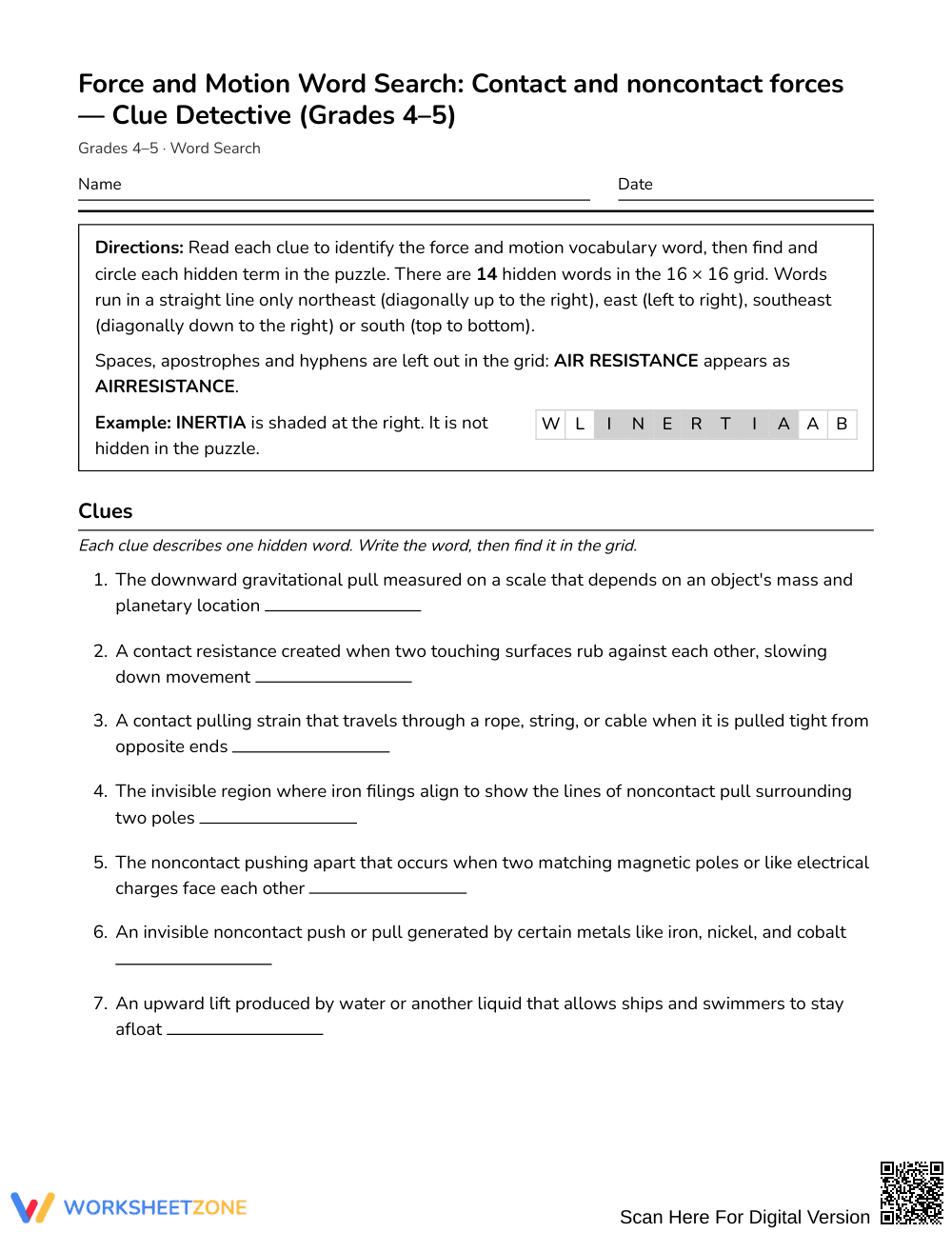


Essential Force & Motion Word Search | Grades 4–5 Science

Paste this activity's link or code into your existing LMS (Google Classroom, Canvas, Teams, Schoology, Moodle, etc.).
Students can open and work on the activity right away, with no student login required.
You'll still be able to track student progress and results from your teacher account.
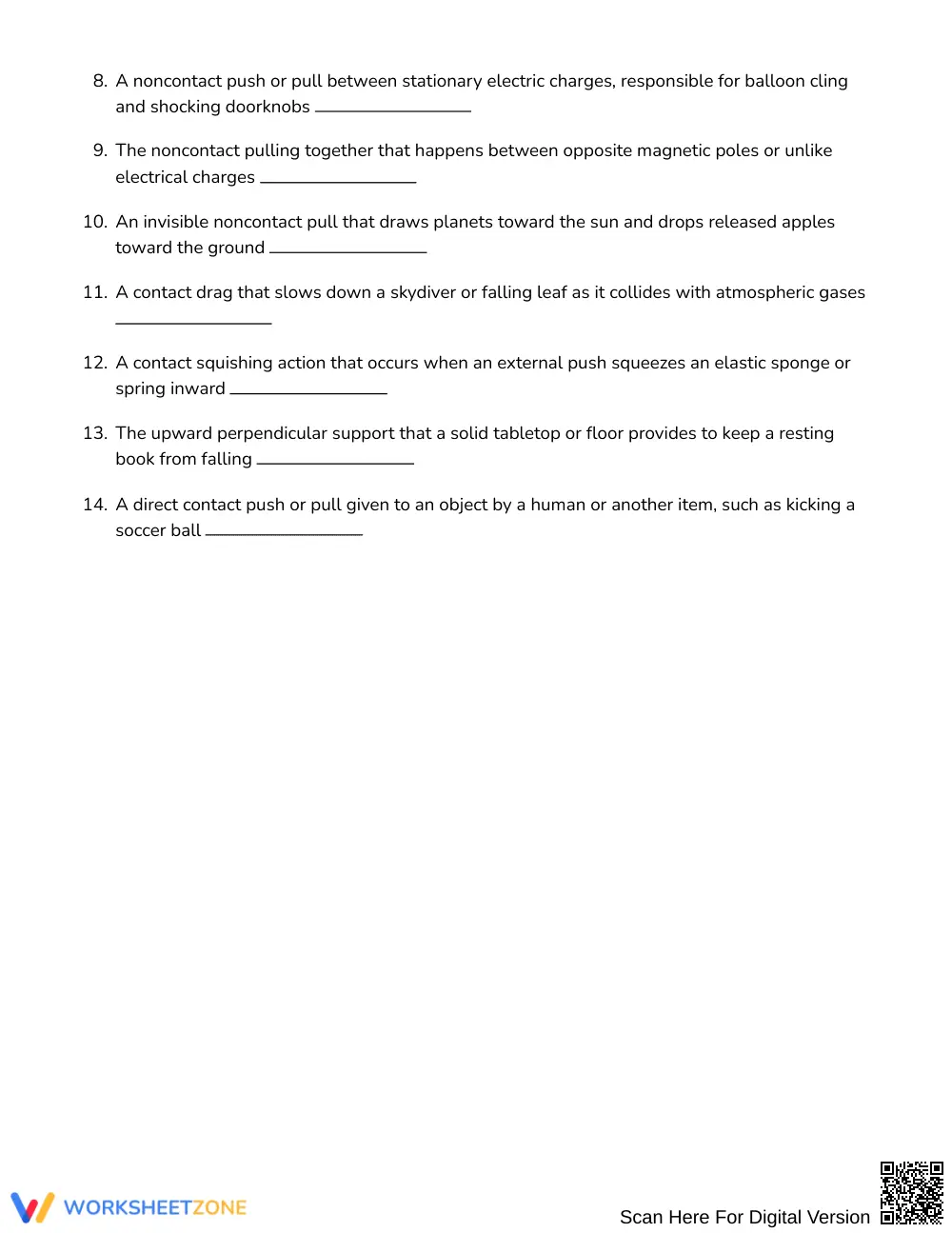
This science word search helps upper elementary students master key physical science terminology by identifying contact and noncontact forces through definition clues. Learners read targeted scientific descriptions to deduce terms like friction, gravity, and buoyancy, then locate all fourteen vocabulary words within the grid to strengthen conceptual retention and spelling accuracy.
At a Glance
- Grade: Grades 4–5 · Subject: Science
- Standard: Not standards-assessed — vocabulary enrichment for physical science concepts
- Skill Focus: Contact and noncontact forces in physical science
- Format: 3 pages · 14 words · Full answer key included · Printable PDF
- Best For: Independent science learning stations, early finishers, and unit review
- Time: 20–30 minutes of focused student work
What's Inside
This resource spans three student-facing pages accompanied by a complete three-page answer key showing all word placements. Students engage with fourteen science vocabulary words through an integrated clue detective format. Each term features an explanatory definition clue, paired with a shuffled word bank that prompts learners to connect physical science principles to correct terminology before searching the puzzle.
Puzzle Mechanics and Structure
The activity is built around a structured 16 x 16 letter grid containing fourteen hidden vocabulary words. Words run in four distinct orientations: northeast, east, southeast, and south. Rather than relying on a passive word list, the puzzle utilizes a shuffled word bank paired with contextual clues that require students to deduce each term before finding it. Full letter coordinates and circled paths are included across the three-page answer key for straightforward verification.
Standards Alignment
This word search serves as supplementary vocabulary enrichment and is not directly tied to a specific assessed state standard. It reinforces essential academic vocabulary surrounding contact and noncontact forces, supporting broader physical science units on force, motion, and interaction by building foundational word recognition and comprehension.
How to Use It
Use this activity during mid-unit review after direct instruction on contact versus noncontact forces, or set it up as a low-prep independent science station. As a formative assessment observation tip, monitor whether students can identify the correct vocabulary term from the descriptive clue before consulting the shuffled word bank. Most fourth and fifth graders will complete the puzzle in 20 to 30 minutes.
Who It's For
This puzzle is designed for fourth- and fifth-grade science students developing foundational physical science literacy. For students needing additional scaffolding, pair the activity with a visual anchor chart illustrating examples of contact forces like friction and noncontact forces like magnetism. It also pairs effectively with hands-on magnet or ramp lab investigations.
Vocabulary acquisition in upper elementary science directly influences conceptual comprehension and long-term retention of physical phenomena. According to Fisher & Frey (2014), intentional exposure to disciplinary vocabulary through contextual definitions and active retrieval mechanisms strengthens student ability to comprehend complex domain-specific texts. While this word search is not standards-assessed and functions as vocabulary enrichment, it supports scientific literacy by prompting learners to connect descriptive definitions of contact and noncontact forces to their appropriate scientific terms. Searching for terms within a structured grid requires sustained visual scanning and orthographic mapping, reinforcing spelling and lexical precision. When paired with structured science instruction, puzzle-based vocabulary retrieval deepens familiarity with core physical science terminology, including gravity, friction, tension, and magnetic fields, providing fourth and fifth grade students with the linguistic foundation necessary for analytical science writing, classroom collaboration, and inquiry-based investigations.


