




























Views
Downloads


Essential Evidence & Folklore Word Search | Grades 6–7 ELA

Paste this activity's link or code into your existing LMS (Google Classroom, Canvas, Teams, Schoology, Moodle, etc.).
Students can open and work on the activity right away, with no student login required.
You'll still be able to track student progress and results from your teacher account.
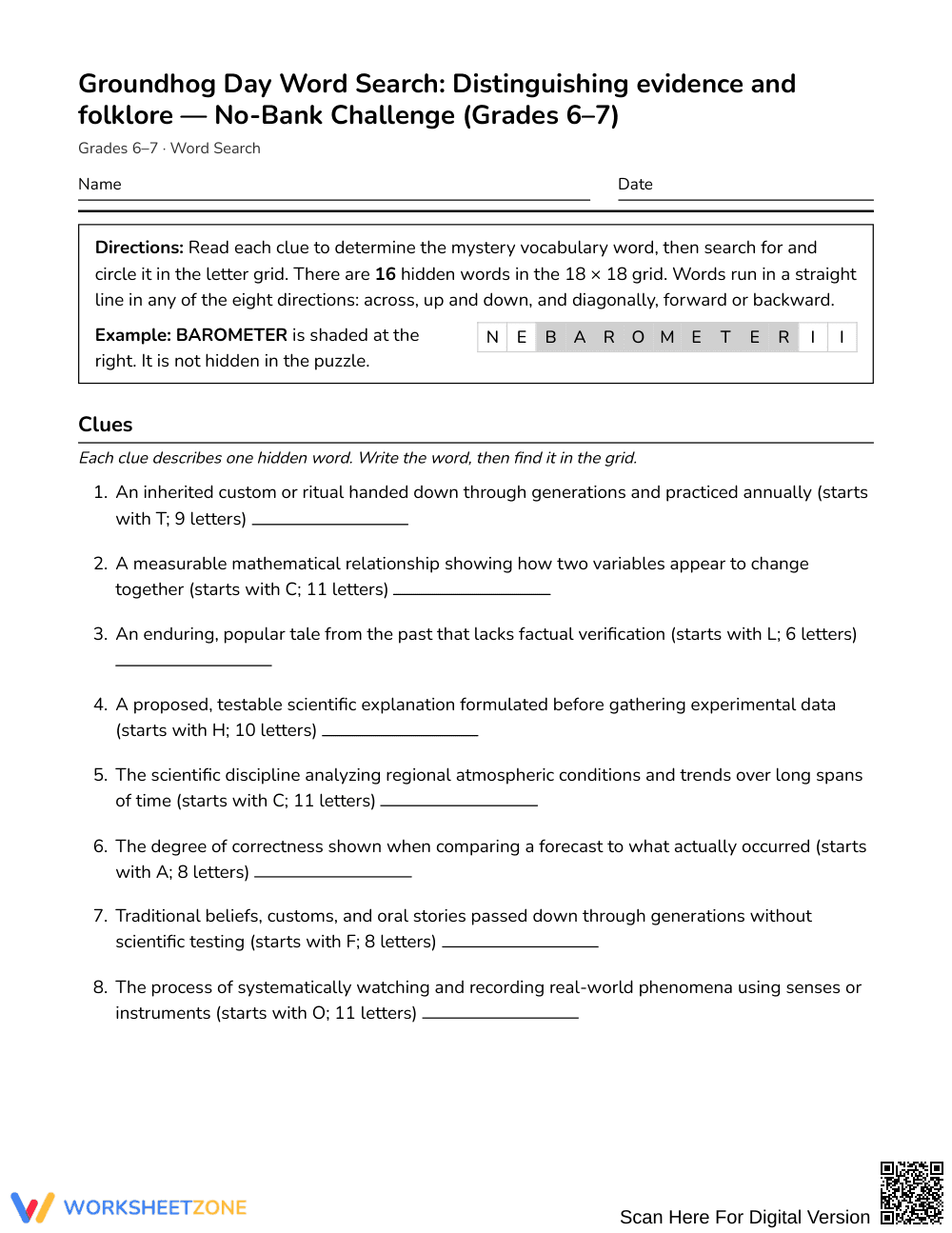
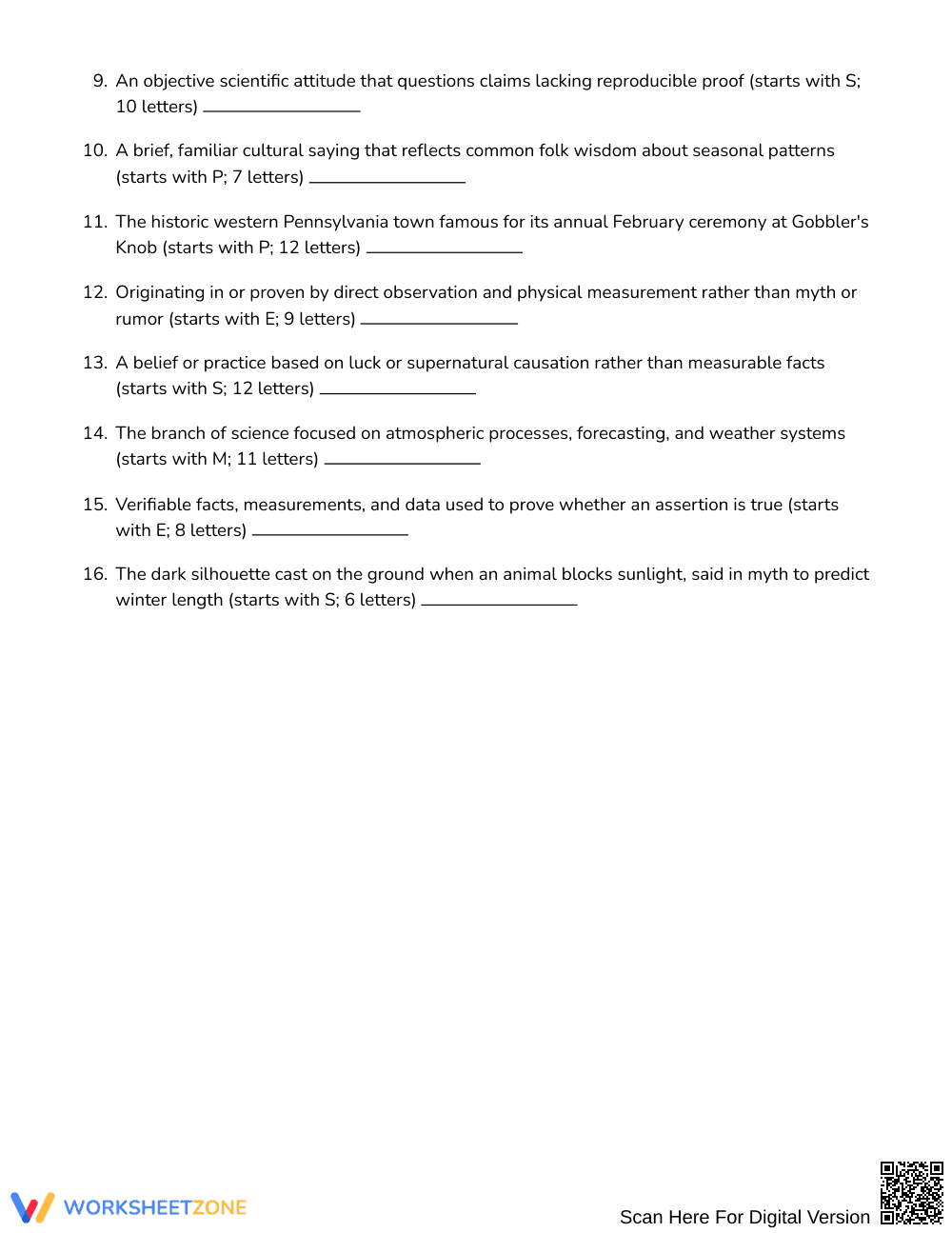
This Groundhog Day vocabulary word search challenges Grades 6–7 students to distinguish scientific evidence from seasonal folklore. Instead of relying on a word bank, students analyze contextual definitions to identify terminology before locating terms in the puzzle, strengthening academic vocabulary and reinforcing critical thinking during February literacy units.
At a Glance
- Grade: Grades 6–7 · Subject: English Language Arts (ELA)
- Standard: Not standards-assessed — targeted cross-curricular vocabulary enrichment and critical analysis
- Skill Focus: Distinguishing empirical scientific evidence from traditional folklore
- Format: 3 printable student pages · 16 hidden words · Full answer key included · PDF
- Best For: Groundhog Day thematic stations, morning work, and literacy practice
- Time: 25–40 minutes active completion
What's Inside
This 3-page printable resource features a no-bank vocabulary challenge designed for content-area integration. The activity includes a 16-word clue list presenting definitions across two categories: cultural folklore and scientific inquiry. Students identify each term from clues before searching. The package includes complete answer key pages showing exact letter coordinates and highlighted solution paths for all 16 target words.
Puzzle Mechanics
The puzzle features an 18-by-18 letter grid designed to reinforce orthographic recall. Words run in eight directions: North, Northeast, East, Southeast, South, Southwest, West, and Northwest. Because this activity omits a standard word bank, students cannot rely on passive letter matching. Instead, learners read contextual clues, identify the matching term, and locate it across horizontal, vertical, and diagonal orientations.
Standards Alignment
This instructional activity serves as vocabulary enrichment rather than formal standards assessment and is not aligned to a specific standard. It supports cross-curricular literacy by reinforcing Tier 2 and Tier 3 academic vocabulary across science and ELA. Educators can use this puzzle alongside units on informational text, hypothesis testing, and distinguishing empirical evidence from cultural myth.
How to Use It
Use this word search during a Groundhog Day unit after direct instruction on scientific inquiry versus tradition. Assign it as a partner activity where students discuss clue definitions, or use it for independent literacy centers and sub plans. Formatively observe whether students differentiate terms like empirical and superstition. Expected completion time is 25 to 40 minutes.
Who It's For
This resource is designed for Grades 6–7 students building academic vocabulary in ELA or introductory science. It offers enrichment for learners who need a challenge beyond standard word banks through active semantic retrieval. For emerging readers, pair the puzzle with an anchor chart contrasting folklore and scientific observation.
According to Fisher & Frey (2014), intentional academic vocabulary acquisition requires students to encounter content-rich words within meaningful, cognitively demanding contexts rather than through rote memorization drills. This Groundhog Day vocabulary puzzle engages Grades 6–7 students in distinguishing scientific evidence from cultural folklore by replacing passive word banks with rigorous definitional clues. Learners actively retrieve terminology such as empirical, hypothesis, skepticism, and folklore, strengthening the semantic connections necessary for reading complex informational texts. By requiring students to interpret scientific and historical definitions before identifying words hidden across eight directions in an 18-by-18 grid, the task integrates orthographic mapping with conceptual understanding. The resource provides educators with an actionable tool for cross-curricular literacy enrichment that reinforces domain-specific terminology without sacrificing instructional rigor. Teachers can utilize this clue-based puzzle to promote academic dialogue, assess conceptual mastery, and bridge folklore traditions with empirical scientific analysis.


