


























Views
Downloads

Essential Error Analysis Worksheet | Grade 12 Precalculus
Paste this activity's link or code into your existing LMS (Google Classroom, Canvas, Teams, Schoology, Moodle, etc.).
Students can open and work on the activity right away, with no student login required.
You'll still be able to track student progress and results from your teacher account.
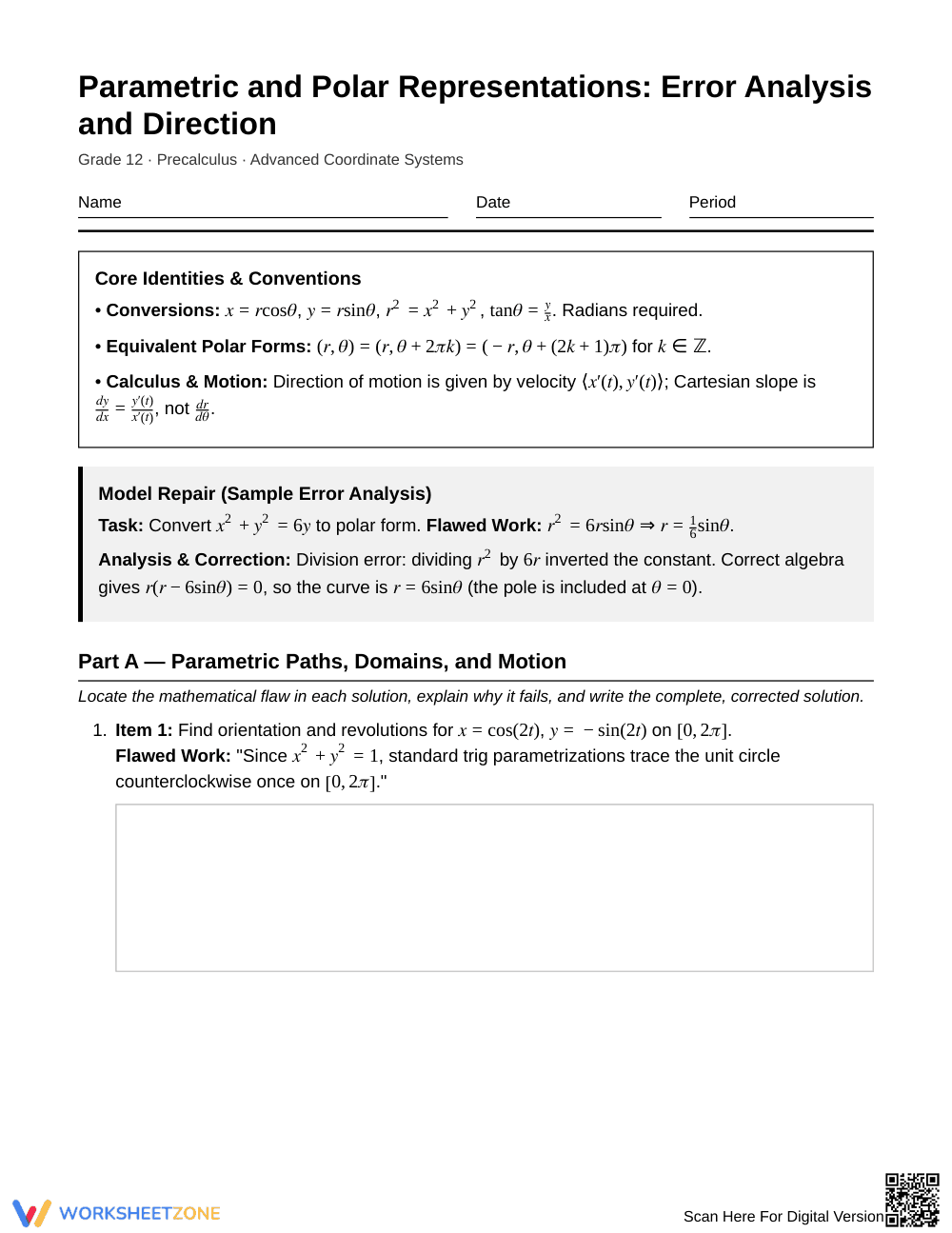
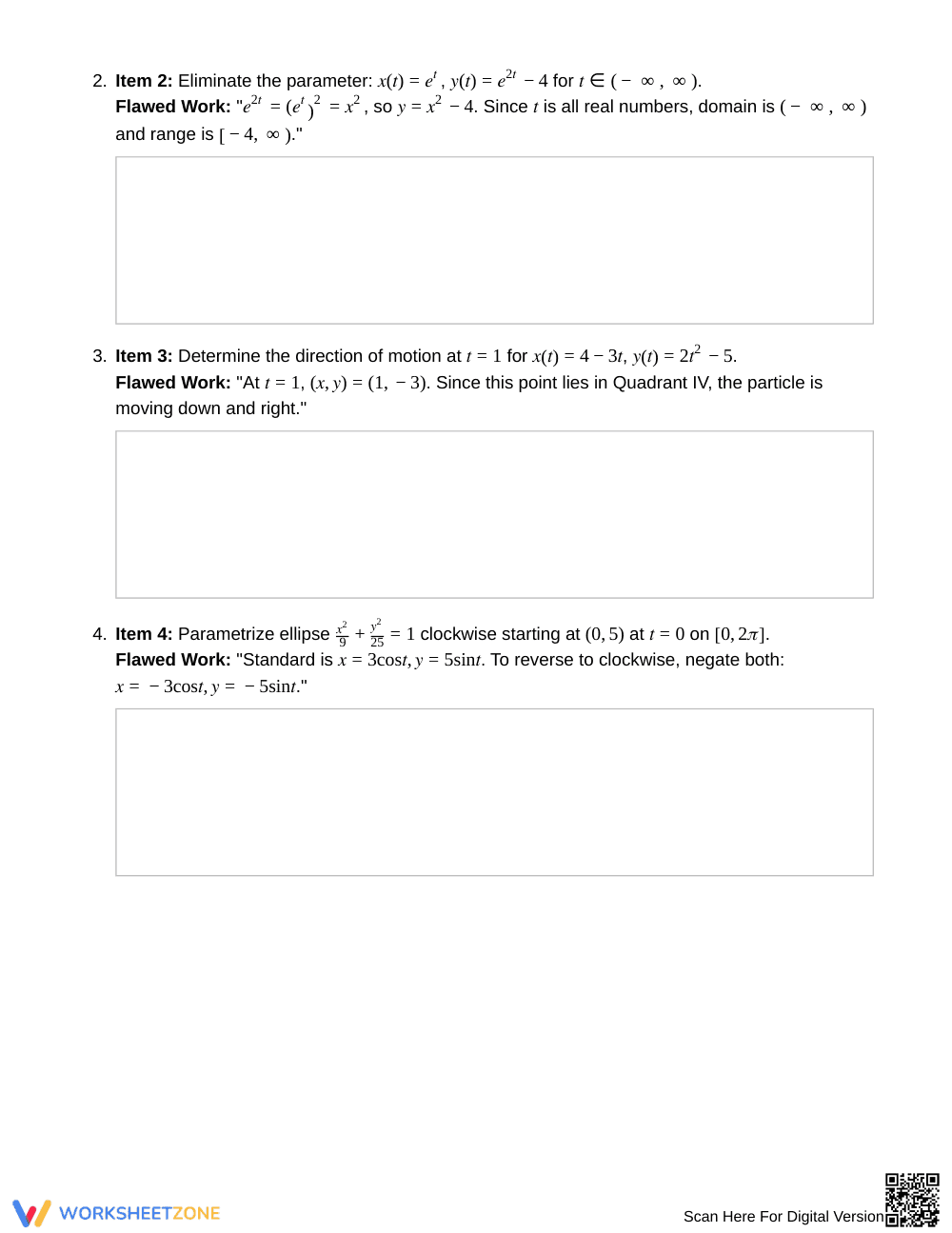
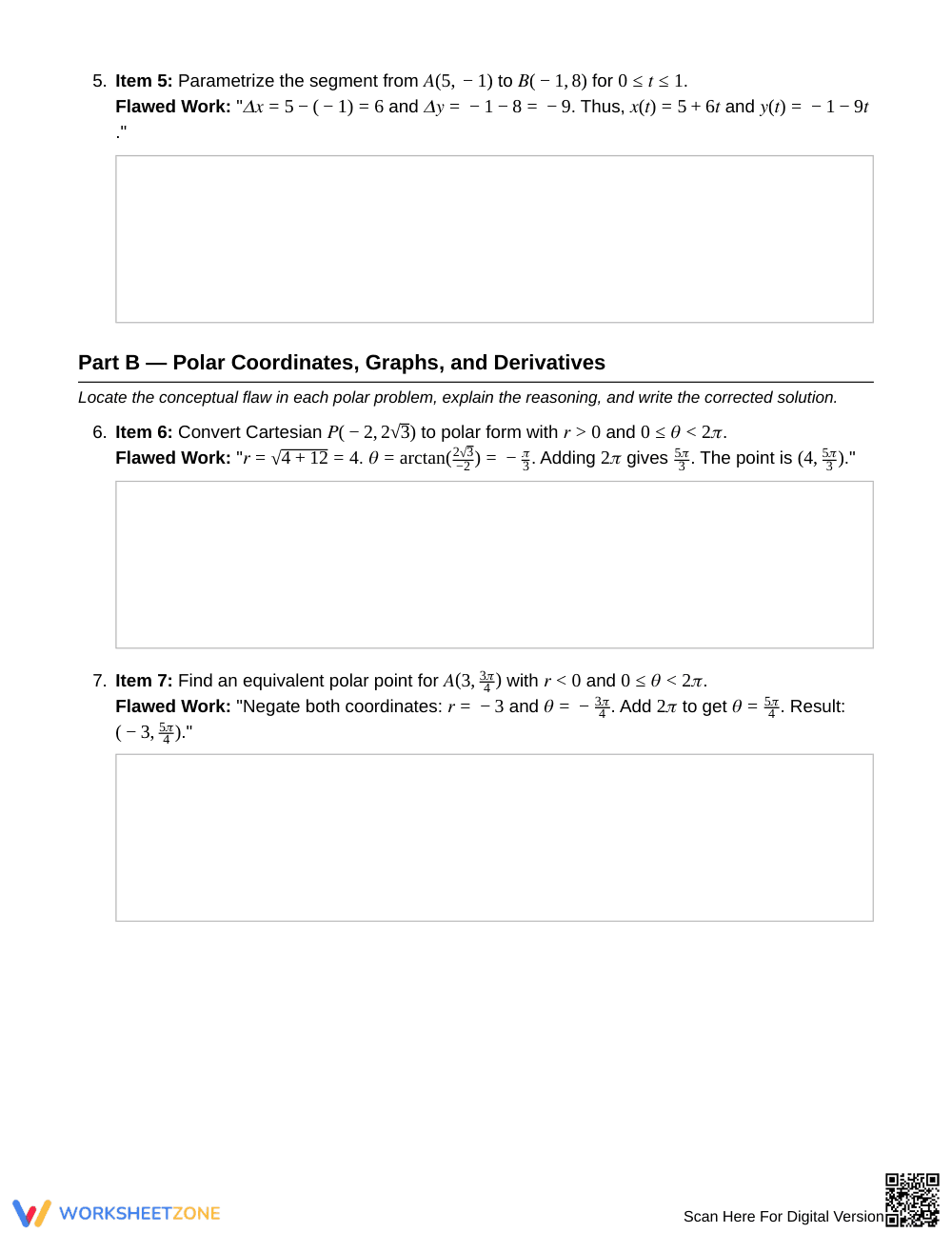
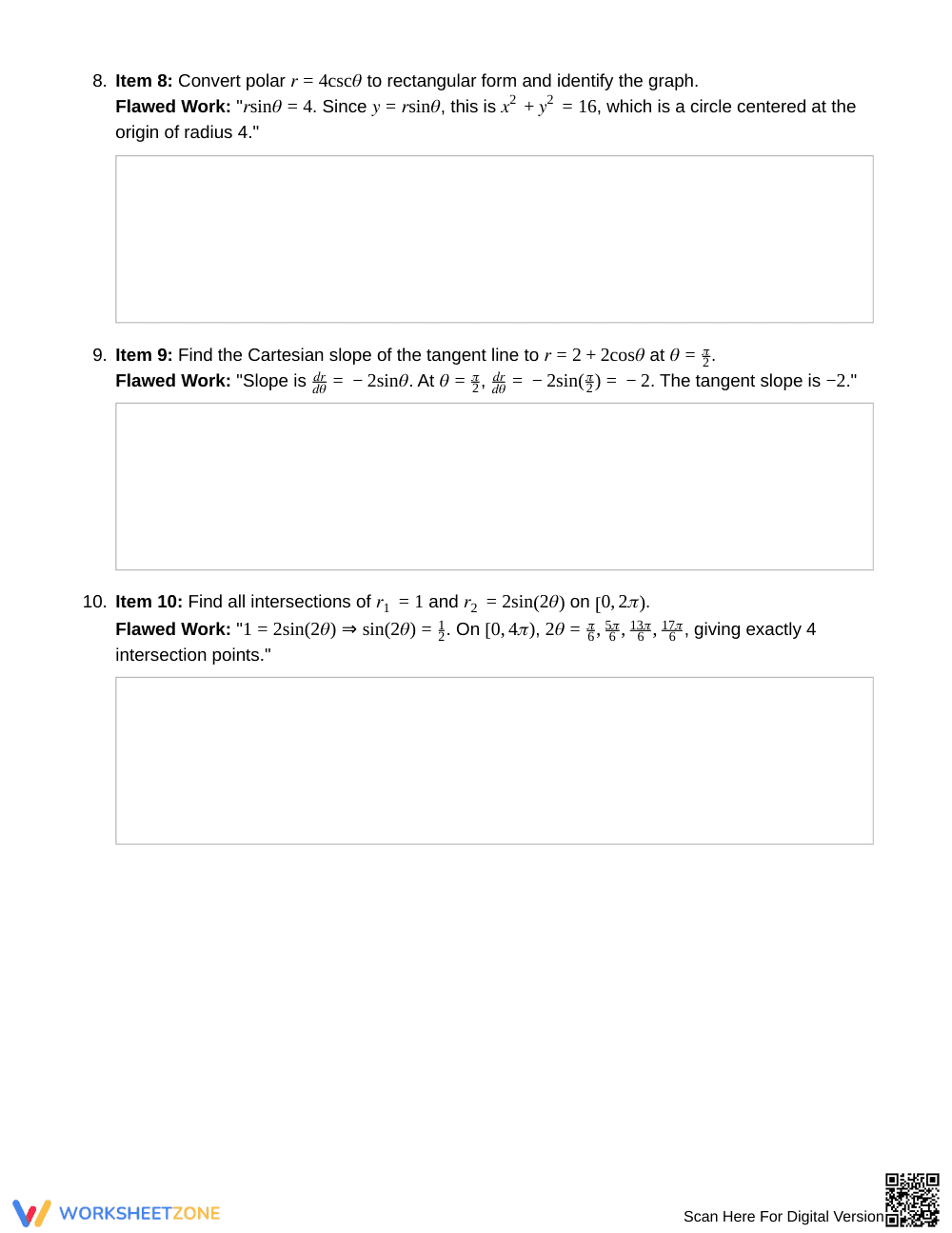
Students will sharpen their ability to spot and repair mistakes in parametric and polar representations, mastering direction analysis and multiple-representation conversions. This worksheet guides learners through ten targeted error‑analysis tasks, ensuring they can confidently translate curves and motion between coordinate systems.
At a Glance
- Grade: 12 · Subject: Precalculus
- Standard:
— Identify and fix errors in parametric and polar representations for curves- Skill Focus: Correct Multiple-Representation and Direction Errors
- Format: 4 pages · 10 problems · Answer key included · PDF
- Best For: Advanced coordinate‑system practice for students preparing for AP exams
- Time: 30–45 minutes
What's Inside
Each of the ten items presents a flawed solution, prompting students to locate the mathematical mistake, explain why it fails, and construct a fully corrected answer. The four‑page packet includes a concise answer key, a quick‑reference rule box of polar‑Cartesian identities, and optional sentence frames for novice writers.
Skill Progression
- Guided practice (2 problems) with a worked example and sentence frames.
- Supported practice (4 problems) with a word bank of conversion formulas.
- Independent practice (4 problems) requiring full error analysis without scaffolds.
The sequence follows the classic I Do, We Do, You Do gradual‑release model.
Standards Alignment
` ` Students analyze and correct errors in converting between Cartesian, parametric, and polar forms, focusing on direction and representation accuracy. This aligns with high‑school advanced mathematics expectations for rigorous reasoning and precise communication. Both standard references can be copied directly into lesson plans, IEP goals, or district curriculum mapping tools.
How to Use It
- Use as a pre‑assessment before introducing the unit on advanced coordinate systems, allowing the teacher to gauge each learner’s current fluency with conversions and motion direction.
- Deploy during a guided‑practice session after direct instruction, having students work in pairs to critique each other’s solutions; observe their explanations to inform immediate feedback. Expected completion time: 30–45 minutes.
Who It's For
Designed for Grade 12 Precalculus students who have completed basic parametric and polar topics. The worksheet supports differentiated instruction through optional sentence frames and a word bank, making it suitable for both on‑level learners and those needing additional scaffolding. Pair it with a teacher‑led mini‑lecture on velocity vectors or an anchor chart of polar identities.
Research shows that explicit error analysis combined with guided feedback improves conceptual mastery in advanced mathematics (Fisher and Frey, 2014). When learners actively evaluate flawed reasoning, they build metacognitive awareness that prevents common procedural traps during coordinate transformations. This resource embodies that proven methodology by challenging students to isolate misconceptions, justify mathematical principles, and produce accurate polar and parametric models. In addition, providing structured answer keys alongside scaffolded prompts supports formative assessment cycles, enabling educators to monitor student thinking in real time. As students diagnose orientation shifts and conversion errors, they develop the precise analytical habits necessary for sustained success in calculus coursework. Incorporating structured peer critique and intentional mistake analysis helps bridge the gap between mechanical computation and rigorous mathematical communication, ensuring high school seniors develop lasting conceptual confidence before taking summative college readiness exams.


