


























Views
Downloads
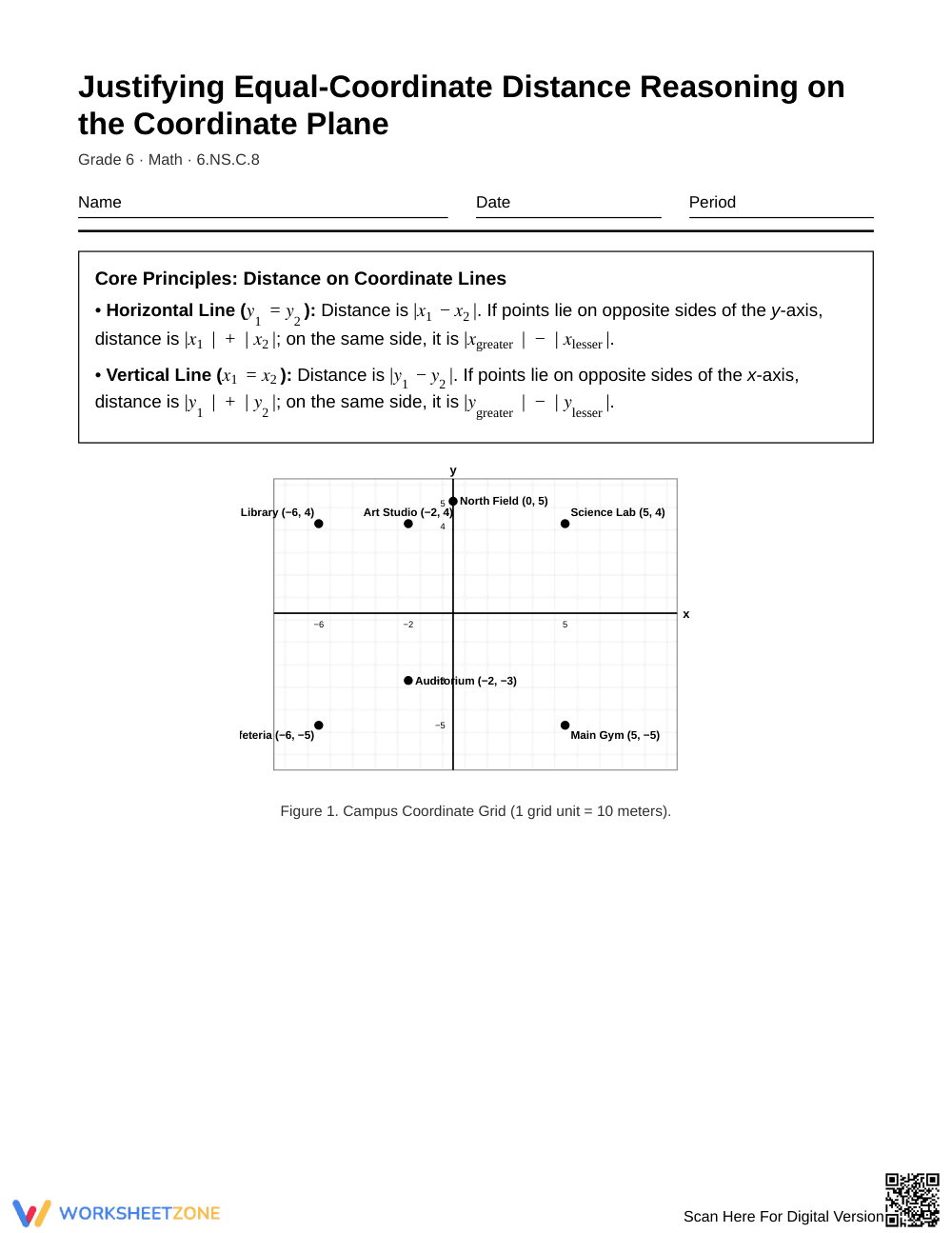
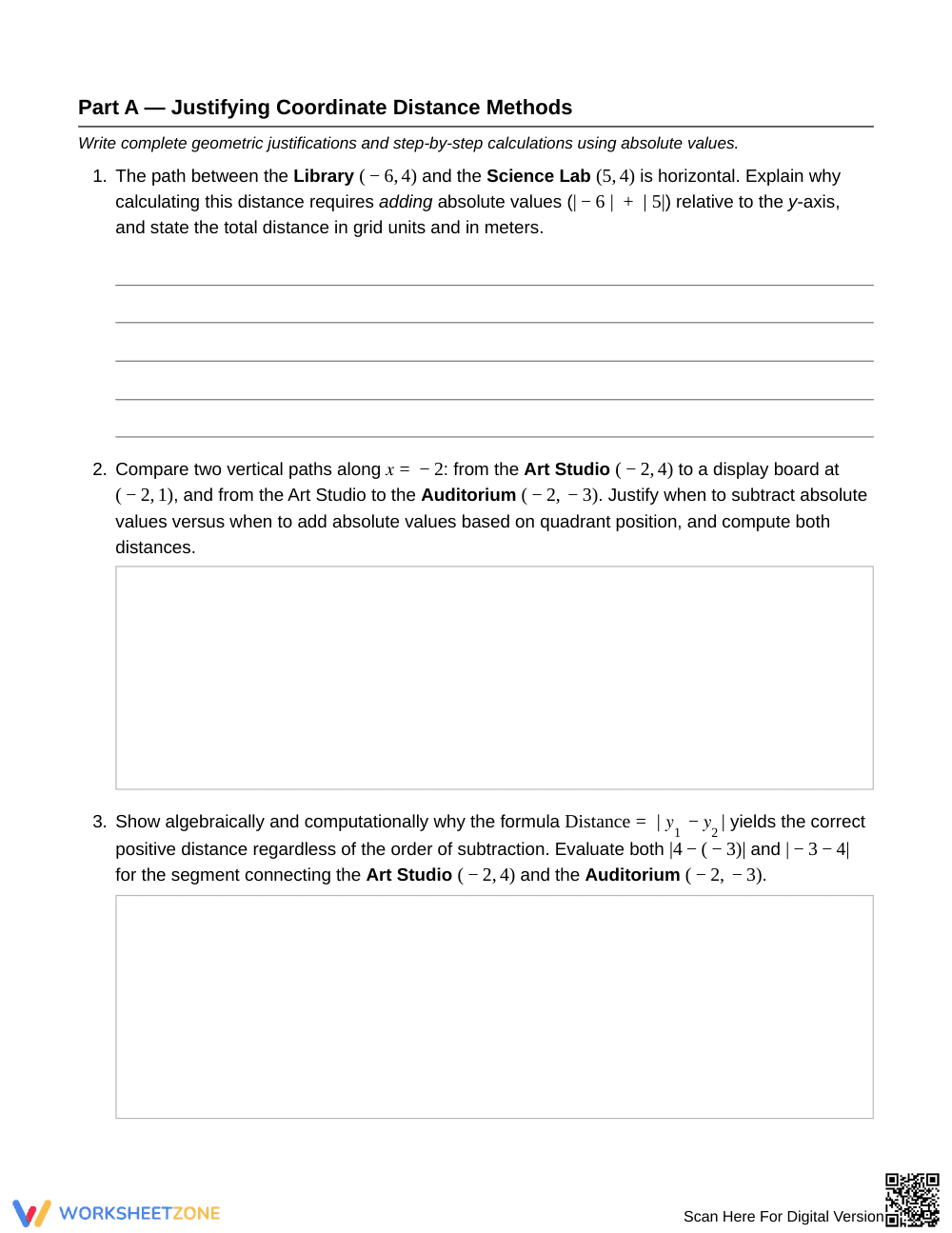
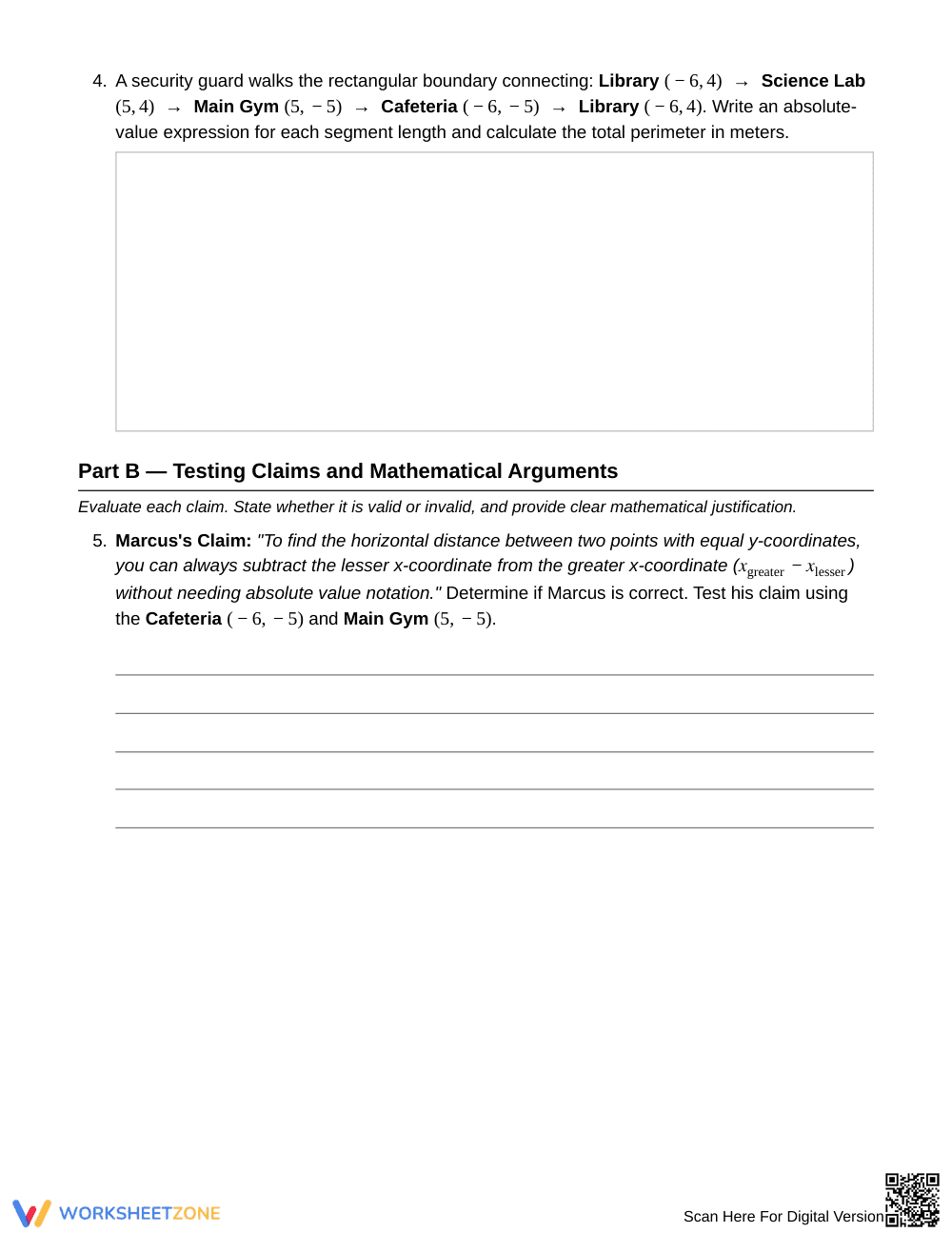
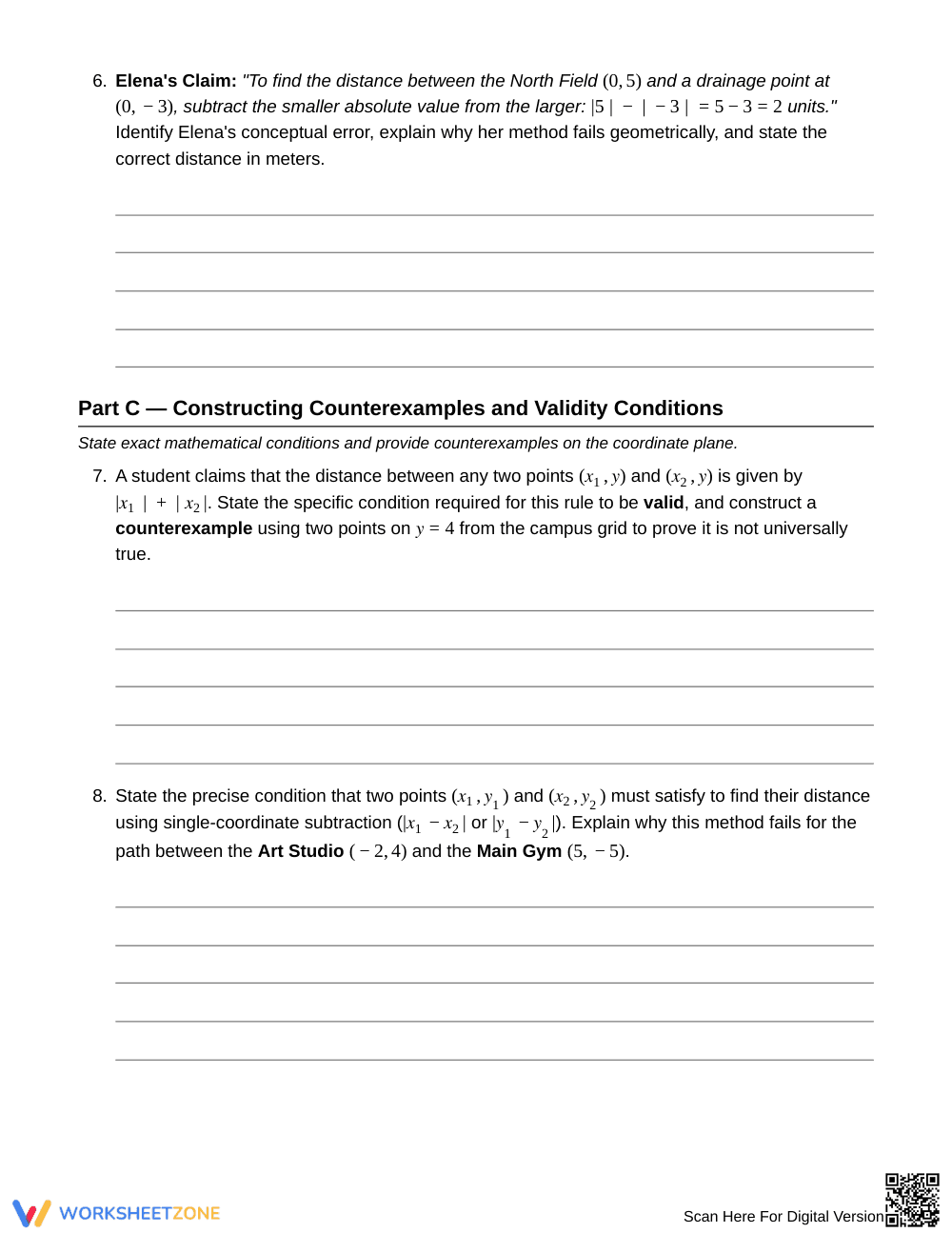

Essential Coordinate Distance Worksheet | Grade 6 Math
Paste this activity's link or code into your existing LMS (Google Classroom, Canvas, Teams, Schoology, Moodle, etc.).
Students can open and work on the activity right away, with no student login required.
You'll still be able to track student progress and results from your teacher account.
This Grade 6 coordinate geometry worksheet guides students to calculate and justify distances between points sharing an x- or y-coordinate. Using a realistic campus grid map, learners master when to add or subtract absolute values across quadrants, evaluate student arguments, and identify boundary conditions for coordinate distance formulas to build solid geometric reasoning.
At a Glance
- Grade: 6 · Subject: Math
- Standard:
6.NS.C.8— Find horizontal and vertical distances between points on a coordinate plane- Skill Focus: Justify Equal-Coordinate Distance Reasoning
- Format: 4 pages · 8 problems · Answer key included · PDF
- Best For: Deep conceptual practice and error analysis
- Time: 45–60 minutes
What's Inside
This 4-page printable resource includes 8 multi-part problems anchored by a core principles reference box and a scaled campus coordinate grid where 1 grid unit equals 10 meters. Students tackle rigorous calculation tasks, mathematical error evaluations, and counterexample constructions. A complete 2-page answer key provides step-by-step algebraic justifications and model explanations.
Skill Progression
- Guided Practice (Part A, Problems 1–4): Students calculate segment lengths and multi-segment perimeter on the campus map, writing absolute-value expressions and explaining why axis crossings require adding absolute values while same-quadrant alignments require subtraction.
- Supported Practice (Part B, Problems 5–6): Students critique mathematical claims made by peers, evaluating whether non-absolute subtraction always succeeds and diagnosing misconceptions regarding quadrant locations and axis positions.
- Independent Practice (Part C, Problems 7–8): Students construct coordinate counterexamples and define the formal mathematical constraints required for single-coordinate subtraction to accurately measure distance on coordinate lines.
This structured progression reflects the gradual-release model, moving learners from scaffolded geometric proofs to independent mathematical critique.
Standards Alignment
Primary Standard: `6.NS.C.8` — Solve real-world and mathematical problems by graphing points in all four quadrants of the coordinate plane. Include use of coordinates and absolute value to find distances between points with the same first coordinate or the same second coordinate. Supporting standard 6.NS.C.6 reinforces plotting pairs of integers and positioning coordinate values on horizontal and vertical number lines. Both standard codes can be copied directly into lesson plans, IEP goals, or district curriculum mapping tools.
How to Use It
Deploy this activity after direct instruction on absolute value operations and four-quadrant plotting. In a partner workshop, have pairs work through Part B together to debate the validity of each student claim before recording written justifications. During formative circulation, observe whether students correctly identify when points lie on opposite sides of an axis versus the same side, catching students who reflexively subtract absolute values without verifying sign differences. Expected completion time is 45 to 60 minutes.
Who It's For
This worksheet serves general education Grade 6 math classrooms, advanced Grade 5 students, and Grade 7 intervention groups needing reinforcement with coordinate geometry. It pairs effectively with a teacher-led coordinate plane anchor chart or introductory lessons on integer distance.
According to EdReports 2024 evaluations of middle school mathematics, rigorous task design requires students to construct mathematical arguments rather than merely memorize procedural algorithms for distance. This worksheet directly supports standard 6.NS.C.8 by challenging Grade 6 learners to justify why absolute value operations change when measuring line segments across quadrants versus within a single quadrant. Through 8 demanding tasks, students explain absolute value models, evaluate student reasoning, calculate real-world perimeter in meters, and generate coordinate counterexamples. Research synthesized by EdReports 2024 demonstrates that engaging learners in identifying conceptual errors substantially deepens geometric comprehension and preserves procedural fluency. By anchoring abstract coordinate expressions to a concrete campus grid, this resource ensures middle school mathematicians build lasting conceptual proficiency that easily bridges integer operations, coordinate geometry, and subsequent high school distance formulas.


