




























Views
Downloads



Essential Cloud Cover Word Search | Grades 4–5 Science

Paste this activity's link or code into your existing LMS (Google Classroom, Canvas, Teams, Schoology, Moodle, etc.).
Students can open and work on the activity right away, with no student login required.
You'll still be able to track student progress and results from your teacher account.
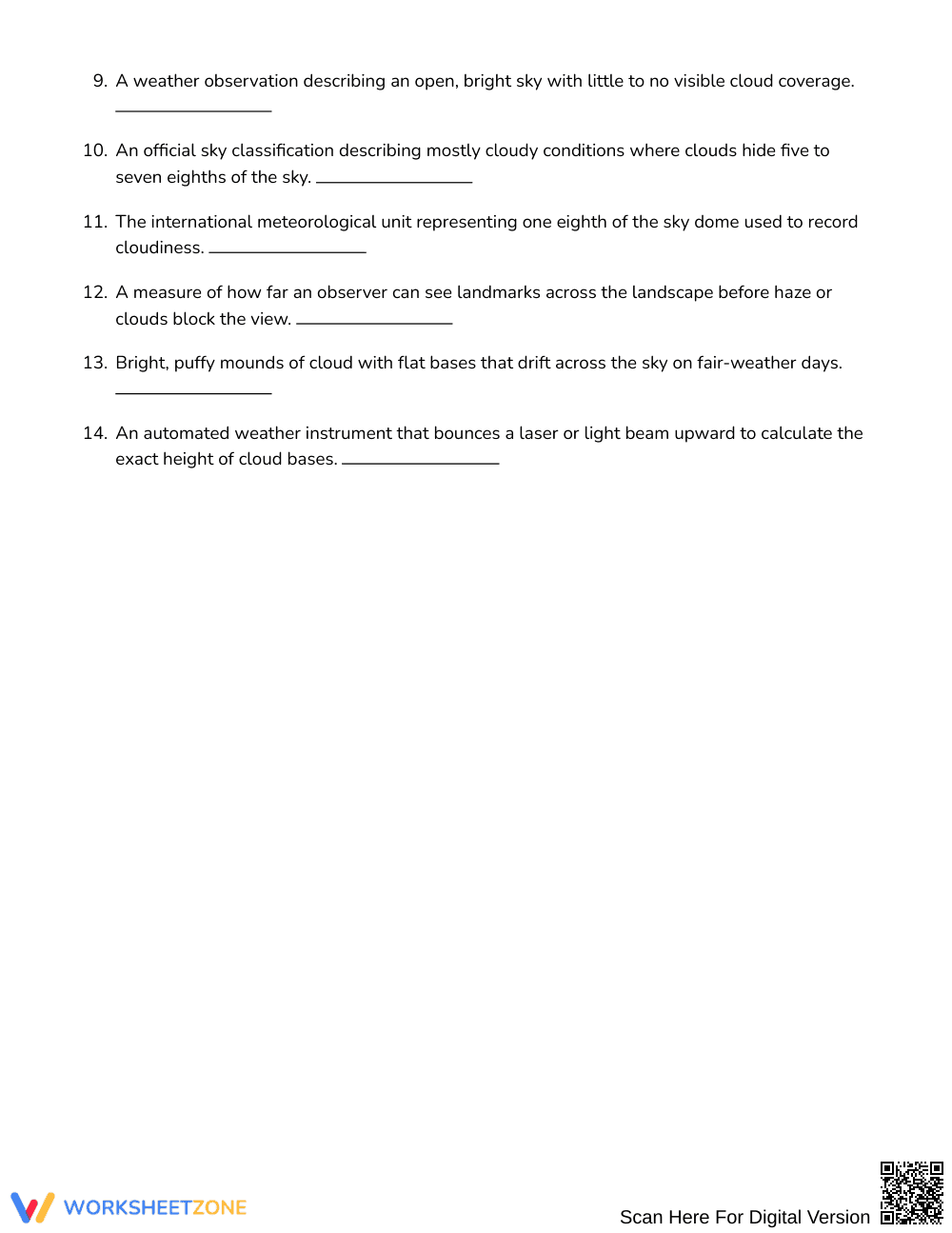
This Grades 4–5 science word search reinforces cloud cover observations by challenging students to connect meteorological concepts with precise weather terminology. Learners read descriptive field clues, identify key atmospheric terms, and locate 14 target vocabulary words within the grid. The activity strengthens scientific literacy, helping young observers accurately describe conditions across the sky dome.
At a Glance
- Grade: Grades 4–5 elementary students · Subject: Earth and Space Science
- Standard: Not standards-assessed — vocabulary enrichment
- Skill Focus: Cloud cover observations and meteorological vocabulary
- Format: 3 student pages · 14 hidden words · Full 3-page answer key included · Printable PDF
- Best For: Weather unit vocabulary reinforcement, science stations, and independent desk work
- Time: 20–30 minutes of focused student work
This 3-page printable science resource contains a clue-driven word search featuring 14 critical meteorological terms. Instead of a simple word list, students read thorough definitions and observational clues describing cloud formations, sky cover categories, and weather instruments. The resource includes a shuffled word bank to assist spelling recall alongside a complete 3-page answer key that clearly displays every solution for rapid checking.
Puzzle Mechanics and Structure
The activity is built on a 16 x 16 letter grid designed to engage upper elementary students. Words run across four distinct orientations: northeast, east, southeast, and south. Rather than merely searching for familiar letter strings, learners analyze contextual clues for terms like okta, ceilometer, and overcast, identifying the correct word before finding it within the puzzle.
Standards Alignment
This word search serves strictly as science vocabulary enrichment and is not aligned to a specific state or national standard. It supports broader Earth science study by familiarizing students with observational weather terms, cloud altitude concepts, and sky coverage classifications used by operational meteorologists.
How to Use It in the Classroom
Deploy this word search during direct instruction as a guided vocabulary break, or assign it after teaching cloud types to consolidate terminology. During class, monitor students as they read the clues to formatively assess whether they can match definitions like fractional sky cover to terms such as broken or scattered without consulting notes. Most learners complete the full search in 20 to 30 minutes.
Who It's For
This activity is tailored for Grades 4–5 science students learning weather patterns and Earth systems. For developing readers or English learners, provide a highlighted cloud identification anchor chart to bridge definitions with visual cues. The puzzle pairs naturally with an outdoor sky observation lesson where students log real-time cloud conditions.
Vocabulary acquisition in upper elementary science directly underpins conceptual comprehension and observational inquiry. This 14-word meteorological puzzle targets cloud cover observations, helping Grades 4–5 students master domain-specific terminology including okta, visibility, stratus, and ceiling. As highlighted by Fisher & Frey (2014), intentional exposure to academic vocabulary through varied, low-stakes retrieval tasks allows students to consolidate disciplinary language before applying it in complex scientific writing and laboratory analysis. Although designed as an unaligned vocabulary enrichment resource rather than a standards-assessed measure, the clue-driven format requires active semantic processing rather than passive letter scanning. By connecting precise observational definitions with spatial word location, the activity reinforces foundational earth science knowledge. Teachers can deploy this self-contained resource during weather units to ensure all learners develop the specialized lexicon necessary to record, discuss, and evaluate real-world atmospheric conditions accurately.


