


























Views
Downloads


Essential Algebraic Expressions Worksheet | Grade 6 Math
Paste this activity's link or code into your existing LMS (Google Classroom, Canvas, Teams, Schoology, Moodle, etc.).
Students can open and work on the activity right away, with no student login required.
You'll still be able to track student progress and results from your teacher account.
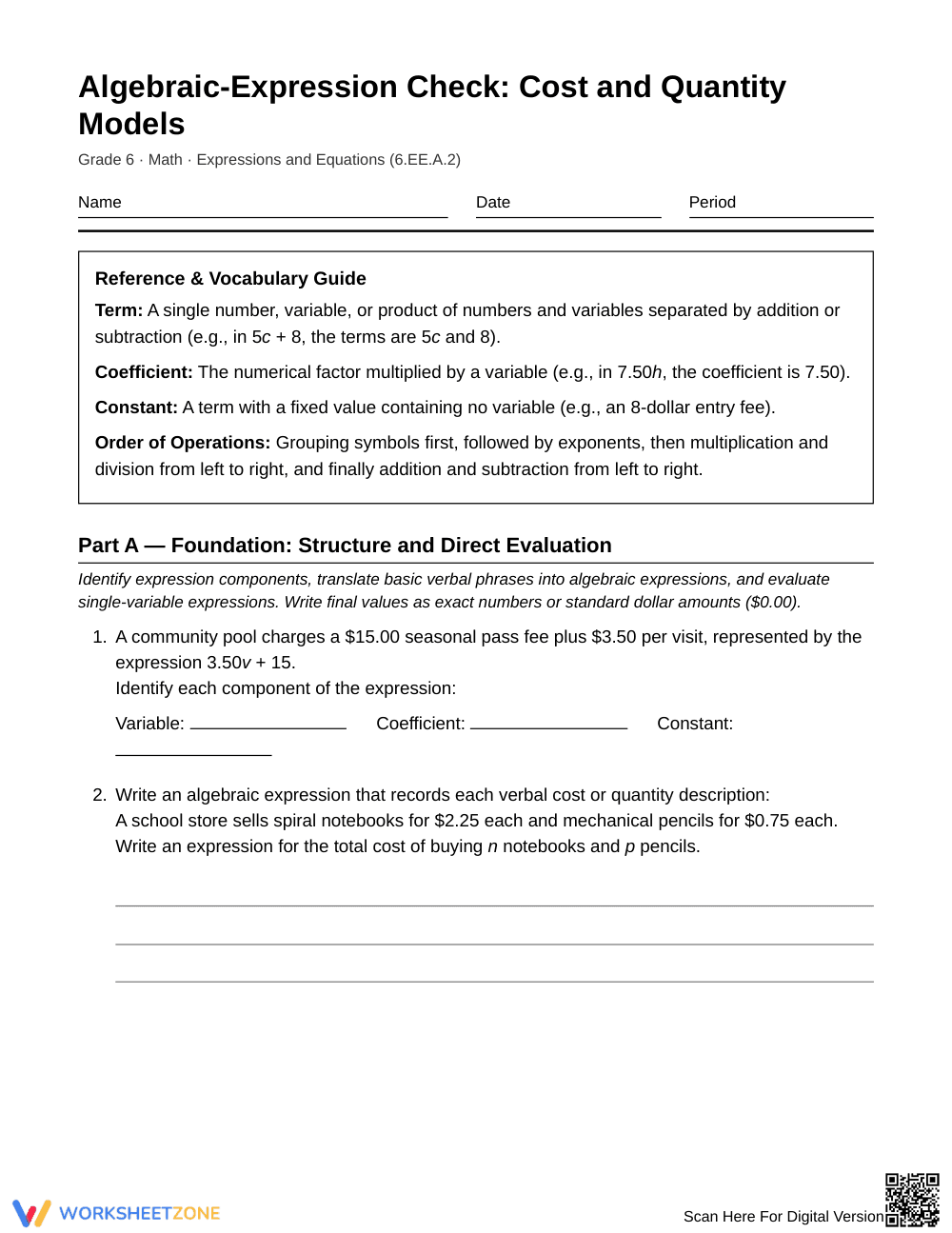
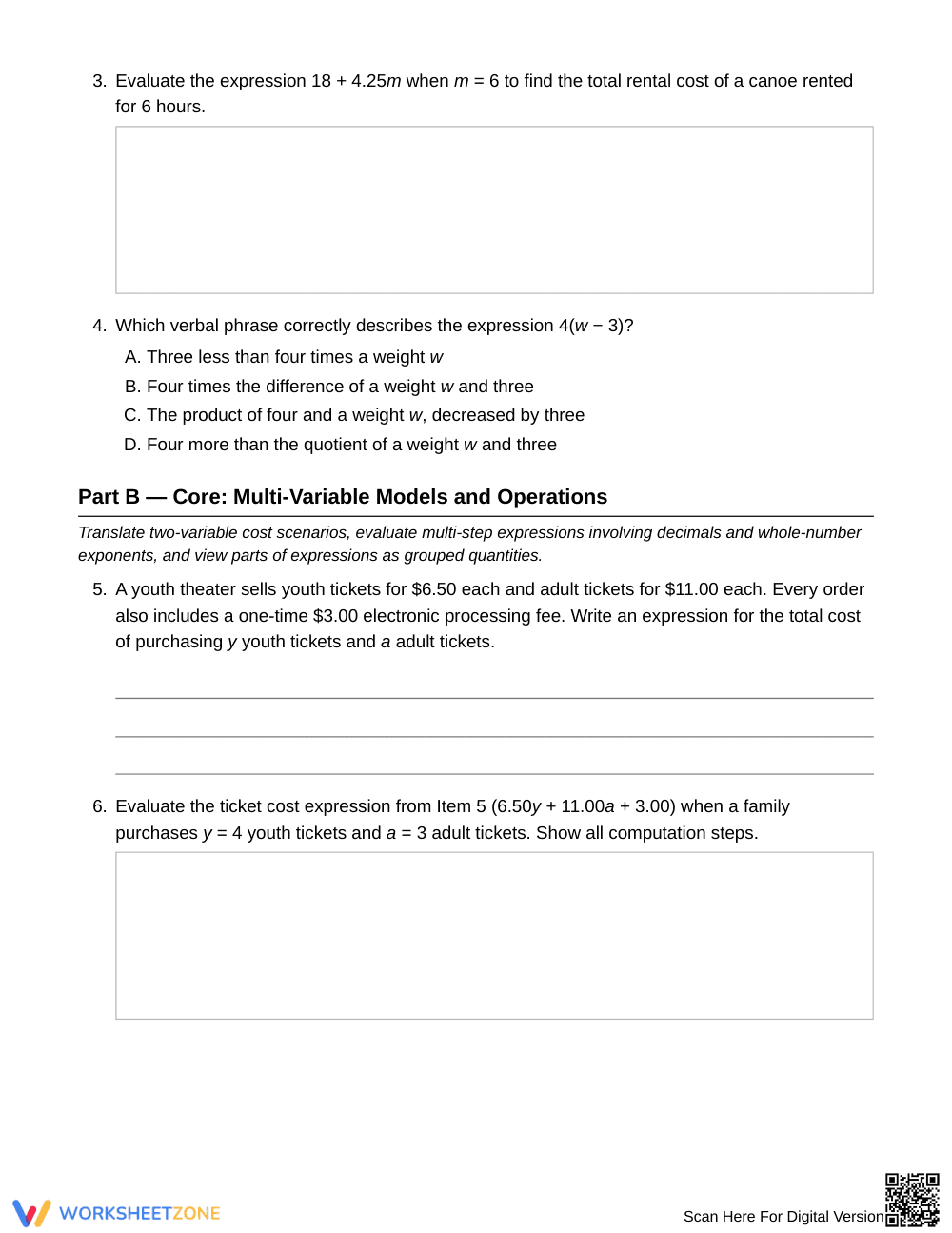
This Grade 6 math worksheet guides students through writing, interpreting, and evaluating algebraic expressions from real-world situations. Learners identify expression parts, substitute rational values into multi-variable cost models, and apply order of operations with exponents to solve applied mathematical problems with precision.
At a Glance
- Grade: 6 · Subject: Math
- Standard:
6.EE.A.2— Write, read, and evaluate expressions in which letters stand for numbers- Skill Focus: Algebraic-Expression Check
- Format: 5 pages · 16 problems · Answer key included · PDF
- Best For: Guided practice and independent skill review
- Time: 40–50 minutes
What's Inside
The resource features 16 scaffolded tasks arranged across three progressive sections, supported by a reference box defining terms, coefficients, constants, and the order of operations. Tasks include component identification, multi-variable expression translation, cost table completion, exponent evaluation, and a 3-page complete step-by-step answer key.
Skill Progression
- Guided Practice (Part A, Items 1–4): Students identify variables, coefficients, and constants in single-variable linear models, translate single-operation phrases, and evaluate basic cost formulas with guided structure.
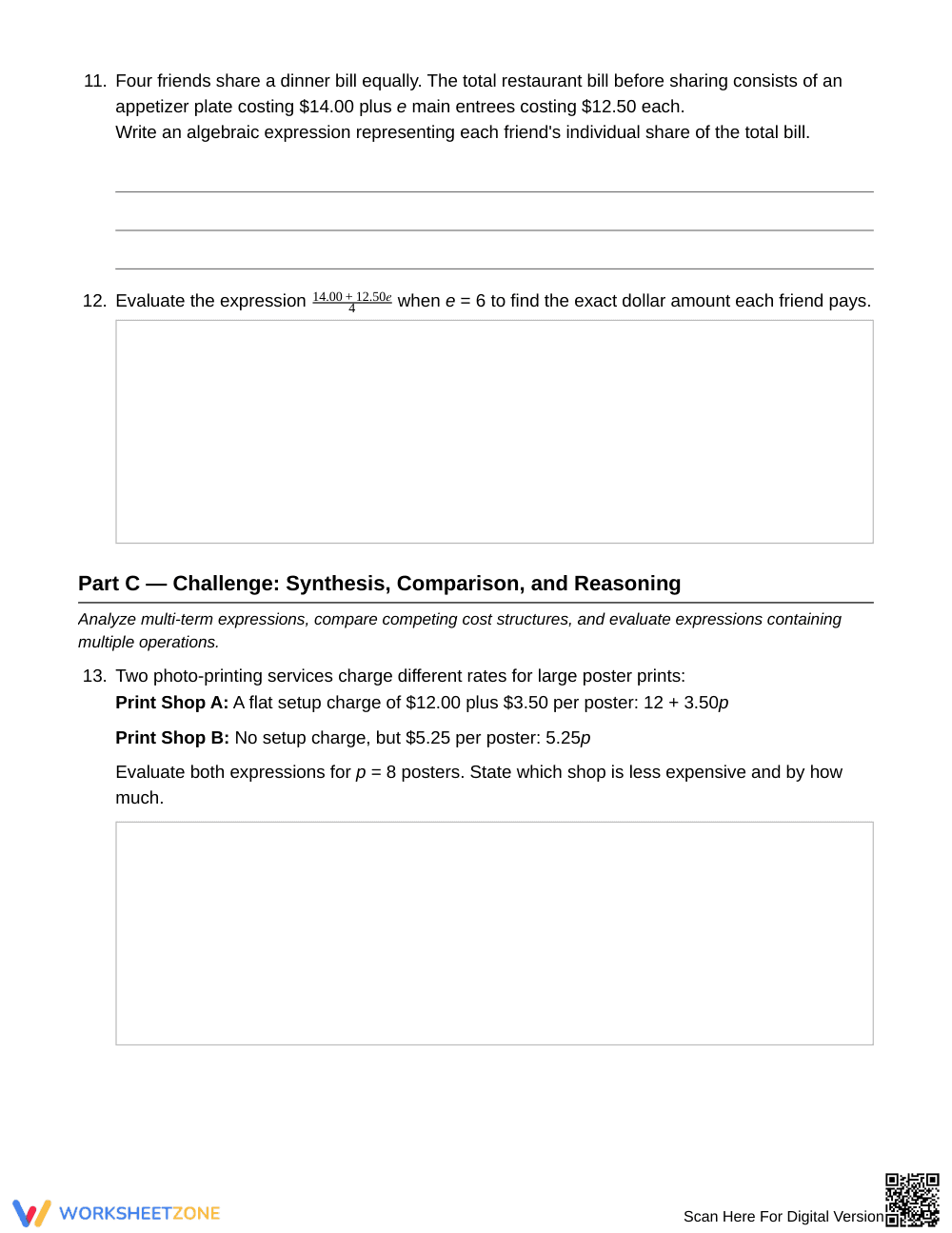
- Supported Practice (Part B, Items 5–12): Learners evaluate two-variable linear and non-linear cost scenarios, compute geometric formulas with exponents like 4s² + 25, complete input-output calculation tables, and interpret sub-expressions.
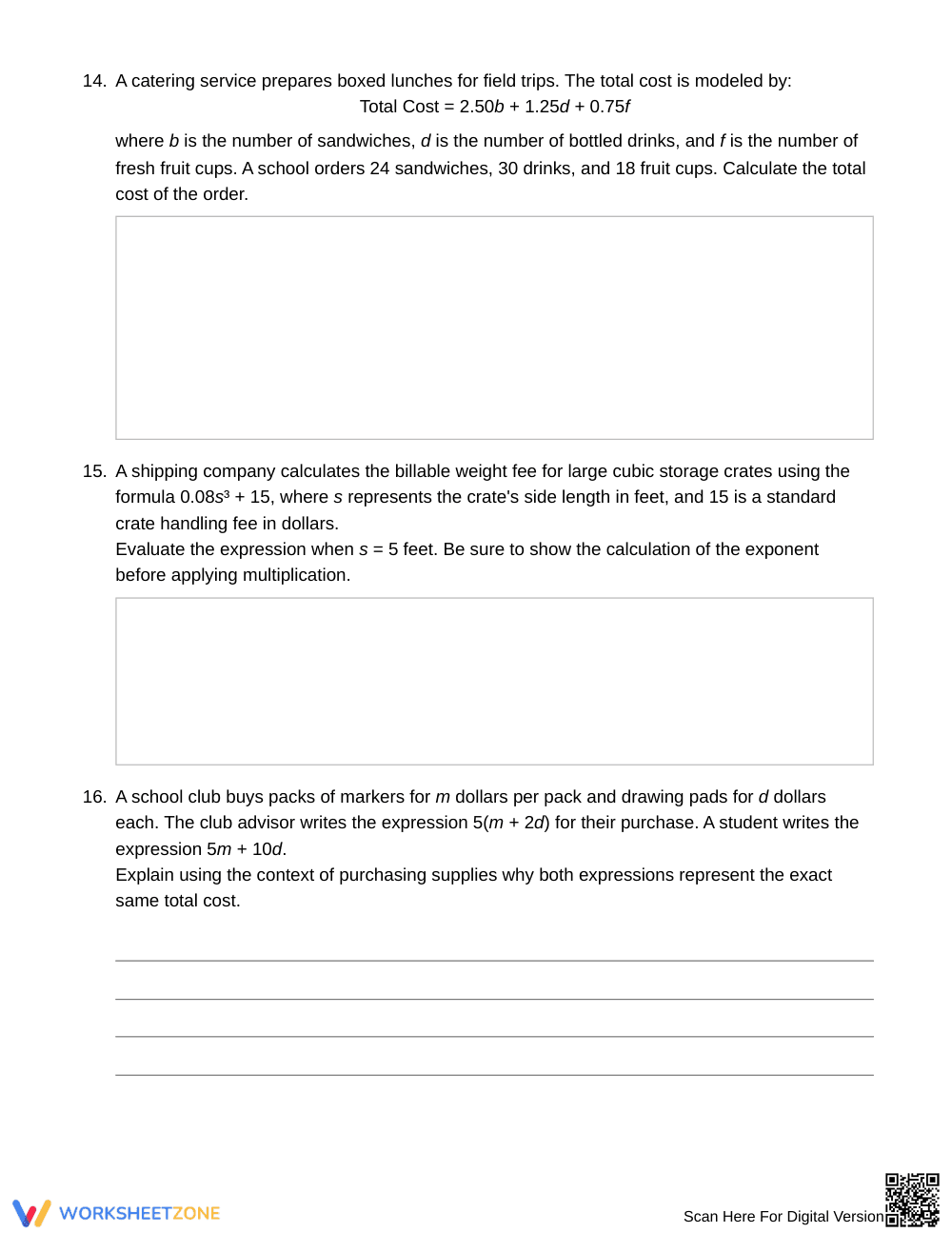
- Independent Practice (Part C, Items 13–16): Students independently analyze competing vendor pricing models, evaluate three-variable catering expressions, compute cubic volume shipping fees, and explain equivalent algebraic structures.
This structure follows a gradual-release model that transitions students from foundational terminology to multi-step evaluation and conceptual explanation.
Standards Alignment
This worksheet directly addresses primary standard 6.EE.A.2: Write, read, and evaluate expressions in which letters stand for numbers. Students evaluate expressions at specific values of their variables, including expressions arising from real-world formulas, and perform arithmetic operations including whole-number exponents following conventional order. Both standard codes can be copied directly into lesson plans, IEP goals, or district curriculum mapping tools.
How to Use It
Administer this 5-page worksheet during the guided application phase following direct instruction on algebraic notation and variable substitution. Alternatively, assign individual sections across consecutive days as targeted homework or formative review stations. As a formative check, observe student order of operations in Part B, verifying that students calculate powers prior to applying multiplication. The estimated completion time is 40 to 50 minutes.
Who It's For
Designed for Grade 6 general mathematics classrooms, this resource supports students building procedural fluency in algebraic modeling. For differentiated support, pair the opening reference guide with a concrete variable anchor chart, or challenge advanced learners to write equivalent factored forms for Part C word problems.
According to research on explicit mathematics instruction by Fisher & Frey (2014), structuring student work through purposeful task progression significantly improves conceptual understanding and procedural fluency when translating abstract notation into concrete mathematical models. This worksheet reinforces standard 6.EE.A.2 by requiring middle school students to read, write, and evaluate algebraic expressions within authentic real-world contexts, such as ticket sales, garden plots, and shared restaurant bills. By systematically moving from identifying components like constants and coefficients to calculating multi-variable formulas with exponents, students build durable operational mastery. Educational research confirms that connecting vocabulary acquisition with immediate computational application solidifies pre-algebra readiness across diverse student cohorts.


