


























Views
Downloads



Essential Algebraic Expressions Worksheet | Grade 6 Math
Paste this activity's link or code into your existing LMS (Google Classroom, Canvas, Teams, Schoology, Moodle, etc.).
Students can open and work on the activity right away, with no student login required.
You'll still be able to track student progress and results from your teacher account.
Master algebraic expression writing and evaluation with targeted real-world cost modeling. This comprehensive Grade 6 worksheet guides middle school students through identifying algebraic components, formulating expressions from verbal descriptions, and substituting values using the order of operations. Students build strong pre-algebra foundations through structured, authentic problem-solving exercises.
At a Glance
- Grade: 6 · Subject: Math
- Standard:
6.EE.A.2— Write, read, and evaluate expressions in which letters stand for numbers- Skill Focus: Mix Expression Writing and Evaluation
- Format: 5 pages · 16 problems · Answer key included · PDF
- Best For: Guided practice and independent review
- Time: 40–50 minutes
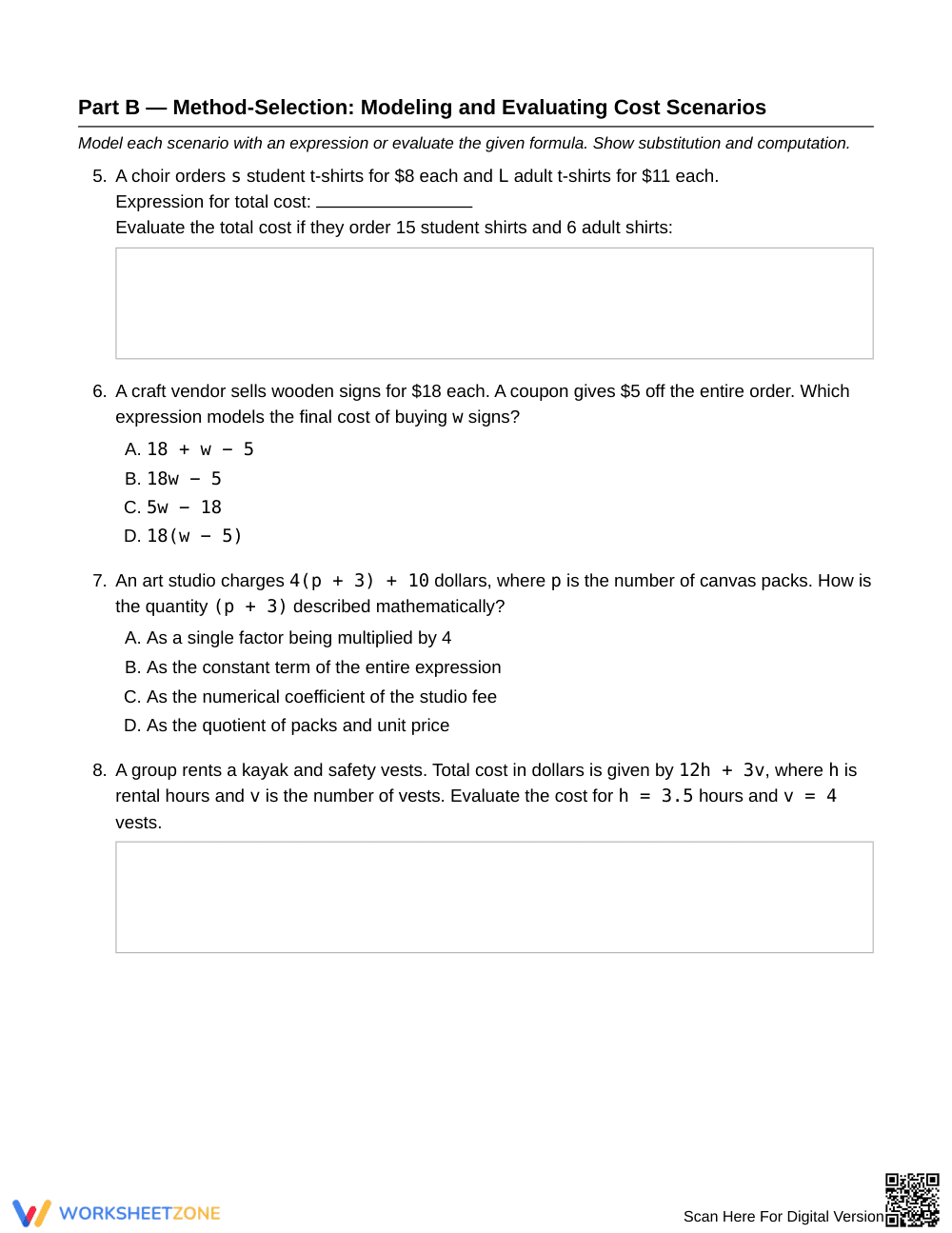
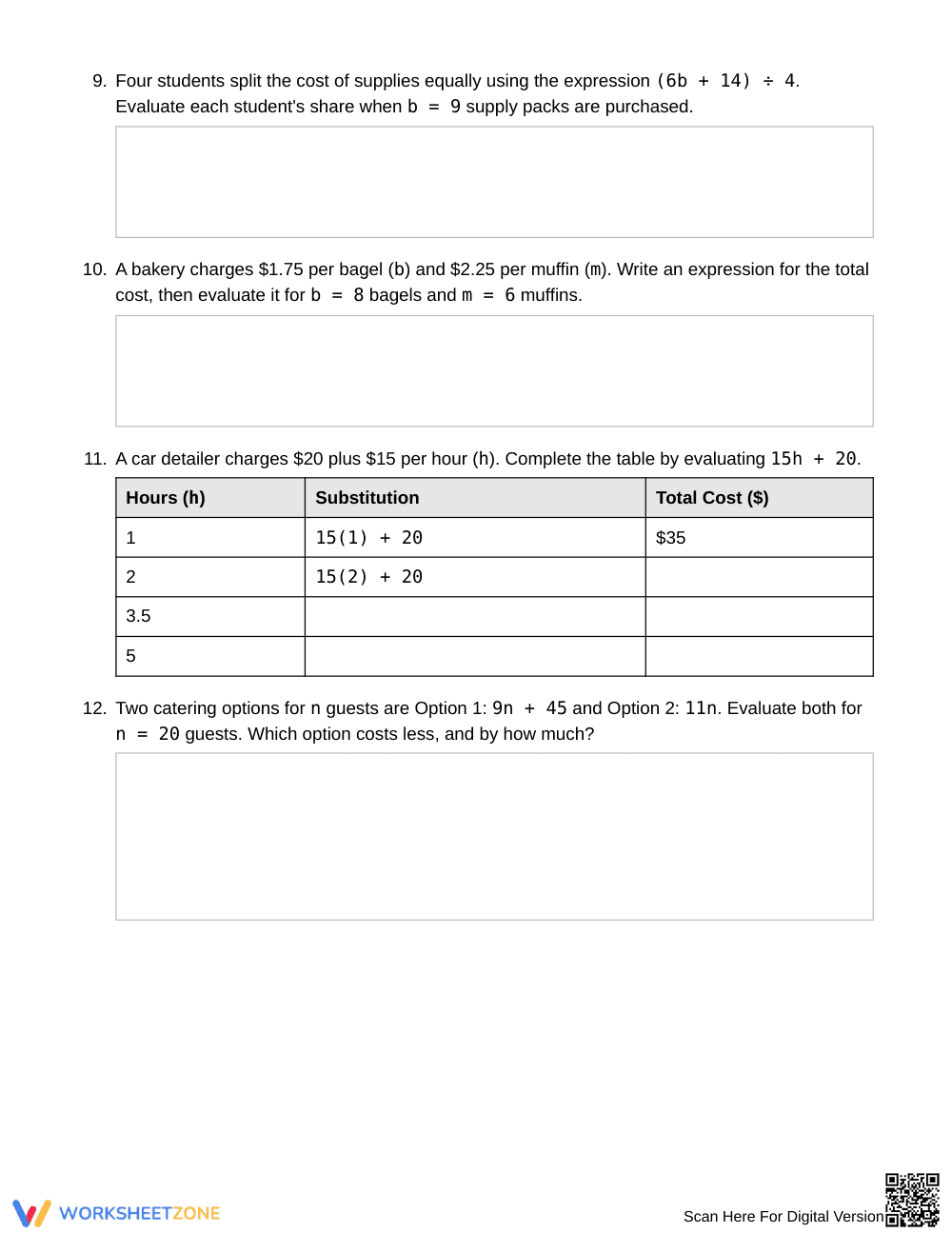
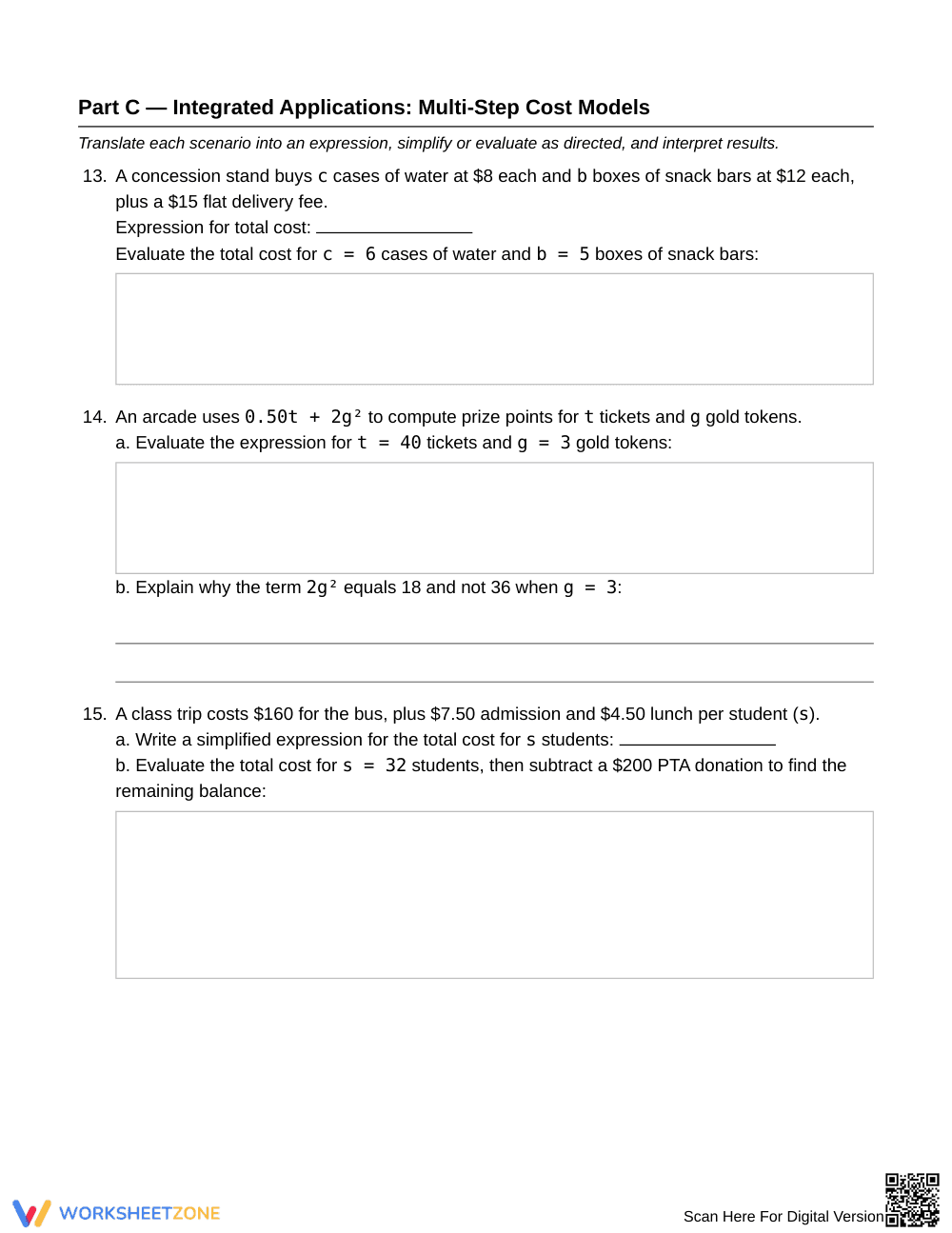
This 5-page printable resource includes 16 focused problems designed around authentic financial and quantity scenarios, complete with a key concepts reference bar covering terms, coefficients, constants, and the order of operations. Across three dedicated sections, students analyze algebraic structures, complete input-output cost tables, solve multiple-choice structural identification questions, and work through multi-step real-world applications with a full 2-page answer key.
Skill Progression
- Guided Practice (Part A — 4 Tasks): Focuses on baseline structure and terminology identification, direct verbal-to-algebraic translation, and single-variable evaluations containing exponents and basic operations.
- Supported Practice (Part B — 8 Tasks): Expands into dual-variable cost scenarios, contextual formula evaluations, rate tables, and multiple-choice questions analyzing mathematical factors.
- Independent Practice (Part C — 4 Tasks): Challenges students with multi-step contextual models requiring distributing, combining like terms, multi-variable substitutions, and error analysis.
This scaffolded progression adheres to the gradual release of responsibility model, ensuring students master structural components before managing composite algebraic expressions.
Standards Alignment
Directly aligned to Common Core standard 6.EE.A.2, this activity requires students to write, read, and evaluate algebraic expressions where letters represent real quantities. Students identify parts of an expression using terms, coefficients, and constants while performing arithmetic operations in conventional order. Both standard codes can be copied directly into lesson plans, IEP goals, or district curriculum mapping tools.
How to Use It
Deploy this resource during the core practice phase following direct instruction on variables and expressions, or use it as an intensive review before a unit assessment. While students work through Part B, circulate to monitor how they handle exponent rules during substitution. Expect typical completion in 40 to 50 minutes.
Who It's For
Ideal for general education Grade 6 math classrooms, accelerated Grade 5 learners, or Grade 7 students needing targeted intervention with algebraic notation. Pair this printable with a teacher-led visual anchor chart on order of operations or a collaborative whiteboard warmup.
According to EdReports 2024, high-quality instructional materials in middle school mathematics must intentionally balance procedural fluency with conceptual modeling of algebraic structures. Standard 6.EE.A.2 marks a critical developmental transition where learners shift from purely arithmetic reasoning to abstract symbolic representation. By embedding variable evaluation within familiar purchasing and ticketing scenarios, students connect concrete arithmetic calculations with generalized mathematical formulas. Research from Fisher & Frey (2014) highlights that structuring practice through intentional gradual release increases conceptual retention when transitioning between verbal descriptions and multi-step symbolic manipulations. This 16-task resource operationalizes standard 6.EE.A.2 by moving learners methodically from identifying isolated coefficients and constants to simplifying and evaluating multi-term algebraic models, establishing essential prerequisites for Grade 7 linear expressions and secondary algebra.


